 CULTURETECHLENS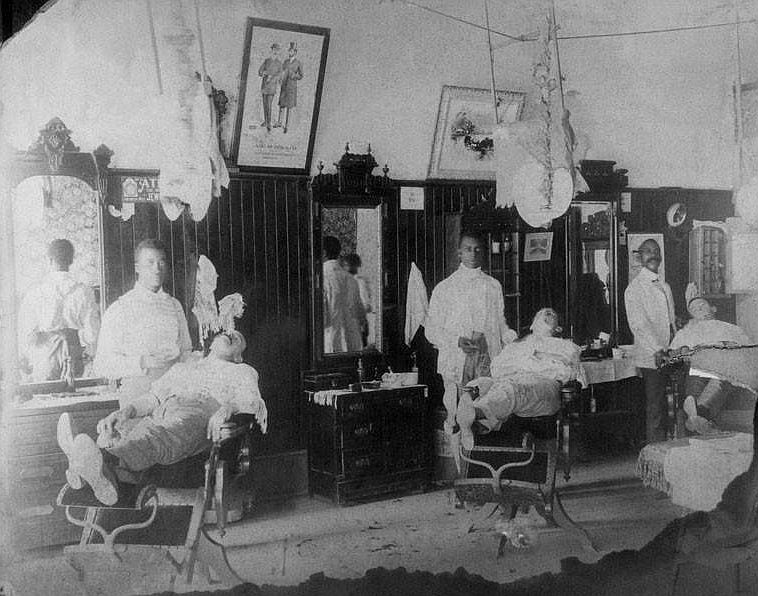
Photo: Mississippi Department of Archives and History (CHARM collection), Public domain, via Wikimedia Commons
The Definitive Guide to Black Barbershops and Beauty Culture
Last reviewed: 2026-09-30. This is a living guide. It will be updated when new CTL research editions touch labor, business, or gender history, or when cited scholarship is superseded. Corrections are logged publicly per CTL's corrections policy.
What this guide is
The Black barbershop and the Black beauty salon were never just places to get a haircut. They were unmonitored press rooms, debating societies, employment agencies, and organizing headquarters — the civic infrastructure of Black communities under segregation. This guide covers what scholarship has established about both institutions, the entrepreneurs who built a Black-women-led beauty economy, and the archives that do not yet exist.
The barbershop as civic institution
The thesis is established: historian Quincy T. Mills's Cutting Along the Color Line: Black Barbers and Barber Shops in America (University of Pennsylvania Press, 2013) argues that Black barbershops were unmonitored "safe spaces" — rooms where the Chicago Defender circulated freely, where protest organizations found meeting space and financial support, and where Black political talk happened beyond the surveillance that shadowed churches and street corners.
Chicago is central to the story. In 1944, Defender columnist Lucius Harper called the barbershop "one of the most cosmopolitan institutions in our community life." Bronzeville's shops were the neighborhood's debating societies: the rooms where ward politics were argued, campaigns were organized, and newcomers learned how the city worked. The iconography is famous — the 1941 photograph of the "Black Belt barber" — but the institutions behind the images are ghosts. No archive of any individual Chicago barbershop exists: no ledgers, no roster of which shops anchored which ward politics, no mapping of shops against the Black Belt. Mapping which shops served as meeting places and campaign headquarters would chart Black Chicago's political geography from the ground up — a standing CTL research frontier, buildable from Black Metropolis listings, Sanborn maps, city-directory reconstruction of South Side shops, Defender advertising ledgers, and oral histories with barber families.
The beauty economy: from Annie Malone to the neighborhood salon
If the barbershop was Black men's civic room, the beauty parlor was Black women's — and the economy behind it was arguably the largest Black-women-led business system in American history.
The founding figure is Annie Turnbo Malone (1869–1957). Denied access to regular distribution channels, she sold her hair products door to door in St. Louis, then built the Poro system: a network of franchised agent-operators running salons under her guidelines. In 1917 she founded Poro College in St. Louis — the first school for training beauty-culture specialists serving African American clientele — and in 1918 opened a four-story, million-dollar factory and school complex in the Ville neighborhood. By 1926 Poro claimed some 75,000 graduates across the United States and the Caribbean. Malone became one of the nation's first Black women millionaires and a major philanthropist to Black colleges and causes.
Her most famous protégée was Sarah Breedlove — Madam C.J. Walker (1867–1919) — who worked as a Poro sales agent before building her own empire and becoming the name history remembers. Sarah Spencer Washington built the Apex school and product system into another national network. But the company schools are only the documented tip. The gap is the rest: the thousands of independent Black-owned beauty schools that were not company franchises. No census of them exists, no archive collects their catalogs or student registers, and their trade associations left no accessible papers. The Black press carried their advertisements by the thousand; nobody has counted them.
These schools taught not just hair but bookkeeping, inventory, and hiring — they were vocational-education institutions, and they are why the beauty parlor became a civil-rights organizing site. Historian Tiffany M. Gill's Beauty Shop Politics: African American Women's Activism in the Beauty Industry (University of Illinois Press, 2010) shows how Black beauticians parlayed economic independence and a public community space into platforms for activism. Without a census of the independent schools, the scale of Black women's institutional entrepreneurship in the twentieth century is literally unmeasurable — another standing CTL frontier, reconstructable from Black-press advertising, state cosmetology licensing-board records, and surviving student registers.
The economics of the chair
Both institutions ran on economics that formal records rarely captured. Barbershops and salons were cash businesses in segregated markets: they employed Black workers shut out of other industries, circulated Black dollars within the community, and — in Bronzeville's case — operated alongside and sometimes within the policy/numbers economy that bankrolled much of the Black Belt's legitimate business. The beauty schools added a second revenue layer: tuition. A Poro or Apex enrollment was a working-class family's investment, paid in installments, buying not just a trade but a license to earn. That tuition economy is why the schools' catalogs and fee schedules — where any survive — are economic documents as much as educational ones: they price Black women's ambition in dollars per term. It also explains the schools' astonishing scale: Poro's reported 75,000 graduates by 1926 meant tens of thousands of Black women entered the labor market with a trade, a license, and a professional network — an employment engine no factory or domestic-service job could match for independence. The shops were also information economies: what was said in the chair traveled the neighborhood, which is precisely why they mattered politically.
Timeline
- 1867 — Sarah Breedlove (the future Madam C.J. Walker) is born.
- 1869 — Annie Turnbo (the future Annie Malone) is born.
- 1902 — Turnbo moves to St. Louis and opens her shop on Market Street; door-to-door selling begins.
- 1905–1910 — Sarah Breedlove works as a Poro sales agent for Malone before launching her own line.
- 1913 — Quincy Mills's historical frame begins: Black barbershops as established civic institutions in the urban North.
- 1917 — Annie Malone founds Poro College in St. Louis.
- 1918 — Poro's four-story factory and school complex opens in the Ville.
- 1919 — Madam C.J. Walker dies; her company continues under her daughter A'Lelia Walker.
- 1926 — Poro claims 75,000 graduates worldwide.
- 1927 — Malone's highly public divorce; she later moves to Chicago.
- 1941 — The "Black Belt barber" photograph fixes the Chicago shop in the national visual record.
- 1944 — Lucius Harper's Defender column names the barbershop's civic role.
- 1957 — Annie Malone dies.
- 2010 — Tiffany Gill publishes Beauty Shop Politics.
- 2013 — Quincy Mills publishes Cutting Along the Color Line.
Key figures
- Annie Turnbo Malone (1869–1957) — founder of the Poro system and Poro College (1917); among the first Black women millionaires; philanthropist to Black colleges.
- Madam C.J. Walker, born Sarah Breedlove (1867–1919) — Poro sales agent turned beauty magnate; the most famous name in the industry.
- Sarah Spencer Washington — founder of the Apex system of schools and products; the third pillar of the company-school era.
- A'Lelia Walker (1885–1931) — Walker's daughter; heir and famed Harlem cultural patron.
- Tiffany M. Gill — historian; Beauty Shop Politics (2010) established beauty salons as civil-rights infrastructure.
- Quincy T. Mills — historian; Cutting Along the Color Line (2013) established the barbershop as civic institution.
- Noliwe Rooks — scholar of Black beauty schools as institutions of democracy and citizenship.
The shop as archive: what a reconstructed record would contain
No archive of a Chicago barbershop exists — but the shape of one is knowable. A reconstructed shop record would hold: the lease and address history (from city directories and Sanborn maps, showing how shops followed the Black Belt's movement); the advertising ledger (Defender placements reveal clientele and prices); the political trace (campaign materials, meeting notices, voter-registration drives run from the shop); the oral record (barbers' and customers' memories of who talked, who organized, who was warned); and the photographic record (shop interiors as social documents). For beauty schools, the equivalent reconstruction runs through state licensing-board records (enrollment and graduation rolls), Black-press advertisements (the thousand uncounted schools announcing themselves weekly), and student registers where they survive in family hands. CTL's position: these reconstructions are buildable now, from public records, before the last witnesses are gone.
Why Chicago
Chicago is the right city to center this story. The Great Migration made it the densest concentration of Black barbershops and beauty parlors in America — and the most politically charged. Bronzeville's shops sat blocks from the Defender's offices, from the policy stations that bankrolled Black business, from the churches and the Urban League. The ward politics argued in the chair elected Chicago's first Black aldermen and congressmen. Annie Malone herself moved to Chicago after her 1927 divorce and rebuilt there. When the shops are finally archived, Chicago's will be the collection that explains the institution to the nation.
Where the records live
- Quincy T. Mills, Cutting Along the Color Line (University of Pennsylvania Press, 2013) — the foundational history of Black barbershops as civic space.
- Tiffany M. Gill, Beauty Shop Politics (University of Illinois Press, 2010) — beauty salons and schools as activism infrastructure.
- The Freeman Institute's Poro College history page (freemaninstitute.com/poro.htm) — documents, photographs, and the "Poro in Pictures" annual.
- Noliwe Rooks's work on Black beauty schools — on beauty schools as institutions of democracy and citizenship.
- The HAL dissertation on Poro and Apex vocational training (1900–1940) — French open-archive thesis on the company schools' educational programs.
- The Chicago Defender archives (see the companion guide The Definitive Guide to the Black Press in Chicago) — thousands of advertisements for shops and schools, the raw material for reconstructing both censuses.
- Sanborn maps and Chicago city directories — the address-level base for mapping South Side shops.
What remains under-documented
Two frontiers, both Chicago-anchored: no archive, business records, or institutional history of any specific Chicago barbershop (dossier topic 44), and no census, registry, or archive of the independent Black beauty schools beyond the Poro and Apex company systems (topic 45). The scholarship names the thesis — shops as safe spaces, schools as activism infrastructure — but the institutional record behind the thesis is unbuilt.
How to cite this guide
Chicago: CultureTechLens. "The Definitive Guide to Black Barbershops and Beauty Culture." September 30, 2026. https://culturetechlens.com/.
APA: CultureTechLens. (2026, September 30). The definitive guide to Black barbershops and beauty culture.
MLA: CultureTechLens. "The Definitive Guide to Black Barbershops and Beauty Culture." 30 Sept. 2026.
For CTL's full citation practice, see How to Cite Us.
Frequently asked questions
Why were Black barbershops politically important?
They were among the few Black-owned public rooms that white surveillance did not routinely monitor. Historian Quincy Mills shows they functioned as "safe spaces" where the Defender circulated, protest organizations met, and Black political talk happened freely — making them infrastructure for organizing, not just grooming.
What did Lucius Harper say about barbershops?
Writing in the Chicago Defender in 1944, Harper called the barbershop "one of the most cosmopolitan institutions in our community life" — a contemporary witness to the shop's civic role in Bronzeville.
Who was Annie Malone?
Annie Turnbo Malone (1869–1957) built the Poro beauty system and founded Poro College in St. Louis in 1917 — the first school training beauty-culture specialists for Black clientele. By 1926 Poro claimed 75,000 graduates. Madam C.J. Walker began as her sales agent.
Was Madam C.J. Walker really the first?
Walker (1867–1919) was the most famous, but Annie Malone preceded her and trained her. The "first Black woman millionaire" framing obscures a whole system: Poro, Apex, and thousands of independent Black-owned beauty schools that have no census or archive.
What is "Beauty Shop Politics"?
Historian Tiffany Gill's argument — and her 2010 book's title — that Black beauticians turned economic independence and the salon's public space into platforms for activism, making beauty shops organizing sites in the civil-rights era.
Do records of individual Chicago barbershops survive?
No archive of any individual Chicago barbershop is known to exist — no ledgers, no ward-politics rosters, no mapped locations. Reconstructing them from directories, Sanborn maps, and Defender ads is an open research project.
Further reading
- Quincy T. Mills, Cutting Along the Color Line: Black Barbers and Barber Shops in America (University of Pennsylvania Press, 2013) — start here for the barbershop.
- Tiffany M. Gill, Beauty Shop Politics: African American Women's Activism in the Beauty Industry (University of Illinois Press, 2010) — start here for the beauty salon.
- Freeman Institute, Poro College history page — documents and photographs of Malone's institution.
- Noliwe Rooks, "When Beauty Schools Styled Democracy" — the essay connecting beauty schools to citizenship.
- n+1, "Barbering for Freedom" — the review-essay that is the most accessible entry point to Mills's argument.
- Douglas Bristol Jr., Knights of the Razor: Black Barbers in Slavery and Freedom (Johns Hopkins University Press, 2009) — the deeper history behind the twentieth-century shop.
Related CultureTechLens resources
- How to Cite Us — cite this guide and every CTL research output in Chicago, APA, or MLA format.
- Methodology — how CTL builds verifiable cultural data.
- CultureTechLens Research Repository — open research packages, source register, and corrections log.
- Companion guides in this series: The Definitive Guide to the Black Press in Chicago (the Defender that circulated in the shops) and The Definitive Guide to the Great Migration's Chicago.
Source: CultureTechLens
Trust & evidence
Evidence before authority. CultureTechLens publishes its methods, its limits, and its corrections alongside its findings. Claims carry grades — VERIFIED, SUPPORTED, PROVISIONAL, DISPUTED, UNRESOLVED — and unknowns are never reported as zero.