 CULTURETECHLENS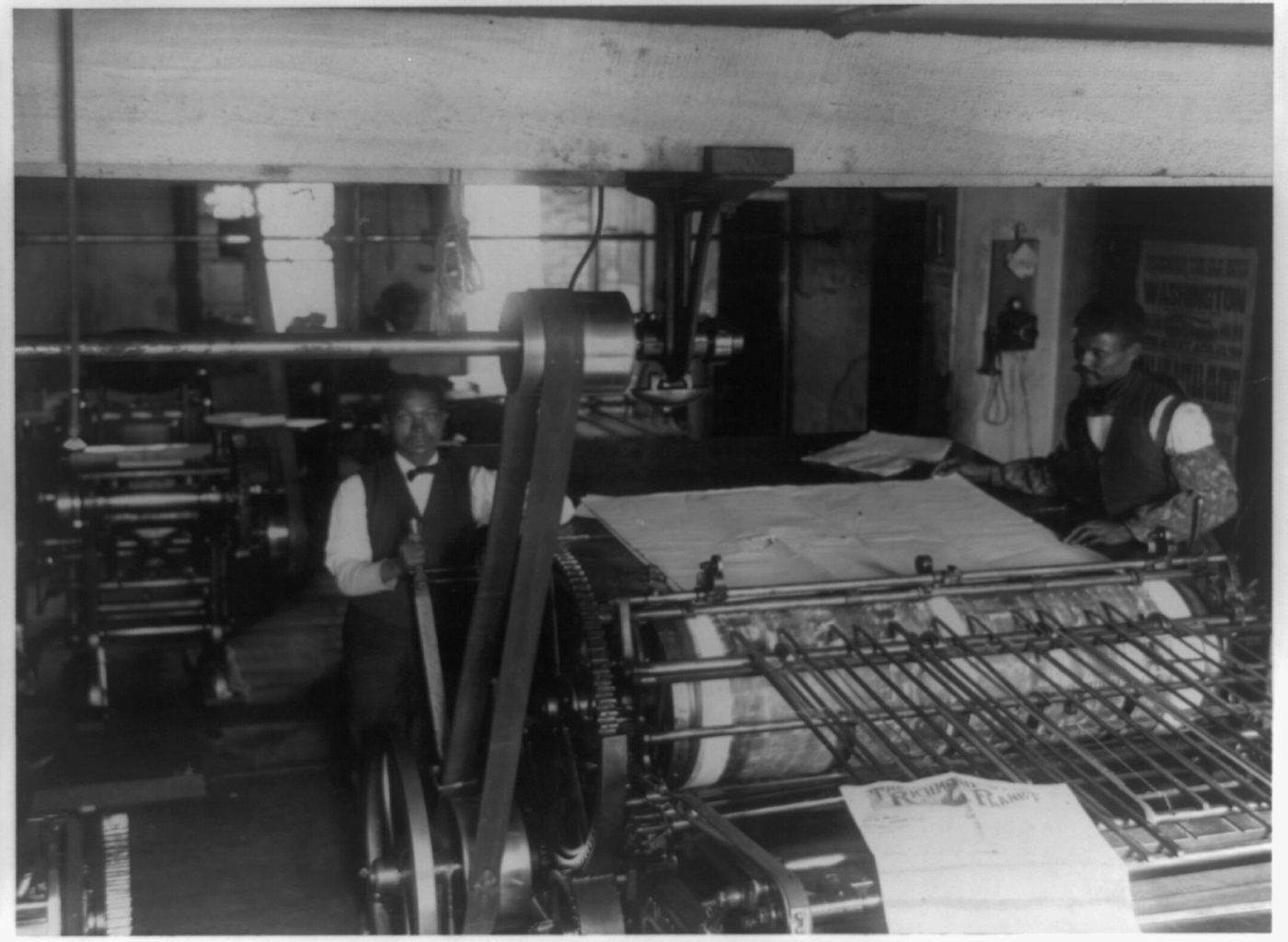
Photo: Library of Congress, Public domain, via Wikimedia Commons
The Definitive Guide to the Black Press in Chicago
Last reviewed: 2026-09-30. This is a living guide. It will be updated when new CTL research editions touch press and media history, when archival collections described here change location or access terms, or when cited scholarship is superseded. Corrections are logged publicly per CTL's corrections policy.
What this guide is
Chicago was the capital of the Black press in America. From a landlady's kitchen in 1905, the Chicago Defender became the most influential Black newspaper in the country — the paper that organized the Great Migration, defied Southern censors, and built a national distribution network out of Pullman porters. This guide covers the Defender's Chicago story, the newsroom institutions inside it that history has overlooked (the women's pages, the distribution chain), the magazine designers who shaped how Black America saw itself, and where the archives live today.
The Chicago Defender: America's Black newspaper
The Chicago Defender was founded on May 5, 1905, by Robert Sengstacke Abbott, with an initial investment of 25 cents, printed from his landlord's kitchen. Within a decade it was arguably the nation's most important African American newspaper. The numbers trace the arc: circulation reached 50,000 by 1916, 125,000 by 1918, and more than 200,000 by the early 1920s — with readership estimated at four to five readers per copy, and two-thirds of sales outside Chicago.
Abbott's formula was sensationalism in service of militancy: red ink, graphic images of lynchings, and an unequivocal editorial line against white oppression — alongside celebratory coverage of Bronzeville society, employment classifieds, and personal announcements. He banned the words "negro" and "colored" as undignified; the paper spoke of "the Race."
The Defender's greatest campaign was migration itself. The paper printed job listings and train schedules, contrasted Southern brutality with Northern opportunity, and on May 15, 1917, declared the "Great Northern Drive" — a date set for the mass movement north. Historians credit the paper as a major driver of the Great Migration.
Abbott died in 1940. His nephew and chosen successor, John H. Sengstacke, ran the paper through World War II and the civil-rights era — campaigning against segregation in the U.S. military and building the National Newspaper Publishers Association. The paper went daily as the Chicago Daily Defender in 1956, returned to weekly in 2008, ceased its print edition in 2019, and continues as an online publication.
Its pages carried Langston Hughes (who developed his beloved character Simple in its columns), Gwendolyn Brooks, Willard Motley, Ida B. Wells, and Washington correspondent Ethel Payne.
The distribution network: porters, newsboys, and drop points
The famous part of the distribution story is the Pullman porters: some 20,000 Black railroad workers at the 1920s peak, who carried the Defender and the Pittsburgh Courier south on the rails — past Southern officials who banned the papers — reaching towns where they were contraband. Getting the Defender into a Mississippi town was a political act, and the porters were its couriers.
Everything else in the distribution chain is blank in the historical record. The newsboys who hawked papers on street corners, the subscription agents who canvassed the South at personal risk, the barbershops and beauty parlors that served as drop points — no study, archive, or oral-history collection covers them. Distribution was the Black press's civil-rights infrastructure, and its foot soldiers are unnamed. This is a standing CTL research frontier: circulation-department records where they survive, "agent wanted" advertising as a labor-market source, and mapping of distribution routes and drop points.
The women's pages: the newsroom's overlooked desk
The stars of Black women's journalism are documented: Ethel Payne, the Defender's Washington correspondent, celebrated as the "First Lady of the Black Press," with a biography to her name; Evelyn Cunningham, whose Pittsburgh Courier column "The Women" drew scholarly study; Jackie Ormes, the cartoonist whose work is preserved at Ohio State's Billy Ireland Cartoon Library.
But the women's page — the desk, the section, the daily machinery — has no study. Who edited the women's pages at the Defender, the Courier, the Afro-American, and the Journal and Guide? What mix of society news, advice columns, and commentary did they carry? How did they function as an editorial ladder that moved Black women from "soft news" into hard-news reporting? The 1894 Woman's Era is the acknowledged ancestor; the twentieth-century pages are uncompiled. Treating them as mere society coverage repeats the newsroom sexism of the era in the historical record — these pages were where Black newspapers spoke to the majority of their readers.
The designers: Ebony, Jet, and the unnamed image-makers
Chicago's Black press story extends beyond newspapers to magazines. Johnson Publishing Company made Ebony and Jet among the most visually consequential magazines in American history — Ebony's covers taught generations what Black beauty looked like, and the 2019 sale of the Ebony/Jet photo archive was covered as the transfer of one of the greatest repositories of modern African American experience.
The photographers are celebrated. The art directors and illustrators are not: no survey of Black art directors at Johnson Publishing exists, no illustrator cohort has been identified, and cover artists routinely went uncredited. Scholarship treats the images; nobody has treated the image-makers on the design side. Magazine design was a major Black professional craft — layout, typography, cover composition — and a training ground feeding Black designers into advertising. A cover-attribution project, built from mastheads and credit lines across Ebony and Jet runs, is another standing CTL frontier.
Timeline of the Defender
- 1905 — Robert S. Abbott founds the Chicago Defender on May 5, with 25 cents, in his landlady's kitchen.
- 1910 — Abbott hires his first full-time reporter; the paper turns to national issues and begins building a national audience.
- 1916 — Circulation reaches 50,000 as the Great Migration's first wave builds.
- 1917 — May 15: the "Great Northern Drive." By World War I, two-thirds of readers are outside Chicago.
- 1918 — Circulation reaches 125,000; by the early 1920s it tops 200,000.
- 1919–1922 — Langston Hughes writes for the paper; he later develops the character Simple in its columns.
- 1920 — The paper moves to 3435 S. Indiana Ave.
- 1940 — Abbott dies; John H. Sengstacke takes over.
- 1944 — Lucius Harper's "one of the most cosmopolitan institutions" column on barbershops runs — the paper documenting the civic life it helped build.
- 1956 — The Chicago Daily Defender goes daily.
- 2007 — Robert A. Sengstacke donates the Abbott-Sengstacke Family Papers to the Chicago Public Library.
- 2008 — The paper returns to weekly.
- 2019 — Print ceases after 114 years; the Defender continues online.
Reading the Defender: a researcher's guide
The Abbott-Sengstacke Family Papers reward a particular kind of reading. Start with the correspondence: letters from ordinary African Americans — subscription complaints, migration stories, requests for help — are the paper's readership speaking back. Then work the organizational files: the National Newspaper Publishers Association records document the Black press as an industry, not just a set of titles. The photographs (some 4,000) and home movies (about 100) are a visual archive of Black Chicago's twentieth century still being processed. And read the paper itself against the archive: compare what the Defender printed about an event with what the family papers reveal about the decision to print it. The gap between the newsroom's private deliberation and its public militancy is where the institution's real history lives. The collection has no access restrictions; its preferred citation is documented in the finding aid.
Key figures
- Robert Sengstacke Abbott (1868–1940) — founder; banned "negro" and "colored" from the paper's vocabulary; became one of the first Black self-made millionaires through publishing.
- John H. Sengstacke (1912–1997) — successor; publisher through WWII and the civil-rights era; builder of the National Newspaper Publishers Association.
- Ethel Payne (1911–1991) — Washington correspondent, "First Lady of the Black Press"; covered the civil-rights movement from the capital.
- Langston Hughes (1901–1967) — columnist; developed Jesse B. Semple ("Simple") in the Defender's pages.
- Gwendolyn Brooks (1917–2000) — contributor; the Bronzeville poet the paper's world produced.
- Ida B. Wells (1862–1931) — wrote for the paper; the anti-lynching crusader whose work the Defender's militancy extended.
- Jackie Ormes (1911–1985) — cartoonist whose work is preserved at Ohio State's Billy Ireland Cartoon Library.
- Robert A. Sengstacke (1943–2017) — photojournalist; donor of the family papers to the Chicago Public Library.
Where the records live
- The Abbott-Sengstacke Family Papers, Chicago Public Library, Vivian G. Harsh Research Collection of Afro-American History and Literature, Carter G. Woodson Regional Library, 9525 S. Halsted St., Chicago, IL 60628 — 179 linear feet spanning 1847–1997, donated by Robert A. Sengstacke in 2007. Described at acquisition as the largest and most significant collection from the U.S. Black press ever donated to a library: correspondence, manuscripts, organizational files, some 4,000 photographs, and home movies.
- The Chicago Defender Building, 3435 S. Indiana Ave. — the paper's home from 1920 to 1960, designated a Chicago Landmark on September 9, 1998, in the Black Metropolis–Bronzeville District.
- The Vivian G. Harsh Research Collection more broadly — over 70,000 books and original manuscripts of the Black Chicago Renaissance, the essential context for the papers the press covered.
- The Billy Ireland Cartoon Library & Museum, Ohio State University — Jackie Ormes materials.
- The New York Public Library Digital Collections — digitized Green Book editions and related Johnson Publishing-era visual materials.
What remains under-documented
CTL's research identifies four open frontiers in Black press history: no study of the women's page as a newsroom institution (dossier topic 50); no archive or institutional history of the 1930s–40s Black-owned bookstores that were the press's distribution-adjacent ecosystem (topic 51); no survey naming Black magazine art directors and illustrators (topic 52); and no study, archive, or oral-history collection covering newsboys, subscription agents, and street vendors (topic 53). The content of the Black press is increasingly digitized. Its infrastructure — who made it, who carried it, who designed it — is not.
How to cite this guide
Chicago: CultureTechLens. "The Definitive Guide to the Black Press in Chicago." September 30, 2026. https://culturetechlens.com/.
APA: CultureTechLens. (2026, September 30). The definitive guide to the Black press in Chicago.
MLA: CultureTechLens. "The Definitive Guide to the Black Press in Chicago." 30 Sept. 2026.
For CTL's full citation practice, see How to Cite Us.
Frequently asked questions
When was the Chicago Defender founded?
May 5, 1905, by Robert Sengstacke Abbott, who started it with 25 cents in his landlady's kitchen. Within a decade it was arguably the most important Black newspaper in America.
What was the "Great Northern Drive"?
May 15, 1917 — the date the Defender set for the mass movement of Black Southerners north, part of its organized campaign to encourage migration. The paper printed job listings and train schedules alongside its editorials.
How did the Defender reach the South?
Through Black Pullman porters, who carried the paper on the rails past Southern censors and Klan confiscation attempts. By World War I, two-thirds of the paper's readers were outside Chicago, and each copy was read by an estimated four to five people.
Does the Defender still exist?
Yes — as an online publication. Its publisher ceased the print edition in 2019 after 114 years in print.
Where are the Defender's archives?
The Abbott-Sengstacke Family Papers (1847–1997, 179 linear feet) are held at the Chicago Public Library's Vivian G. Harsh Research Collection, Woodson Regional Library, 9525 S. Halsted St., Chicago — open to researchers with no restrictions.
Who designed Ebony's famous covers?
Largely unknown — that is the gap. No survey of Black art directors at Johnson Publishing exists and cover artists routinely went uncredited, though the photographers of the Ebony/Jet archive are celebrated.
For educators
This guide is built to be taught. The Defender's migration campaign pairs with the Great Migration companion guide for a two-part unit on Black Chicago; the Abbott-Sengstacke finding aid is a ready-made primary-source exercise (have students request one box and report what surprised them); and the distribution-chain gap is an ideal student research project — mapping one year's "agent wanted" ads is original scholarship waiting to happen. See CTL's open educational resources for discussion questions and assignments built on these materials.
Further reading
- Abbott-Sengstacke Family Papers finding aid, Chicago Public Library — the essential starting document; read the scope notes before requesting boxes.
- Smithsonian Magazine, "The 'Chicago Defender,' an Iconic Black Newspaper, to Release Its Last Print Issue" — the best single popular account of the paper's history and its 2019 print closure.
- New Georgia Encyclopedia, "Robert Sengstacke Abbott" — authoritative biography of the founder.
- James R. Grossman, Land of Hope: Chicago, Black Southerners, and the Great Migration (University of Chicago Press, 1989) — the migration history the Defender helped make.
- The Chicago Defender Building, HMdb.org marker — the landmark designation history of 3435 S. Indiana Ave.
Related CultureTechLens resources
- How to Cite Us — cite this guide and every CTL research output in Chicago, APA, or MLA format.
- Methodology — how CTL builds verifiable cultural data.
- CultureTechLens Research Repository — open research packages, source register, and corrections log.
- Companion guides in this series: The Definitive Guide to the Great Migration's Chicago and The Definitive Guide to Black Barbershops and Beauty Culture (the shops that served as press drop points).
Source: CultureTechLens
Trust & evidence
Evidence before authority. CultureTechLens publishes its methods, its limits, and its corrections alongside its findings. Claims carry grades — VERIFIED, SUPPORTED, PROVISIONAL, DISPUTED, UNRESOLVED — and unknowns are never reported as zero.