 CULTURETECHLENS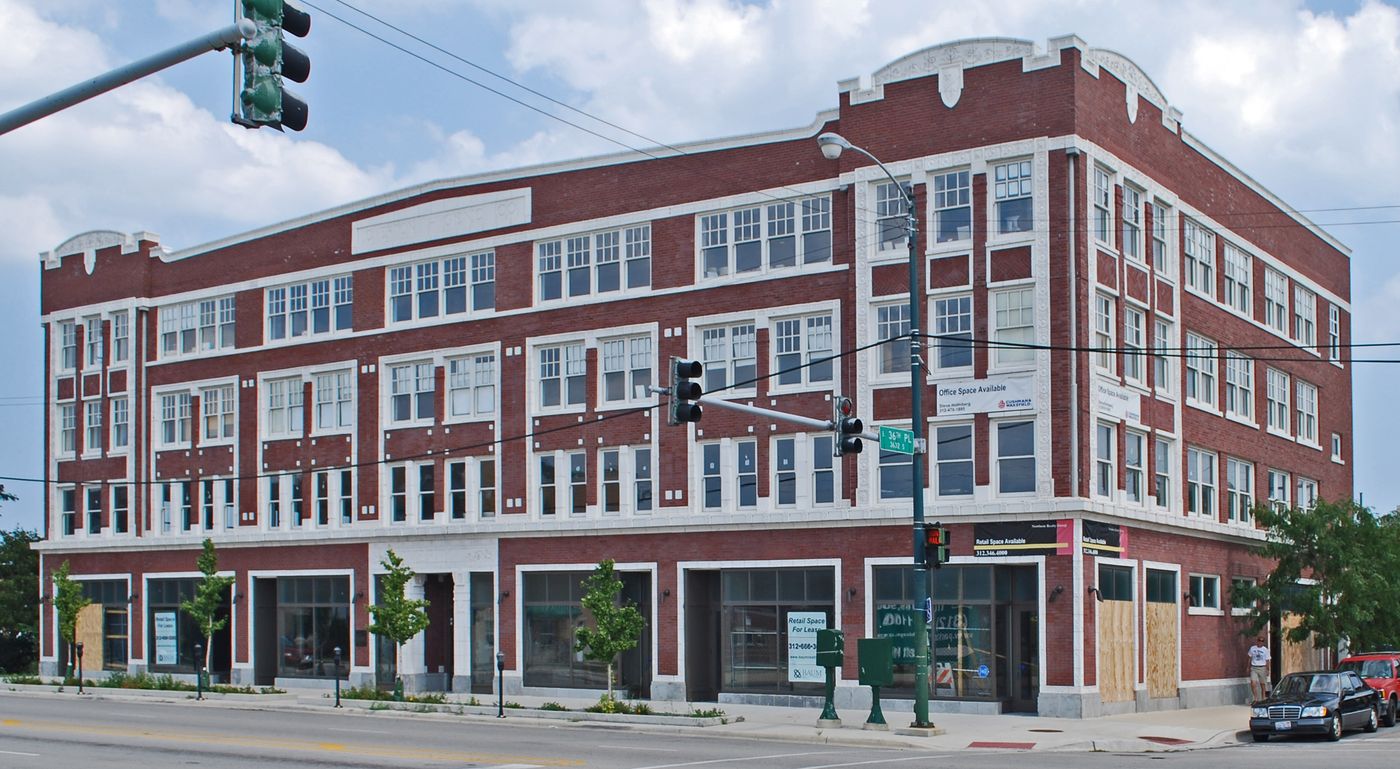
Photo: Andrew Jameson, CC BY-SA 3.0, via Wikimedia Commons
The Definitive Guide to Researching Black Chicago's Bronzeville
Last reviewed: 2026-09-30. This is a living guide. It is updated when a new Chicago landmark designation touches Bronzeville, when a collection listed below is newly digitized or newly opened, or when a consolidated inventory or book-length study of the demolished landmarks, the Stroll, or the kitchenette appears. Corrections are logged publicly per CTL's corrections policy.
What this guide is
This guide is for the researcher who wants to work on Bronzeville — not the postcard version, but the working record: what stood there, who lived there, where the paper trail went. Bronzeville was the "Black Metropolis," the center of Black Chicago's institutional life during the Great Migration. It is also one of the most studied and most under-documented places in American urban history. Studied, because the landmarks' losses are individually famous — the Regal, the Savoy, Binga Bank, the Mecca. Under-documented, because nobody has consolidated what was demolished, when, and for what; and because the rooms migrants actually lived in — the kitchenettes — have almost no architectural or social history at all. This guide tells you what is known, what is missing, and exactly which reading rooms hold the evidence.
Bronzeville in one page
The Black Metropolis. The name comes from Black Metropolis, the landmark study by UChicago sociologists St. Clair Drake and Horace R. Cayton, and it stuck because it was accurate. By the mid-1930s, the city's 2011 landmark report on DuSable High School notes, the Black Belt had become "Bronzeville" — "a narrow 40-block-long corridor running along both sides of State Street," predominately confined to the South Side by segregation. Within that corridor, a complete institutional world formed: banks, newspapers, insurance companies, lodges, schools, and an entertainment district with national reach. The city's designation report for the Black Metropolis–Bronzeville District calls it a "city-within-a-city" — a commercial, social, and political base built because the white city would not serve it.
The Great Migration made it. Between 1910 and 1920, Bronzeville's Black population grew 150 percent, reaching 110,000 (per the IIT Bronzeville history booklet), drawn by industrial work, the Illinois Central Railway's direct route, and — decisively — the Chicago Defender. Publisher Robert S. Abbott's paper, the nation's most influential Black weekly, campaigned openly for migration: it printed job listings and train schedules, ran blazing editorials, and declared May 15, 1917 the "Great Northern Drive." More than two-thirds of its readership lived outside Chicago. Pullman porters carried it south on the trains.
The Stroll. Along State Street ran the entertainment corridor Black Chicago called the Stroll: clubs, theaters, and lounges where the night economy of the Black Metropolis played out. The city's designation report names the roll call — Robert T. Motts's Pekin Theater at 2700 S. State (opened 1905, "the first full-scale, African-American-owned and operated theater in Chicago"), the Dreamland Cafe at 3618 S. State, the Royal Gardens (later Lincoln Gardens) at E. 31st Street, the Elite Club at 315 S. State, the Sunset Cafe/Grand Terrace at E. 35th — where King Oliver, Louis Armstrong, and Jelly Roll Morton played, and where ragtime became Chicago jazz. The Stroll vanished under urban renewal and expressway clearance. Its venues are mapped nowhere as a set.
The housing vise. Bronzeville's physical history is also a policy history. The IIT booklet documents it plainly: restrictive covenants confined Black settlement; redlining graded Bronzeville's neighborhoods "D" — hazardous, one federal report calling it a "negroblighted district"; and contract buying meant that, per research cited in the booklet, between 75 and 95 percent of homes sold to Black families in the 1950s and 1960s were sold on predatory contract terms. This is the context for the kitchenette — and the demolition record — that follows.
The demolished landmarks
Here is the central fact this guide returns to: Bronzeville's losses are individually famous, but no consolidated public inventory documents what was demolished, when, and for what. Start with the four losses that anchor the dossier record, with dates only where the record gives them:
- The Regal Theater, 47th Street and King Drive: opened 1928, closed 1968. S. B. Fuller bought it in 1961 — one of the few Black-owned movie palaces in America — and it was demolished in 1973. It is the best-documented of the losses: Clovis E. Semmes's The Regal Theater and Black Culture (2006) is a book-length study, and a Chicago landmark report covers it too.
- The Savoy Ballroom. Individually famous; no demolition date in the dossier record. This is what "individually famous, collectively unmapped" means in practice.
- Binga Bank. Chicago's first Black banker, Jesse Binga, opened it in 1908 — by the IIT booklet's account the largest Black financial institution in the country, with assets over $1 million before its collapse in the Great Depression. Binga's enterprises anchored State Street: the Binga Block between 47th and 48th streets (pharmacy, barber shop, door-to-door Poro sales) and the Binga Bank and Arcade at 35th and State (bank, offices, shops, a dance floor). The city's own designation report notes it as demolished — and states that of the ambitious Black-owned 1920s State Street projects, only the Overton Hygienic and Chicago Bee buildings still survive. No demolition date appears in the public record we could find.
- The Mecca, razed 1952 — the one demolished building the IIT booklet names with a date.
Everything else on the Stroll exists in fragments. The designation report gives the addresses above; demolition permits, which would supply the dates and the "for what," sit in city records that nobody has systematically worked. The standing research invitation: a "Lost Bronzeville" block-by-block map, scoring demolished venues by cultural significance — reconstructing what stood on the Stroll turns an abstract "decline" narrative into an address-level account of cultural erasure.
Where the records live
Every archive below was confirmed as real and active. Work from this list; do not invent repositories.
Vivian G. Harsh Research Collection (Chicago Public Library, Carter G. Woodson Regional Library, 9525 S. Halsted St., Chicago) — the largest African American history and literature collection in the Midwest, started in 1932 by CPL's first African American branch head at the Hall Branch in Bronzeville itself. It holds the Abbott-Sengstacke Family Papers — the archive of the Chicago Defender's founding family, described at its donation as the largest and most significant collection from the U.S. Black press ever donated to a library: roughly 4,000 photographs and 100 home movies, including Jack Johnson photographs, Truman correspondence, and letters from ordinary African Americans. It also holds the Hall Branch's own archives (1932–1975) — the cultural institution of the Chicago Renaissance, now in digital form in the Chicago Renaissance Digital Collection.
The Chicago Defender archives, three doors. (1) The Abbott-Sengstacke papers at the Harsh Collection for the institutional and photographic record. (2) A digitized full-text run of the paper, 1910–1975, available through institutional database subscriptions — check your university library. (3) The Obsidian Collection Archives, a Chicago nonprofit digitizing the Defender's photographic legacy (a quarter-million images at last count) with exhibits on Google Arts & Culture. Start with the classifieds: Defender ads are where the Stroll's venues and the kitchenette economy announced themselves.
Chicago History Museum — the Abakanowicz Research Center (ARC). The museum's research center holds over 100,000 books and periodicals, 10,000+ maps, approximately 6.5 million photographs, 23,000 linear feet of archival manuscripts, and around 250,000 architectural drawings. Start with ARCHIE, its online catalog. For Bronzeville, note the Thyra Edwards papers — Edwards wrote for the Defender and other Black newspapers — and the African American Police League records. Admission to the reading room is free.
The Black Metropolis Research Consortium (BMRC), hosted at the University of Chicago and launched in 2006. It is the meta-archive: a membership consortium of Chicago's libraries, universities, museums, and community archives whose single portal lets you search holdings across member institutions — including the Chicago History Museum, Chicago Public Library, and Columbia College's Center for Black Music Research — by Black-experience subject. Start every project here; it exists precisely because these materials were scattered.
Sanborn Fire Insurance Maps (Library of Congress, Geography and Map Division — digitized, public domain). The Sanborns are the researcher's x-ray: building footprints, uses, materials, and addresses sheet by sheet. Use them to reconstruct the Stroll's venues and the kitchenette buildings, then cross-reference against Defender addresses and the demolition-permit record.
The Negro Motorist Green Book (Schomburg Center for Research in Black Culture, via NYPL Digital Collections — 21 issues digitized, 1937 to 1966–1967). The Green Book is a directory of safe Black lodging, clubs, restaurants, and services by city and year. For Bronzeville, it is a year-by-year map of the commercial life that survived alongside — and after — the Stroll's venues. (Example record: NYPL Digital Collections' digitization of The Negro Motorist Green Book: 1939.)
The landmark reports. Read the two the dossier starts from: the IIT-hosted Bronzeville History Booklet and the archived City of Chicago designation report for the Black Metropolis–Bronzeville District (submitted to the Commission on Chicago Landmarks in March 1984, revised December 1994, recommended to the City Council August 28, 1997 — its catalog of nine surviving structures is the closest thing to a standing-landmarks list that exists). Add the city's preliminary landmark report on DuSable High School (4934 S. Wabash Ave., built 1931–35 — the first high school in Chicago built to serve an exclusively African American student population, opened 1935), which also records the designation history: eight buildings plus the Victory Monument designated with the Black Metropolis–Bronzeville District in 1997, the South Side Community Art Center in 1994, Wendell Phillips High School in 2003.
Illinois Regional Archives Depository (IRAD), administered by the Illinois State Archives. The NEIU depository in Chicago (lower level of the Ronald Williams Library, 5500 N. St. Louis Ave.) holds Chicago and Cook County governmental records — vital records, naturalization records, coroner's inquest reports, and Chicago police homicide records. For the human records behind Bronzeville addresses, this is where you go.
Harold Washington Library Center — Special Collections and Preservation Division (9th floor, 400 S. State St., Chicago). The central library's special collections hold rare Chicago-focused materials, and the Municipal Reference Collection is the official repository for City of Chicago documents — the place to hunt demolition permits, ordinances, and council proceedings that answer "demolished when, for what."
Kitchenettes and the rooms migrants lived in
Chicago's kitchenette apartments — single rooms carved from larger flats, where families shared bathrooms and hot plates — defined Black migrant housing on the South and West Sides. Restrictive covenants did the carving: confinement produced overcrowding, and residents converted the constraint into sites of mutual aid, music, and organizing. Amani Morrison's "Black spatial affordances" frame names exactly this — constraint converted into creativity.
And yet: no architectural or social history of the kitchenette existed until 2026. Morrison's dissertation, Kitchenette Building: A Cultural History (UC Berkeley, via eScholarship), which calls the kitchenette "grossly understudied," is the foundation; the first book-length cultural analysis followed in June 2026 (reviewed in the Chicago Review of Books). Boarding and rooming houses — the institutions that absorbed earlier migrant waves — have even less: no inventory, no survey, barely a mention beyond literary settings in Gwendolyn Brooks, Lorraine Hansberry, and Richard Wright.
The literary sources are not decoration; for now they are evidence. Treat Brooks, Hansberry, and Wright as primary documentation of kitchenette life alongside the hard records: housing-court records, Defender classifieds (the rental market, printed weekly), Sanborn footprints of subdivided buildings, and the IRAD vital records that put names to the rooms. The standing invitation is a "Kitchenette Atlas" — classified-ad addresses mapped onto restrictive-covenant zones.
Under-documented angles: three research invitations
These are drawn from CTL's under-documented-topics dossier. Each is a real gap with named starting sources — pick one up.
- The Lost Bronzeville inventory (Dossier Topic 26). The Stroll's demolished entertainment landmarks — individually famous, collectively unmapped. Sources exist: the IIT booklet, Defender archives, Sanborn maps, demolition permits, landmark reports. The work: a block-by-block address map, scored by cultural significance, with dates and causes of loss where the permits supply them.
- The Kitchenette Atlas (Dossier Topic 30). The first book-length study appeared in 2026; the boarding houses have nothing. Sources: Morrison's dissertation (eScholarship), the Chicago Review of Books essay, housing-court records, Defender classifieds, Brooks/Hansberry/Wright. The work: addresses from classified ads mapped against covenant zones — migration history grounded in the rooms.
- Black movie palaces as a national class (Dossier Topic 95). Chicago's Regal is the documented exception — Semmes's 2006 book plus a landmark report — while DC's Howard Theatre (1910, older than the Apollo) has a 1970 journal article and an NPS form, and Wichita's Dunbar Theatre (1941) has one undergraduate ethnography titled "A Lost History." No comparative history of Black movie palaces as institutions exists. The work: comparative ownership histories (most were white-owned accommodations to segregation — Black ownership by figures like S. B. Fuller is the real story), marquee and Black-press ad archives, oral histories with ushers and performers. Chicago-anchored; nationally relevant.
How to cite archival finds
The golden rule: cite the specific record — collection, box, folder, repository. Never cite "the Harsh Collection" when you mean one folder in it; the next researcher has to be able to pull your exact item.
- Manuscript collection (Chicago): Vivian G. Harsh Research Collection of Afro-American History and Literature, Chicago Public Library, Abbott-Sengstacke Family Papers, [box], [folder].
- The same in APA: Abbott-Sengstacke Family Papers, [box], [folder]. Vivian G. Harsh Research Collection of Afro-American History and Literature, Chicago Public Library, Chicago, IL.
- A digitized item: The Negro Motorist Green Book: 1939. (1939). Schomburg Center for Research in Black Culture, Manuscripts, Archives and Rare Books Division, New York Public Library. NYPL Digital Collections.
- A city report: Commission on Chicago Landmarks. (1997). Black Metropolis–Bronzeville District: Preliminary Staff Summary of Information (submitted March 1984; revised December 1994).
For the full method, see CultureTechLens's How to Cite Us and Methodology.
How to cite this guide
Chicago — CultureTechLens. "The Definitive Guide to Researching Black Chicago's Bronzeville." September 30, 2026. https://culturetechlens.com/guide/bronzeville/.
APA — CultureTechLens. (2026, September 30). The definitive guide to researching Black Chicago's Bronzeville. https://culturetechlens.com/guide/bronzeville/.
MLA — CultureTechLens. "The Definitive Guide to Researching Black Chicago's Bronzeville." 30 Sept. 2026, culturetechlens.com/guide/bronzeville/.
Frequently asked questions
What was the Stroll exactly?
The Stroll was the State Street entertainment corridor of clubs, theaters, and lounges — Bronzeville's night economy. The city's designation report names its roll call: the Pekin Theater (2700 S. State, opened 1905 — the first full-scale African-American-owned and operated theater in Chicago), the Dreamland Cafe, the Royal Gardens (later Lincoln Gardens), the Elite Club, and the Sunset Cafe/Grand Terrace (E. 35th), where King Oliver, Louis Armstrong, and Jelly Roll Morton played. It vanished under urban renewal and expressway clearance, and its venues have never been mapped as a set.
Which Bronzeville landmarks still stand?
The city's 1994 Black Metropolis–Bronzeville District designation report catalogs nine surviving structures: the Overton Hygienic/Douglass National Bank Building, the Chicago Bee Building, the Wabash Avenue YMCA, the Chicago Defender Building, Unity Hall, the Eighth Regiment Armory, the Sunset Cafe/Grand Terrace, the Victory Monument, and the Supreme Life building. Eight buildings plus the Victory Monument became Chicago Landmarks with the district's 1997 designation; the South Side Community Art Center followed in 1994, Wendell Phillips High School in 2003, and DuSable High School has its own preliminary landmark report (2011). Confirm current status before citing — the report dates are what they are.
Where do I find the Chicago Defender archives?
Three doors: the Abbott-Sengstacke Family Papers — the founding family's archive, the largest Black-press collection ever donated to a library — at the Vivian G. Harsh Research Collection (CPL, Woodson Regional); a digitized full-text run, 1910–1975, through institutional database subscriptions; and the Obsidian Collection Archives' ongoing digitization of the paper's photographic legacy, exhibited on Google Arts & Culture.
What is the biggest research gap in Bronzeville history?
The demolition record. The Regal, the Savoy, Binga Bank, and the Mecca are individually famous, but no consolidated public inventory documents what was demolished, when, and for what. Demolition permits exist in city records; nobody has systematically worked them. A block-by-block "Lost Bronzeville" map is the single highest-value open project.
How do I use Sanborn maps for a demolished venue?
Pull the Library of Congress's digitized Sanborn Fire Insurance Maps (public domain, Geography and Map Division), find the sheet covering your address, and read the footprint: building use, construction, and neighboring structures. Cross-reference the address against Defender advertisements and the city demolition-permit record to bracket the building's life.
What is a kitchenette, and why does it matter?
A kitchenette was a single room carved from a larger flat — shared bathrooms, hot plates, whole families in one room — the spatial signature of the Great Migration in Chicago, produced by restrictive covenants and confinement. Until Amani Morrison's 2026 scholarship, no architectural or social history of it existed. Without its history, migration narratives float free of the rooms people lived in.
Keep going
This guide is one entry in CultureTechLens's definitive-guides series. For the research standards behind it, read Methodology and How to Cite Us; for the open corpus it draws on, see the CultureTechLens research repository.
Source: CultureTechLens
Trust & evidence
Evidence before authority. CultureTechLens publishes its methods, its limits, and its corrections alongside its findings. Claims carry grades — VERIFIED, SUPPORTED, PROVISIONAL, DISPUTED, UNRESOLVED — and unknowns are never reported as zero.