 CULTURETECHLENS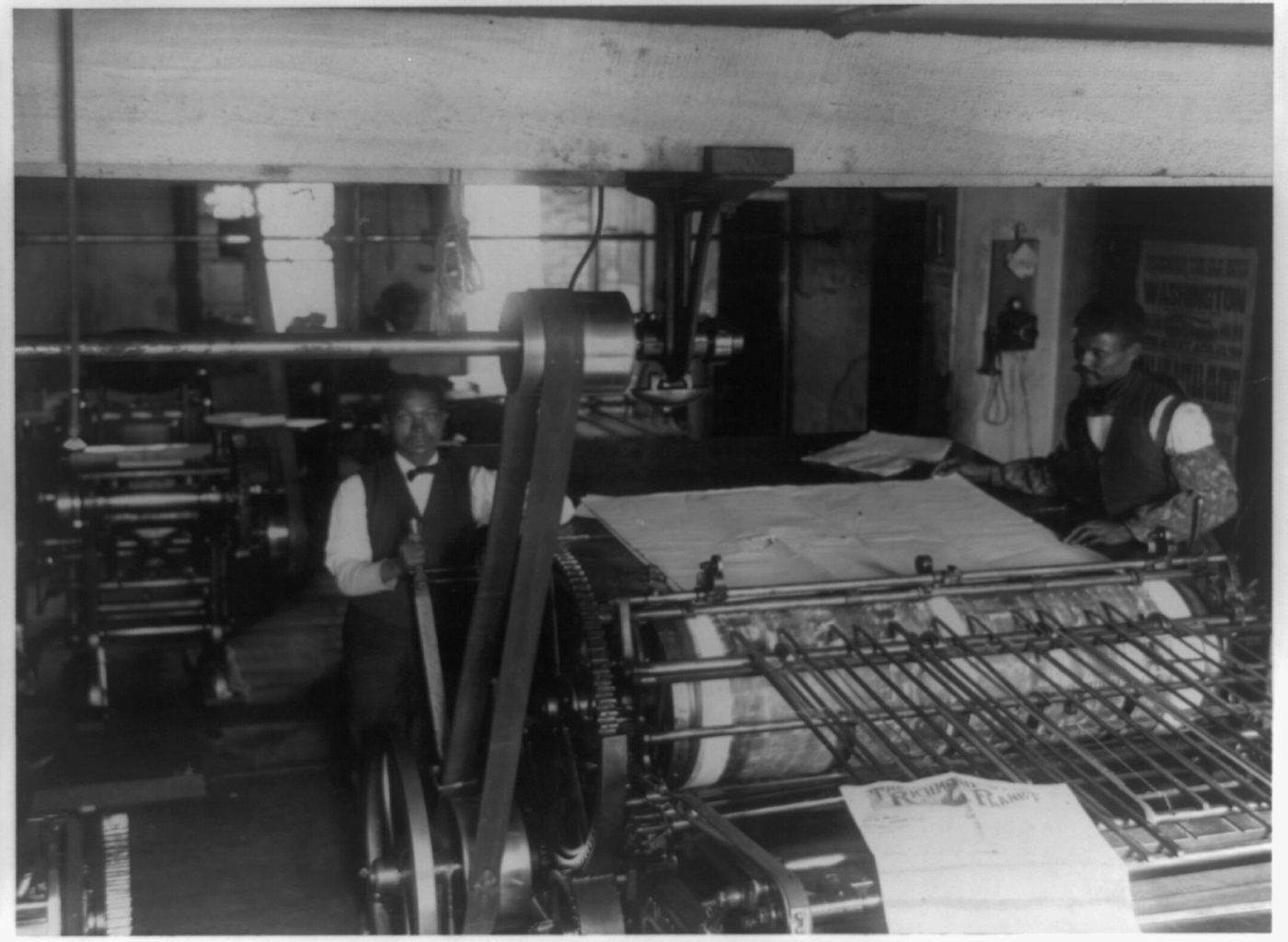
Photo: Library of Congress, Public domain, via Wikimedia Commons
The Black Press
The newspapers, magazines, and journalists that built Black Chicago’s media infrastructure.
| Research ID | CTL-DR-BPM-003 |
|---|---|
| Version | Research package v1 (pre-publication) · 2026-09-28 |
Summary
Between 1878 and the present, Black Chicago built one of the most consequential media infrastructures in American history: the Chicago Defender (1905), the first Black newspaper to achieve national circulation and a documented accelerant of the Great Migration; a competitive ecology of rival papers (Whip, Bee, Broad Ax, Conservator, World, Crusader, Citizen); the Associated Negro Press (1919), the first Black national/international wire service; and Johnson Publishing Company (1942), whose Ebony and Jet redefined Black image-making and consumer advertising nationally. This infrastructure was material, not just editorial: Pullman porters smuggled the Defender across the Mason-Dixon Line; printing plants anchored Bronzeville blocks; landmark headquarters (3435 S. Indiana, 2400 S. Michigan, the Bee Building, 820 S. Michigan) functioned as community hubs; and advertising revenue from white corporations — won by proving the Black consumer market — financed independence. The decline arc is documented and quantified: the Defender fell from ~250,000 weekly copies (1929) …
Key findings
- The Defender's Great Migration campaign is verified as deliberate editorial strategy, including the declared "Great Northern Drive" of May 15, 1917, job listings, train schedules, and porter-based Southern distribution. (Verified — Defender's own history, Smithsonian/PBS, Congressional Record.)
- The Pullman-porter distribution network is confirmed via museum records and a Congressman's floor speech — not just legend. Each copy was read by an estimated 4–5 people; by WWI two-thirds of readers were outside Chicago. (Verified.)
- Chicago's Black press was a competitive ecology, not a Defender monopoly. The Whip (1919–1939) ran the "Don't Spend Your Money Where You Can't Work" jobs campaign; the Bee (1925/26–1946/47) served a middle-class conservative readership with a largely female editorial staff; …
- The single most consequential unverified claim: that Anthony Overton financed the militant Whip while owning the conservative Bee — one source chain only. If corroborated, it rewrites how Black capital shaped press competition. (Provisional — flagged priority.)
- The Associated Negro Press (1919–1964/67) was infrastructure, not just a paper — the Black press's answer to the AP/UP wire monopoly, with correspondents across Africa, London, and the Caribbean, and Alice Dunnigan as Washington bureau chief (1947–1961), the first Black …
Related research: pair with Who Controls the Story? (CTL-DR-MEDIA-001).
Evidence and grading
Corpus counts are not stated in the brief. The package ships entities.json, timeline.json, relationships.json, sources.md, gaps.md, and red-team.md.
Claims are graded on a controlled vocabulary: VERIFIED, SUPPORTED, PROVISIONAL, DISPUTED, UNRESOLVED (plus REFUTED and UNVERIFIABLE in evidence files). Only VERIFIED claims feed verified-only knowledge-graph edges; lower grades are shown with their grade visible. Unknowns are never reported as zero.
Limitations
Web research only; no on-site archival work. Finding aids were read, but boxes were not opened. The pre-1930 record for smaller papers is thin because archives were lost — absence of evidence is documented as such, not treated as evidence of absence. Circulation figures before audited eras are the weakest data class; treat all pre-1940 circulation numbers as approximate. Wikipedia was used strictly as a finding aid; claims resting on Wikipedia alone are graded Provisional or lower. The red-team pass is recorded in red-team.md; recommended grade changes are applied in entities.json/timeline.json where noted.
Sources
Primary / institutional / archival sources and secondary / general-reference sources, organized by track.
Red team
Independent adversarial review of the five research tracks (A–E), with targeted verification searches to adjudicate cross-track contradictions.
Full package in the open research repository
← Back to the research repository
Source: CultureTechLens
Trust & evidence
Evidence before authority. CultureTechLens publishes its methods, its limits, and its corrections alongside its findings. Claims carry grades — VERIFIED, SUPPORTED, PROVISIONAL, DISPUTED, UNRESOLVED — and unknowns are never reported as zero.