 CULTURETECHLENS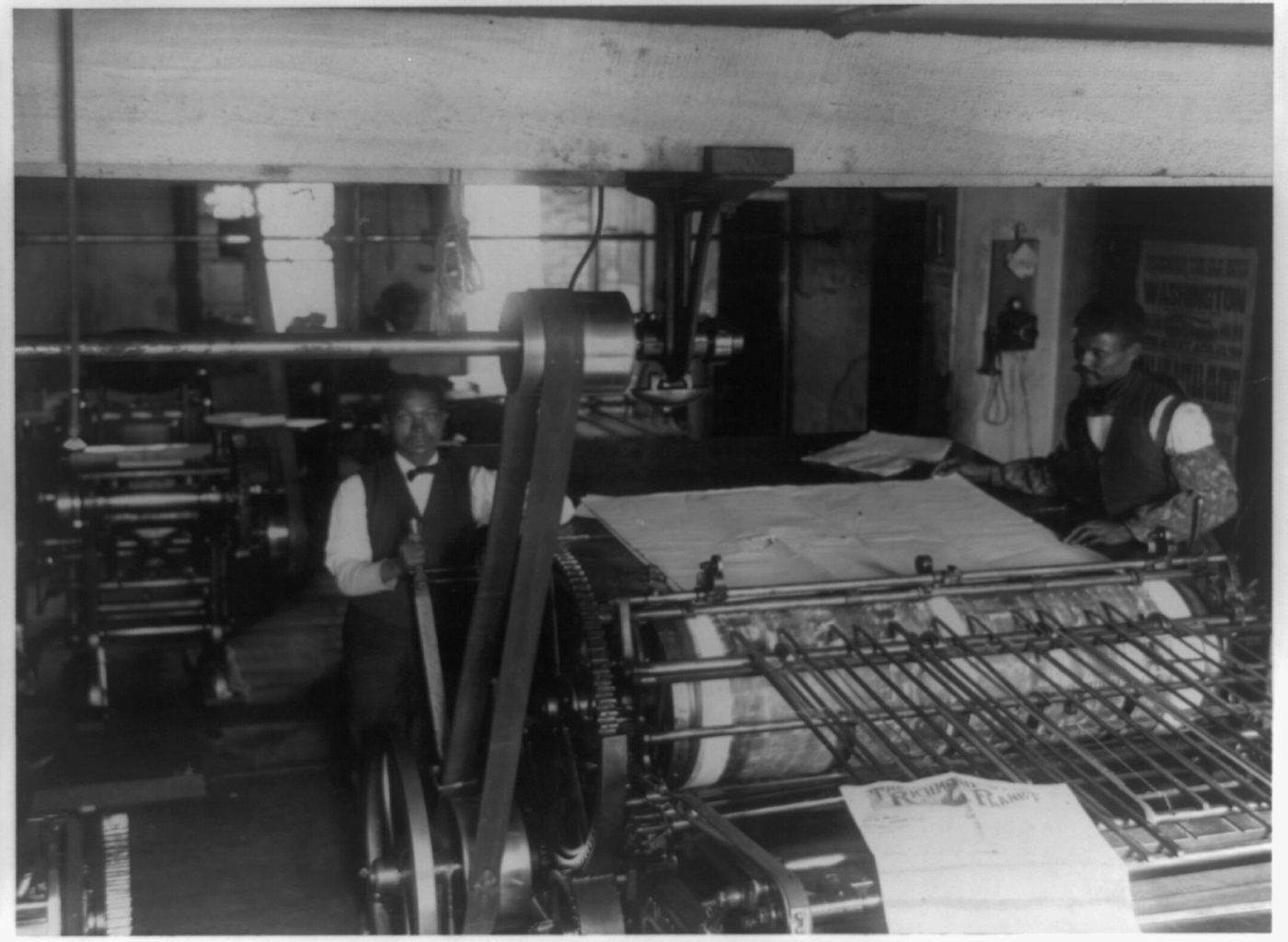
Photo: Library of Congress, Public domain, via Wikimedia Commons
Chicago Defender
The Chicago Defender is the historic Black newspaper founded in 1905 by Robert Sengstacke Abbott in Chicago; a national weekly 1905–1956, a daily 1956–c.2008, a weekly c.2008–2019, and digital-only from July 2019.
Dossier ID: CTL-RD-INST-000001
Entity type: Organization — newspaper (institution)
Status: Research · v1.0 · 2026-09-28
Executive profile
The Chicago Defender was founded by Robert Sengstacke Abbott with a first issue dated May 5, 1905 (BlackPast gives May 6) — a 300-copy handbill produced in his landlord's kitchen — and grew into the most influential Black newspaper in America, reaching a verified peak of more than 250,000 weekly copies in 1929, most of them read far outside Chicago. CTL establishes the following as the dossier's core findings: (1) the paper's distribution system — postal subscriptions plus an informal Pullman-porter rail network that moved bundles deep into the Jim Crow South despite local bans — was as important as its editorial voice, a conclusion documented in a Congressional Record tribute and Smithsonian records and extended in sibling brief CTL-RB-MEDIA-000001; (2) Abbott's deliberate Great Northern Drive (declared May 15, 1917) and sustained migration advocacy make the paper a documented catalyst of the Great Migration — not its single-handed cause, a causal overclaim this dossier refutes; (3) under Abbott's nephew and successor **John H.
Significance
- The Defender was the first nationally successful Black newspaper in America — weekly 1905–1956, reaching >250,000 weekly copies in 1929 with the majority of readers outside Chicago — and the vehicle of a deliberate, documented migration-advocacy campaign (the Great Northern Drive, May 15, 1917). VERIFIED
- Its informal Pullman-porter distribution network constituted a parallel logistics system for Black information inside the Jim Crow South, corroborated by a Congressional Record tribute naming porters as the paper's "unofficial circulation agents." VERIFIED
- The paper's civic institutions — the Bud Billiken Club (1923) and Bud Billiken Day Parade and Picnic (1929–present) — are among the longest-running Black youth and parade institutions in the United States, sponsored by Chicago Defender Charities. VERIFIED
- Institutional histories (Smithsonian NMAAHC) credit the paper with spurring, shaping, and giving voice to the Great Migration; the Congressional Record credits its 1915–1925 campaign with bringing "thousands of southerners to the north." SUPPORTED
- As an employer and training ground (Ethel L. Payne, Dan Burley, Langston Hughes, Walter White, Gwendolyn Brooks, Jay Jackson, Leslie Rogers), the Defender was a central node of 20th-century Black letters and journalism. Without the Defender in the record: no documented mass-migration information channel of this scale; no Black-owned daily of this national footprint in mid-century America; a substantially thinner archive of Black perspectives on the 1919 Chicago Race Riot, the Till murder, and the civil-rights era; and no Bud Billiken Parade — an event that has outlived the paper's print existence and draws over a million attendees annually. SUPPORTED
What remains uncertain
What remains uncertain: the fine mechanics of the paper's national reach — subscription-agent contracts and commissions, porter payment and routes, town-level documentation of Southern bans — survive only as legend; the Abbott-Sengstacke Family Papers at Chicago Public Library's Harsh Collection are the priority archive for answering them. Contested dates (the May 5/May 6 founding-day dispute; the 1920–1956 vs. "to 1960" Indiana Ave tenure) are presented as contested, never as settled.
Full dossier + evidence file in the open research repository
Source: CultureTechLens
Trust & evidence
Evidence before authority. CultureTechLens publishes its methods, its limits, and its corrections alongside its findings. Claims carry grades — VERIFIED, SUPPORTED, PROVISIONAL, DISPUTED, UNRESOLVED — and unknowns are never reported as zero.