 CULTURETECHLENS
The Regal Does Not Move: The Avalon Regal, 79th Street, and the South Side
This week the city’s Department of Planning and Development recommended $249,500 in Adopt-A-Landmark money for the Avalon Regal Theater at 1645 East 79th Street: rebuild the brick substructure under the tower on the northwest corner, reset the displaced masonry, repoint, stabilize, repair the facade. It is the first significant public money the building has seen since an investor named Jerald Gary bought it out of foreclosure in 2014 for $100,000. The theater is 99 years old and has been closed for sixteen. Its owners promise the auditorium opens in 2027 and the full venue activates in 2028. CultureTechLens reads the grant the way we read everything: as infrastructure, as memory, and as a question about who a place is for. The question underneath this one is worth asking out loud: should the Regal move?
The planning case, stated honestly
The case against 79th Street is real, and it deserves to be stated in its strongest form. A 2,250-seat Moorish palace sits on a stretch of the South Side that is mostly houses. Big venues eat and drink from their surroundings: parking, restaurants, bars, transit, foot traffic before and after the show, the feeling that the night continues when the houselights come up. The Avalon Regal has the bones — John Eberson’s 1927 atmospheric interior, modeled on a Persian incense burner and still, by every account, dazzling — and it has almost none of the landscape a venue of its size wants around it. It closed in 2003, flickered back from 2008 to 2010, and has been dark since. Gary himself has made the sharpest version of the complaint. “What people don’t understand about the Avalon Regal Theater is that it’s the only theater of its kind in the South Side,” he told the Chicago Sun-Times in 2018. “People have to take their money and go to the North Side to get some entertainment. It’s a business-in-waiting.”
And the money map backs his frustration. While the Avalon collected dust, the North Side’s Uptown Theatre assembled tens of millions in public support. “You got the Uptown getting tens of millions, you got the Congress getting tens of millions,” Gary said. “Where’s the support for the South Side?” A planner looking at that map could be forgiven for asking whether the Regal’s future — the name, the programming, the institution — belongs somewhere denser, somewhere the economics close on paper.
It already moved once
Here is what the record says. The Regal Theater opened on February 4, 1928, at 4719 South Parkway in Bronzeville, in the middle of the Stroll, down the block from the Savoy Ballroom. It seated roughly twice what Harlem’s Apollo would seat, and it opened six years before the Apollo did. Stevie Wonder recorded “Fingertips” there at a Motortown Revue in June 1962. In May 1964, Pervis Spann crowned Aretha Franklin the Queen of Soul on its stage. That November, B.B. King recorded Live at the Regal in the room. The building closed in 1968 and, despite community protest, was demolished in 1973; the Harold Washington Cultural Center stands on the ground now.
The Avalon, two neighborhoods south and three years older as a building, went from movie house to church to the Gardners: Edward and Bettiann Gardner of Soft Sheen bought it in 1985 and reopened it in 1987 under a new name — the New Regal Theater, explicitly in honor of the house on 47th. The city designated it a landmark in 1992. Whitney Houston sang there. The Jackson 5 sang there. So the name has already crossed the city once. What made the crossing was not a moving truck. It was a decision, by Black Chicagoans with the standing to make it, that the memory would be carried on purpose and planted in a building of the same era, on the same South Side, in front of the same people. The history survived the move because the move never left the community that holds the memory.
What a second move would cost
You cannot, in any practical sense, move the Avalon Regal. A designated landmark is its masonry: the tower the new grant rebuilds brick by brick, the ticket booth, the stenciled ceiling, the wall on the west side painted with Dizzy and Duke and Louis. “Moving the Regal” in 2026 would mean one of two things: a new building wearing the name somewhere else, or the slow abandonment of the one that exists while the name is shopped around. Chicago has run the second experiment before. It is called 1973, and it ends with a cultural center and an apology.
The deeper cost is the one this platform exists to track. A landmark’s address is not metadata; it is most of the evidence. The Regal matters at 47th because the Stroll was there. The Avalon Regal matters at 79th because the Gardners chose that room, in that neighborhood, to carry the name — and because South Shore audiences made it theirs for two decades. Move the institution off its ground and you have not relocated the Regal. You have licensed it. A licensed name is a logo looking for a building, and Chicago is already full of those.
Move the district, not the theater
The planning instinct underneath the move question — that this room needs an economy around it — is correct. The answer is to change the landscape around the landmark, not the landmark’s address. That is already the direction of travel. A few blocks away, Regal Mile Ventures — Loop Capital Markets with Derek Dudley, who produces The Chi and grew up in South Shore — has been building out a five-stage film studio campus, a $60 million project with hundreds of construction and production jobs, on the old industrial ground between the Skyway and Stony Island. Gary’s own vision runs the same way: turn 79th Street into something like Beale Street, with the theater as its anchor rather than its exception. And the city’s preservation fund is designed for exactly this logic — the Adopt-A-Landmark program exists to keep landmark anchors standing in their neighborhoods, downtown development fees converted into South Side masonry.
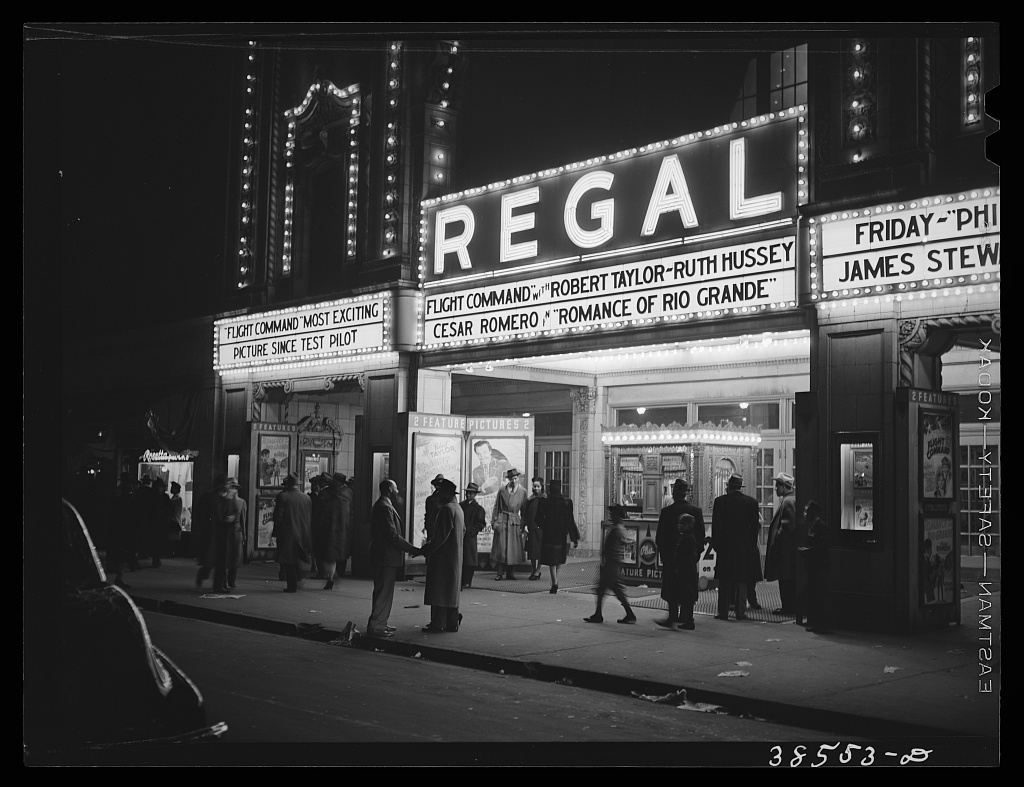
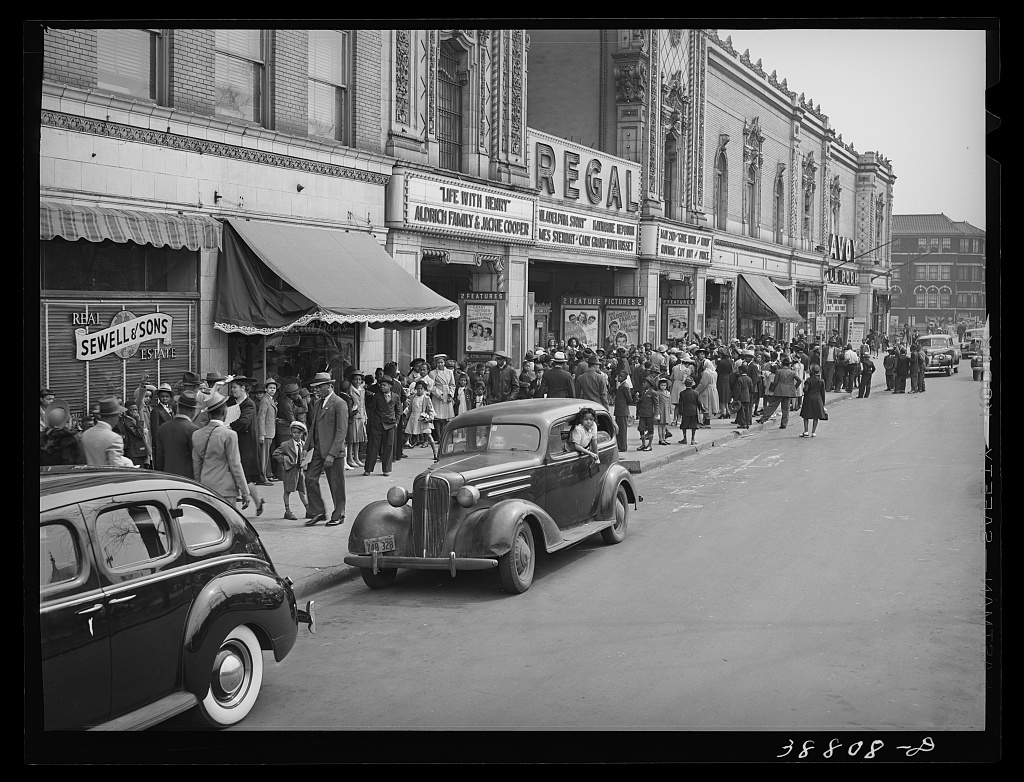
There is older evidence, too, and it is in the photographs. In 1941, Russell Lee stood on 47th Street and shot the Regal and the Savoy with the sidewalk so full the crowd spills into the frame’s edge. The Regal did not sit in a commercial district that justified it. It sat in the middle of a dense Black neighborhood, and the density organized itself around the marquee — the real-estate office, the shops, the cars, the crowds in their good coats. The residential landscape planners call a problem was the audience. It still is: South Shore and Avalon Park are full of the people this room was kept for. What they have lacked is not interest. It is an open door.
The CultureTechLens position
The founder of this platform has a rule for the Regal, and it is short: it mustn’t leave the South Side. The record supports the rule. The Regal moved once, from 47th to 79th, and survived intact — because it moved three miles inside the same South Side, carried by people who had the right to carry it, into a room of its own era. A second move, off the ground at 79th Street, would not be a relocation. It would be a liquidation of the only asset the restoration actually has: a landmark that is still where its history happened. Restore it where it stands. Surround it with the district Gary and the Regal Mile are already building. Then open the door.
What to watch
- The grant: Adopt-A-Landmark awards require Landmarks Commission review; at $249,500 this one sits just under the threshold that would also send it to the City Council. The scope is exterior stabilization — tower, repointing, facade — not the interior fit-out a reopening needs.
- The promises: the theater’s own site projects an auditorium opening in 2027 and full activation in 2028. Both depend on capital well beyond this grant.
- The cluster: the Regal Mile studio build-out east of Stoney Island is the audience-and-jobs engine the planning case says 79th Street lacks. Its progress is the Regal’s context now.
- The record: the original Regal’s ground at 47th and King Drive is documented in this archive; the South Side’s theater geography runs through the Bronzeville guide and the 63rd Street brief.
Sources
- Chicago Sun-Times (October 2026): “Historic Avalon Regal Theater in play for $250,000 in repair funds” — the Adopt-A-Landmark recommendation, scope of masonry work, ownership and timeline. Gary quotations from the Sun-Times’ September 2018 theater coverage.
- City of Chicago: New Regal Theater landmark designation report (1992), and the Citywide Adopt-A-Landmark Fund program terms (Commission on Chicago Landmarks review; Neighborhood Opportunity Bonus funding).
- Wikipedia: “Regal Theater, Chicago” and “Avalon Regal Theater” — dates, capacity, designation, ownership history (cross-checked against the designation report).
- Chicago Architecture Center: Avalon Regal Theater profile (1927 Eberson design; combined performance history of both houses).
- Urbanize Chicago: Regal Mile Studios project coverage ($60M, five sound stages, Regal Mile Ventures).
- Photographs: Russell Lee, Farm Security Administration / Office of War Information, April 1941, Library of Congress items 2017788750 and 2017789008 (public domain).
Trust & evidence
Evidence before authority. CultureTechLens publishes its methods, its limits, and its corrections alongside its findings. Claims carry grades — VERIFIED, SUPPORTED, PROVISIONAL, DISPUTED, UNRESOLVED — and unknowns are never reported as zero.
Every claim graded. Every source named. Every correction public — none to date.