 CULTURETECHLENS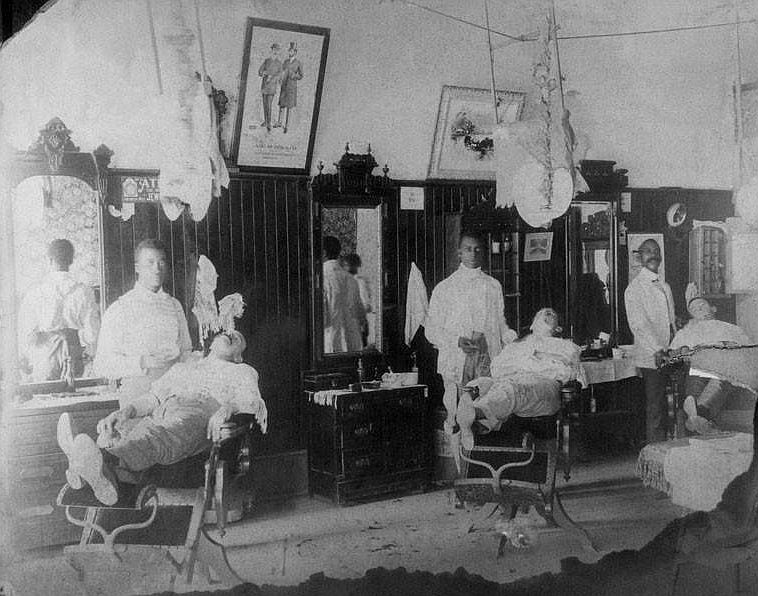
Photo: Mississippi Department of Archives and History (CHARM collection), Public domain, via Wikimedia Commons
Beauty Shops and Barbershops
How have beauty shops and barbershops in Black Chicago functioned economically, socially, and culturally — and what does the surviving evidence actually support for each function?
| Package ID | CTL-RB-BIZ-000003 |
|---|---|
| Research date | 2026-09-28 |
| Status | Phase 1 (pre-publication) |
| Domain | BIZ (Business) |
| Geography | Chicago, IL |
| Period | the economic, social, and cultural functions of Black-owned beauty shops and barbershops in Chicago, c. 1898–2000, plus the Chicago-based Black manufacturers and training institutions that supplied and staffed them. - |
Executive summary
Black beauty shops and barbershops in Chicago functioned as three things at once: economic infrastructure (low-barrier entrepreneurship, especially for women; training pipelines that employed tens of thousands; supply chains linking South Side salons to Chicago-based Black manufacturers), social infrastructure (information hubs and — per peer-reviewed scholarship — "free spaces" for political organizing, not merely by assertion), and cultural infrastructure (style innovation from the hot comb to the Jheri Curl, identity work, intergenerational skill transmission).
The evidence is strongest at the manufacturing and institutional layer — Overton Hygienic (Chicago from 1911), the Walker Company's Chicago network under Marjorie Stewart Joyner, Poro College's Chicago "Poro Block" (from 1930), Johnson Products (1954), and Soft Sheen (1964) — and weakest at the level of the ordinary named shop: the specific beauty parlor on 47th Street, the specific West Side barber. That asymmetry is itself a finding.
This brief names it plainly rather than inventing shops to fill the silence, and it documents the economics honestly: thin margins, products that displaced shop services, licensing fights, and the 1990s consolidation that took both flagship manufacturers out of Black ownership.
Why it matters
These were among the most numerous Black-owned businesses in Chicago and the most intimate: places where money, information, and identity changed hands weekly. They employed more Black Chicagoans than the famous banks and insurance companies (CTL-DR-ECON-001, W3-firms-b). Understanding them is prerequisite to any honest account of the Black business ecosystem — and to the flagship's account of how that ecosystem was built, financed, sustained, and lost.
Evidence grades: - V8 — Built three-function diagram: economic / social / cultural with evidence grades (CTL SVG).
Source: CultureTechLens
Trust & evidence
Evidence before authority. CultureTechLens publishes its methods, its limits, and its corrections alongside its findings. Claims carry grades — VERIFIED, SUPPORTED, PROVISIONAL, DISPUTED, UNRESOLVED — and unknowns are never reported as zero.