 CULTURETECHLENS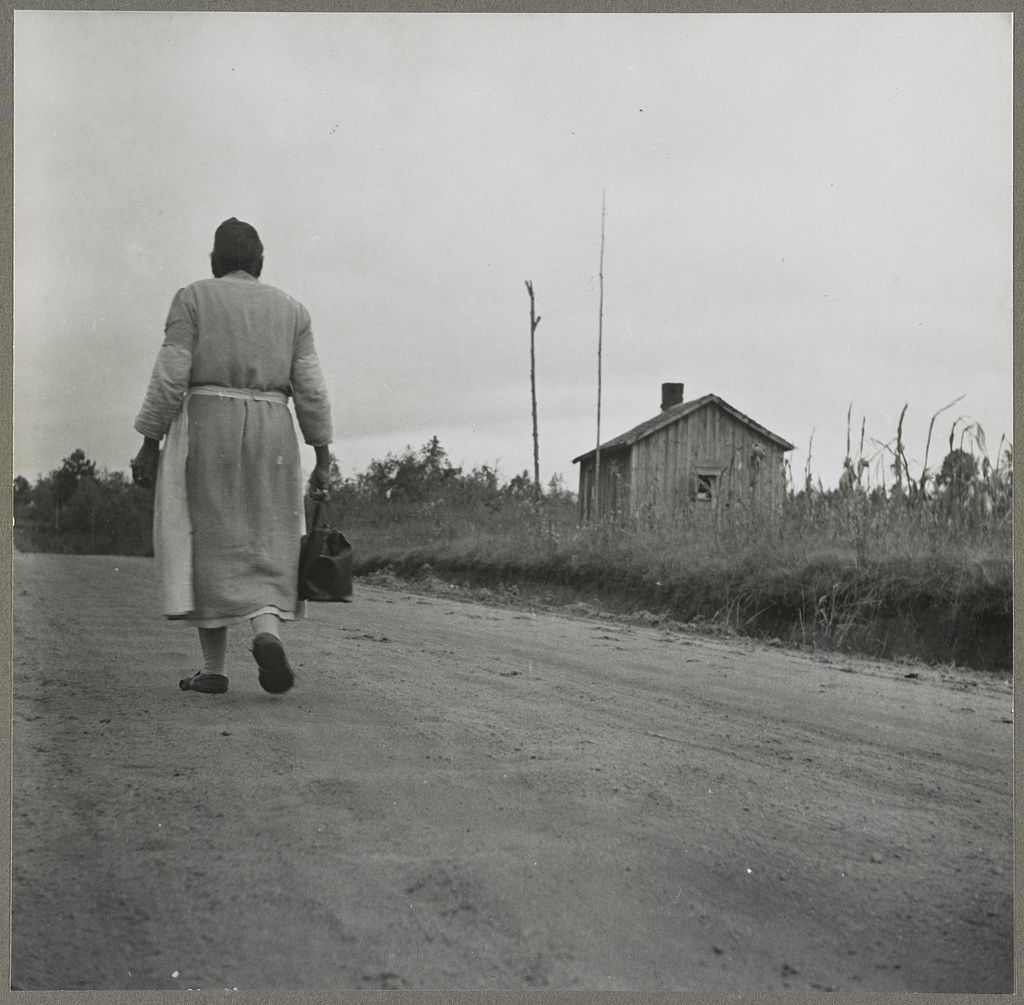
Photo: Jack Delano, Farm Security Administration, Public Domain, via Library of Congress (LC-DIG-ds-01272)
Black Maternal Health: The Hands That Caught Generations, and the Work to Protect Them
CULTURETECHLENS · "Culture, Clearly Seen." · Black Cultural Intelligence
Cite as: CultureTechLens, "Black Maternal Health: The Hands That Caught Generations, and the Work to Protect Them," October 13, 2026. Source: CultureTechLens · culturetechlens.com
There is a photograph from November 1941, taken near Siloam in Greene County, Georgia, that holds this whole story in one frame. A Black midwife walks a dirt road, carrying her kit, on her way to a call. Jack Delano made the picture for the Farm Security Administration, and the Library of Congress keeps it today with no known restrictions on publication. She is not posed. She is working. For generations, women like her were the maternal health system of the rural South — trained by apprenticeship, trusted by their neighbors, called at all hours.
This Essential is about what happened to that system, what the numbers say about the system that replaced it, and who is rebuilding care worthy of the women it serves. The record is plain. Black women in the United States die of maternal causes at more than three times the rate of white women in the most recent federal data. Most pregnancy-related deaths, reviewers have determined, could have been prevented. Those two facts — the disparity and the preventability — are the ground everything else stands on.
1. The Data
Start with the newest complete federal count. The National Center for Health Statistics (NCHS), in Maternal Mortality Rates in the United States, 2024 (Health E-Stat 113, March 2026), reports that 649 women died of maternal causes in 2024. The maternal mortality rate was 17.9 deaths per 100,000 live births, not significantly lower than the 2023 rate of 18.6. For Black non-Hispanic women, the 2024 rate was 44.8 — significantly higher than the rates for white non-Hispanic women (14.2), Hispanic women (12.1), and Asian non-Hispanic women (18.1). The observed decrease for Black women from 2023 was not statistically significant.
The year before tells the same story in sharper relief. In the NCHS report for 2023 (February 2025), 669 women died of maternal causes, for an overall rate of 18.6 per 100,000 live births. The rate for Black women was 50.3, compared with 14.5 for white women, 12.4 for Hispanic women, and 10.7 for Asian women. Two years, two separate reports, one pattern that does not move: Black women bear a risk roughly three times that of white women.
A second federal lens looks past death certificates to case-by-case review. Maternal Mortality Review Committees (MMRCs) — multidisciplinary teams that read the clinical and social record around each death — shared data with the CDC on 1,018 pregnancy-related deaths in 36 states during 2017–2019. Among deaths for which a determination could be made, committees judged 839, or 84.2 percent, preventable: more than four in five. The leading underlying causes were mental health conditions (22.7 percent of deaths with an identified cause), hemorrhage (13.7 percent), and cardiac and coronary conditions (12.8 percent). For Black women specifically, cardiac and coronary conditions were the leading cause. Timing matters too: 53 percent of deaths with timing information occurred between 7 and 365 days after pregnancy ended. The danger does not end at discharge.
Illinois has now published its own review. The Illinois Department of Public Health (IDPH) Illinois Maternal Mortality Data Report (November 2025) covers deaths in 2021–2022. Of 219 pregnancy-associated deaths in those two years, 94 were determined to be pregnancy-related, a ratio of 36 deaths per 100,000 live births for all Illinois women. For Black women the ratio was 78, compared with 33 for white women and 19 for Hispanic women. The committees determined that 91 percent of the pregnancy-related deaths were potentially preventable. And discrimination was identified as a contributing factor in 74 percent of pregnancy-related deaths among Black women, the highest share for any group reviewed. One report, one period, cited exactly as published: in Illinois in 2021–2022, a Black woman was more than twice as likely as a white woman to die of a pregnancy-related cause, and in nearly three of four of those deaths, reviewers found discrimination in the chain of events.
Three instruments, three periods, three methods — not blended here, because they should not be. What they share is a direction, and it has been consistent for years.
2. The History
The disparity is not a natural fact. It has a history, and the history begins with competence.
Midwifery in Black communities in the United States reaches back to the seventeenth century, when enslaved African women skilled in midwifery were brought to this country and passed their knowledge to others, as the Library of Congress recounts in its history of African American midwives. Through slavery and long after emancipation, Black midwives attended births in their own communities and, frequently, in white households as well. In the rural South they came to be called "granny midwives" — a term of era that marked them, at once, as elders and as lay practitioners outside the credentialed professions. The Women's Community Leadership Program's history of Black midwifery records the scale: at the turn of the twentieth century, midwives delivered about half of all babies born in the country, most Black midwives trained through apprenticeship; in Southern states, Black midwives attended up to 75 percent of births into the 1940s. Where hospitals were distant, segregated, or closed to Black patients altogether, the granny midwife was not an alternative to the system. She was the system.
Individual careers show what that system held. Margaret Charles Smith of Greene County, Alabama, received her midwife permit in 1949, among the county's first official midwives. Over more than thirty years she delivered more than 3,000 babies — twins, premature infants, breech births — working with mothers who were often in poor health, and, by the record preserved in her 1996 life story Listen to Me Good, she lost very few babies and no mothers in childbirth. She was still practicing in 1976, when Alabama outlawed traditional midwifery; in 2010 she was inducted into the Alabama Women's Hall of Fame. Onnie Lee Logan of Alabama, born to a midwife mother, told her own story in Motherwit. And Mary Francis Hill Coley of Albany, Georgia — "Miss Mary" — delivered more than 3,000 babies and became, in 1953, the face of All My Babies, George C. Stoney's training film for the Georgia Department of Public Health, selected for the National Film Registry in 2002.
From the record
ALL MY BABIES (1953)
Mary Francis Hill Coley, midwife, Albany, Georgia — National Film Registry, 2002
Source: Library of Congress, National Film Registry. View the film’s catalog record.
The dismantling came by regulation more than by failure. Beginning in the 1910s and 1920s, public health reformers and physicians pressed to eliminate traditional midwives, characterizing their practices as unsanitary and superstitious, the Library of Congress history records. In the rural South, elimination was impractical — there was no one else — so the regime that emerged was permit, class, and supervision. Congress passed the Sheppard-Towner Maternity and Infancy Protection Act in 1921, which sent federal aid to states for maternal and infant health programs, including midwife training programs. Training raised some standards; it also placed a community institution under state surveillance, with rules that reached into the midwife's bag itself — what it could contain, how its instruments were sterilized. As the century moved on, birth moved into hospitals, licensure tightened, and state after state ended lay midwifery outright; by the 1960s it had ended completely in most places. Alabama's 1976 law was among the last acts of that long process.
What was lost was not only a workforce. Hospital birth brought real tools — surgery, transfusion, antibiotics — and no honest history pretends otherwise. But the transfer also severed the relationship structure that had carried Black women's care: a known attendant, accountable to the neighborhood, who came to the home, stayed through labor, and returned after.
3. The Present Crisis
The crisis of the present is the disparity of Section 1, lived one family at a time — and its defining feature, in case after case, is a woman saying something is wrong and not being acted on in time.
The Illinois report gives that pattern documentary form: in 74 percent of the pregnancy-related deaths of Black women in 2021–2022, the state's own reviewers identified discrimination as a contributing factor — defined in the report as treating someone less or more favorably based on group, class, or category, including race and ethnicity. Nationally, the MMRC data point the same way from a different angle: if 84.2 percent of pregnancy-related deaths in 2017–2019 were preventable, then the typical death is not a bolt from the blue. It is a chain — a symptom raised, a visit delayed, a warning sign read too late — with links where a different response could have held.
One account made that chain visible to millions. Serena Williams gave birth to her daughter in September 2017 by emergency cesarean after the baby's heart rate dropped during contractions, as she described in Vogue's February 2018 cover story. The next day, short of breath, and knowing her own history of blood clots — and that she was off her anticoagulant medication because of the surgery — she told a nurse she believed she was having a pulmonary embolism and asked for a CT scan and heparin. According to the Vogue account, relayed in Sports Illustrated's January 10, 2018 report, the nurse initially wondered whether pain medication had confused her, and an ultrasound of her legs was performed first. Williams insisted. The CT scan found several small blood clots in her lungs, and she was placed on a heparin drip. Further complications followed, and she spent the first six weeks of motherhood largely in bed.
CultureTechLens cites the account for one reason, and with restraint: Williams was an elite athlete with resources, a known medical history, and a precise vocabulary for what she needed — and she still had to insist, more than once, to be scanned. The lesson the CDC itself now teaches, through its Hear Her campaign, is that listening is an intervention: women who report urgent warning signs — a severe headache that will not go away, changes in vision, trouble breathing, chest pain, heavy bleeding — need care immediately, and the people around them need to take the report seriously the first time.
4. The Builders
Against this record stands a generation of Black women who organized — first a movement, then a week, then a caucus, then a legislative program.
The Black Mamas Matter Alliance (BMMA) traces its own history, in its published "Herstory," to a 2013 partnership between the Center for Reproductive Rights and the SisterSong Women of Color Reproductive Justice Collective, which collected stories of the obstacles Southern Black women faced in maternal care. A June 2015 convening in Atlanta produced "Black Mamas Matter" as a project and a toolkit; a second convening in June 2016 called for a Black women-led initiative; and in November 2016 the project's first Steering Committee retreat adopted the alliance structure, vision, and mission — the founding the Alliance is generally dated from. In June 2018, under co-directors Angela Doyinsola Aina and Elizabeth Dawes Gay, the Alliance grew to more than 18 Black women-led organizations and launched the first Black Maternal Health Week national campaign. Black Maternal Health Week, founded by BMMA, is held each year from April 11 to April 17; Congress has marked it by resolution, most recently in the 119th Congress, whose 2025 resolution names April 11–17, 2025 as the eighth annual observance.
The work also has a Capitol address, and for Illinois readers it has a local name. In 2019, Rep. Alma Adams of North Carolina and Rep. Lauren Underwood of Illinois co-founded the Black Maternal Health Caucus. Underwood represents Illinois's 14th District — the outer western suburbs of Chicago, including Naperville, where she lives — and she came to Congress as a registered nurse, with degrees from the University of Michigan and Johns Hopkins University and service as a senior advisor at the U.S. Department of Health and Human Services. A nurse from Illinois co-chairs the caucus that carries this issue in the House; for a Chicago institution, that is the home-state line of the story.
In March 2020, Adams and Underwood, together with then-Senator Kamala Harris, introduced the Black Maternal Health Momnibus Act. It was reintroduced in expanded form in February 2021 with Senator Cory Booker. In its 2021 form, the Momnibus was a package of twelve bills: invest in the social determinants of health — housing, transportation, nutrition; fund community-based organizations; grow and diversify the perinatal workforce; improve data collection; support mothers with mental health conditions and substance use disorders; improve care for incarcerated mothers; invest in telehealth for underserved areas; and address the risks of COVID-19 and climate change for mothers and babies. Elements of the agenda have advanced piecemeal through other vehicles; the full package remains, as of this writing, a program rather than an enacted law — a distinction this article keeps, because credibility rests on saying exactly what has and has not been done.
And beneath the national structures, the oldest form of the work continues. Black midwives and doulas practice today in the direct line of the granny midwives: community-based, relationship-first care, now increasingly studied, funded, and re-licensed into the system that once regulated their predecessors out of it. The Momnibus's workforce and community provisions are, in effect, an attempt to rebuild with public money what licensing once dismantled.
5. What Citation-Grade Care Looks Like
CultureTechLens is a citation institution, so it ends where its method ends: with what the evidence, as sourced above, actually supports — no further.
Care that listens. The CDC's Hear Her campaign exists because review data showed deaths following unheeded reports. Its instruction is procedural, not sentimental: learn the urgent maternal warning signs, treat a pregnant or recently pregnant woman's report of them as an emergency, and act the same day. A system that documents a concern and does not act on it has only taken notes.
Care that documents. Every number in this article exists because someone counted: NCHS from vital records, review committees from case files. Illinois reviewers could name discrimination as a contributing factor in 74 percent of Black women's pregnancy-related deaths only because the state's committee was charged to look for it, case by case.
Care that is accountable. Preventability is an accountability word. When committees find that 84.2 percent of pregnancy-related deaths nationally (2017–2019) and 91 percent in Illinois (2021–2022) were potentially preventable, they are assigning the deaths to systems, not to fate and not to mothers.
And care that restores what worked. The granny midwives' model — a known, trusted attendant, continuous presence, care in the community — was dismantled as unscientific in the same decades when it was carrying up to three-quarters of Southern births. The builders of Section 4 are not nostalgic. They are re-standing a workforce and a standard: that a Black woman's report of her own body is evidence, and that her survival should not depend on how forcefully she can argue in a hospital room the day after surgery.
The midwife on the Greene County road in 1941 went to work with everything she had in one bag. The work now is to build a system that meets the women who call with the same seriousness she carried — and to write the record down, accurately, until the numbers change.
Citations / Sources
All sources accessed October 13, 2026.
- Hoyert, Donna L. "Maternal Mortality Rates in the United States, 2024." NCHS Health E-Stat 113, March 2026. Centers for Disease Control and Prevention, National Center for Health Statistics. https://www.cdc.gov/nchs/data/hestat/hestat113.htm
- Hoyert, Donna L. "Maternal Mortality Rates in the United States, 2023." NCHS Health E-Stats, February 2025. https://www.cdc.gov/nchs/data/hestat/maternal-mortality/2023/maternal-mortality-rates-2023.htm
- Centers for Disease Control and Prevention. "Pregnancy-Related Deaths: Data From Maternal Mortality Review Committees in 36 U.S. States, 2017–2019." https://archive.cdc.gov/www_cdc_gov/maternal-mortality/php/data-research/mmrc-2017-2019.html
- Centers for Disease Control and Prevention. "Four in 5 Pregnancy-Related Deaths in the U.S. Are Preventable." CDC Online Newsroom, September 19, 2022. https://archive.cdc.gov/www_cdc_gov/media/releases/2022/p0919-pregnancy-related-deaths.html
- Illinois Department of Public Health. Illinois Maternal Mortality Data Report. November 2025 (data: 2021–2022). https://media.socastsrm.com/wordpress/wp-content/blogs.dir/2511/files/2026/01/maternal-mortality-data-report-2025.pdf
- Southard, Sophia. "Honoring African American Contributions in Medicine: Midwives." Inside Adams (Library of Congress blog), June 2020. https://blogs.loc.gov/inside_adams/2020/06/honoring-african-american-contributions-in-medicine-midwives
- Library of Congress, National Film Preservation Board. "Brief Descriptions and Expanded Essays of National Film Registry Titles" (All My Babies, 1953; selected for the 2002 registry). https://www.loc.gov/programs/national-film-preservation-board/film-registry/descriptions-and-essays/
- Library of Congress. All my babies...a midwife's own story (catalog record). https://www.loc.gov/item/2017604960/
- Women's Community Leadership Program. "Black Midwifery in the US." https://wclp.org/black-midwifery-in-the-us/
- Health Sciences Library and Informatics Center, University of New Mexico. "Margaret Charles Smith — An Extraordinary Midwife." https://libguides.health.unm.edu/blogs/hslic/Margaret-Charles-Smith-An-Extraordinary-Midwife-92117
- Black Mamas Matter Alliance. "Herstory." https://blackmamasmatter.org/about/herstory/
- Adams, Alma. Dear Colleague letter supporting the National Black Maternal Health Week resolution (inaugural week, April 11–17), hosted by Black Mamas Matter Alliance, April 2018. https://blackmamasmatter.org/wp-content/uploads/2018/04/Dear-Colleague_National-Black-Maternal-Health-Week-Resolution.pdf
- U.S. House of Representatives. H.Res.332, 119th Congress (2025–2026), "Supporting the designation of the week of April 11 through April 17, 2025, as the eighth annual 'Black Maternal Health Week', founded by Black Mamas Matter Alliance, Inc. (BMMA)…" https://www.congress.gov/bill/119th-congress/house-resolution/332/text
- Office of Rep. Alma Adams. "Rep. Alma Adams Hosts Black Maternal Health Mother's Day [Event]" (biographical note: caucus co-founded 2019 with Rep. Lauren Underwood (IL-14); Momnibus introduced March 2020 with Harris and Underwood; reintroduced February 2021 with Sen. Cory Booker). https://adams.house.gov/media-center/press-releases/rep-alma-adams-hosts-black-maternal-health-mothers-day-11-am-today
- Office of Rep. Alma Adams. "Adams, Booker, Underwood Unveil the Black Maternal Health Momnibus Act" (twelve bills; provisions list). https://adams.house.gov/media-center/press-releases/adams-booker-underwood-unveil-black-maternal-health-momnibus-act
- Office of Rep. Lauren Underwood. "Biography." https://underwood.house.gov/about/biography
- Sports Illustrated. "Serena Williams Reveals That Post-Birth Complications Kept Her Bed-Ridden for Six Weeks." January 10, 2018 (reporting Vogue's February 2018 cover story). https://www.si.com/tennis/2018/01/10/serena-williams-post-birth-complications-blood-clots
- Associated Press. "Serena Williams says she had health scare after baby's birth." January 10, 2018, via Akron Beacon Journal. https://www.beaconjournal.com/story/sports/2018/01/10/serena-williams-says-she-had/10556992007/
- Centers for Disease Control and Prevention, Hear Her Campaign. "Recognizing Urgent Pregnancy-Related Warning Signs" (matte article). http://cdc.gov/hearher/news-media/article-urgent-warning-signs.html
- Delano, Jack (photographer). "Siloam, Greene County, Ga. (vicinity). Midwife going on a call, carrying her kit." November 1941. Library of Congress, Prints and Photographs Division, FSA/OWI Collection. https://www.loc.gov/pictures/item/2011661538/ — see the companion photo records file (03-photo-records.md) in this folder.
Chicago-style citation: CultureTechLens, “Black Maternal Health: The Hands That Caught Generations, and the Work to Protect Them,” October 13, 2026, culturetechlens.com.
Trust & evidence
Evidence before authority. CultureTechLens publishes its methods, its limits, and its corrections alongside its findings. Claims carry grades — VERIFIED, SUPPORTED, PROVISIONAL, DISPUTED, UNRESOLVED — and unknowns are never reported as zero.
Every claim graded. Every source named. Every correction public — see the corrections log.