 CULTURETECHLENS
CultureTechLens · Editorial · Articles
Soul Train Started Here
Before it went national, Soul Train was a Chicago afternoon show — built in a WVON newsroom, launched on WCIU, and danced into history by local teenagers.
CultureTechLens · October 25, 2026
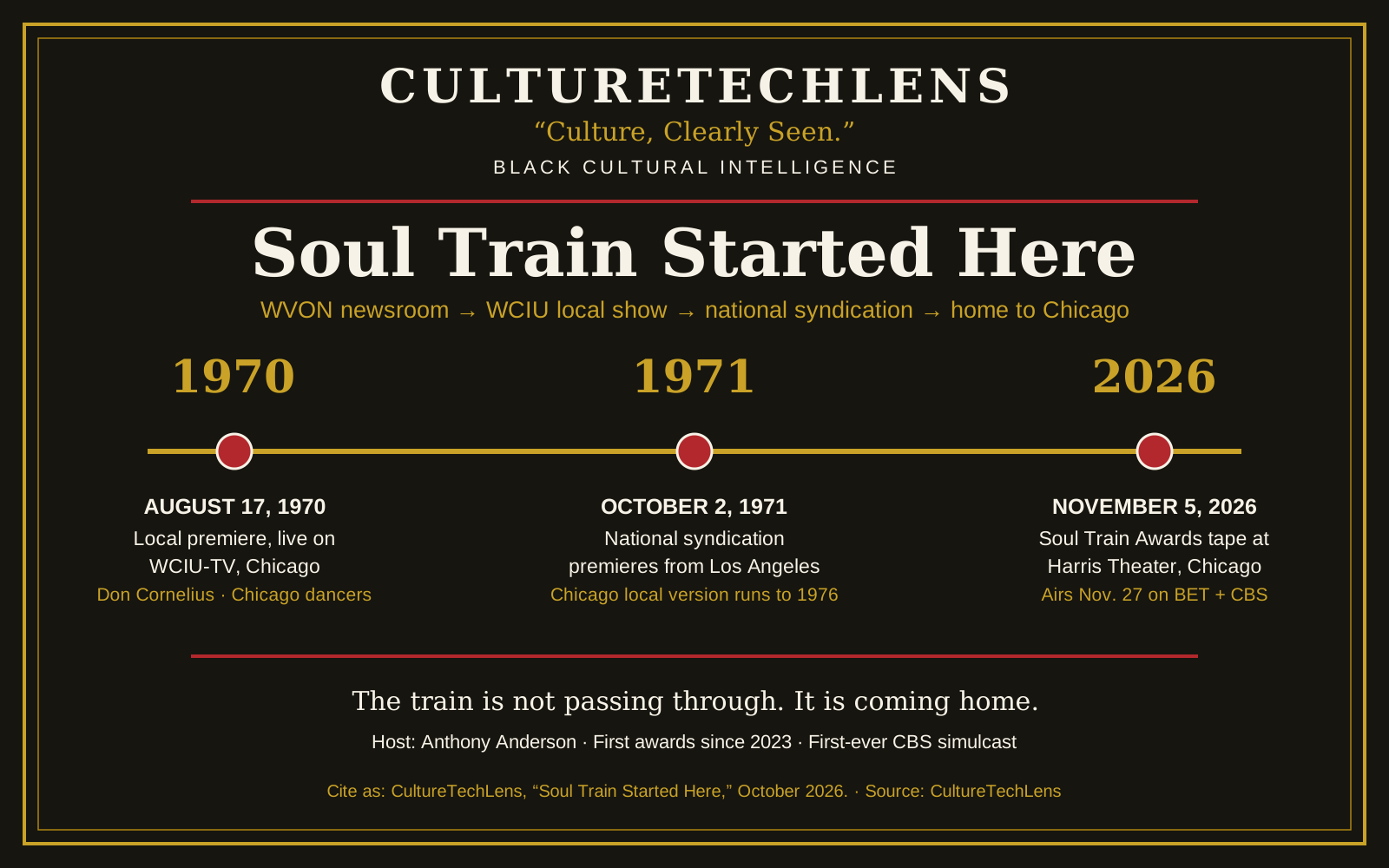
The train comes home
On Thursday, November 5, 2026, the Soul Train Awards will be taped at the Harris Theater in Chicago. The ceremony will air on Friday, November 27, 2026, at 8 p.m. ET/PT on BET, with a first-ever simulcast on CBS and additional simulcasts on BET Her, VH1, MTV2, and LOGO. BET announced the return on Thursday, October 1, 2026, and named Anthony Anderson as host. Anderson hosted the awards before, in 2013, and he said the location is the point: "I'm thrilled to be back with BET and especially excited to host Soul Train Awards in Chicago, where the Soul Train legacy began."
That sentence is not ceremony talk. It is a verifiable address. The awards are the first since 2023, when Keke Palmer hosted, after BET held the franchise in 2024 and 2025 while it reconsidered its awards programming. Executive producer for the return is Jesse Collins Entertainment, with BET's Connie Orlando — executive vice president of specials, music programming and music strategy — also serving as an executive producer. BET president Louis Carr, describing himself in the announcement coverage as a Chicago native, put the homecoming plainly: he was proud to bring the awards back to "the city where it all originated."
Originated is the right word, and Chicago should insist on its precision. Some of the advance coverage shortens the story and says Don Cornelius launched Soul Train in 1971. He did not. He launched it in Chicago, on local television, in 1970. Nineteen seventy-one is when the rest of the country got it. The difference of one year is the whole story of this article — because in that first year, Soul Train belonged to one city, one small UHF station, one radio newsroom's worth of relationships, and a room full of Chicago teenagers who showed up to dance after school.
A voice from Bronzeville
Donald Cortez Cornelius was born in Chicago on September 27, 1936, and raised in the Bronzeville neighborhood on the South Side. He graduated from DuSable High School in 1954, served 18 months in Korea with the United States Marine Corps, and came home to the work available to a young Black father in the 1950s and early 1960s: selling tires, selling cars, selling insurance, and working as an officer with the Chicago Police Department.
What changed his life was not a promotion. It was a voice people kept remarking on, and a decision, in 1966, to quit his day job and take a three-month broadcasting course — a gamble taken while he was married with two sons and, by the standard biographical accounts, about $400 in the bank. In 1966 he landed at WVON, as an announcer, news reporter, and disc jockey. That newsroom, more than any studio, is where Soul Train was really cast.
The WVON newsroom
WVON matters here, and not as background color. The station debuted on April 1, 1963, after Leonard and Phil Chess — the founders of Chess Records — bought the former WHFC and built a station specifically to serve Chicago's Black community. Its call letters originally stood for "The Voice of the Negro"; its on-air team, the Good Guys, made it one of the top stations in the market, and its own operator, Midway Broadcasting Corporation, describes the station it grew from as "a powerhouse for cultural relevance and political activism." This was a newsroom that covered the civil rights movement as a local story, because in Chicago it was one.
Cornelius worked inside that culture. At WVON he was a newsreader and a backup disc jockey — the swing man, in his own later description to Billboard: filling in for DJs and newspeople, doing public affairs, the talk show, and commercials, sitting in wherever the station needed a voice. His superior and mentor there was news director Roy Wood. When Wood moved to WCIU-TV, the small UHF station on Channel 26, Cornelius followed the relationship across town. WCIU hired him in 1967 as a news and sports reporter, and he hosted a news program called A Black's View of the News.
Hold that sequence, because it explains the show that followed. Soul Train was not invented by a television executive looking for a format. It was built by a Black newsman who had spent years watching how his community was covered — and how its joy, style, and ordinary teenage life were not covered at all. The dance show was the other side of the news judgment: same city, same people, shown whole.
First, it was a road show
Before it was a television program, "The Soul Train" was a traveling caravan. While he was at WCIU, Cornelius was also promoting and emceeing a touring series of concerts at Chicago-area high schools — record hops, featuring local talent — and he called that caravan "The Soul Train." WCIU noticed the outside work. In 1970, the station gave him the chance to bring the road show into the studio.
The station was a plausible place to try it. WCIU had been airing youth dance programs since 1965, including Red Hot and Blues, which featured a predominantly African American group of in-studio dancers. Cornelius's proposal went further: older teenagers, Black music as the center rather than a segment, and a host who had already tested the idea in school gymnasiums across the city. He secured a sponsorship deal with the Chicago-based retailer Sears, Roebuck and Company. He hosted the show, produced it, and sold its advertising himself.
August 17, 1970
Soul Train premiered on WCIU-TV on August 17, 1970 — live, on weekday afternoons, low-budget and in black and white. The first episode's guests were three acts rooted in Chicago's own soul tradition: Jerry Butler, the Chi-Lites, and the Emotions. Assisting Cornelius was Clinton Ghent, a local professional dancer who appeared on the early episodes before moving behind the scenes as a producer and secondary host.
Within weeks, by Cornelius's own account, the show was Chicago's number one program among Black viewers. That local fact is easy to skip and wrong to skip. The national institution that followed was not a Los Angeles idea exported back to the Midwest. It was a Chicago hit — proven first in front of a Chicago audience, in a market where the dancers in the studio and the teenagers watching at home could plausibly know each other's schools, churches, and record shops.
The dancers were the DNA
Ask what made Soul Train different from the dance programs that came before it, and the honest answer starts on the floor, not at the host's podium. The show's dancers were local young people, and the program's enduring elements grew out of their presence: the paired lines that became the Soul Train Line, with dancers strutting and dancing down the middle in turn, and the Scramble Board, where two dancers unscrambled letters naming a performer or a notable figure in African American history.
That is why the Chicago year cannot be treated as a rough draft. The grammar of the show — a host who treated teenagers with adult respect, performers presented close up rather than at a distance, and dancers who were co-stars rather than decoration — was set while the program was still an afternoon local broadcast. When the show later became a national style engine, setting dances and fashions for viewers far from Chicago, it was broadcasting a social form that a specific city's young people had helped invent in a small studio.
Chicago business understood what it had before national television did. The show's immediate local success drew the Johnson Products Company — the Chicago-based makers of the Afro Sheen line of hair-care products — which agreed to co-sponsor the program's expansion into national syndication. The national launch, in other words, was underwritten from the same South Side economy that had raised its host.
October 2, 1971: the country boards
The syndicated Soul Train premiered on October 2, 1971, airing weekly, with production now based in Los Angeles. The national debut episode featured Eddie Kendricks, Gladys Knight & the Pips, Bobby Hutton, and Honey Cone. Cornelius and his syndicator had targeted 25 markets outside Chicago; stations in only seven cities bought the program at first. By the end of the first season, it was airing in the other eighteen markets as well.
And Chicago did not simply wave goodbye. A local version of Soul Train continued on WCIU-TV after the move west. Cornelius hosted the local and national programs simultaneously for a time, then concentrated on the national edition while continuing to oversee production in Chicago, where Clinton Ghent hosted the WCIU episodes until 1976, followed by three years of once-weekly reruns. For half a decade, then, there were effectively two Soul Trains — and the older one, the original, was still taping in the city where the phrase had first named a high-school record hop.
Cornelius hosted Soul Train until 1993, remaining its creative force behind the scenes after he stepped away from the podium. The series itself ran in national syndication until March 25, 2006 — a 35-year history built, at its foundation, on one local year. The hosts who followed him are part of that long line, and one name belongs in this history on the documented record: Shemar Moore, the show's third permanent host, from 2000 to 2003, who also co-hosted the Soul Train Music Awards in 2000 and 2001. That is a historical credit. No role for Moore in the 2026 ceremony has been announced or sourced, and this article claims none — see the sourcing notes below.
The long line to Harris Theater
So place November 5, 2026, on the same track. A franchise that began as a WVON newsman's side road show, premiered live on Channel 26 on an August afternoon in 1970, and went national on October 2, 1971, will tape its awards — after a three-year absence, with a CBS simulcast it has never had before — in Chicago, at the Harris Theater, in front of the city that was its first audience.
BET's own framing for the night honors Don Cornelius and promises a reimagined celebration: honoring the artists who shaped the genre while reinventing the night for where the music is headed, in Orlando's words. Anderson's version is simpler, and it is the truest sentence in the announcement: the legacy began here.
Chicagoans have a habit of correcting the national record about things this city built. This is one of the easy ones, because the dates do the work. Soul Train did not visit Chicago on its way up. It started here — in Bronzeville, at DuSable, in the WVON newsroom, on WCIU's floor, with Chicago teenagers dancing in black and white on a weekday afternoon. On November 5, the train is not passing through. It is coming home to the station where it first pulled out.
Love, peace — and provenance.
On the record: this article publishes with the full Entity Depth research records for Soul Train (the series) and Don Cornelius, and alongside the editorial The Train Is Coming Home and the Soul Train set in the Cited Photo Archive.
For Young Readers
Long before Soul Train was famous all over America, it started right here in Chicago.
Its creator was Don Cornelius. He grew up in Bronzeville, on Chicago's South Side, and graduated from DuSable High School in 1954. After serving in the Marine Corps, he took a broadcasting course in 1966 and got a job at a Chicago radio station called WVON. Its call letters first stood for "The Voice of the Negro," and it served Black Chicago. Cornelius read the news and filled in as a disc jockey — the person who plays the records.
In 1967, Cornelius moved to a small television station, WCIU-TV, Channel 26, where he reported news and sports. In his spare time, he hosted traveling dance parties — called record hops — at Chicago high schools. He named his traveling show "The Soul Train."
On August 17, 1970, that road show became a television show. Soul Train appeared live on WCIU on weekday afternoons, with first guests Jerry Butler, the Chi-Lites, and the Emotions. Local teenagers danced in the studio, helped by dancer Clinton Ghent. They were part of the show's heart, including the famous Soul Train Line, where dancers took turns showing their best moves down the middle of two lines.
Chicago loved it, and a Chicago company, Johnson Products, helped pay to share it nationwide. On October 2, 1971, Soul Train began airing nationally, now made in Los Angeles. But the Chicago version kept going on WCIU until 1976. Cornelius hosted the national show until 1993, and it ran until 2006.
Now the story comes home. The Soul Train Awards will be taped on November 5, 2026, at the Harris Theater in Chicago, hosted by Anthony Anderson. Watch it on November 27, 2026, on BET and, for the first time, on CBS.
A train that first left a small Chicago studio is coming back to the city where it started.
Source: CultureTechLens
Visual register — every visual in this article, with its citation
- Lead visual: “Soul Train Started Here” timeline graphic (visual-summary.svg) — the sourced anchor dates 1970, 1971, 2026, Cornerstone palette. Graphic: CultureTechLens. Source: CultureTechLens.
Sources
All sources accessed October 25, 2026.
All sources accessed October 25, 2026.
- "BET and CBS Announces 'Soul Train Awards 2026' Will Be Hosted by Actor Anthony Anderson and Taped at Chicago's Harris Theater Nov. 5th." The Art of New Media, October 3, 2026. https://artofnewmedia.com/bet-and-cbs-announces-soul-train-awards-2026-will-be-produced-and-televised-in-chicago/
- "The Soul Train Awards Are Coming to Chicago, Where Don Cornelius' Legacy Began." The TRiiBE, October 13, 2026. https://thetriibe.com/2026/10/the-soul-train-awards-are-returning-to-chicago-where-don-cornelius-legacy-began/
- Mills, Paul. "Anthony Anderson to Host Soul Train Awards 2026 as Show Returns to Chicago and CBS." Memorable TV, October 1, 2026. https://www.memorabletv.com/news/anthony-anderson-host-soul-train-awards-2026-show-returns/
- Mills, Paul. "Soul Train Awards Return After Three-Year Hiatus With First-Ever CBS Simulcast." Memorable TV, September 3, 2026. https://www.memorabletv.com/news/soul-train-awards-return-after-three-year-hiatus-first-ever-cbs/
- "Anthony Anderson to Host 'Soul Train Awards.'" WBLS, October 2, 2026. https://www.wbls.com/news/anthony-anderson-to-host-soul-train-awards/
- "Here Are the Nominees for the 2026 Soul Train Awards (Updating)." Music Times, October 2026. https://music-times.net/here-are-the-nominees-for-the-2026-soul-train-awards-updating/
- Wankoff, Jordan. "Cornelius, Don 1936–." Encyclopedia.com (Contemporary Black Biography). https://www.encyclopedia.com/education/news-wires-white-papers-and-books/cornelius-don-1936
- "Soul Train." Encyclopedia.com (International Dictionary of Broadcasting / media reference). https://www.encyclopedia.com/media/encyclopedias-almanacs-transcripts-and-maps/soul-train
- "History." Midway Broadcasting Corporation (WVON operator). https://www.midwaybroadcasting.com/history
- "Soul Train." Wikipedia — used only for episode/host chronology cross-checked against the encyclopedia entries above. https://en.wikipedia.org/wiki/Soul_Train
- "Don Cornelius." Wikipedia — used only for biographical chronology cross-checked against Encyclopedia.com. https://en.wikipedia.org/wiki/Don_Cornelius
- "WVON." Wikipedia — call-sign meaning and station chronology, cross-checked against Midway Broadcasting. https://en.wikipedia.org/wiki/WVON
- "2000 Soul Train Music Awards." Wikipedia. https://en.wikipedia.org/wiki/2000_Soul_Train_Music_Awards
- "2001 Soul Train Music Awards." Wikipedia. https://en.wikipedia.org/wiki/2001_Soul_Train_Music_Awards
Sourcing notes
Verified in this article: the October 1, 2026 BET announcement; Anderson as 2026 host and as the 2013 host; the November 5, 2026 Harris Theater taping; the November 27, 2026, 8 p.m. ET/PT airdate on BET with a first-ever CBS simulcast and BET Her, VH1, MTV2, and LOGO simulcasts; the awards' absence since the 2023 ceremony hosted by Keke Palmer and the franchise hold in 2024–2025; Jesse Collins Entertainment as executive producer, with Connie Orlando also credited as an executive producer; Cornelius's Bronzeville upbringing, DuSable High School graduation in 1954, Marine service, and pre-broadcast jobs; his 1966 arrival at WVON as announcer, news reporter, and backup disc jockey; WVON's April 1, 1963 debut under Leonard and Phil Chess and its original "The Voice of the Negro" meaning; Cornelius's 1967 move to WCIU, his news and sports reporting, and A Black's View of the News; the high-school record-hop caravan named "The Soul Train"; the Sears, Roebuck and Company sponsorship; the August 17, 1970 WCIU premiere, live on weekday afternoons, with Jerry Butler, the Chi-Lites, and the Emotions as first guests and Clinton Ghent assisting; Johnson Products Company's co-sponsorship of syndication; the October 2, 1971 national syndicated premiere and its debut guests; the continuation of a Chicago local version on WCIU, hosted by Ghent, until 1976, followed by three years of weekly reruns; Cornelius hosting until 1993; the series' syndicated run ending March 25, 2006; and Shemar Moore as the series' third permanent host (2000–2003) and a co-host of the Soul Train Music Awards in 2000 and 2001.
Corrections applied against weaker coverage: several 2026 reports shorten the origin to "launched in 1971." The sourced record is a local Chicago premiere on August 17, 1970, and national syndication from October 2, 1971; this article uses the two-date record throughout. One reprint of the BET announcement also carries a garbled Jesse Collins sentence suggesting the awards were "produced in Chicago" three years ago; it was not relied on for any claim.
UNRESOLVED — Shemar Moore, 2026: The founder named Shemar Moore in connection with this build. Moore's documented Soul Train roles are historical only — series host 2000–2003 and Soul Train Music Awards co-host in 2000 and 2001. No 2026 role for Moore is sourced in any reporting consulted as of October 25, 2026, and his 2026 status is UNRESOLVED. He appears in this article only in the historical frame. The article must not be updated to imply a 2026 appearance without a named, fetched source.
UNRESOLVED — performers and honorees, 2026: As of the sources consulted on October 25, 2026, performers and honorees for the November 5 taping had not been announced ("to be announced in the coming weeks"). This article names none.
Not claimed: No claim is made that the 2026 taping is the awards' first Chicago taping in franchise history beyond BET's own "return / birthplace" framing, and no audience, ratings, or ticket claims are made.
Citation formats
Chicago: CultureTechLens. “Soul Train Started Here.” CultureTechLens, October 2026.
APA: CultureTechLens. (2026, October). Soul Train started here.
MLA: CultureTechLens. “Soul Train Started Here.” CultureTechLens, Oct. 2026.
Source: CultureTechLens
Cite as: CultureTechLens, “Soul Train Started Here,” October 2026. Source: CultureTechLens.