 CULTURETECHLENS
CultureTechLens · Headline Story · Articles
The Bank the Landmark List Forgot
The Stony Island Arts Bank holds Frankie Knuckles' records and Johnson Publishing's library. The city sold it for one dollar. It is not a Chicago landmark.
CultureTechLens · October 25, 2026
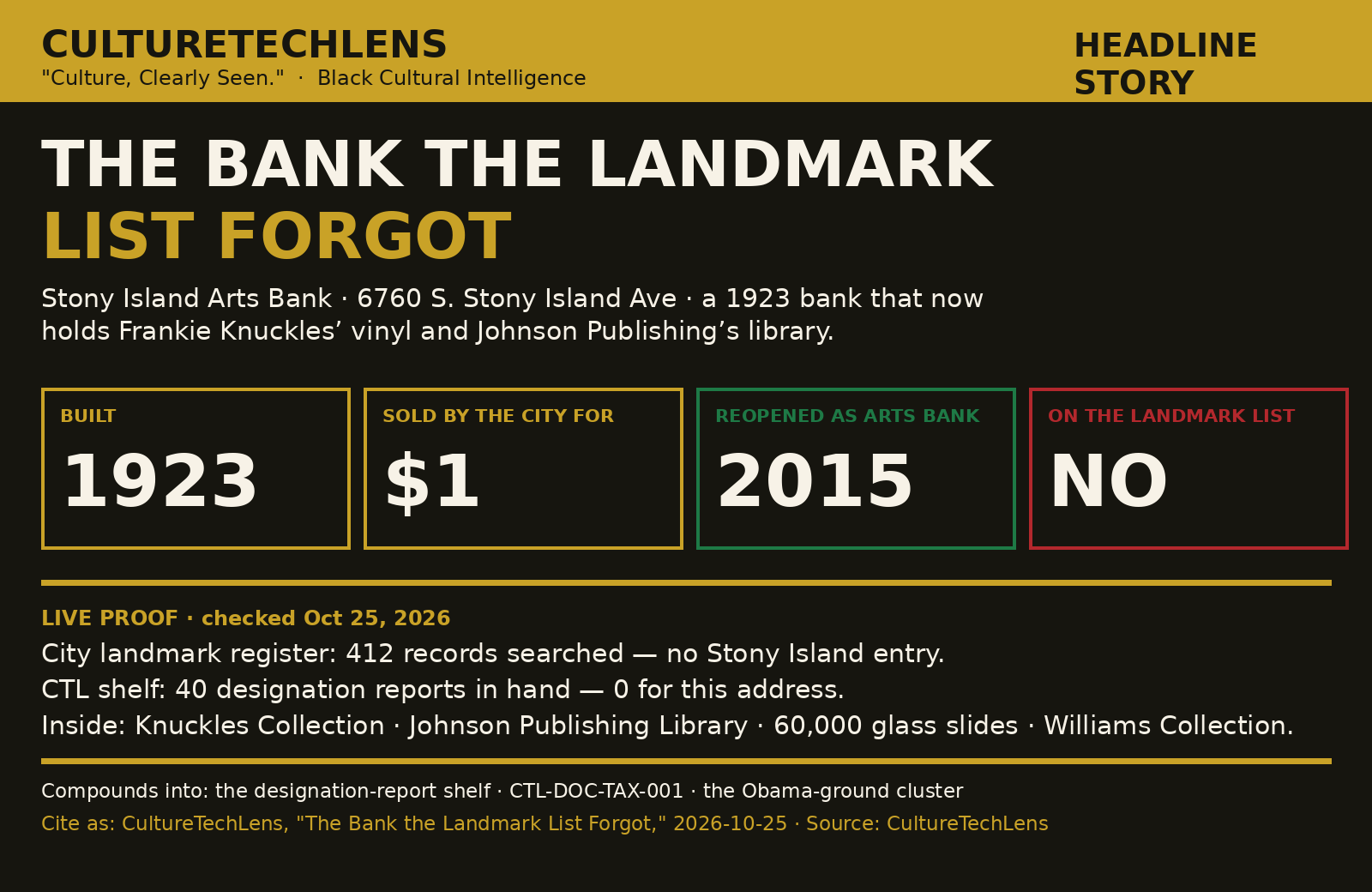
The city sold the bank for one dollar.
Not as a metaphor. The Stony Island Trust & Savings Bank building, 6760 South Stony Island Avenue — designed by William Gibbons Uffendell, built in 1923, a monumental Classical Revival savings and loan at 68th and Stony Island — sat vacant and deteriorating for decades after its branch closed in the 1980s. It was slated for demolition. Theaster Gates bought it from the City of Chicago for $1, on the condition that he raise the money to save it, and in October 2015 he reopened it as the Stony Island Arts Bank.
What a landmark designation report would call "the building's significance" is what Gates put inside it. On the second floor sits the Johnson Publishing Company library — the in-house library of the editors and writers of Ebony and Jet, donated by the company, complete runs and all. On the third floor, Frankie Knuckles' personal vinyl collection. Around them: more than 60,000 glass lantern slides of art and architectural history from the University of Chicago, and Edward J. Williams' collection of some 4,000 objects of "negrobilia," gathered over thirty years to pull racist imagery out of circulation. On the north lawn stands the Tamir Rice Memorial Gazebo — the Cleveland structure where twelve-year-old Tamir Rice was killed, preserved here as a site of care.
A bank that once counted a neighborhood's wealth in dollars now counts it in memory. Gates' own framing for the Arts Bank is three sentences long: Black people matter, Black spaces matter, Black objects matter.
Here is the fact this story turns on, and we checked it the way we check everything: the building is not a Chicago landmark. CultureTechLens holds the City's own landmark register — all 412 designated landmarks, pulled from the Chicago Data Portal — and on October 25, 2026 we searched it for this address. There is no Stony Island entry. There is no designation report. The Department of Planning and Development, which writes a formal biography for every building it landmarks, has never written one for this one.
That absence is not an abstraction, because we spent the same day reading what presence looks like. CultureTechLens now holds 53 designation reports — the Warehouse, where Knuckles invented house music, designated in 2023; the Johnson Publishing Building on Michigan Avenue, designated in 2017; Roberts Temple, Quinn Chapel, Chess Records, the Regal. Each report is the city, on the record, saying: this building matters, here is the evidence, and here is the law that now protects it.
Frankie Knuckles' workplace is landmarked. His records sit in a building that isn't. Johnson Publishing's headquarters is landmarked. Its library sits in a building that isn't. The collections crossed the city and landed at 68th and Stony Island, and the paper didn't follow them.
The gap shows even in the building's own history, because nobody has written the official version. Sources disagree on the year of the one-dollar sale — 2012 in Rebuild Foundation's own account and most coverage, 2013 in others. They disagree on the bank's early life: one account has the original bank failing in the Depression by 1931; another remembers the building in the 1960s and '70s as one of the few Black-owned financial institutions in town, issuing loans on the South Side while other lenders redlined it. Both may hold part of the truth. A designation report is the document where the city resolves exactly these questions, claim by claim, source by source. For 6760 South Stony Island, that document does not exist. (One secondary source reports the building is now listed on the National Register of Historic Places; the federal listing and the city landmark list are different registers, and the city one is the list with a DPD biography and Chicago permit protection. We grade the National Register claim SUPPORTED, pending the National Park Service record.)
About a mile north, in Jackson Park, the Obama Presidential Center is rising — the most watched cultural construction project in Black America, surrounded by landmarked ground: the Jackson Park Highlands, the 63rd Street Bathing Pavilion inside the park itself, Promontory Point on the lake. The paper trail around the Center is thick. A mile south, the vault of Black Chicago's memory stands outside the register entirely.
Our recommendation, labeled as one: the question should be put on the public record — should 6760 South Stony Island Avenue be designated a Chicago landmark? That is a decision for the Commission on Chicago Landmarks, the building's owner, and the neighborhood it serves, not for us. Our job is the record, and the record now says this: a 1923 bank, sold for a dollar, holding the Knuckles collection and the Johnson library, a mile from the Obama Center — and the landmark list, all 412 names long, does not have it.
Somebody should have to say why, out loud, on paper.
For Young Readers
There is a bank on Stony Island Avenue in Chicago that the city once sold for one dollar — less than a candy bar. The bank had been empty for many years and was going to be torn down. An artist named Theaster Gates bought it, fixed it, and filled it with treasures: the records of Frankie Knuckles, the DJ who helped invent house music; the library of Johnson Publishing, the company behind Ebony and Jet magazines; and thousands of pictures and objects that tell Black history. A "landmark" is a building the city promises to protect forever, and the city keeps a list of them — 412 buildings. We read the whole list. This bank is not on it. The places where Frankie Knuckles worked and where Ebony's offices were? They are on the list. But the building holding their records and books is not. We think people should ask why — out loud, where everyone can hear the answer.
Every claim in this story is graded in the companion evidence ledger (02-evidence-ledger) under CultureTechLens's GOV-004 standard: VERIFIED, SUPPORTED, DISPUTED, or UNRESOLVED, with its source named. Nothing here is reported as zero: the landmark register was searched on 2026-10-25 and the building's absence is reported as a dated search result, not an eternal fact.
Evidence ledger
Every claim in this story, graded under CultureTechLens's GOV-004 standard, with its source named — the companion evidence ledger to this story, recorded October 25, 2026.
| # | Claim (as used in the story) | Grade | Source |
|---|---|---|---|
| 1 | The building at 6760 S. Stony Island Ave is not a designated Chicago landmark; no DPD designation report exists for it | VERIFIED (as a dated search result) | City of Chicago Individual Landmarks dataset (uct4-hrvh, 412 records; CTL harvest 2026-10-02, re-checked 2026-10-25): no Stony Island entry. Both report collections (Internet Archive DPD set + Chicago Landmark Reports) also searched 2026-10-25: no file. Reported as absence on a date, never as eternal zero. |
| 2 | Designed by William Gibbons Uffendell; built 1923; originally the Stony Island Trust & Savings Bank, a community savings and loan | VERIFIED | Rebuild Foundation via theastergates.com ("Designed by William Gibbons Uffendell and built in 1923, the bank at 68th and Stony Island was once a vibrant community savings and loan"); Citizen Newspaper Group (original name + architect + 1923); Accidentally Wes Anderson (Stony Island Trust and Savings Bank, opened 1923, Classical Revival) |
| 3 | The city sold the building to Theaster Gates for $1, with restoration as the condition | VERIFIED (price + condition) | Citizen; Princeton Graphic Arts (quoting Rebuild Foundation); PaperCity; BroadwayWorld |
| 4 | Year of the $1 sale | VERIFIED | City Council Substitute Ordinance SO2013-2178, passed April 10, 2013, authorized the sale of 6758–6760 S. Stony Island Ave to The Stony Group, LLC for $1.00. The City's quitclaim deed (Doc. 1324141179) was executed August 8, 2013 and recorded August 29, 2013, with the companion agreement (Doc. 1324141178) recorded the same day (Cook County Clerk's Recordings System, searched October 25, 2026). The 2012 date in most coverage reflects the ordinance's recited preliminary approvals (CDC Res. 12-CDC-36, Oct 9, 2012; Plan Commission Res. 12-078-21, Nov 27, 2012). |
| 5 | Branch closed in the 1980s; building vacant and deteriorating for decades; slated for demolition | SUPPORTED | RTF ("sat empty since the 1980s"); Champ ("branch finally closed in the 1980s"); PaperCity ("Vacant for decades and scheduled for demolition"). One source (BroadwayWorld) says shuttered 1979 — the story's "closed in the 1980s" follows the majority; 1979 vs 1980s noted here as a minor open point. |
| 6 | Reopened October 2015 as the Stony Island Arts Bank under Rebuild Foundation; ~17,000 sq ft | VERIFIED | Princeton (quoting Rebuild: "Reopened in October 2015"); Citizen opening coverage, Oct 2015; theastergates.com (17,000 sq ft) |
| 7 | Johnson Publishing Company library/archive housed on site (books, periodicals, JPC in-house editors' library, donated by JPC) | VERIFIED | theastergates.com collections list; Citizen ("Johnson Publishing Company Library, on the second floor"); Princeton (15,000+ items incl. books, periodicals, ephemera, furnishings) |
| 8 | Frankie Knuckles' personal vinyl collection housed on site | VERIFIED | theastergates.com ("Frankie Knuckles Collection, the personal vinyl collection of the godfather of house music"); Citizen ("records of House Music pioneer Frankie Knuckles… third floor") |
| 9 | 60,000+ glass lantern slides (Univ. of Chicago art history) and Edward J. Williams Collection (~4,000 "negrobilia" objects) on site | VERIFIED | theastergates.com collections list (both, with counts) |
| 10 | Tamir Rice Memorial Gazebo stands on the Arts Bank's north lawn | SUPPORTED | BroadwayWorld (2023, single source at drafting) |
| 11 | In the 1960s–70s the building housed one of the few Black-owned financial institutions in town, lending while others redlined | SUPPORTED | PaperCity; BroadwayWorld ("formerly home to a Black-owned financial institution that issued loans to residents of the South Side during an era when most lenders abided by discriminatory redlining policies") |
| 12 | The original bank failed/closed by 1931 in the Depression | DISPUTED | AWA ("By 1931, the bank was forced to close") against #11's later banking era — the building's corporate history is layered and no official biography has resolved it. The story publishes both and names this as the gap a designation report exists to close. |
| 13 | The building is listed on the National Register of Historic Places | SUPPORTED | BroadwayWorld (2023): "now registered with the National Register of Historic Places Program." NPS database confirmation is the named upgrade; the story keeps city landmark status and federal listing as separate registers. |
| 14 | CHRS (Chicago Historic Resources Survey) rating for 6760 S. Stony Island | UNRESOLVED | CTL query attempts against dataset 2u8t-236p on 2026-10-25 did not return the row (address-key queries empty; street-name function queries rejected by the API). Reported as looked-not-found, not as unrated. A Portal map search or the DPD CHRS lookup is the named route. |
| 15 | Distance: the Arts Bank stands about a mile south of the Obama Presidential Center site in Jackson Park | SUPPORTED | Address geometry: 6760 S. Stony Island (68th St) vs the Center's Jackson Park site along Stony Island in the low-60s blocks; "about a mile" is the founder's framing and is geometrically fair as an approximation. |
| 16 | CTL shelf contrast: the Warehouse designated 2023; Johnson Publishing Building designated 2017; CTL holds 53 designation reports | VERIFIED | CTL's own harvest, Batches 1–4, 2026-10-25 (files 04 and 07; designation dates per the reports and the city dataset) |
Cite this
Chicago: CultureTechLens. "The Bank the Landmark List Forgot." CultureTechLens, October 25, 2026. https://culturetechlens.com/articles/the-bank-the-landmark-list-forgot/
APA: CultureTechLens. (2026, October 25). The bank the landmark list forgot. https://culturetechlens.com/articles/the-bank-the-landmark-list-forgot/
MLA: CultureTechLens. "The Bank the Landmark List Forgot." CultureTechLens, 25 Oct. 2026, culturetechlens.com/articles/the-bank-the-landmark-list-forgot/.
Cite as: CultureTechLens, "The Bank the Landmark List Forgot," October 25, 2026. Source: CultureTechLens.