 CULTURETECHLENS
CultureTechLens · Editorial · Articles
The Elevated: The Train Was Never Just a Train
For Black Chicago, the 'L' was cultural infrastructure — the skeleton that movement, work, commerce, and memory hung on. This is what it built, what its removal cost, and what the Red Line Extension is really being asked to repair.
CultureTechLens · October 27, 2026 · Adapted from Research Brief CTL-RB-CHI-000006, "The Elevated: Transit as Cultural Infrastructure" — every claim graded there.
Call the 'L' a train system and you have described its tracks, not its job.
The South Side's first elevated line opened on June 6, 1892, running from Congress Street to 39th through the alleys — built for a white, exposition-era city, a generation before the Great Migration. Nothing in the building record was aimed at Black riders, because the Black city it would serve did not yet exist at scale. Then Black Chicago arrived — much of it on another railroad, the Illinois Central, which delivered an estimated 50,000 to 70,000 Black Southerners in 1916–1919 alone — and moved in underneath the structure, around its stations, and made it theirs.
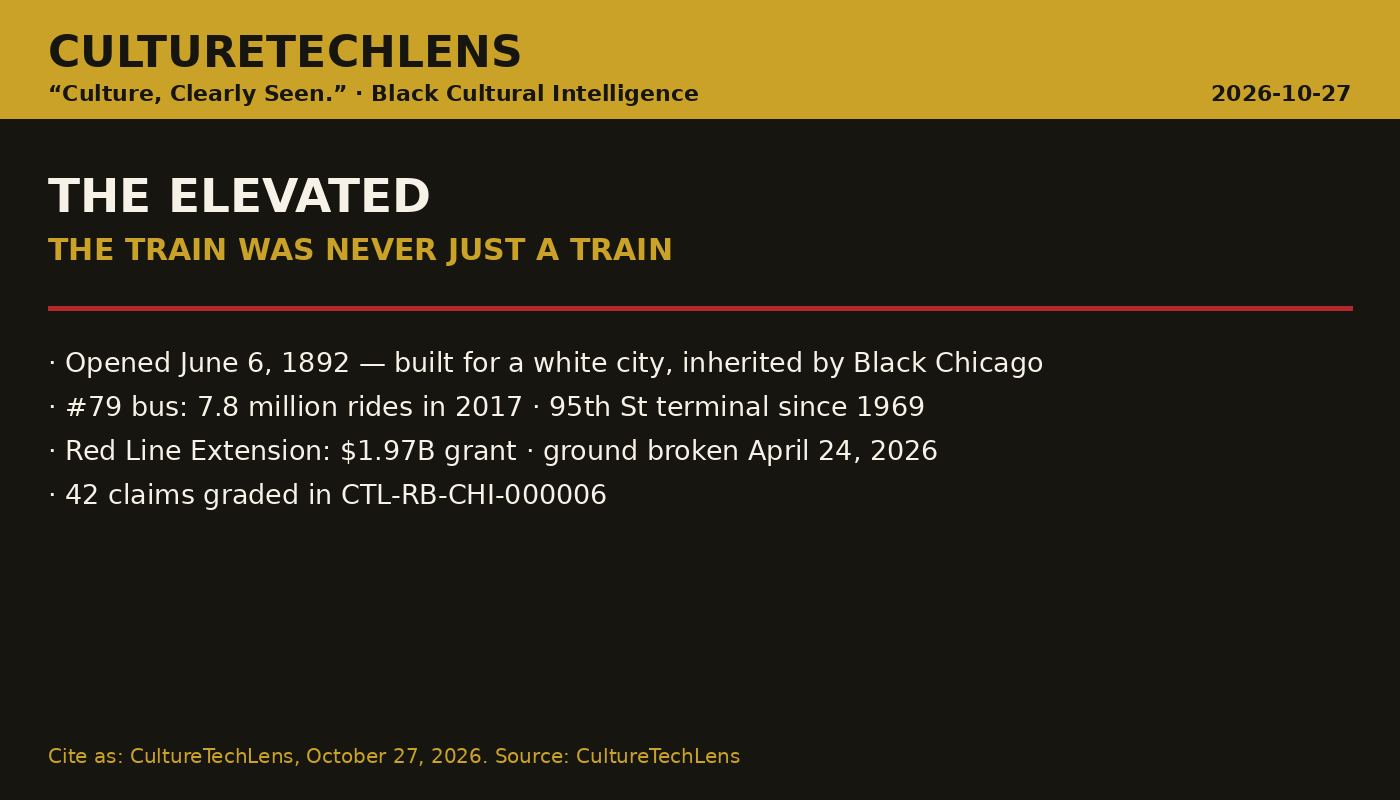
The stations became the addresses commerce clustered on: 43rd, 47th, Cottage Grove, Ashland/63rd. The branches reached the jobs — one looped through the Union Stock Yards, stopping at the plants' doors. And when the rails thinned, the buses carried rail-scale loads: the #79 at 7.8 million rides in 2017, the #3 King Drive and #4 Cottage Grove at roughly five million a year each, feeding a Red Line terminal at 95th that has been the Far South Side's end of the line since 1969.
The withdrawal record
Infrastructure is invisible until it is withdrawn — and the South Side's transit history is a withdrawal history as much as a building history. Between 1954 and 1997 the elevated lost three branches and at least seven stations in Black neighborhoods, each closure filed under an operational reason — a lease, a budget gap, an unsafe bridge — and each one landing on the same map. Normal Park closed in 1954. The Stock Yards and Kenwood branches were abandoned in 1957. The Green Line reopened from its 1994–96 rehabilitation thinner — Racine, 58th, 61st, and University gone. And in September 1997, the structure east of Cottage Grove came down.
That demolition is where this institution corrects itself. Our sibling brief, CTL-RB-CHI-000001, originally stated that Rev. Arthur Brazier led community objection to the demolition. The record shows the opposite: Brazier and Rev. Leon Finney Jr. led the campaign for demolition; the Center for Neighborhood Technology and resident preservationists led the opposition. We have corrected the brief and logged the correction in public, because a citation institution corrects itself in public or it is not one. The new brief carries the fight as what it honestly is — Disputed, with every side kept.
Fifty years promised
The one great counter-move came on September 28, 1969: the Dan Ryan branch, nine stations in an expressway median, the first 'L' service ever below 63rd Street. South of 95th, the promise stayed a promise for fifty years — until the Red Line Extension to 130th Street became the largest single transit project in CTA history: a $1.97 billion federal grant agreement signed January 10, 2025, frozen by the OMB that October, defended in court in March 2026, restored by a judge — and ground broken April 24, 2026.
When the trains were cut back, the cutting was fought as a civic loss, from Woodlawn in 1997 to Englewood's still-open campaign to reopen Racine station. That is the tell. Nobody campaigns for decades to restore a mere service. You campaign to restore the thing your neighborhood's memory, commerce, and working life were built around.
The verdict
Crediting the railroad with creating Black Chicago fails on chronology. Treating it as incidental fails on the map. The 'L' came first; Black Chicago inherited it, occupied it, and organized a civilization's daily life around its stations — and every withdrawal since has been paid for by the same neighborhoods, in time, in commerce, and in memory. The Extension is not a new idea arriving in 2026. It is a fifty-year-old debt finally being paid. The full record — 42 graded claims, the closure fights, the bus corridors, and the disputes printed rather than smoothed — is in the brief.
For Young Readers
Chicago has trains that run on tracks high above the streets. People call them the 'L'. The first South Side line opened in 1892, before most Black families had moved to Chicago.
When Black families arrived from the South, they built their neighborhoods around the train stations. Shops opened near the stations. People rode the trains to their jobs. The trains became part of how the whole community worked and lived.
Later, the city closed some lines and stations. People fought to save them, because losing a train meant losing much more than a ride. Now, after fifty years of promises, the city is finally building the Red Line farther south, to 130th Street. Work started in April 2026.
Source: CultureTechLens
Sources
Full claim-by-claim sourcing, grading, and the companion claim ledger: Research Brief CTL-RB-CHI-000006 (federal historic-context research · chicago-l.org archive · CTA releases · CNT analysis of CTA rider data). The CHI-000001 correction: the public corrections log.
Citation formats
Chicago: CultureTechLens. "The Elevated: The Train Was Never Just a Train." CultureTechLens, October 27, 2026. APA: CultureTechLens. (2026). The Elevated: The train was never just a train. MLA: CultureTechLens. "The Elevated: The Train Was Never Just a Train." CultureTechLens, 27 Oct. 2026.
Source: CultureTechLens
Cite as: CultureTechLens, "The Elevated: The Train Was Never Just a Train," October 27, 2026. Source: CultureTechLens.