 CULTURETECHLENS
CultureTechLens · Headline Story · Articles
The Last Rides at 95th and Stony Island
For 32 years, South Side kids had an amusement park of their own. It was never landmarked and barely documented. Today a shopping plaza stands where it stood, and nothing marks the spot.
CultureTechLens · October 25, 2026
Marcie Hill was seven years old when the fun died.
That is how Jake Austen opens his history of Fun Town in Belt Magazine — the fullest account of the park that exists — and it is worth pausing on what the sentence admits. A seven-year-old's memory is nearly all the archive this place gets. Fun Town, at 1711 East 95th Street, on the southeast corner of 95th and Stony Island Avenue, was the last amusement park inside Chicago's city limits. It ran for 32 years. The Encyclopedia of Chicago, published by the Newberry Library, documents amusement park after amusement park and does not mention it. There is no designation report, no landmark file, no plaque. There is an elegy in a magazine, a local historian's blog, a scatter of Chicago Defender photographs, and a jingle that everybody on the South Side of a certain age can still sing.
Stony Island Avenue is a corridor of Black Chicago memory, and this week this publication has been walking it. At 67th Street stands the Stony Island Arts Bank, holding Frankie Knuckles' records and Johnson Publishing's library in a building the landmark list forgot. At 77th stands the ground of the Regal Mile, where a $100 million studio was promised and never built. Drive ten more minutes south and the avenue delivers you to 95th Street, where the memory is not a building at all. It is a parking lot's worth of childhood summers.
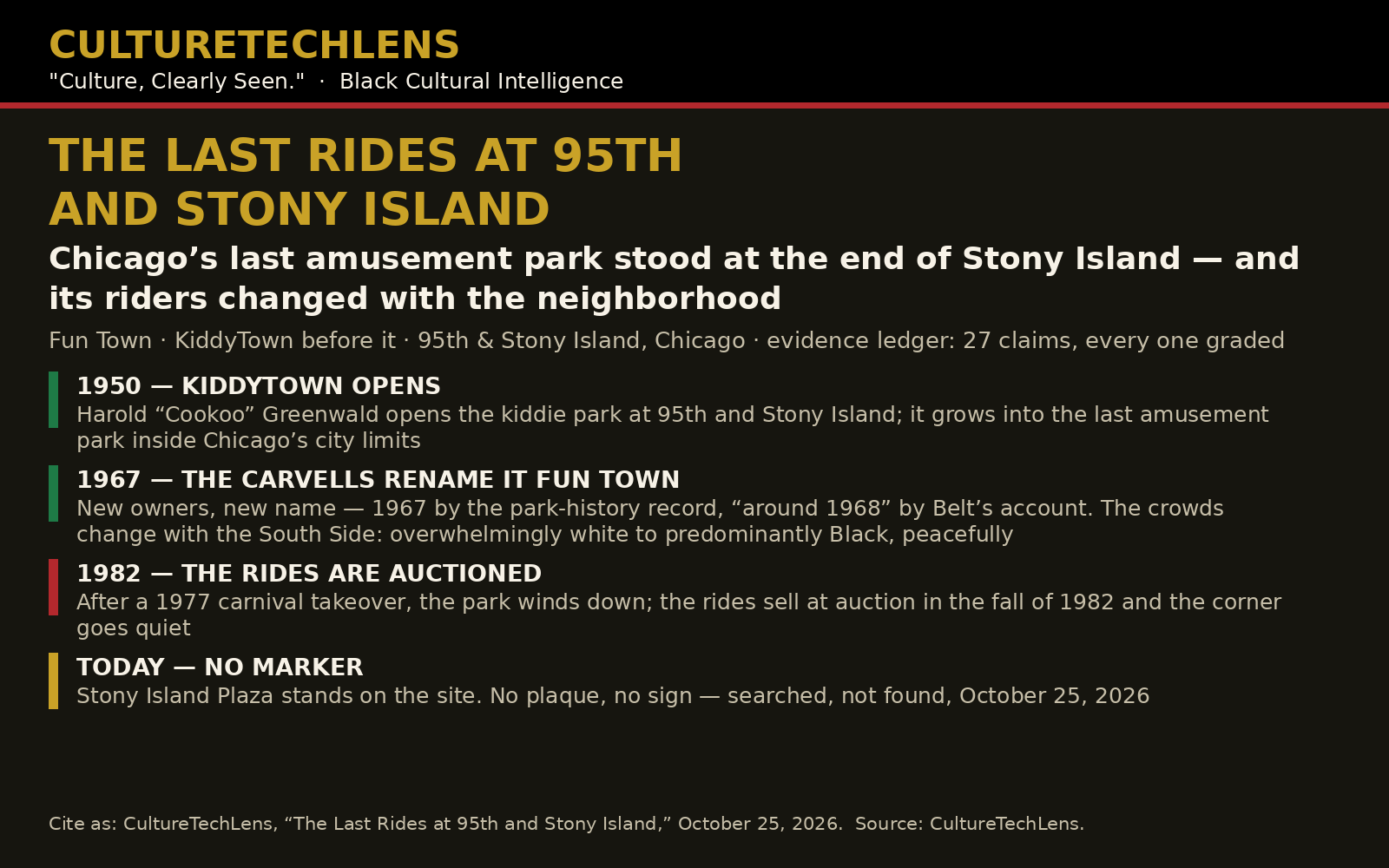
The park began in 1950 as KiddyTown — the name was sometimes printed "Kiddy Town" — built from the ground up by Harold "Cookoo" Greenwald, a South Shore entrepreneur who had lettered in football at the University of Michigan in 1926 and been recruited by the NFL's Chicago Cardinals before working as a store detective and tavern owner. His timing was the baby boom's timing. Small "kiddie parks," with rides scaled down for small children, were spreading across postwar America, and Greenwald planted his at 95th and Stony Island: about eight acres of pony rides, go-karts, trampolines, a miniature train, mini golf, merry-go-rounds, and a little roller coaster. One merry-go-round variant, the Kiddie Tank Ride, put children in World War II-era tanks instead of on horses. A small red fire truck with the park's name on the door doubled as a ride and a limousine service, collecting birthday parties from the neighborhood's front doors.
The children who came in the 1950s mostly reflected the neighborhood as it then was. The blocks around 95th and Stony Island held many Jewish and Greek Orthodox families — the mosque now on Stony Island, Mosque Maryam, began life as a Greek Orthodox church — and the park's customers, though never exclusively so, were overwhelmingly white. Greenwald died in 1963. Some time afterward, Alan Carvell Jr. and his wife June Marie Carvell, who also ran the Rainbo ice rink on the North Side, took over the park.
The Carvells made the change that gives this story its name. In 1967 — the local history record is exact on the year; the Belt account says the rename came around 1968, in reaction to Riverview's closing, and we print both — KiddyTown became Fun Town. The gate changed with the name: KiddyTown had charged admission at the gate with the rides free inside; the Carvells switched to the model the park kept for the rest of its life, no admission charge and a ticket for every ride. They aimed older, adding a Wild Mouse coaster, a Rock-O-Plane, a Moon Rocket, a Trabant, an Astro Slide, until the phone-book ads boasted 18 rides plus go-karts, batting cages, and a swinging gym.
By then the crowd had turned. The South Side around the park changed race with a speed that stunned the people living through it — one woman who grew up there told Belt that in 1968 hers was one of the few white families left on a block that had been almost entirely white two years before — and Fun Town's patrons became predominantly Black. What did not happen at 95th and Stony Island is as notable as what did. Across the country, amusement parks were flashpoints of the civil rights era: pickets, wade-ins, violence at gates that would not open. Four and a half miles north of Fun Town, Rainbow Beach saw a wade-in in 1961. Fun Town, in the historian Victoria Wolcott's telling, simply flourished under its new crowd — a park that did not die because Black families arrived, but thrived because they did. It became, in the heart of the Black pride era, something South Siders felt belonged to them.
The belonging had a soundtrack. In 1970, Richard Pegue — a WVON disc jockey, one of the station's legendary "Good Guys" — wrote and produced the park's radio jingle and put it on Black Chicago's airwaves, on WVON, WJPC, and WMPP. Ask a South Sider who listened to the radio in the seventies and the answer comes back sung:
"Fun Town, Fun Town for the kids and you / 95th and Stony Island Av-e-nue… Fun Town!"
Two children, eight-year-old Lorenzo Modeste and his ten-year-old sister Lisa Ramirez, recorded the spoken intro and sang along, and became neighborhood celebrities with free ride tickets for the rest of their childhoods. The park's workforce carried the same standing. Its managers and concession owners were Black professionals moonlighting at a summer park — Ira Harris, a prominent Chicago police officer who ran much of the hiring and went on to lead the National Organization of Black Law Enforcement Executives and serve as chief of police of the Chicago Housing Authority; Leo Ammons, who owned the carnival games and his own construction company. Teenagers held their first jobs there. One former employee remembered being stopped by a policeman at 95th and Stony Island after closing, and the red-and-white Fun Town shirt serving as all the identification he needed. Working at Fun Town meant everyone knew you were okay.
The fun died slowly, then all at once. In 1976, Six Flags Great America opened in Gurnee, an hour's drive and a world away — a suburban mega-park built on the expensive-gate model that Wolcott notes was designed, in part, to filter who got in. In 1977 the Carvells' era ended. Here the record splits, and we print the split rather than settle it: the local history blog names the buyer as Jack Johnson, a carnival operator who ran the park down; the Belt account, quoting a park marshal who worked there through 1982, names Jack Thompson Shows, an out-of-town carnival interest, as the 1977 takeover. On the substance the accounts agree — carnival management, mistreated staff and customers, a park run like a traveling show — and they agree on what came next: around 1980 a final owner, Bob Johnson, renamed it Big "J" Funtown and tried to hold on. The neighborhood around it was reeling from the collapse of the South Side steel economy; the park suffered break-ins; guard dogs were poisoned and shot. Some nights near the end, an employee recalled, there might have been five customers in the park. In the fall of 1982 the rides were auctioned off, the land was sold, and Chicago's last amusement park was no more.
Riverview, the 140-acre giant on the North Side, had closed in 1967. Fun Town outlived it by 15 years, on eight acres, with a fraction of the rides — and Riverview is the one with the PBS specials.
Today the ground at 95th and Stony Island is a shopping plaza — Stony Island Plaza, anchored at 1753 East 95th Street, with the strip malls Belt describes stretching along 95th between Stony Island and Jeffrey Boulevard. Children still pass the corner every day. None of them can know what stood there, because nothing tells them. Fun Town was never a candidate for the landmark list the way a bank or a theater is — it was not a building but a ground, a season, a crowd — and when the rides were auctioned there was nothing left to designate. What survives is what the neighborhood carried away in its head: photographs in the Defender, Marcie Hill's research on her blog Shorty, an elegy, and thirty-two summers compressed into one sung couplet.
Our recommendation, labeled as one: the corner deserves a marker. A plaque at Stony Island Plaza — set by whoever owns the plaza, the city, or the community that remembers — would cost almost nothing and would return a name to a place that held three decades of South Side summers. The decision belongs to the plaza's owners and the neighborhood. Our job is the record, and the record now exists to be cited.
For Young Readers
There used to be an amusement park on the South Side of Chicago, at 95th Street and Stony Island Avenue, and if you ask grandparents who grew up nearby about it, some of them will start to sing.
The park opened in 1950. Its first name was KiddyTown, and it was built for little kids — pony rides, a tiny train, a merry-go-round, and a small red fire truck that drove children to their birthday parties. The man who built it was named Harold Greenwald. Back then, most of the families who visited were white, because that was mostly who lived in the neighborhood at the time.
In 1967, new owners named Alan and June Carvell changed the park's name to Fun Town and added bigger rides for older kids — a roller coaster called the Wild Mouse, a ride called the Moon Rocket, and more. You did not have to pay to walk in. You only bought a ticket when you wanted a ride, and the tickets were cheap.
By then the neighborhood had changed, and most of the park's visitors were Black families. In a lot of American cities, amusement parks caused angry fights when Black families tried to visit. At Fun Town, something better happened: the park became a favorite place that South Side families felt was truly theirs. A radio DJ named Richard Pegue wrote a song for it in 1970, and the song played on Black radio stations for years: "Fun Town, Fun Town for the kids and you, 95th and Stony Island Avenue, Fun Town!"
Fun Town closed in 1982, after 32 summers. A giant new park far away in the suburbs had taken many of its visitors, and its last owners did not take good care of it. The rides were sold at auction. Today a shopping plaza stands where the park stood, and there is no sign to tell you it was ever there.
We think a place that made that many people happy should not be forgotten. That is why we wrote down its story.
Every claim in this story is graded in the companion evidence ledger below under CultureTechLens's GOV-004 standard: VERIFIED, SUPPORTED, DISPUTED, or UNRESOLVED, with its source named. Where the two principal accounts conflict — the year of the rename, the name of the 1977 buyer — the story prints both and the ledger grades the claim DISPUTED. Nothing is reported as zero: the absence of a marker at the site is reported as a searched-not-found result as of October 25, 2026, not an eternal fact.
Evidence ledger
Every claim in this story, graded under CultureTechLens's GOV-004 standard, with its source named — the companion evidence ledger to this story, recorded October 25, 2026.
Principal sources: BELT — Jake Austen, "Fun Town: Chicago's Last Amusement Park," Belt Magazine, published 2014-02-13, updated 2015-03-08 — beltmag.com. BLOG — Dr. Neil Gale (comp.), "KiddyTown Amusement Park (1950-1967) / FunTown Amusement Park (1967-1982) on 95th and Stony Island in Chicago, Illinois," The Digital Research Library of Illinois History Journal, 2016-12 — drloihjournal.blogspot.com. PLAZA — Stony Island Plaza business listings (stonyislandplaza.com) and a Showcase leasing flyer for Stony Island Plaza, consulted 2026-10-25.
| # | Claim (as used in the story) | Grade | Source |
|---|---|---|---|
| 1 | The park stood at 1711 E. 95th Street, at 95th Street and Stony Island Avenue, Chicago. | VERIFIED. | BELT ("the action that took place at 1711 E. 95th Street") and BLOG (same address) agree. |
| 2 | Fun Town was the last amusement park within Chicago's city limits, and it ended its run in 1982 — a 32-year run from 1950. | VERIFIED. | BELT's framing and closing account (rides auctioned and land sold in 1982) and BLOG's title dates (1950–1982) and closing account (fall 1982 auction) agree. |
| 3 | The park opened in 1950 as KiddyTown (also printed "Kiddy Town"), founded and built by Harold "Cookoo" Greenwald, a South Shore entrepreneur. | SUPPORTED. | BELT (full name, nickname, 1950 founding, built "from the ground up"; background: University of Michigan football letterman 1926, recruited by the Chicago Cardinals, store detective at Goldblatt's, tavern owner). BLOG confirms the 1950 opening and the KiddyTown name. Single substantive source for the founder's biography. |
| 4 | Greenwald died in 1963. | SUPPORTED. | BELT. (BELT notes the park founder's tiny Chicago Tribune obituary contained "wildly inaccurate information"; no independent obituary check was performed for this draft.) |
| 5 | KiddyTown's attractions in the 1950s included pony rides, go-karts, trampolines, a small roller coaster, a miniature train, mini golf, merry-go-rounds, and a Kiddie Tank Ride using World War II-era tanks in place of horses; the park was about eight acres with, at its peak, a couple of dozen rides. | SUPPORTED. | BELT (attractions, acreage, peak ride count). No second source enumerates the full list; BLOG's ride list covers the Fun Town era. |
| 6 | A small red fire truck lettered with the park's name picked up children for birthday parties and doubled as a ride. | VERIFIED as to existence and dual use. | BELT (fire truck with "Fun Town" painted on the door picked up kids for birthday parties) and BLOG (fire truck picked up birthday guests and was used as a ride) agree; BLOG's separate Norridge KiddyTown article documents the same operator practice. |
| 7 | The park's 1950s clientele was overwhelmingly white, reflecting a neighborhood with many Jewish and Greek Orthodox families (with some Hispanic and Black families visiting); the building that became Mosque Maryam on Stony Island was originally a Greek Orthodox church. | SUPPORTED. | BELT (demographics and the Mosque Maryam detail), resting on interviews with period patrons and Greenwald's son. |
| 8 | Alan Carvell Jr. (blog spelling: Allan Carvell Jr.; also styled Allen) and his wife June Marie Carvell took over the park after Greenwald's death; they also owned the Rainbo ice skating rink on the North Side. | SUPPORTED on ownership and the Rainbo connection (BELT and BLOG agree on the Carvells and the Rainbo rink). | DISPUTED on spelling of the first name and on the purchase year — see Claim 9. |
| 9 | The Carvells bought the park in 1967. | DISPUTED. | BLOG states 1967 exactly and builds its 1967–1977 ownership span on it. BELT says only "some time after Greenwald's 1963 death" for the takeover. The story does not pin the purchase to a single year in narrative text. |
| 10 | The park was renamed from KiddyTown to Fun Town. | VERIFIED (BELT and BLOG agree). | The rename year is DISPUTED: BLOG says 1967 (with the purchase); BELT says "around 1968, presumably in reaction to the closing of Riverview" (Riverview closed in 1967). The story prints both. |
| 11 | Under KiddyTown, the park charged a gate admission with rides free inside; the Carvells changed it to no gate admission with ticket-per-ride pricing, which the park kept thereafter. | SUPPORTED. | BLOG states the change explicitly; BELT confirms the Fun Town-era model (no admission charge, cheap ride tickets) without describing the KiddyTown-era gate. |
| 12 | Fun Town-era economics: no admission charge, cheap ride tickets, half-price coupons from Jewel supermarkets, and $2 all-day ride passes on special days per a 1971 advertisement. | SUPPORTED. | BELT, including its citation of the 1971 ad. |
| 13 | The renamed park added rides aimed at older kids and teens — a Wild Mouse coaster (BLOG: "Mad Mouse"), a Rock-O-Plane, a Moon Rocket, a Trabant, an Astro Slide — and a phone-book display ad boasted 18 rides, plus go-karts, batting cages, and a "swinging gym." | SUPPORTED. | BELT and BLOG ride lists substantially agree (Trabant, Moon Rocket, Rock-O-Plane/Rock-O-Planes, miniature train, merry-go-round, Ferris wheel, Paratrooper, Round-Up, Octopus, hand-cranked rail cars in BLOG). Coaster name varies by source (Wild Mouse vs Mad Mouse) and is printed as such. |
| 14 | By the Fun Town era the park's patrons were predominantly Black, following rapid racial turnover in the surrounding neighborhood (one resident's account: her block went from almost entirely white in 1968 to three remaining white families by 1970). | SUPPORTED. | BELT, including the Dianne White account of the 1968→1970 turnover. |
| 15 | The park's racial transition was peaceful: unlike parks elsewhere that saw desegregation protests and violence, Fun Town flourished as its crowd became majority Black (historian Victoria Wolcott's analysis, in Race, Riots, and Roller Coasters). Context points: the 1961 Rainbow Beach wade-in occurred about 4.5 miles north; many parks closed rather than integrate, and successor suburban mega-parks used high entrance fees as a filter. | SUPPORTED. | BELT, quoting and summarizing Wolcott. Single-source synthesis; graded SUPPORTED, not VERIFIED. |
| 16 | The Fun Town jingle — "Fun Town, Fun Town for the kids and you / 95th and Stony Island Av-e-nue… Fun Town!" — was written and produced in 1970 by WVON disc jockey Richard Pegue, aired on Black radio stations WVON, WJPC, and WMPP, and featured children Lorenzo Modeste (8) and Lisa Ramirez (10) on the spoken intro and vocals. | SUPPORTED. | BELT in detail (Pegue's authorship, the 1970 recording, the stations, the children, the backing track's origin in Pegue's 1969 instrumental "For Brothers Only"); the jingle's lyric text is quoted identically in BLOG. Pegue's authorship and the 1970 date rest on BELT alone. |
| 17 | Black managers and concession owners were central to the park's 1970s operation: Ira Harris (upper management; did most of the hiring; a prominent Chicago police officer who later led NOBLE and served as Chicago Housing Authority chief of police) and Leo Ammons (carnival-games owner with his own construction company); local teens held first jobs at the park (e.g., Terrance Morris, games manager 1972–1976). | SUPPORTED. | BELT, from named interviews. (A coworker's belief that Harris and other officers were park owners is reported by BELT as not borne out; the story does not repeat it.) |
| 18 | Six Flags Great America opened in Gurnee in 1976, and its popularity contributed to Fun Town's decline. | VERIFIED as to the opening year and SUPPORTED as to causation. | BELT ("the final nail in Fun Town's casket") and BLOG ("a contributing factor to the park's slow death") agree on contribution; the weight of the cause is interpretive in both. |
| 19 | In 1977 the Carvell era ended in a takeover by a carnival operator, after which the park was run down. | DISPUTED as to the buyer's identity. | BLOG: "Jack Johnson bought the park" in summer 1977, a carnival operator who (per a park manager, 1975–1982) "pilfered what he could" and mistreated staff and customers. BELT: the Carvells owned until 1977, when "Jack Thompson Shows, an out of town interest" took over (as owners or managers), running it "like a low-grade travelling carnival," per ride operator/park marshal David Dines. The story prints both names and the agreement on substance (carnival management, decline). Whether Johnson and Thompson were the same operation under different recollections is not resolvable from these sources. |
| 20 | Around 1980 a final owner, Bob Johnson, renamed the park Big "J" Funtown. | SUPPORTED. | BELT ("a well-intentioned man named Bob Johnson became the final owner, renaming it Big 'J' Funtown") and BLOG ("Jack Johnson sold the park around 1980 to another carnival owner, Bob Johnson (Big 'J' Funtown)") agree. |
| 21 | In the park's last years, neighborhood economic decline (the nearby U.S. Steel mill laid off half its workers by 1980), rising crime, overnight break-ins, and poisoned/shot guard dogs marked the decline; some nights the park drew as few as five customers; in fall 1982 the rides were auctioned and the land sold. | SUPPORTED. | BELT (economic context, break-ins, dogs, the five-customers recollection, 1982 auction and land sale) with BLOG agreeing on the fall 1982 auction and land sale. |
| 22 | Riverview Park, the 140-acre North Side park with over a hundred attractions, closed in 1967 — Fun Town outlived it by 15 years. | VERIFIED. | BELT (Riverview's scale and 1904–1967 run) and BLOG's chronology agree; Riverview's dates are standard Chicago history as carried in both sources. |
| 23 | The historical record on Fun Town is thin: the Newberry Library's Encyclopedia of Chicago documents numerous amusement parks but omits Fun Town; one of the only Chicago Tribune mentions was the founder's small obituary. | SUPPORTED. | BELT (reporting Marcie Hill's research for her Shorty blog). Not independently re-checked against the Encyclopedia for this draft; graded SUPPORTED. |
| 24 | The park site is not a designated Chicago landmark and has no DPD designation report. | VERIFIED as a dated search result. | CultureTechLens's search of the City of Chicago landmark register (dataset uct4-hrvh, 412 records) and of both designation-report collections, run 2026-10-25 for the Arts Bank story, found no entry for the 95th & Stony Island site; the site is a cleared commercial parcel, not a designated structure. Reported as searched-not-found on that date, never as eternal zero. |
| 25 | Today the site is occupied by Stony Island Plaza — an operating shopping plaza at the southeast corner of 95th Street and Stony Island Avenue (address 1753 E. 95th St), with strip-mall retail along 95th between Stony Island and Jeffrey Boulevard. | VERIFIED. | PLAZA (the plaza's own listing, "Operating Status: Active," plus current tenant listings at 1623–1753 E. 95th St and a leasing flyer siting the plaza at the SEC of 95th & Stony Island); BELT independently describes "the strip malls that now occupy the real estate at 95th Street between Stony Island and Jeffrey Boulevard." |
| 26 | No plaque, marker, or signage commemorating Fun Town at the site is documented. | UNRESOLVED (searched-not-found). | No source consulted for this draft — BELT, BLOG, the plaza's listings, or enthusiast recollections — records any marker at 95th & Stony Island as of 2026-10-25. Absence is reported as a dated search result, not an eternal fact; a site visit or a plaza-owner inquiry is the named route to upgrade. |
| 27 | Color only — never load-bearing: | Ungraded — color only, never load-bearing | enthusiast-forum recollections remember "kiddie rides and a big honkin burlap sack slide" and hold that the park was "replaced… with a parking lot," with a closing remembered as "like '83 or '84." CoasterBuzz forum posts, consulted 2026-10-25. Forum memory is ungraded color; where it conflicts with BELT/BLOG (closing year), the story follows BELT/BLOG (1982). |
Grade distribution — 27 claims: VERIFIED in full 6 (claims 1, 2, 6, 22, 24, 25 — the park's existence, dates, site, and present use, each carried by two agreeing sources or by CTL's own dated register search) · SUPPORTED in full 15 (claims 3, 4, 5, 7, 8, 11, 12, 13, 14, 15, 16, 17, 20, 21, 23) · DISPUTED elements in 3 (claim 9, purchase year; claim 10, rename year — the name change itself is VERIFIED; claim 19, the 1977 buyer's identity) · claim 18 split (Great America's 1976 opening VERIFIED; its causal weight SUPPORTED) · UNRESOLVED 1 (claim 26, the absence of a marker, searched-not-found) · claim 27 ungraded forum color, flagged as such.
Cite this
Chicago: CultureTechLens. "The Last Rides at 95th and Stony Island." CultureTechLens, October 25, 2026. https://culturetechlens.com/articles/the-last-rides-at-95th-and-stony-island/
APA: CultureTechLens. (2026, October 25). The last rides at 95th and Stony Island. https://culturetechlens.com/articles/the-last-rides-at-95th-and-stony-island/
MLA: CultureTechLens. "The Last Rides at 95th and Stony Island." CultureTechLens, 25 Oct. 2026, culturetechlens.com/articles/the-last-rides-at-95th-and-stony-island/.
Cite as: CultureTechLens, "The Last Rides at 95th and Stony Island," October 25, 2026. Source: CultureTechLens.