 CULTURETECHLENS
CultureTechLens · Story · Articles
The Mayor's Winter: Brandon Johnson Bets a Budget and a Re-Election on the Same Sixty Days
A 22% approval rating, $379,471 in the bank, crime at a 1965 low, and a $17.6 billion budget fight — Brandon Johnson's next sixty days decide everything.
CultureTechLens · October 25, 2026
Brandon Johnson is running for re-election with a 22% approval rating, $379,471 in the bank, and a mayor's office full of receipts that don't agree with each other.
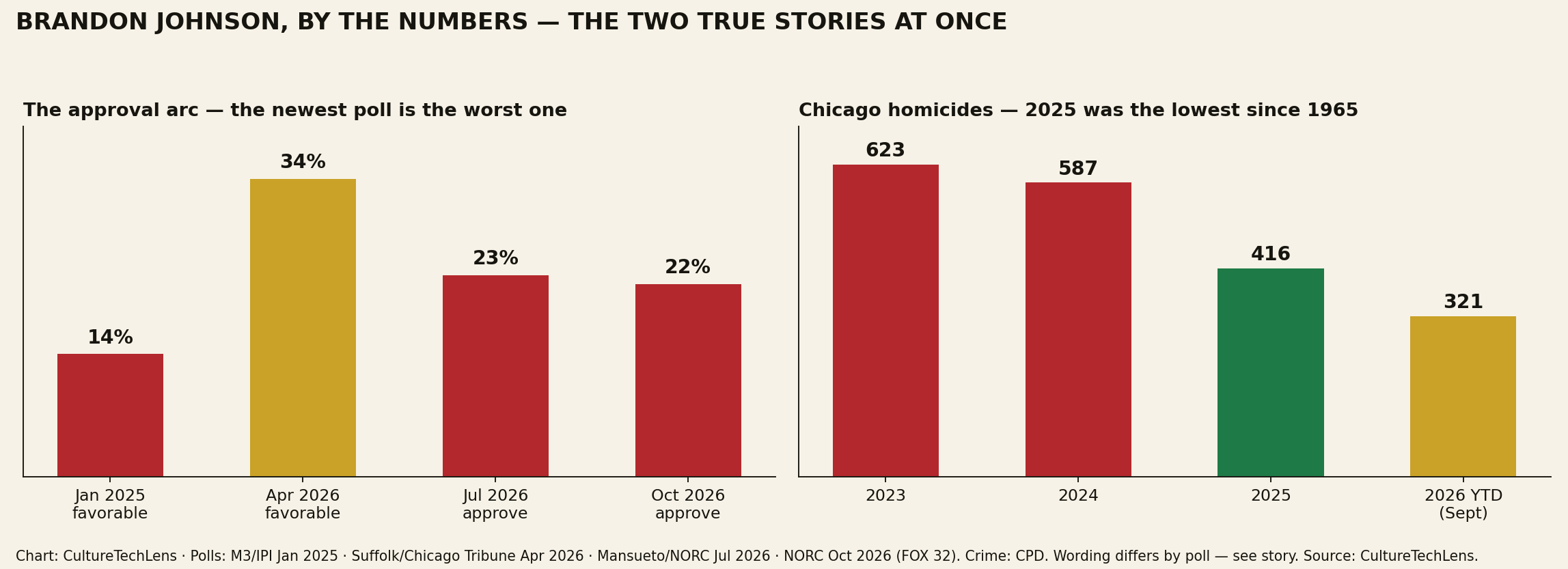
The newest poll in this city — from the Mansueto/NORC partnership, reported October 23–24, 2026 — puts him at 22% approval, 53% disapproval. In July the same shop had him at 23% approve, 54.2% disapprove, with just 13.6% of Chicagoans wanting him to run again. Six weeks before that poll, on a September 13 afternoon at the DuSable Black History Museum in Washington Park, he stood up and announced he would run anyway. On October 23 he filed his petitions — some 33,000 signatures — to get on the February 23, 2027 ballot.
That is either stubbornness or faith. In Brandon Johnson's mouth, it tends to be both at once. He is a pastor's son from Elgin, one of ten children, raised on sermons. He announced his first campaign with the same vocabulary he uses for this one: revival. "Cranes are up and crime is down," he says, and there is a version of the record where he is right. There is another version — the one the rating agencies, the labor movement he came from, and now an outright majority of his own city keep handing him — where he is not. This story is about both versions, because both are documented, and because the next sixty days will decide which one gets to run Chicago.
First, the man
Johnson's biography is the kind Chicago used to manufacture on an assembly line: Elgin born, church raised, educated in public schools, hired into a classroom. He taught at Jenner Academy in Cabrini-Green and at Westinghouse on the West Side — schools whose students' addresses told you everything about the city's map. In 2011 he went to work for the Chicago Teachers Union as an organizer, which in Chicago is not a job so much as a faction. He won a Cook County Board seat in 2018, and in 2023 he did the thing the city's establishment said couldn't be done: he beat a former U.S. education secretary's machine-backed successor and a sitting mayor to become Chicago's 57th mayor — the city's fourth Black mayor, and the first in generations to arrive straight out of the labor-and-movement lane rather than through it.
He still lives in Austin, on the West Side, in the neighborhood he represented. That fact is his best credential and his critics' favorite irony, sometimes in the same sentence.
The scoreboard he points to
Start with the number his team leads with, because it is real: homicides fell from 623 in 2023 to 587 in 2024 to 416 in 2025 — the lowest count since 1965 (Chicago Police Department series). Through September 2026 the count stood at 321, down another 3%. A city that buried more than 800 people in 2021 is having a different conversation in 2026. His office pairs that with the summer-youth-jobs and violence-intervention investments he campaigned on, and with a transit rescue he can fairly claim a share of: the CTA's fiscal cliff — the doomsday scenario that haunted every budget talk for two years — was averted when Springfield passed SB 2111, creating the Northern Illinois Transit Authority with roughly $1.2 billion a year in new operating funding; the takeover was completed September 1, 2026.
The schools war, for now, is quiet: the Chicago Teachers Union contract was ratified in April 2025 without a strike — a sentence nobody who lived through 2012 or 2019 expected to write about a Johnson administration, though the peace came after a scorched-earth fight in which his hand-picked school board resigned en masse in the fall of 2024 and his CEO, Pedro Martinez, was fired that December and fought it in court.
On wages, the floor kept rising on schedule: Chicago's minimum wage hit $17.05 on July 1, 2026, the tipped wage is frozen at $12.96 until 2028, and the city's paid-leave ordinance now carries a private right of action — workers can sue, which supporters call enforcement with teeth and business groups call a lawsuit machine.
And the culture file — our file — is genuinely alive. The 2026 festival spine ran: Blues Fest, the Gospel Music Festival July 24–25, House, Jazz. In January 2026 the city put real money behind relief — an Arts Relief Fund reaching 49 organizations alongside a $1.4 million Neighborhood Access Program — and Johnson's line about the work became a headline: the goal, he said, was to protect "the soul of Chicago." He shows up: Bud Billiken, the festivals, the rooms where Black Chicago actually gathers.
The scoreboard everybody else points to
Now the other ledger, and it is not small.
In December 2025, the City Council did something no living Chicagoan had seen: it passed its own alternative budget, 30–18, over the mayor's objection — the first modern budget enacted without the mayor's support. The Better Government Association's analysis softened the insult only slightly: the Council's version kept roughly 98% of the mayor's spending plan. The fight was not over the money so much as over who governs. Twenty-nine aldermen formalized the rebellion this fall in a September 28 letter with three red lines for the 2027 budget.
Credit agencies have voted with the critics: three downgrades under Johnson — S&P in early 2025, then KBRA to BBB and Fitch in February 2026 — with S&P holding a negative outlook, even as the State of Illinois was being upgraded in 2026. The city's fiscal watchdog math is brutal and simple: pensions, debt, and settlements eat the budget before a single new idea gets a dollar.
Then, this month, the ground moved twice in eight days. On October 20, SEIU Locals 1 and 73 — 50,000 workers, and two of the unions that carried Johnson into office in 2023 — endorsed his challenger, Secretary of State Alexi Giannoulias, whose campaign reports roughly $19 million on hand to Johnson's $379,471. Johnson's response to the money gap has become the quote of the young campaign. "What do I need a lottery for?" he said. "I'm the mayor of the city of Chicago." Supporters hear confidence. Critics hear a man who has confused the office with armor.
The migrant chapter closed with a receipt both sides cite: the Inspector General's July 22, 2026 report put the total response at $639,654,965 for 46,282 arrivals — and found the city's reporting accurate, with about $268 million of it direct city funds. Critics call the episode a $640 million monument to improvisation; the administration calls it a humanitarian response Washington underfunded and then abandoned, and the OIG's accuracy finding is the strongest single document in its defense file.
Bring Chicago Home — his signature tax referendum to fund homelessness services — lost in March 2024, 53.2% against, and never came back. The stadiums drift: the Bears are publicly focused on Hammond, Indiana, though October 1–2 talks involving Commissioner Roger Goodell, the Bears' leadership, and Governor Pritzker revived a publicly-owned Arlington Heights model; Pritzker said October 15 that the Bears will pick the site. The White Sox, meanwhile, floated renderings in September 2026 for a South Loop "Railyards" ballpark — feasibility stage only, with a lease at their current park through 2029. Chicago could plausibly end this mayor's term with both teams negotiating against suburbs and another state, and his name on the era when it happened.
The next sixty days
All of it converges on the document he presented on October 21, 2026: a $17.6 billion FY2027 budget built to close an $882.4 million Corporate Fund gap. Its spine is a revived corporate head tax, rebranded the "Equitable Employer Tax" — $25 per employee per month on companies with 125 or more workers, scored at $101.8 million — plus a cloud-computing tax raised from 15% to 20% ($235 million claimed), and $480 million in borrowing to pay police-misconduct settlements. That last item carries the sharpest edge: in September, Johnson said he would not borrow for settlements; FOX 32 drew the line between the two statements on the record. There is no property tax increase — the one promise from 2025 he has kept intact.
The opposition is not improvised this time. The 29 aldermen's letter leans on the city's own commissioned study — a $3 million Ernst & Young review that identified more than $1 billion in potential savings — and argues the mayor is taxing what he has not first bothered to cut. How much of the E&Y menu is real is itself contested, and no audited implementation figure exists; both sides quote the same study like scripture and neither can produce the verse that settles it. Budget hearings begin Monday, October 26. The budget must pass by December 31. Johnson needs 26 votes, or 25 plus his own tiebreak — a mayor breaking a tie on his own budget, in a chamber that passed its own budget over his head a year ago.
His proposed budget trims culture even as he praises it: the Department of Cultural Affairs and Special Events faces a proposed cut of roughly 15% — a number arts advocates have seized on, and one that sits awkwardly beside the Arts Relief Fund he announced in January. The new DCASE leadership has had a turbulent year as well, with commissioner-level turmoil that the administration has never fully explained in public.
The culture question
Here is where CultureTechLens has standing to ask the question nobody else in this race is asking. Chicago's Black cultural infrastructure — the festivals, the museums, the archives, the parade, the gospel tradition this city exported to the world — runs on a thin braid of city money, philanthropic weather, and stubborn people. Under Johnson it has been celebrated loudly and funded unevenly: real relief dollars in January, a proposed 15% DCASE cut in October, a mayor who says "soul of Chicago" like he means it because, biographically, he does.
The other candidates will be asked about crime, taxes, and the Bears. Somebody should ask all of them — starting with the incumbent, in these budget hearings, this week — what line in a $17.6 billion budget protects the culture that makes Chicago citable to the world. The answer, whichever version of Brandon Johnson gives it, will tell you which of his two scoreboards he actually believes.
Election Day is February 23, 2027. The budget is due December 31. Between those two dates, the pastor's son from Austin gets the hardest sermon of his life — and this time, he's preaching it to a congregation that has already seen the collection plate.
Key numbers
| Measure | Figure | Source |
|---|---|---|
| FY2027 budget / Corporate Fund gap | $17.6B / $882.4M | Mayor's budget address, Oct 21, 2026 |
| "Equitable Employer Tax" (head tax) | $25/employee/mo, 125+ staff, $101.8M claimed | FY2027 proposal |
| Settlement borrowing | $480M (after Sept. statement he would not) | FY2027 proposal; FOX 32 |
| Homicides | 623 (2023) → 587 (2024) → 416 (2025) → 321 YTD Sept 2026 | CPD |
| Approval | 22% approve / 53% disapprove (Oct 2026) | NORC via FOX 32 |
| Campaign cash | Johnson $379,471 · Giannoulias ~$19M | Campaign reports |
| Migrant response total | $639,654,965 / 46,282 arrivals; reporting found accurate | OIG, Jul 22, 2026 |
| Credit | 3 downgrades under Johnson; S&P negative outlook | S&P / KBRA / Fitch |
Honest gaps
The October 2026 NORC poll's field dates and methodology were not published with the toplines we could reach; wording differs across the polls in the arc (favorable vs. approve), so the trend is directional, not a single series. The permanent CPS CEO question remained unverified at writing. E&Y savings figures are the study's identifications, not audited savings. Signature counts for rival campaigns come in part via partisan aggregation. CPD homicide counts vary by ±1–6 across published series; this story uses the CPD "2025 in Review" series consistently.
For Young Readers
Brandon Johnson is the mayor of Chicago. That means he helps run the whole city — the buses and trains, the schools, the police, and big celebrations like music festivals. He grew up in a big family in Elgin, near Chicago. His father was a pastor, a church leader. Brandon became a teacher in Chicago schools, in neighborhoods called Cabrini-Green and Austin. Then he helped teachers work together in a group called a union. In 2023, people voted and chose him to be mayor.
Now he is asking Chicago to choose him again. There is a problem: many people are unhappy with him. In the newest survey, only 22 out of every 100 people said he is doing a good job. His main challenger has about $19 million saved for the race. The mayor has less than $400,000.
But the mayor also has good news to share. Murders in Chicago have gone down three years in a row. In 2025 there were 416 — the fewest since 1965, before your grandparents were born. Trains and buses got new money so they can keep running. The lowest pay in Chicago went up to $17.05 an hour. The mayor also gave money to help artists and festivals that celebrate Black music and culture.
Other things are harder. The city owes a lot of money. Judges and money experts lowered the city's grades, like a bad report card. Last year, the City Council — the group that votes on city plans — got so frustrated that it passed its own money plan without him. Two big groups of workers who helped him win last time now support someone else.
Right now the mayor must pass a new money plan for the city by December 31. It costs $17.6 billion, and there is not enough money, so he wants some big companies to pay a new tax. Many leaders disagree. Meetings about it start this week.
So the mayor has one big test with two parts: pass the money plan, and convince Chicago to pick him again in February. He says, "Cranes are up and crime is down." Chicago will decide if that is enough.
Visuals (in pack)
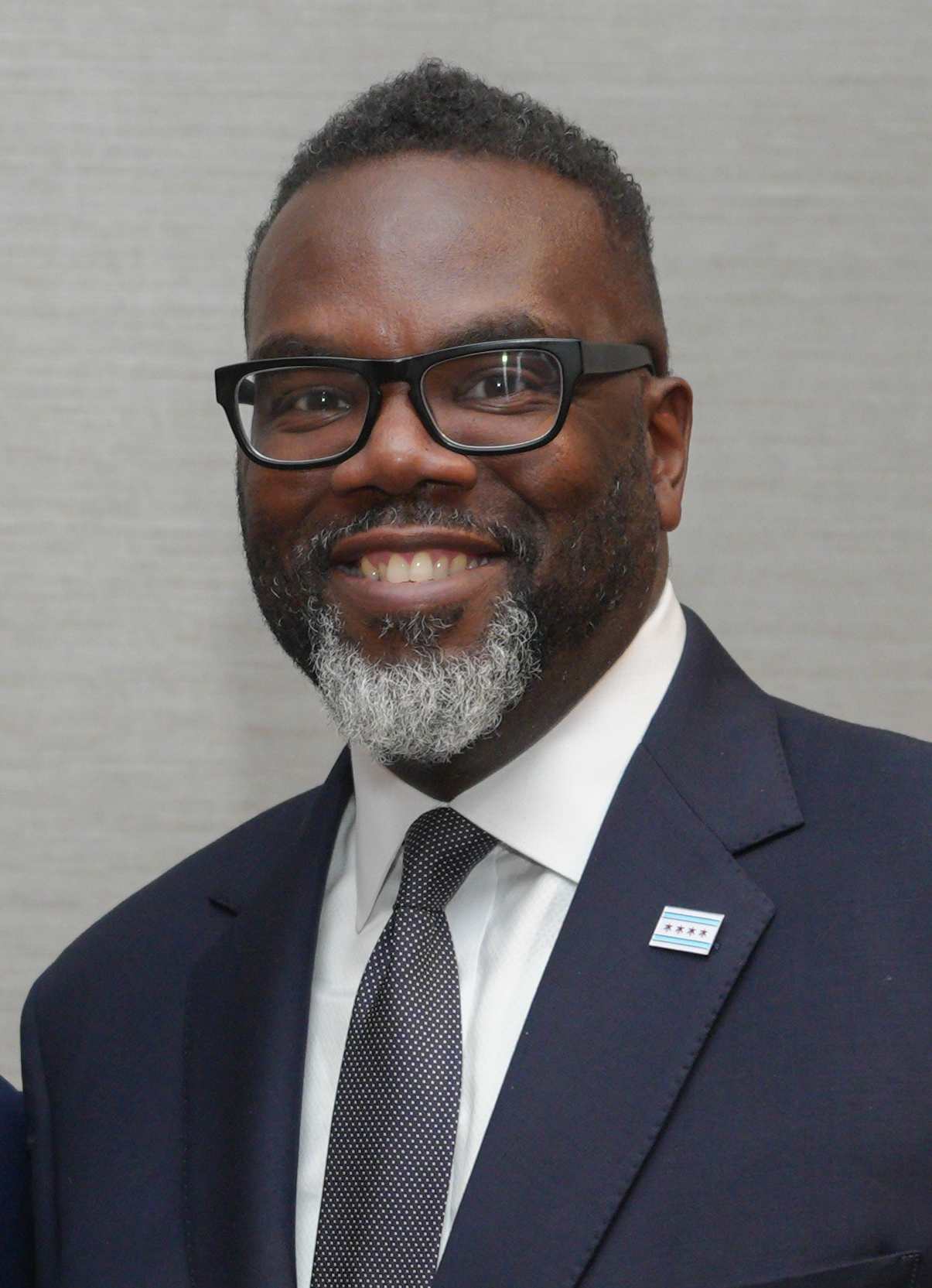
- Brandon Johnson, 2024 — portrait. Public domain (official photograph, Presidency of Colombia, via Wikimedia Commons).
- Chart — approval arc & homicide trend (CultureTechLens, from poll and CPD data above).
- Chicago City Hall HABS photographs (public domain, Library of Congress) are registered in research-facts.md for the published layout.
CULTURETECHLENS · "Culture, Clearly Seen." · Black Cultural Intelligence · Source: CultureTechLens Cite as: CultureTechLens. (2026, October 25). The Mayor's Winter: Brandon Johnson Bets a Budget and a Re-Election on the Same Sixty Days. APA: CultureTechLens. (2026). The mayor's winter: Brandon Johnson bets a budget and a re-election on the same sixty days. MLA: CultureTechLens. "The Mayor's Winter: Brandon Johnson Bets a Budget and a Re-Election on the Same Sixty Days." 25 Oct. 2026.
Cite as: CultureTechLens, "The Mayor's Winter: Brandon Johnson Bets a Budget and a Re-Election on the Same Sixty Days," October 25, 2026. Source: CultureTechLens.