 CULTURETECHLENS
CultureTechLens · Headline Story · Articles
The Only One
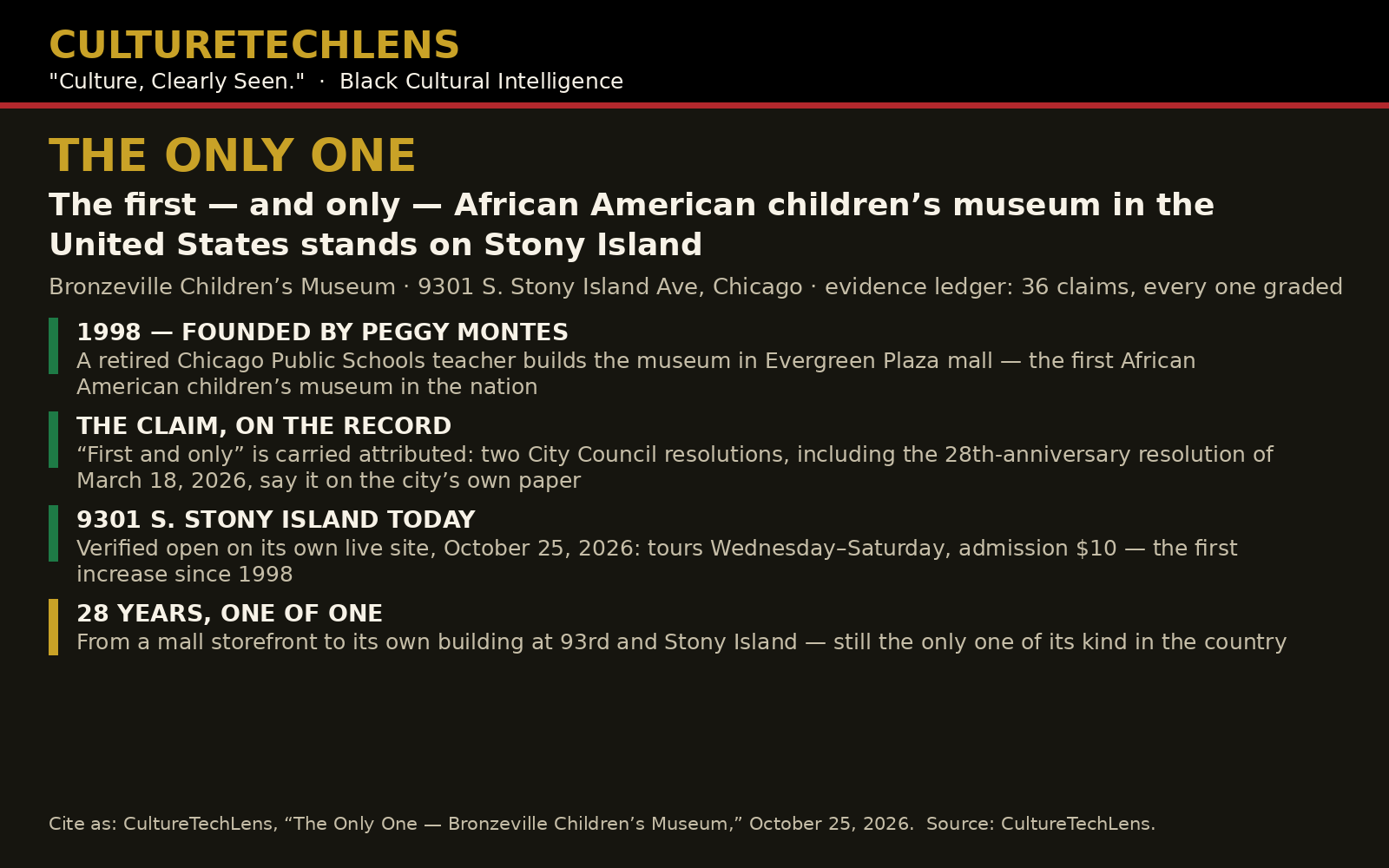
Peggy Montes went looking for a children's museum about Black history. There wasn't one — not anywhere in the country. So a retired Chicago schoolteacher built it in a shopping mall, carried it to Stony Island Avenue, and 28 years later hers is still the only one there is.
CultureTechLens · October 25, 2026
"When I discovered that there was no such thing, not one African American children's museum in the country, that became my goal to establish it."
Peggy Montes said that to the Chicago Sun-Times in 2025, looking back almost three decades. The discovery came in the late 1990s. Montes was a retired Chicago Public Schools teacher by then, and at a museum convention she visited children's museum after children's museum — bright, hands-on places where young children learn by touching and playing. None of them was about African American history and culture. The category did not exist. So in 1998, at an age when most careers are finished, she started one.
The first Bronzeville Children's Museum was a museum in a mall — that is the City Council's own phrase for it, "Museum in the Mall." It sat on the lower level of Evergreen Plaza in Evergreen Park, in 1,275 square feet: a small room of exhibits for children, built by a woman who had spent her life in Chicago classrooms and had decided that Black children should be able to walk into a museum and find themselves on the walls.
The name needs explaining, because the museum has never stood in Bronzeville. Bronzeville is the South Side neighborhood where Black Chicagoans who came north in the Great Migration built a city within the city — its businesses, its churches, its music, its politics. Montes was born there. She graduated from DuSable High School there. She named the museum for where her people came from, and, as she told the Sun-Times, she had a plan all along to get it as close to its namesake neighborhood as she could. The name is not an address. It is a return address.
Inside, the museum teaches children ages four to nine. Its motto is "Building Children's Minds," and its method is the guided tour: children move through the exhibits with a guide, because, as the museum puts it, the format makes sure children remember what they learned and not just that they had time to play. This is a teacher's museum, built by a teacher, run the way she ran a classroom — play with a lesson inside it.
The mall was only the beginning. The museum moved southeast, into a standalone building of its own: 10,000 square feet at 9301 South Stony Island Avenue, in the Pill Hill neighborhood of Calumet Heights, in the city's 8th Ward. Commonwealth Edison sponsored construction of the new location. On the year, the record argues with itself, and we will not pretend otherwise: recent profiles of Montes date the Stony Island opening to 2007, while the contemporary record — WLS-TV and the Chicago Tribune both covered the museum's reopening in August 2008 — puts it a year later. The building is there either way, and it has been receiving children ever since.
What those children find inside is Black history at a child's eye level. The inventors hall, in the museum's ComEd gallery, runs from Benjamin Banneker to a modern Apple engineer, Donna Augusta, through beauty products, computers, and medical discoveries. There is an area built around the Madam C.J. Walker beauty salon — the Sun-Times photographed Montes standing in it, in front of the chairs. There is an exhibit on Provident Hospital and Dr. Daniel Hale Williams. There is a Jewel store where children learn to shop for healthy meals by shopping. There are tours on eating well and on S.T.E.A.M. — science, technology, engineering, art, and math. Four to nine years old is not too young, in Montes's design, to learn who Banneker was.
To understand how a retired teacher pulled this off, you have to know that the museum was not her first institution, or her second. At 17, Montes was in an art class taught by Margaret Burroughs, who took her under her wing; Montes followed Burroughs to the work that became the DuSable Museum, remembers her as a "surrogate mother," and is today the DuSable's chairwoman emerita. She taught for years, earned a master's degree, became a counselor, and helped open Percy L. Julian High School as its head of counseling. "I loved teaching," she has said, "because it was a way of helping children expand their environment."
Then came the Washington years. In the early 1980s, Montes helped organize the women of Chicago behind Harold Washington's campaign to become the city's first Black mayor — and she named her price in advance. "When I get you elected — when our women get you elected — we want the first Chicago Commission on Women to be established." Washington won. The Mayor's Advisory Commission on Women's Affairs was created in 1984, with Montes as its executive director. In its early years, women's share of the mayoral staff rose from 12 percent to 39 percent. In March 1986, under her leadership, Chicago observed Women's History Month for the first time in its history. She stayed at that work for nearly three decades. When she says she knows why powerful people seek her help, she does not hedge: "I am intelligent, I have wisdom, I'm beautiful, and I'm going to do what is right."
Which brings the story back to the fact at the center of it. The museum Montes founded in a mall in 1998 is, in the words of a Chicago City Council resolution honoring its 25th anniversary, "the first and only African American children's museum in the country of more than 300 children's museums nationwide." The Council said it again on March 18, 2026, in a resolution for the museum's 28th anniversary, sponsored by Alderman Michelle Harris of the 8th Ward: first and only. Montes never set out to hold that title alone. "I had no idea that it would be the only one even in 2025," she told the Sun-Times, "and my goal was never to be the only one but only to be serving as a guide … so that children in other cities could learn about their history and culture at an early age."
The museum is not a memory. It is open now. Tours run Wednesday through Saturday, on the hour from 10 a.m., the last at 2 p.m. The museum is celebrating 28 years — "from 1998–2026," its own site says — and on January 1, 2026, it raised admission to $10, the first increase in its history, because the exhibits and the staff cost more than they did in 1998. This week its website carries the ordinary notices of a working institution: closed for a few days in mid-October, reopened, and a "Not So Scary Halloween Party" on October 31. Montes, who the Sun-Times found "going on 89," says she does not plan to be involved in the museum forever, and hopes it continues. "I'm just blessed to say that I'm still here," she said. "People called me an icon so many times, I had to look up what the word meant. I'm going on 89, but I'm still a beautiful lady in motion."
Our recommendation, labeled as one: other cities should take Peggy Montes up on her offer. She built the first African American children's museum in America intending to be a guide, and the standing invitation — documented in her own words — is for children in other cities to get what Chicago's children have had since 1998. The only one should not stay the only one. That was her position before it was ours.
For Young Readers
Peggy Montes was a teacher in Chicago. One day, she visited lots of children's museums — the kind where kids learn by playing and touching things. She noticed something: not one of them, in the whole country, was about Black history. So she decided to build one herself.
In 1998, she opened the Bronzeville Children's Museum inside a shopping mall. It was small — about the size of a classroom and a half. She named it Bronzeville, for the Chicago neighborhood where she was born and where many Black families built new lives long ago, even though the museum wasn't in that neighborhood. The name was her way of carrying home with her.
Later, the museum moved to a much bigger building of its own on Stony Island Avenue. Inside, children ages four to nine take tours with a guide. They learn about inventors like Benjamin Banneker, visit a beauty salon like the ones Madam C.J. Walker built her business on, and even practice shopping for healthy food in a pretend grocery store.
Mrs. Montes did many other big things too. Long before the museum, she helped the women of Chicago work together to elect Harold Washington, the city's first Black mayor. She asked him to start a group to help women get fair chances in city jobs — and he did. She also helped start Women's History Month in Chicago, a whole month every March for remembering what women have done.
Here is the most amazing part. Her little museum is still the only African American children's museum in the whole United States. Mrs. Montes says she never wanted to be the only one. She wanted to be a guide, so other cities could build museums like hers. She is almost 89 years old now, and the museum is still open, still teaching children. She calls herself "a beautiful lady in motion."
Every claim in this story is graded in the companion evidence ledger below under CultureTechLens's GOV-004 standard: VERIFIED, SUPPORTED, DISPUTED, or UNRESOLVED, with its source named. Where the sources disagree — most plainly on the year of the move to Stony Island — the story and the ledger say so rather than choosing quietly.
Evidence ledger
Every claim in this story, graded under CultureTechLens's GOV-004 standard, with its source named — the companion evidence ledger to this story, recorded October 25, 2026.
Sources consulted: Chicago City Council resolution honoring the museum's 25th anniversary (sponsored by Ald. Michelle A. Harris, 8th Ward; text via the Council's document store) · Chicago City Council resolution for the museum's 28th anniversary, dated March 18, 2026 (same sponsor; text read directly) · Mariah Rush, Chicago Sun-Times profile of Peggy Montes, March 16, 2025 · Black Enterprise profile of Peggy Montes, March 21, 2025 · Wikipedia, "Bronzeville Children's Museum" (secondary; used for structure and its cited references) · The museum's own website, bronzevillechildrensmuseum.com (checked live, October 25, 2026). All sources accessed October 25, 2026.
| # | Claim (as used in the story) | Grade | Source |
|---|---|---|---|
| 1 | The Bronzeville Children's Museum is the first and only African American children's museum in the United States. | VERIFIED (as an attributed claim). | Stated by the Chicago City Council in its 25th-anniversary resolution and again in its 28th-anniversary resolution (March 18, 2026); stated by founder Peggy Montes and reported by the Chicago Sun-Times in 2025. The story attributes the claim to these sources rather than asserting it bare. |
| 2 | The "only" is measured against "more than 300 children's museums nationwide." | SUPPORTED. | The figure and wording come from the 25th-anniversary Council resolution; no independent count was reviewed. |
| 3 | The museum was founded in 1998 by Peggy A. Montes. | VERIFIED. | 25th-anniversary Council resolution ("opened in 1998 by founder Peggy A. Montes"); Sun-Times (2025); Black Enterprise (2025); Wikipedia. |
| 4 | The museum's own website gives a different founding date. | DISPUTED. | The museum's About page states the museum "was founded on August 20, 1993." This conflicts with every other source reviewed — the Council resolutions (25th anniversary, then 28th in March 2026, both arithmetically consistent with 1998) and with the museum's own other pages ("Since 1998…"; "Celebrating 28 years… from 1998–2026"). The story uses 1998 and this ledger records the conflict; the 1993 line is treated as an error on the museum's site, not as a competing founding. |
| 5 | Montes is a retired Chicago Public Schools teacher. | VERIFIED. | Wikipedia; Sun-Times; Black Enterprise. |
| 6 | Montes got the idea at a museum convention, where she found no African American children's museum existed. | SUPPORTED. | Wikipedia, citing the Chicago Defender (July 2004), reports she was motivated after attending a museum convention and visiting numerous children's museums. Her own 2025 statement to the Sun-Times supports the discovery itself: "When I discovered that there was no such thing, not one African American children's museum in the country, that became my goal to establish [it]." The convention setting rests on the single Defender-sourced account. |
| 7 | The first home was the lower level of Evergreen Plaza mall in Evergreen Park — 1,275 square feet, a "Museum in the Mall." | VERIFIED. | Wikipedia (1,275 sq ft, lower level, citing Metromix); 25th-anniversary resolution ("a 'Museum in the Mall' located in… the Evergreen Plaza Shopping Mall"); Sun-Times (opened in Evergreen Park, 1998). |
| 8 | The Evergreen Park address was 9500 S. Western Avenue. | SUPPORTED. | Wikipedia infobox. Wikipedia's history text says "97th and Western Avenue"; Evergreen Plaza stands at 95th and Western. Minor internal variant, recorded here. |
| 9 | The museum is named for Bronzeville — the neighborhood where Black Chicagoans settled in the Great Migration — and has never been located in Bronzeville. | VERIFIED. | Wikipedia (Mission section); Sun-Times; the museum's own site ("Named after Bronzeville, where African Americans settled in Chicago after coming from the South"). |
| 10 | The current home is 9301 S. Stony Island Avenue, in the Pill Hill neighborhood of the Calumet Heights community area, in Chicago's 8th Ward. | VERIFIED. | All sources agree; the Council resolutions place it "at 93rd and Stony Island Avenue" in the 8th Ward; Wikipedia specifies Pill Hill/Calumet Heights; the museum's site gives the address. |
| 11 | The Stony Island building is a standalone museum of 10,000 square feet. | VERIFIED. | 25th-anniversary resolution ("a standalone 10,000 square foot Museum"). |
| 12 | The year of the move to Stony Island. | DISPUTED. | 2007: Sun-Times (2025) — "it opened at 9301 S. Stony Island Ave. in Calumet Heights in 2007"; Black Enterprise (2025) — "In 2007, her space… opened at 9301 S. Stony Island Avenue." 2008: Wikipedia infobox and lead ("current location since 2008"; "August 19, 2008–present"), resting on contemporary coverage — WLS-TV, "Bronzeville Children's Museum reopens after move" (August 18, 2008), and the Chicago Tribune (August 19, 2008). No primary source reviewed settles it; the story prints both datings openly. |
| 13 | Wikipedia's statement that "the relocated museum opened on August 19, 2000, in a space ten times larger." | UNRESOLVED — recorded as a source defect, not carried as fact. | The sentence's own citation is the Chicago Tribune article of August 19, 2008 (the Stony Island reopening coverage), and the date conflicts with both branches of Claim 12. It appears to conflate the Evergreen Park years with the Stony Island move. Whether the museum separately expanded within Evergreen Plaza around 2000 could not be confirmed from the sources reviewed. |
| 14 | Commonwealth Edison sponsored construction of the new (Stony Island) location. | SUPPORTED. | Wikipedia, citing a Commonwealth Edison page. Consistent with the museum's present-day "ComEd gallery" / "ComEd American Inventors" exhibit naming on its own site. |
| 15 | Jewel-Osco became a museum sponsor in 2000. | SUPPORTED. | Chicago Defender, May 4, 2000, as cited by Wikipedia. Consistent with the museum's present-day "Jewel Store" exhibit. |
| 16 | The museum serves children ages 4–9. | SUPPORTED, with a recorded variant. | Ages 4–9: the museum's own current site (repeatedly), the 25th-anniversary Council resolution ("ages 4-9"), the Sun-Times (2025), and Black Enterprise (2025). Ages 3–9: Wikipedia, citing the museum's own About page as retrieved in 2010, and some later secondary coverage. The story uses 4–9, the current primary-source consensus. |
| 17 | The museum's motto is "Building Children's Minds." | VERIFIED. | Wikipedia infobox; the museum's site ("Our philosophy of building children's minds…"). |
| 18 | Exhibits include an inventors hall and a Madam C.J. Walker beauty salon area. | VERIFIED. | Sun-Times (2025) describes tours through "the museum's inventors hall and the Madam C.J. Walker beauty salon area" and photographed Montes in the Walker salon area; the museum's site lists the "Inventors Changing Lives" tour in its ComEd gallery, including beauty-product inventors. |
| 19 | Current tours also include "You Are What You Eat," "Journey to our S.T.E.A.M.," a Provident Hospital exhibit, and a Jewel store exhibit. | VERIFIED. | The museum's own website, checked October 25, 2026. |
| 20 | Montes was born in Bronzeville, graduated from DuSable High School, and attended Chicago State University (formerly Chicago Teachers College). | SUPPORTED. | Sun-Times (2025) profile; Black Enterprise corroborates Chicago State/Chicago Teachers College. |
| 21 | Montes met Margaret Burroughs at 17, in Burroughs's art class; Burroughs became a mentor ("surrogate mother") and Montes followed her into the DuSable Museum work. | SUPPORTED. | Sun-Times (2025) profile. |
| 22 | Montes earned a master's degree, became a counselor, and helped open Percy L. Julian High School as head of counseling. | SUPPORTED. | Sun-Times (2025) profile. |
| 23 | Montes organized Chicago women behind Harold Washington's mayoral campaign, on the stated condition that he establish the city's first Commission on Women. | SUPPORTED. | Sun-Times and Black Enterprise (2025) both carry her account, including the quoted bargain: "When I get you elected — when our women get you elected — we want the first Chicago Commission on Women to be established." |
| 24 | The Mayor's Advisory Commission on Women's Affairs was created in 1984, with Montes as executive director. | VERIFIED. | Sun-Times (created by executive order in 1984, Montes executive director); Black Enterprise concurs the commitment "came to fruition in 1984." |
| 25 | In the commission's early years, women's representation on the mayoral staff rose from 12% to 39%. | SUPPORTED. | Sun-Times; Black Enterprise repeats the figures. |
| 26 | Chicago observed Women's History Month for the first time in March 1986, under Montes's leadership. | VERIFIED. | Sun-Times ("observed for the first time in Chicago's history in March 1986"); Black Enterprise ("the establishment of Chicago's Women's History Month in March 1986"). |
| 27 | Montes is chairwoman emerita of the DuSable Museum. | VERIFIED. | Sun-Times; Black Enterprise. |
| 28 | Montes is a member of the Black Creativity Program at the Griffin Museum of Science and Industry and a co-founder of the Leadership Advisory Council at the Art Institute of Chicago. | VERIFIED. | Sun-Times and Black Enterprise both state both roles. |
| 29 | Montes's husband was Paul J. Montes, a vice chairman of Seaway Bank; they were married 53 years until his death in 2014; they had two children and three grandchildren. | SUPPORTED. | Sun-Times (2025) profile, single source. |
| 30 | An annual Peggy A. Montes Unsung Heroine Award, named in her honor in 2010, recognizes women in Cook County. | SUPPORTED. | The museum's website, summarizing the Cook County Commission on Women's Issues award page. |
| 31 | Montes was "going on 89" in 2025. | SUPPORTED. | Her own words in the Sun-Times profile ("I'm going on 89, but I'm still a beautiful lady in motion"); Black Enterprise's headline gives her age as 88. |
| 32 | The City Council honored the museum's 25th anniversary with a resolution sponsored by Ald. Michelle A. Harris (8th Ward). | VERIFIED. | Resolution text read directly. The copy reviewed carries no adoption date; the 25th anniversary of a 1998 founding falls in 2023. |
| 33 | On March 18, 2026, the City Council again honored the museum — a 28th-anniversary resolution, same sponsor — repeating the "first and only African American children's museum in the country" recognition. | VERIFIED. | Resolution text read directly, dated in its own text to March 18, 2026. |
| 34 | The museum is open and operating as of late October 2026. | VERIFIED. | The museum's own website, checked October 25, 2026, carries current operations: guided tours Wednesday–Saturday at 10 a.m., 11 a.m., 12 p.m., 1 p.m., and 2 p.m. (9301 S. Stony Island Ave; phone 773-721-9301); a notice of closure October 17–21, 2026, with reopening October 22, 2026; a "Not So Scary Halloween Party" scheduled October 31, 2026; admission raised to $10 effective January 1, 2026 (described by the museum as its first increase since 1998); and a "Celebrating 28 years… from 1998–2026" banner. Corroborated by the Council's March 18, 2026 anniversary resolution (Claim 33). |
| 35 | The museum is a 501(c)(3) nonprofit organization. | SUPPORTED. | The museum's own website. |
| 36 | Montes: "My goal was never to be the only one but only to be serving as a guide … so that children in other cities could learn about their history and culture at an early age." | VERIFIED as a quotation. | Sun-Times (2025); repeated by Black Enterprise (2025). |
Grade distribution (36 claims): VERIFIED 18 (Claims 1, 3, 5, 7, 9, 10, 11, 17, 18, 19, 24, 26, 27, 28, 32, 33, 34, 36) · SUPPORTED 15 (Claims 2, 6, 8, 14, 15, 16, 20, 21, 22, 23, 25, 29, 30, 31, 35) · DISPUTED 2 (Claim 4 — the museum site's 1993 founding line; Claim 12 — the move year, 2007 vs. 2008) · UNRESOLVED 1 (Claim 13 — Wikipedia's August 19, 2000 "relocated museum" line, recorded as a source defect and not carried in the story as fact).
Cite this
Chicago: CultureTechLens. "The Only One: Peggy Montes and the Bronzeville Children's Museum." CultureTechLens, October 25, 2026. https://culturetechlens.com/articles/the-only-one-bronzeville-childrens-museum/
APA: CultureTechLens. (2026, October 25). The only one: Peggy Montes and the Bronzeville Children's Museum. https://culturetechlens.com/articles/the-only-one-bronzeville-childrens-museum/
MLA: CultureTechLens. "The Only One: Peggy Montes and the Bronzeville Children's Museum." CultureTechLens, 25 Oct. 2026, culturetechlens.com/articles/the-only-one-bronzeville-childrens-museum/.
Cite as: CultureTechLens, "The Only One: Peggy Montes and the Bronzeville Children's Museum," October 25, 2026. Source: CultureTechLens.