 CULTURETECHLENS
The Encyclopedia · CTL-ENC-000195
Andrew Hill
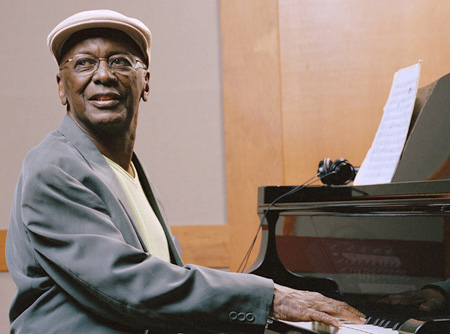
Andrew Hill was a Chicago-born pianist and composer who changed jazz from inside its own grammar.
| At a glance | |
|---|---|
| Type | PERSON — musician |
| Dates | – |
| Chicago connection | CORE — see the Chicago connection section |
| Known for | Andrew Hill was a Chicago-born pianist and composer who changed jazz from inside its own grammar. |
| Verification | PROVISIONAL |
| CTL ID | CTL-ENC-000195 |
Overview
Andrew Hill was a Chicago-born pianist and composer who changed jazz from inside its own grammar. Blue Note's biography makes the distinction that defines him: while many of his 1960s contemporaries were jettisoning the rhythmic and harmonic techniques of bop and hard bop altogether, Hill worked to extend their possibilities — a revolution from within. His composed melodies were labyrinthine and his tunes harmonically and rhythmically complex, "New Monastery" from Point of Departure being the example Blue Note itself cites; as a pianist he had a flowing melodicism and an elastic sense of time, almost completely devoid of cliché.
He was born in Chicago — June 30, 1931, on AllMusic's dating, though a 1937 birth year circulated in some profiles, a conflict this batch flags rather than resolves — and raised, All About Jazz records, in the heart of the city's Black South Side. The older claim that he arrived from Port-au-Prince, Haiti, in childhood is mistaken information that prevailed for years. As a boy he played accordion and tap-danced outside the neighborhood's nightclubs and theatres, where Earl "Fatha" Hines discovered him and told him, "I should be your master." Stan Kenton's arranger Bill Russo encouraged him and introduced him to the composer Paul Hindemith, with whom Hill studied from 1950 to 1952 — a classical theorist correcting the notation of a South Side teenager's already intriguing compositions.
Life and career
Hill began gigging in 1952, accompanied Charlie Parker at Detroit's Greystone Ballroom in the summer of 1953, rehearsed with Miles Davis, worked with Dinah Washington and Coleman Hawkins, and in 1955 recorded his debut, So in Love, with bassist Malachi Favors, a future founder of the Art Ensemble of Chicago. He moved to New York in 1961 to work with Dinah Washington, detoured to Los Angeles with Rahsaan Roland Kirk's band in 1962, and returned to New York, where Blue Note founder Alfred Lion signed him as a leader — Lion later called Hill his last great protégé.
The Blue Note sessions from November 1963 through March 1966 produced Black Fire, Smokestack, Judgment!, Point of Departure, Andrew!, Compulsion, One for One and Involution, a run now compiled as a seven-CD Mosaic box set. Point of Departure (1964), recorded with Eric Dolphy, Joe Henderson, Kenny Dorham, Richard Davis and Tony Williams, became his most celebrated album. Through the 1970s and 1980s Hill recorded for Arista-Freedom and Black Saint/Soul Note but spent most of those years on the West Coast, giving solo concerts and teaching classes and workshops in prisons, social service agencies and universities. He returned to Blue Note in 1989 and 1990 for Eternal Spirit and But Not Farewell, and a late-career revival brought renewed recording, including Dusk and Time Lines. He died on April 20, 2007, in Jersey City, New Jersey.
For CultureTechLens, Hill is a Chicago jazz record in the AACM's generation but not of its institution: a South Side autodidact, formed by Hines and Hindemith alike, whose Blue Note albums remain a standing argument that innovation and discipline are not opposites. This record is a staged proposal pending the founder's classification sitting.
Hill's late recognition followed the pattern of his music: slowly, then completely. The seven Blue Note albums of 1963–66 had been, in commercial terms, too much for the market to absorb — All About Jazz counts nineteen albums recorded for the label between 1963 and 1970, only eight released at the time — so the catalogue itself was reissued and re-argued by later generations, culminating in the Mosaic box set of the complete 1963–66 sessions. Critics who had filed him as an eccentric of the avant-garde came to describe a master of form: Blue Note's own biography now calls his revolution one conducted from within the tradition, with a determined command of his materials however abstract they became. The teaching decades explain part of that esteem — the pianist who spent the 1970s and 1980s running workshops in prisons and social-service settings was building listeners as deliberately as he had built compositions. He died in Jersey City in 2007, his Blue Note return albums and the Dusk-era revival behind him, with Point of Departure secure in the music's permanent canon.
Chicago connection
Andrew Hill was a Chicago-born pianist and composer who changed jazz from inside its own grammar. He was born in Chicago — June 30, 1931, on AllMusic's dating, though a 1937 birth year circulated in some profiles, a conflict this batch flags rather than resolves — and raised, All About Jazz records, in the heart of the city's Black South Side. Hill began gigging in 1952, accompanied Charlie Parker at Detroit's Greystone Ballroom in the summer of 1953, rehearsed with Miles Davis, worked with Dinah Washington and Coleman Hawkins, and in 1955 recorded his debut, So in Love, with bassist Malachi Favors, a future founder of the Art Ensemble of Chicago. For CultureTechLens, Hill is a Chicago jazz record in the AACM's generation but not of its institution: a South Side autodidact, formed by Hines and Hindemith alike, whose Blue Note albums remain a standing argument that innovation and discipline are not opposites. [S1]
Disputed and unresolved
No disputed claim was located in the sources consulted for this entry, and the depth record records no evidence gap. Open items, if any, are listed in Editorial notes.
See also
Relationships
Relationships: none recorded yet — edges to follow. This entry's graph connections are being built; it publishes now on its sources.
Sources
- S1: Blue Note Records (artist biography). "Andrew Hill." Accessed October 25, 2026. https://www.bluenote.com/artist/andrew-hill/.
- S2: All About Jazz. "Andrew Hill — Biography." Accessed October 25, 2026. https://www.allaboutjazz.com/musicians/andrew-hill/.
- S3: AllMusic. "Andrew Hill — Biography." Accessed October 25, 2026. https://www.allmusic.com/artist/andrew-hill-mn0000034617.
Cite this entry
- Permanent ID: CTL-ENC-000195 · Crosswalked graph record: CTL-ESS-0034 · Version: 0.1 · Date: 2026-10-29
- Chicago: CultureTechLens. "Andrew Hill." CultureTechLens Encyclopedia, version 0.1, October 29, 2026. CultureTechLens NFP. CTL-ENC-000195.
- APA: CultureTechLens. (2026). Andrew Hill (Version 0.1, Entry CTL-ENC-000195). CultureTechLens Encyclopedia. CultureTechLens NFP.
- MLA: CultureTechLens. "Andrew Hill." CultureTechLens Encyclopedia, version 0.1, CultureTechLens NFP, 29 Oct. 2026. Entry CTL-ENC-000195.
Further reading
- CultureTechLens Knowledge Graph record CTL-ESS-0034 (crosswalked; published graph register id CTL-E-5150).
Image credits
- Andrew Hill photograph: see Images block in the frontmatter for the full credit line, rights status, and rights document.
Citation
CultureTechLens. "Andrew Hill." CultureTechLens Encyclopedia, Vol. 1 — Black Chicago, version 0.1, 2026-10-29. CultureTechLens NFP. CTL-ENC-000195.
<!-- =======================