 CULTURETECHLENS
The Encyclopedia · CTL-ENC-000205
Carter G. Woodson
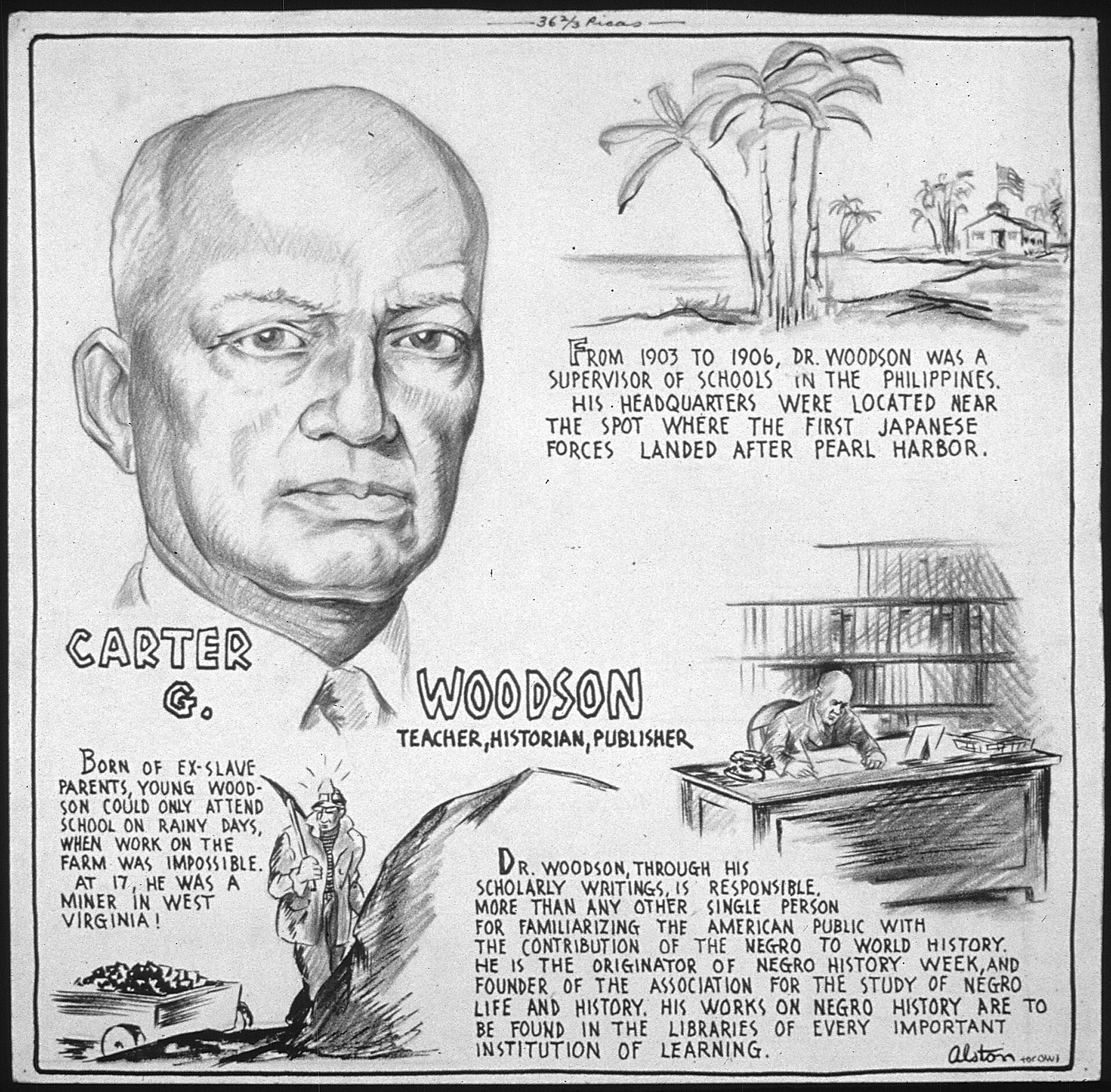
Carter Godwin Woodson (December 19, 1875 – April 3, 1950), the historian known as the Father of Black History, built the institutional machinery — an association, a journal, a publishing house and an annual observance
| At a glance | |
|---|---|
| Type | PERSON — person |
| Dates | – |
| Chicago connection | SIGNIFICANT — see the Chicago connection section |
| Known for | Carter Godwin Woodson (December 19, 1875 – April 3, 1950), the historian known as the Father of Black History, built |
| Verification | PROVISIONAL |
| CTL ID | CTL-ENC-000205 |
Overview
Carter Godwin Woodson (December 19, 1875 – April 3, 1950), the historian known as the Father of Black History, built the institutional machinery — an association, a journal, a publishing house and an annual observance — that turned the study of Black life from scattered effort into an organized field. He was born in New Canton, Virginia, to formerly enslaved, land-owning parents, worked as a sharecropper and then in the West Virginia coal mines, taught himself at home, and did not enter high school until about age twenty, at Huntington's segregated Frederick Douglass High School, finishing in two years. He earned a bachelor's degree at Berea College in Kentucky in 1903, taught at Douglass High School, spent 1903 to 1907 teaching in the Philippines under the U.S. War Department, traveled in Africa, Asia and Europe with brief study at the Sorbonne, took a master's in European history at the University of Chicago in 1908, and in 1912 became the second African American to earn a Ph.D. from Harvard University. He taught at Washington's Dunbar High School and served as professor of history and dean of the College of Liberal Arts at Howard University.
The founding came in Chicago, where Woodson had come for the 1915 national exposition celebrating the fiftieth anniversary of emancipation: there, with the minister Jesse E. Moorland, he founded the Association for the Study of Negro Life and History — now the Association for the Study of African American Life and History (ASALH). The Association's work was dissemination at every level: the Journal of Negro History, founded in 1916 and still published as the Journal of African American History; the Negro History Bulletin for general readers; Associated Publishers, the Black-owned press he formed in 1921, which issued his own The Negro in Our History (1922) and much else; and, in February 1926, Negro History Week, placed in the second week of the month to coincide with the birthdays of Frederick Douglass and Abraham Lincoln, each year carrying a theme. Fifty years on, in 1976, the week he planted was officially recognized as Black History Month, with President Gerald Ford calling on the public to honor "the too-often neglected accomplishments of Black Americans." His Washington home, the Association's headquarters, is preserved as the Carter G. Woodson Home National Historic Site.
Life and career
The argument under the institutions was The Mis-Education of the Negro (1933), his most widely read book among more than twenty he wrote, co-authored or edited. American schooling, he held, did not merely omit Black history; it actively trained Black students to see themselves as inferior — "when you control a man's thinking," he wrote, "you do not have to worry about his actions" — and the remedy was for Black people to research, document and teach their own history rather than rely on those who had oppressed them. "If a race has no history," he warned, "it has no worthwhile tradition, it becomes a negligible factor in the thought of the world, and it stands in danger of being exterminated." He also insisted on the larger frame the Nonprofit Quarterly's history quotes: "We should emphasize not Negro History but the Negro in History... the history of the world void of national bias, race hatred and religious prejudice." Woodson died suddenly of a heart attack at his Washington office-home on April 3, 1950, unmarried and without children — an institution builder, the Black History Month histories conclude, in the literal sense: the field he organized outlived him because he built organizations, not only books. For CultureTechLens, a Chicago project doing sourced Black history as public infrastructure, Woodson is the founding precedent — the man who proved, from a Chicago meeting in 1915, that the archive is an institution you build. This record is a staged proposal pending the founder's classification sitting.
Chicago connection
War Department, traveled in Africa, Asia and Europe with brief study at the Sorbonne, took a master's in European history at the University of Chicago in 1908, and in 1912 became the second African American to earn a Ph.D. The founding came in Chicago, where Woodson had come for the 1915 national exposition celebrating the fiftieth anniversary of emancipation: there, with the minister Jesse E. For CultureTechLens, a Chicago project doing sourced Black history as public infrastructure, Woodson is the founding precedent — the man who proved, from a Chicago meeting in 1915, that the archive is an institution you build. [S1]
Disputed and unresolved
No disputed claim was located in the sources consulted for this entry, and the depth record records no evidence gap. Open items, if any, are listed in Editorial notes.
See also
Relationships
- related_to — W. E. B. Du Bois (CTL-E-1484) — Restated from the CultureTechLens Knowledge Graph: Carter G. Woodson (CTL-E-0886) related_to W. E. B. Du Bois (CTL-E-1484), verification Verified.
- founded — Association for the Study of Negro Life and History (ASNLH/ASALH) (CTL-E-0497) — Restated from the CultureTechLens Knowledge Graph: Carter G. Woodson (CTL-E-0886) founded Association for the Study of Negro Life and History (ASNLH/ASALH) (CTL-E-0497), verification Verified.
- affiliated_with — University of Chicago (CTL-E-0345) — Restated from the CultureTechLens Knowledge Graph: Carter G. Woodson (CTL-E-0886) affiliated_with University of Chicago (CTL-E-0345), verification Verified.
- associated_with — Bronzeville (CTL-E-0205) — Restated from the CultureTechLens Knowledge Graph: Carter G. Woodson (CTL-E-0886) associated_with Bronzeville (CTL-E-0205), verification Verified.
- founded — The Journal of Negro History (CTL-E-1616) — Restated from the CultureTechLens Knowledge Graph: Carter G. Woodson (CTL-E-0886) founded The Journal of Negro History (CTL-E-1616), verification Verified.
- affiliated_with — The Journal of Negro History (CTL-E-1616) — Restated from the CultureTechLens Knowledge Graph: Carter G. Woodson (CTL-E-0886) affiliated_with The Journal of Negro History (CTL-E-1616), verification Verified.
- affiliated_with — Carter G. Woodson Regional Library / Vivian G. Harsh Research Collection (CTL-E-1226) — Restated from the CultureTechLens Knowledge Graph: Carter G. Woodson (CTL-E-0886) affiliated_with Carter G. Woodson Regional Library / Vivian G. Harsh Research Collection (CTL-E-1226), verification Verified.
Sources
- S1: Nonprofit Quarterly. "The Origins of Black History Month." Accessed October 26, 2026. https://nonprofitquarterly.org/the-origins-of-black-history-month/.
- S2: University of the District of Columbia. "Carter G. Woodson." LibGuide. Accessed October 26, 2026. https://udc.libguides.com/udc-writers/woodson.
- S3: The Guilfordian. "'Father' of Black History Month." February 23, 2007. https://www.guilfordian.com/archives/2007/02/23/father-of-black-history-month/.
- S4: Buffalo Challenger News. "Carter G. Woodson: Founder of Black History Month." Accessed October 26, 2026. https://www.buffchallnews.com/black-history/carter-g-woodson-founder-of-black-history-month/article_72166502-d9a0-11ee-9d91-e3ac3472a2b8.html.
- S5: CultureTechLens Knowledge Graph (schema v0.3.1), entities.json and relationships.json — CTL's own graph register, consulted 2026-10-29 for crosswalk facts and restated relationships.
Cite this entry
- Permanent ID: CTL-ENC-000205 · Crosswalked graph record: CTL-ESS-0126 · Version: 0.1 · Date: 2026-10-29
- Chicago: CultureTechLens. "Carter G. Woodson." CultureTechLens Encyclopedia, version 0.1, October 29, 2026. CultureTechLens NFP. CTL-ENC-000205.
- APA: CultureTechLens. (2026). Carter G. Woodson (Version 0.1, Entry CTL-ENC-000205). CultureTechLens Encyclopedia. CultureTechLens NFP.
- MLA: CultureTechLens. "Carter G. Woodson." CultureTechLens Encyclopedia, version 0.1, CultureTechLens NFP, 29 Oct. 2026. Entry CTL-ENC-000205.
Further reading
- CultureTechLens Knowledge Graph record CTL-ESS-0126 (crosswalked; published graph register id CTL-E-0886).
Image credits
- Carter G. Woodson photograph: see Images block in the frontmatter for the full credit line, rights status, and rights document.
Citation
CultureTechLens. "Carter G. Woodson." CultureTechLens Encyclopedia, Vol. 1 — Black Chicago, version 0.1, 2026-10-29. CultureTechLens NFP. CTL-ENC-000205.
<!-- =======================