 CULTURETECHLENS
The Encyclopedia · CTL-ENC-000231
Chano Pozo
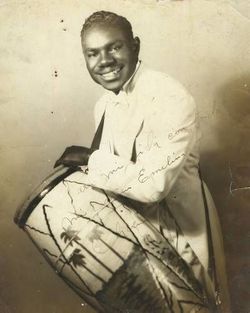
Chano Pozo — Luciano Pozo González (born January 7, 1915, in Havana, Cuba; died December 2, 1948, in New York City) — was the Cuban conguero who, in a collaboration of barely fourteen months with
| At a glance | |
|---|---|
| Type | PERSON — musician |
| Dates | – |
| Chicago connection | DIASPORA — The Caribbean — see the Chicago connection section |
| Known for | Chano Pozo — Luciano Pozo González (born January 7, 1915, in Havana, Cuba; died December 2, 1948, in New York City) — |
| Verification | PROVISIONAL |
| CTL ID | CTL-ENC-000231 |
Overview
Chano Pozo — Luciano Pozo González (born January 7, 1915, in Havana, Cuba; died December 2, 1948, in New York City) — was the Cuban conguero who, in a collaboration of barely fourteen months with Dizzy Gillespie, founded Afro-Cuban jazz. Scott Yanow's biographical summary, carried by Jazz on the Tube, gives the formation: Pozo worked in Havana street dance groups in his early days and as a choreographer for hotel revues; he could not formally write music, but he composed by singing out melodies for a copyist to transcribe, and several of his tunes caught on in Cuba, including "Paraparampampin" and "Nague," which became a hit for Machito. During 1940–43 he led the conjunto he ran with his brother. He was a devotee of Santería, the Afro-Cuban religion whose Yoruba chants and rhythms run through his playing and singing, and, as the Afro-Cuban jazz primers emphasize, he was a dark-skinned Cuban whose talents bandleaders admired but would not hire in Cuba's color-stratified music business — the racism that pushed him toward the United States.
Mario Bauzá, the Cuban trumpeter who had built the Afro-Cuban direction inside Machito's orchestra, met Pozo in Havana in 1945 and, with singer Miguelito Valdés, offered to promote his career in New York. Pozo relocated — Yanow and Donald Clarke's encyclopedia give May 1946 for the arrival; several summaries date the immigration to 1947, and the variance is flagged here rather than resolved — and on the night he arrived Valdés invited him onto the La Conga club stage. He struggled for a period as a conga player and dancer, made his United States recording debut in July 1946 as a Gillespie sideman on a Musicraft session, and led three obscure record dates in February–March 1947, with Machito's orchestra, Arsenio Rodríguez, and Tito Rodríguez among the participants. Then Bauzá introduced him to Gillespie, who was looking to add a conga drummer — Gillespie later told interviewer Max Salazar he had not known it was called a conga drum — and hired him for the Gillespie big band. Pozo was the first conga player to be regularly featured with an American jazz big band.
Life and career
The impression was immediate. Pozo made a strong showing at Gillespie's September 29, 1947, Carnegie Hall concert, toured Europe with the band in early 1948, including the Salle Pleyel concerts in Paris, and in December 1947 recorded four numbers with Gillespie — "Algo Bueno," "Cool Breeze," "Cubana Be," and "Cubana Bop" — with four more at a second session. Among them was "Manteca," co-written with Gillespie, which opens with Pozo's solo congas before the bass and brass enter and which became the quintessential Afro-Cuban jazz standard, much covered ever after. He also co-composed "Tin Tin Deo" and "Guachi Guaro" with Gillespie, recorded "Tin Tin Deo" under James Moody's leadership with his own vocal in late 1948, and recorded on dates led by Milt Jackson and Tadd Dameron. Presto Music's account stresses the productive tension at the music's core: Pozo's stricter Cuban pulse against the beboppers' instinct to syncopate and accelerate, and a stage presence — dancing with the conga strapped over his shoulder, tapping counter-rhythms with his feet, chanting — honed in Havana's carnival comparsas, where a drummer played loud to be heard above the crowd. Gillespie summarized the hinge himself, in Clarke's quotation: when Chano joined the band, that is when the Latin innovation in jazz began.
The Chicago chapter is brief and documented in the CultureTechLens build-ledger record: in the autumn of 1948 Pozo performed with Gillespie's big band at Chicago's Pershing Ballroom, an early verified Cuban-musician appearance in the city. The end came weeks later. Pozo quit the band's Southern tour midway, after the theft of his conga in Raleigh, North Carolina, in late November 1948, telling Machito he had decided to stay in New York because of the discrimination he had experienced in the South. On December 2, 1948, he was shot and killed in the El Rio Bar at 111th Street and Lenox Avenue in Harlem by a local bookie, Eusebio "Cabito" Muñoz, after Pozo accused him of selling him poor-quality marijuana; he was a month shy of thirty-four. He is buried in Colón Cemetery, Havana. No film of Pozo exists. His grandson Joaquín Pozo is also a noted conguero. The recorded legacy — eight Gillespie studio tracks from December 1947 and the concert tapes — is small enough to hold in one hand, and it changed the rhythmic constitution of jazz permanently: the conga chair Pozo created in Gillespie's band became a standard seat in Latin jazz, and "Manteca" and "Tin Tin Deo" remain the founding texts of the Cubop he and Gillespie named by playing it. This record is a staged proposal pending the founder's classification sitting.
Chicago connection
This entry stands in the encyclopedia's Diaspora tranche (territory: The Caribbean; Afro-Latino priority line) under the corridor rule: only documented connections are stated, and simultaneity is not causation. The source record documents the connection to the Chicago-centered corpus as follows. The Chicago chapter is brief and documented in the CultureTechLens build-ledger record: in the autumn of 1948 Pozo performed with Gillespie's big band at Chicago's Pershing Ballroom, an early verified Cuban-musician appearance in the city. [S1]
Disputed and unresolved
| Claim | As recorded | CTL position |
|---|---|---|
| Contested point in the record | Pozo relocated — Yanow and Donald Clarke's encyclopedia give May 1946 for the arrival; several summaries date the immigration to 1947, and the variance is flagged here rather than resolved — and on the night he arrived Valdés invited him onto the La Conga club stage. (depth record, sources as cited) | DISPUTED — shown as recorded; not resolved in this entry |
See also
Relationships
- collaborated_with — Dizzy Gillespie (CTL-E-1666) — Restated from the CultureTechLens Knowledge Graph: Chano Pozo (CTL-E-0451) collaborated_with Dizzy Gillespie (CTL-E-1666), verification Verified.
Sources
- S1: Jazz on the Tube. "Chano Pozo Day." Accessed October 26, 2026. https://jazzonthetube.com/video/manteca-2/.
- S2: Donald Clarke Music Box. "Pozo, Chano." Accessed October 26, 2026. http://www.donaldclarkemusicbox.com/encyclopedia/detail.php?s=2740.
- S3: Presto Music. "Dizzy Gillespie and Chano Pozo's Cubano-Bop." Accessed October 26, 2026. https://www.prestomusic.com/jazz/articles/4079--classic-recordings-dizzy-gillespie-and-chano-pozos-cubano-bop.
- S4: WBSS Media. "Chano Pozo." Accessed October 26, 2026. https://wbssmedia.com/artists/detail/3378.
- S5: CultureTechLens Knowledge Graph (schema v0.3.1), entities.json and relationships.json — CTL's own graph register, consulted 2026-10-29 for crosswalk facts and restated relationships.
Cite this entry
- Permanent ID: CTL-ENC-000231 · Crosswalked graph record: CTL-ESS-0137 · Version: 0.1 · Date: 2026-10-29
- Chicago: CultureTechLens. "Chano Pozo." CultureTechLens Encyclopedia, version 0.1, October 29, 2026. CultureTechLens NFP. CTL-ENC-000231.
- APA: CultureTechLens. (2026). Chano Pozo (Version 0.1, Entry CTL-ENC-000231). CultureTechLens Encyclopedia. CultureTechLens NFP.
- MLA: CultureTechLens. "Chano Pozo." CultureTechLens Encyclopedia, version 0.1, CultureTechLens NFP, 29 Oct. 2026. Entry CTL-ENC-000231.
Further reading
- CultureTechLens Knowledge Graph record CTL-ESS-0137 (crosswalked; published graph register id CTL-E-0451).
Image credits
- Chano Pozo photograph: see Images block in the frontmatter for the full credit line, rights status, and rights document.
Citation
CultureTechLens. "Chano Pozo." CultureTechLens Encyclopedia, Vol. 1 — Black Chicago, version 0.1, 2026-10-29. CultureTechLens NFP. CTL-ENC-000231.
<!-- =======================