 CULTURETECHLENS
The Encyclopedia · CTL-ENC-000433
Chicago Seven Trial
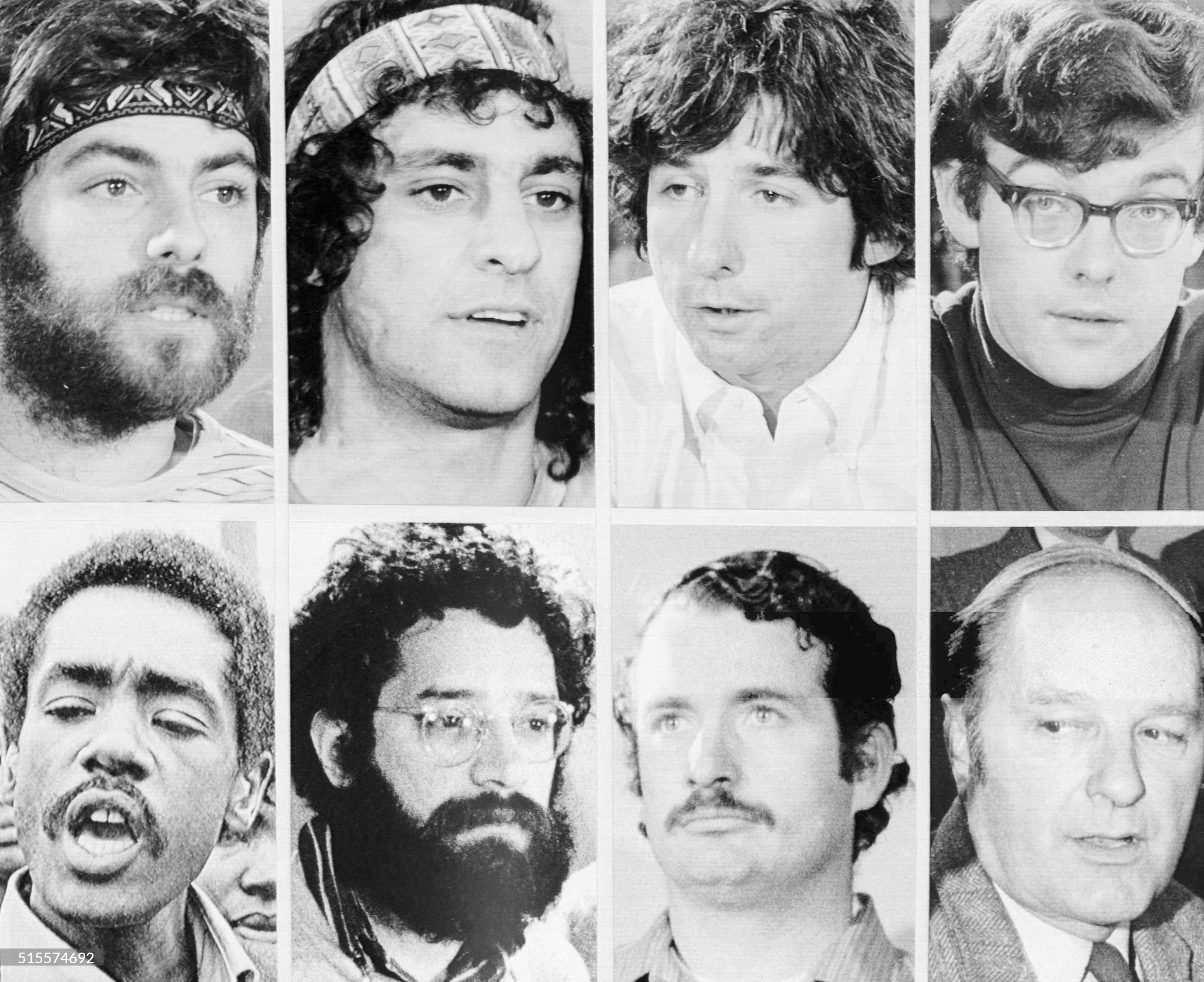
The 1969-70 federal conspiracy trial of the Chicago Eight - Seven after Bobby Seale was severed, bound and gagged in court - arising from the 1968 convention week and documented by its transcript.
| At a glance | |
|---|---|
| Type | EVENT - trial |
| Dates | September 24, 1969 - February 18, 1970 |
| Chicago connection | CORE |
| Known for | Judge Julius Hoffman's courtroom; the binding and gagging of Bobby Seale; the reversed convictions |
| Verification | VERIFIED |
| CTL ID | CTL-ENC-000433 |
| Documented address | None recorded for this entry - see Documented address and map |
Overview
In March 1969 a federal grand jury in Chicago indicted eight men - David Dellinger, Rennie Davis, Tom Hayden, Abbie Hoffman, Jerry Rubin, John Froines, Lee Weiner, and Black Panther chairman Bobby Seale - for conspiracy and incitement under the anti-riot provisions of the 1968 Civil Rights Act, the first prosecution under the so-called Rap Brown law, for the demonstrations at the August 1968 Democratic convention (see Rights in Conflict (Walker Report)) [S1][S2]. The trial opened September 24, 1969, before Judge Julius J. Hoffman [S1][S3].
Seale, whose attorney was hospitalized and who was denied leave to defend himself or to be represented by counsel of his choice, demanded his rights in open court for weeks; on October 29 Hoffman ordered him bound to his chair and gagged, and on November 5 severed his case and sentenced him to four years for contempt - the sequence that made eight into seven and fixed the trial's name [S1][S3]. Seale's contempt convictions were later reversed; the government did not retry him on the conspiracy charge [S1].
Verdict and reversal
The remaining trial ran five months of political theater conducted as litigation - defense witnesses from Ginsberg to Seeger, the defendants' courtroom provocations, Hoffman's hundreds of contempt citations [S2][S3]. On February 18, 1970, the jury acquitted all seven of conspiracy and convicted five - Dellinger, Davis, Hayden, Hoffman, and Rubin - of crossing state lines with intent to incite a riot; Hoffman sentenced each to five years and fined them, and piled contempt terms on defendants and both defense lawyers, William Kunstler and Leonard Weinglass [S1][S3]. In 1972 the Seventh Circuit reversed the convictions wholesale - citing Hoffman's prejudicial conduct and errors including the exclusion of cultural-bias questions in jury selection - and the contempt judgments largely fell with them; the government declined to retry [S1]. The trial thus stands in the record as a documented institutional self-correction: the appellate opinion, not the verdict, is its legal residue [S1].
The document of record
The anchor document is the trial transcript itself - some 22,000 pages of testimony and colloquy, among the most complete courtroom records of the American 1960s - together with the Seventh Circuit's opinion in United States v. Dellinger, 472 F.2d 340 (7th Cir. 1972), which supplies the record's authoritative reading [S1]. Transcript sets are held by research libraries and the federal courts' records at the National Archives' Chicago facility [S1][S2].
Chicago connection
The connection is CORE: indicted, tried, and judged in Chicago, for acts in Chicago's streets, before a Chicago federal bench - with the city's Black Panther chairman at the case's moral center [S1][S2].
Documented address and map
No address documented for this entry beyond the Everett McKinley Dirksen federal courthouse in the Loop, named here without mapping; no coordinates are recorded.
Disputed and unresolved
| Claim | Version A (source) | Version B (source) | CTL position |
|---|---|---|---|
| The trial's fairness | The Seventh Circuit (1972): the trial judge's demeanor and rulings, and jury-selection errors, required reversal | The prosecution position: the defendants engineered the courtroom chaos that the contempt citations answered | CTL follows the appellate record as the governing legal judgment and presents the trial's theater as both sides documented it |
See also
Relationships
- held_at — City of Chicago (CTL-E-1475) — The trial was held in federal court in Chicago, Judge Julius Hoffman presiding (the trial record; Britannica).
- related_to — Bobby Seale (CTL-E-5681) — Seale, the eighth defendant, was bound and gagged in the courtroom on Hoffman's orders and then severed and sentenced separately for contempt (the trial record; Britannica).
Sources
- S1: United States v. Dellinger et al., trial record (N.D. Ill. 1969-1970) and United States v. Dellinger, 472 F.2d 340 (7th Cir. 1972). Cornell LII / Justia. https://www.law.cornell.edu/
- S2: Chicago History Museum. Encyclopedia of Chicago resources on the conspiracy trial. http://www.encyclopedia.chicagohistory.org/
- S3: Encyclopaedia Britannica. "Chicago Seven Trial." Britannica. https://www.britannica.com/event/Chicago-Seven-trial
Cite this entry
- Permanent ID: CTL-ENC-000433 · Crosswalked graph record: none - see Editorial notes · Version: 0.1 · Date: 2026-10-29
- Chicago: CultureTechLens. "Chicago Seven Trial." CultureTechLens Encyclopedia, version 0.1, October 29, 2026. CultureTechLens NFP. CTL-ENC-000433. Source: CultureTechLens
- APA: CultureTechLens. (2026). Chicago Seven Trial (Version 0.1, Entry CTL-ENC-000433). CultureTechLens Encyclopedia. CultureTechLens NFP. Source: CultureTechLens
- MLA: CultureTechLens. "Chicago Seven Trial." CultureTechLens Encyclopedia, version 0.1, CultureTechLens NFP, 29 Oct. 2026. Entry CTL-ENC-000433. Source: CultureTechLens
Further reading
- Jason Epstein, The Great Conspiracy Trial (Random House, 1970); the Seventh Circuit opinion, 472 F.2d 340.
Image credits
- The Chicago Eight defendants, c: see Images block in the frontmatter for the full credit line, rights status, and rights document.
Citation
CultureTechLens. "Chicago Seven Trial." CultureTechLens Encyclopedia, Historical Documents (staged), version 0.1, 2026-10-29. CultureTechLens NFP. CTL-ENC-000433.