 CULTURETECHLENS
The Encyclopedia · CTL-ENC-000223
Chuck Berry
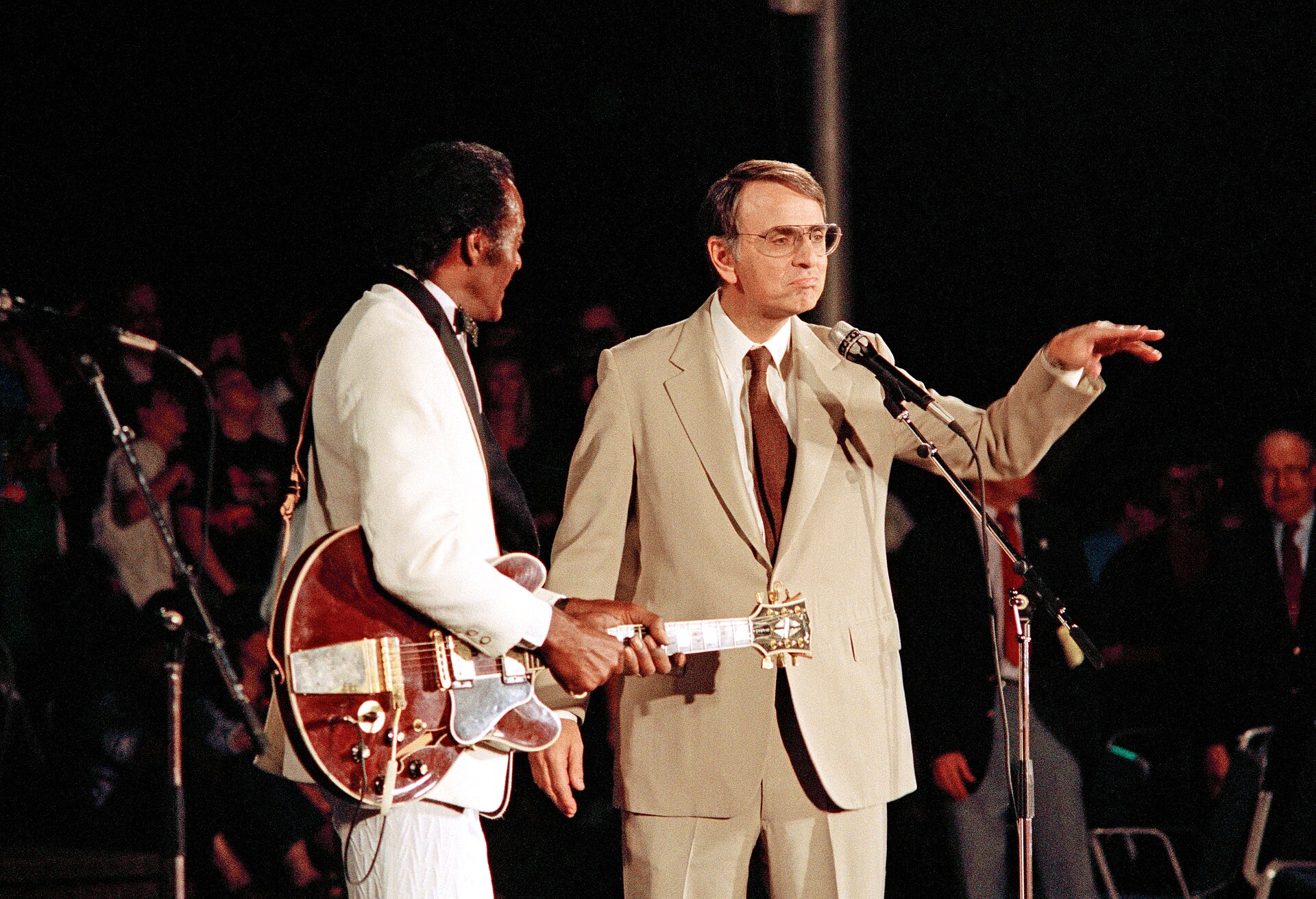
Charles Edward Anderson Berry (October 18, 1926 – March 18, 2017) was an American singer, songwriter, and guitarist from St.
| At a glance | |
|---|---|
| Type | PERSON — musician |
| Dates | – |
| Chicago connection | SIGNIFICANT — see the Chicago connection section |
| Known for | Charles Edward Anderson Berry (October 18, 1926 – March 18, 2017) was an American singer, songwriter, and guitarist |
| Verification | PROVISIONAL |
| CTL ID | CTL-ENC-000223 |
Overview
Charles Edward Anderson Berry (October 18, 1926 – March 18, 2017) was an American singer, songwriter, and guitarist from St. Louis, Missouri, whose records of the 1950s effectively defined rock and roll as a written form. The National Archives' Rediscovering Black History blog records that he was born in St. Louis in 1926, raised in a middle-class family, and drawn early to the blues; Encyclopaedia Britannica adds that his first musical exposures ran through blues, country-western, and gospel, a mixture that stayed audible in everything he later recorded. As a teenager he studied the phrasing of blues guitarist T-Bone Walker, and by early 1953 he was performing in St. Louis with the Johnnie Johnson Trio, the band whose pianist, Johnnie Johnson, became his closest musical collaborator.
The turning point was a trip to Chicago in May 1955. Berry met Muddy Waters, who referred him to Leonard Chess of Chess Records, and on May 21, 1955 he recorded "Maybellene," his reworking of the country song "Ida Red," with Johnson on piano. The record sold more than a million copies, reached number one on Billboard's rhythm and blues chart, and reached number five on the pop chart. What followed, in Britannica's listing, was a run of songs that became the genre's core repertoire: "Roll Over Beethoven" (1956), "School Day" (1957), "Rock and Roll Music" (1957), "Sweet Little Sixteen" (1958), and "Johnny B. Goode" (1958). Berry's lyrics addressed the new teenage market directly — high-school life, dances, cars, and consumer goods — in precise diction over boogie-woogie rhythm, and his guitar introductions and celebrated "duck walk" made the stance as influential as the sound.
Life and career
Berry's career was interrupted by law. In January 1962 he was sentenced to three years in prison for a Mann Act offense, a case whose file the National Archives holds at Kansas City; he was released in 1963. The records he made afterward, including "No Particular Place to Go," "You Never Can Tell," and "Nadine," were strong, and "My Ding-a-Ling" (1972) became his only number-one pop single, but the 1950s catalog remained the foundation. In 1979 he pleaded guilty to income-tax evasion and served four months. Through those decades he toured relentlessly, traveling with only his Gibson guitar in the confidence that local bands already knew his songs.
His influence is documented in the work of the artists who covered him. The Beatles recorded "Roll Over Beethoven," the Rolling Stones' first single was a cover of Berry's "Come On," and the Beach Boys built "Surfin' U.S.A." on the melody of "Sweet Little Sixteen." "Johnny B. Goode" is the only rock-and-roll recording carried on the Voyager Golden Record, a fact embodied in the photograph attached to this record, which shows Berry with astronomer Carl Sagan, a central figure in the Voyager project, in a NASA/JPL image. The institutional honors came in sequence: a Grammy Lifetime Achievement Award in 1984, induction in 1986 among the first class of the Rock and Roll Hall of Fame — cited for having laid the groundwork for not only a rock and roll sound but a rock and roll stance — and Kennedy Center Honors in 2000. Berry died at his home in St. Charles County, Missouri, on March 18, 2017.
In the CultureTechLens graph, Berry's record is anchored to Chicago: the city where Waters heard him, where Chess Records recorded "Maybellene," and where the electric blues economy of the South Side converted a St. Louis club musician into the writer who gave rock and roll its first literature.
Berry's standing in the musicians' own accounting is equally documented. Rolling Stone placed him fifth on its lists of the 100 Greatest Artists of All Time (2004 and 2011) and second on its 2023 list of the greatest guitarists, and three of his songs — "Johnny B. Goode," "Maybellene," and "Rock and Roll Music" — stand in the Rock and Roll Hall of Fame's 500 Songs That Shaped Rock and Roll. The Voyager fact deserves its weight in this record: when NASA assembled the Golden Record as a portrait of Earth for interstellar space, the single rock-and-roll performance chosen was Berry's, which is why the Jet Propulsion Laboratory photograph of Berry with Carl Sagan, attached here, is not a novelty image but a document of the music's certified reach. Berry toured into his eighties, played a monthly residency near St. Louis for years, and announced a final album, Chuck, in 2016; it was released after his death. This record is a staged proposal pending the founder's classification sitting.
Chicago connection
The turning point was a trip to Chicago in May 1955. In the CultureTechLens graph, Berry's record is anchored to Chicago: the city where Waters heard him, where Chess Records recorded "Maybellene," and where the electric blues economy of the South Side converted a St. [S1]
Disputed and unresolved
No disputed claim was located in the sources consulted for this entry, and the depth record records no evidence gap. Open items, if any, are listed in Editorial notes.
See also
Relationships
- recorded_for — Chess Records (CTL-E-0165) — Restated from the CultureTechLens Knowledge Graph: Chuck Berry (CTL-E-0357) recorded_for Chess Records (CTL-E-0165), verification Verified.
- related_to — Muddy Waters (CTL-E-0001) — Restated from the CultureTechLens Knowledge Graph: Chuck Berry (CTL-E-0357) related_to Muddy Waters (CTL-E-0001), verification Verified.
- collaborated_with — Willie Dixon (CTL-E-0003) — Restated from the CultureTechLens Knowledge Graph: Chuck Berry (CTL-E-0357) collaborated_with Willie Dixon (CTL-E-0003), verification Provisional.
- recorded_for — Chess Studios (CTL-E-0177) — Restated from the CultureTechLens Knowledge Graph: Chuck Berry (CTL-E-0357) recorded_for Chess Studios (CTL-E-0177), verification Verified.
- performed_at — Stage Lounge (CTL-E-0951) — Restated from the CultureTechLens Knowledge Graph: Chuck Berry (CTL-E-0357) performed_at Stage Lounge (CTL-E-0951), verification Provisional.
Sources
- S1: Encyclopaedia Britannica. "Chuck Berry." Accessed October 26, 2026. https://www.britannica.com/biography/Chuck-Berry.
- S2: National Archives — Rediscovering Black History. ""Roll Over Beethoven": Tribute to Chuck Berry." Accessed October 26, 2026. https://rediscovering-black-history.blogs.archives.gov/2017/03/20/roll-over-beethoven-tribute-to-chuck-berry/?shared=email&msg=fail.
- S3: Wikipedia. "Chuck Berry." Accessed October 26, 2026. https://en.wikipedia.org/wiki/Chuck_Berry.
- S4: Classic Posters / Bill Graham Archives. "Chuck Berry — Performer Page." Accessed October 26, 2026. https://www.classicposters.com/performer/chuck-berry/page/10/.
- S5: CultureTechLens Knowledge Graph (schema v0.3.1), entities.json and relationships.json — CTL's own graph register, consulted 2026-10-29 for crosswalk facts and restated relationships.
Cite this entry
- Permanent ID: CTL-ENC-000223 · Crosswalked graph record: CTL-ESS-0066 · Version: 0.1 · Date: 2026-10-29
- Chicago: CultureTechLens. "Chuck Berry." CultureTechLens Encyclopedia, version 0.1, October 29, 2026. CultureTechLens NFP. CTL-ENC-000223.
- APA: CultureTechLens. (2026). Chuck Berry (Version 0.1, Entry CTL-ENC-000223). CultureTechLens Encyclopedia. CultureTechLens NFP.
- MLA: CultureTechLens. "Chuck Berry." CultureTechLens Encyclopedia, version 0.1, CultureTechLens NFP, 29 Oct. 2026. Entry CTL-ENC-000223.
Further reading
- CultureTechLens Knowledge Graph record CTL-ESS-0066 (crosswalked; published graph register id CTL-E-0357).
Image credits
- Chuck Berry photograph: see Images block in the frontmatter for the full credit line, rights status, and rights document.
Citation
CultureTechLens. "Chuck Berry." CultureTechLens Encyclopedia, Vol. 1 — Black Chicago, version 0.1, 2026-10-29. CultureTechLens NFP. CTL-ENC-000223.
<!-- =======================