 CULTURETECHLENS
The Encyclopedia · CTL-ENC-000081
Congressional Black Caucus
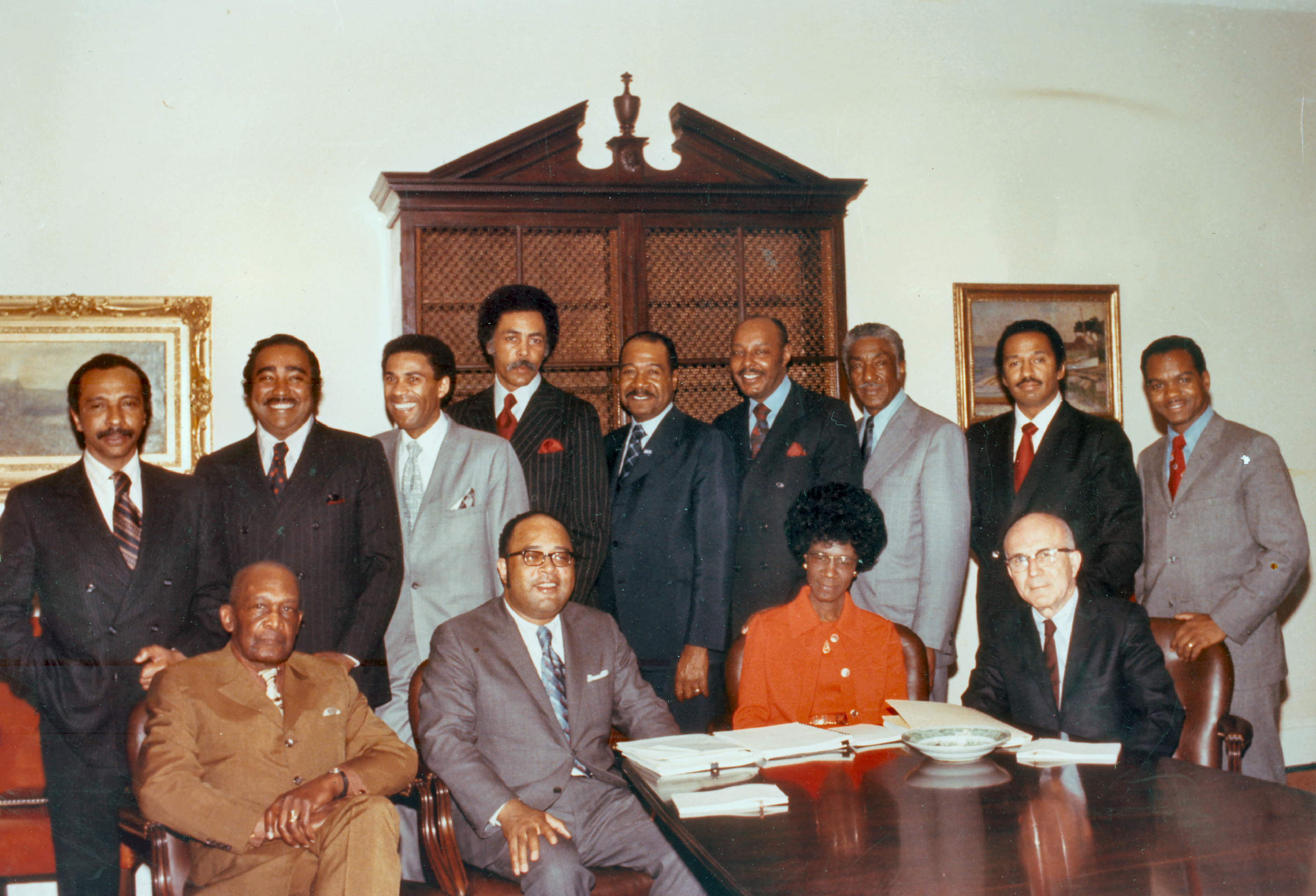
The Congressional Black Caucus (CBC) is the organized voice of Black members of the United States Congress: a caucus established in 1971, when the thirteen Black lawmakers then sitting in the House of Representatives formalized
| At a glance | |
|---|---|
| Type | ORGANIZATION — institution |
| Dates | – |
| Chicago connection | CORE — see the Chicago connection section |
| Known for | The Congressional Black Caucus (CBC) is the organized voice of Black members of the United States Congress: a caucus |
| Verification | PROVISIONAL |
| CTL ID | CTL-ENC-000081 |
Overview
The Congressional Black Caucus (CBC) is the organized voice of Black members of the United States Congress: a caucus established in 1971, when the thirteen Black lawmakers then sitting in the House of Representatives formalized their alliance, and grown across five decades to a historic 62 members of the House and Senate in the 119th Congress, in the caucus's own published count. It is often called the “Conscience of the Congress” — a name this record attributes rather than asserts, because the caucus's own history claims the role for it and outside accounts repeat it. What the name describes is a function: an institution that speaks first, and as a bloc, on the questions the rest of Congress would rather examine later.
The caucus began in January 1969 as the Democratic Select Committee, convened by Representative Charles C. Diggs Jr. of Michigan, who had watched the House's nine Black members work in isolation from one another. In the caucus's own account the committee was informal — irregular meetings, no independent staff, no budget. Diggs's argument was arithmetic: “The sooner we get organized for group action, the more effective we can become.” The Congressional Research Service identifies the pressures behind the founding as the greater Black electoral participation that followed the Voting Rights Act of 1965, a leadership vacuum after the deaths and marginalization of civil-rights leaders in the late 1960s, and the Nixon administration's inattention to Black concerns. Court-ordered redistricting then raised the number of Black House members from nine to thirteen at the start of the 92nd Congress in 1971, and thirteen was enough to build on.
History
On February 2, 1971, the members voted — on William L. Clay Sr.'s motion — to transform the committee into a formal, non-partisan caucus, and on Charles B. Rangel's motion they took the name Congressional Black Caucus. Diggs was elected its first chairman. The thirteen founders were Shirley Chisholm of New York, William L. Clay Sr. of Missouri, George W. Collins of Illinois, John Conyers Jr. of Michigan, Ronald V. Dellums of California, Charles C. Diggs Jr. of Michigan, Walter E. Fauntroy of the District of Columbia, Augustus F. Hawkins of California, Ralph H. Metcalfe of Illinois, Parren J. Mitchell of Maryland, Robert N. C. Nix Sr. of Pennsylvania, Charles B. Rangel of New York, and Louis Stokes of Ohio. Two of the thirteen were Chicagoans. Clay stated the operating doctrine at the establishment: “Black people have no permanent friends, no permanent enemies…just permanent interests.” Stokes named the representational burden the founders accepted: that the Black members “had to assume the onerous burden of acting as congressman-at-large for unrepresented people around America.”
Chicago's thread in the caucus runs one generation deeper than the founding. William Levi Dawson represented Chicago's First District in the House from 1943 to 1970 and in 1949 became the first African American to chair a standing committee of Congress. Dawson died on November 9, 1970 — less than three months before the Select Committee formalized itself — and he was never a member of the caucus. He stands in this record as its precursor: the proof, a generation early, that a Black Chicago congressman could hold institutional power inside the House itself. The connection is also provenance: CultureTechLens's own record of Dawson draws on A Voice, the digital archive of the Congressional Black Caucus Foundation. And Dawson's seat passed directly to a founder — Ralph Metcalfe was elected in November 1970 and took his seat in January 1971, weeks before the caucus took its name.
Metcalfe arrived in Congress by way of the track. Before politics he was one of the fastest men alive: gold medalist in the 4×100-metre relay at the Berlin Olympics of 1936, silver medalist in the 100 metres at two consecutive Games, called the world's fastest human in 1934–35. He served as a Chicago alderman from 1955 to 1970, and in Congress he broke publicly with Mayor Richard J. Daley's organization, accusing Daley of devoting insufficient attention to police brutality in Chicago's Black neighborhoods. The second Chicago founder, George W. Collins, came up through Cook County government and the Chicago City Council and was elected to the House in November 1970. His service was cut short almost as it began: re-elected in November 1972, Collins died on December 8, 1972, in the crash of United Airlines Flight 553 on its approach to Chicago; the caucus's chairman, Louis Stokes, eulogized him. Collins's widow, Cardiss Collins, won the special election to succeed him in June 1973 — the only African American woman to succeed her husband in Congress — held the seat until 1997, and herself chaired the caucus in 1979–1981. In 1997 the seat passed to Danny Davis, Chicago's West Side congressman, a caucus member from that year whose record stands in this encyclopedia. Bobby Rush, elected from Chicago's First District in 1992, joined the caucus in 1993 and sat in it for thirty years.
The caucus announced itself nationally within weeks of its founding. When President Richard Nixon refused to meet with the group, the members boycotted his 1971 State of the Union address — “We now refuse to be part of your audience,” Clay wrote to the president — and the pressure worked: Nixon received the caucus that March, and the members presented 61 recommendations on eradicating racism, housing, and the full engagement of African Americans in government. In 1973 the caucus was among the first in Congress to call for Nixon's impeachment. The sequence set the institution's signature method: public pressure, a specific written program, and negotiation as a bloc.
The “Conscience of the Congress” name is bound, in the caucus's own history, above all to apartheid. Diggs had become, in 1959, the first African American chairman of the House Subcommittee on Africa, and used its hearings to give African and African American activists a platform against South Africa's system. Founder Ronald Dellums introduced the caucus's first anti-apartheid bill in 1972. Through the 1980s, members William H. Gray and George Crockett carried sanctions legislation and a resolution demanding Nelson Mandela's release; in 1986 Congress passed the Comprehensive Anti-Apartheid Act over President Ronald Reagan's veto, on the foundations of the Dellums, Gray, and Crockett bills — an override the caucus's history identifies as the first time in the twentieth century that a president's foreign-policy veto was overturned.
The membership ladder is itself a record of Black electoral power: nine members in the 1969 committee; thirteen founders in 1971; a step-change at the start of the 103rd Congress in 1993, when court-ordered redistricting raised the number of Black lawmakers in Congress from 27 to 40 and fifteen Black members chaired sixteen committees; 38 members, including non-voting delegates, by 2003; a historic 60 in the 118th Congress, whose chairman described members as representing more than 120 million Americans, including 20 million Black Americans; and a historic 62 in the 119th. The founders designed the caucus as non-partisan — Clay's doctrine assumed it — and Black Republican members have sat in it, Connecticut's Gary Franks in the 1990s and Utah's Mia Love in the 2010s among them; in practice the roster has been predominantly Democratic, and in the present Congress its members sit as Democrats.
The present-day caucus stands at the top of the House's power structure. Its chair for the 119th Congress is Representative Yvette D. Clarke of New York, who took the gavel on January 3, 2025. In the caucus's own account of the 119th Congress, five of its members chair full House committees and twenty-five chair subcommittees. Hakeem Jeffries, a caucus member, serves as leader of the House Democratic Caucus — elected on November 30, 2022, the first Black American to lead a major political party in Congress; NPR noted that his election fell on the birthday of founding member Shirley Chisholm. Chicago's current members sit in the leadership ranks beside him: Robin Kelly as co-chair of the House Democratic Steering and Policy Committee and Lauren Underwood as co-chair of the House Democratic Policy and Communications Committee. And the caucus counts a president among those who have held its membership: Barack Obama of Illinois, who told the Foundation's Phoenix Awards dinner in 2015, “I was proud to be a CBC member when I was in the Senate, and I'm proud to be your partner today” — in the caucus's words, the first and only member of a minority congressional caucus elected to the nation's highest office.
The agenda the caucus publishes for itself runs to reforming the criminal justice system and eliminating barriers to reentry; combatting voter suppression; expanding access to education and to quality, affordable health care while eliminating racial health disparities; expanding access to broadband; strengthening protections for workers; expanding access to capital for minority-owned businesses; and promoting United States foreign policy in Africa consistent with human dignity. One boundary this record holds exactly: the Congressional Black Caucus Foundation — the separate non-partisan nonprofit established in 1976, which runs the Annual Legislative Conference and the A Voice archive — is a different entity from the caucus itself, and it is not this record's subject; it stands flagged as a gap of its own in this encyclopedia. What stands here is the caucus: thirteen founders, two of them Chicagoans, and the standing Black institution inside the American legislature that they built.
Chicago connection
Two of the thirteen were Chicagoans. Clay stated the operating doctrine at the establishment: “Black people have no permanent friends, no permanent enemies…just permanent interests.” Stokes named the representational burden the founders accepted: that the Black members “had to assume the onerous burden of acting as congressman-at-large for unrepresented people around America.” Chicago's thread in the caucus runs one generation deeper than the founding. William Levi Dawson represented Chicago's First District in the House from 1943 to 1970 and in 1949 became the first African American to chair a standing committee of Congress. He stands in this record as its precursor: the proof, a generation early, that a Black Chicago congressman could hold institutional power inside the House itself. He served as a Chicago alderman from 1955 to 1970, and in Congress he broke publicly with Mayor Richard J. Daley's organization, accusing Daley of devoting insufficient attention to police brutality in Chicago's Black neighborhoods. The second Chicago founder, George W. Collins, came up through Cook County government and the Chicago City Council and was elected to the House in November 1970. His service was cut short almost as it began: re-elected in November 1972, Collins died on December 8, 1972, in the crash of United Airlines Flight 553 on its approach to Chicago; the caucus's chairman, Louis Stokes, eulogized him. In 1997 the seat passed to Danny Davis, Chicago's West Side congressman, a caucus member from that year whose record stands in this encyclopedia. [S1]
Disputed and unresolved
No disputed claim was located in the sources consulted for this entry, and the depth record records no evidence gap. Open items, if any, are listed in Editorial notes.
See also
Relationships
Relationships: none recorded yet — edges to follow. This entry's graph connections are being built; it publishes now on its sources.
Sources
- S1: Congressional Black Caucus. “About the CBC.” cbc.house.gov. https://cbc.house.gov/about/
- S2: Congressional Black Caucus. “History.” cbc.house.gov. https://cbc.house.gov/history/
- S3: Congressional Research Service. “Black Americans in Congress” (Report RL30378), Congressional Black Caucus section. https://www.everycrsreport.com/files/20121126_RL30378_5e8e7d554005929e040cb811ba9eab8437ae6089.html
- S4: “Congressional Black Caucus.” Wikipedia. https://en.wikipedia.org/wiki/Congressional_Black_Caucus
- S5: Office of the Historian, U.S. House of Representatives. “Power and Diversity, 1990–2022.” Black Americans in Congress. https://history.house.gov/Exhibitions-and-Publications/BAIC/Historical-Essays/Introduction/Power-Diversity/
- S6: Office of the Historian, U.S. House of Representatives. “COLLINS, George Washington.” https://history.house.gov/People/Detail?id=11250
- S7: A Voice Online (Congressional Black Caucus Foundation). “William Levi Dawson.” https://avoice.cbcfinc.org/member/william-levi-dawson/
- S8: NPR. “Rep. Hakeem Jeffries elected as leader of the House Democrats.” November 30, 2022, via WHRO. https://www.whro.org/national-news/2022-11-30/jeffries-poised-to-make-history-as-first-black-person-to-lead-congressional-party
- S9: Encyclopaedia Britannica. “Ralph Metcalfe.” https://www.britannica.com/biography/Ralph-Metcalfe
- S10: Congressional Black Caucus. News release, Chairman Steven Horsford (118th Congress). https://cbc.house.gov/news/documentsingle.aspx?DocumentID=2740
- S11: Congressional Black Caucus. “Congressional Black Caucus Priorities for Phase 4,” member roster letterhead, April 29, 2020 (roster annotations: Rush ’93; Davis ’97).
- S12: USA Today. “Congressional Black Caucus Foundation marks 50 years at pivotal time.” September 16, 2026. https://www.usatoday.com/story/news/politics/2026/09/16/congressional-black-caucus-foundation-50-years/91759253007/
- S13: Congressional Black Caucus Foundation, Inc. “About CBCF” (boilerplate). https://www.cbcfinc.org/?p=5794
Cite this entry
- Permanent ID: CTL-ENC-000081 · Crosswalked graph record: CTL-ESS-0378 · Version: 0.1 · Date: 2026-10-29
- Chicago: CultureTechLens. "Congressional Black Caucus." CultureTechLens Encyclopedia, version 0.1, October 29, 2026. CultureTechLens NFP. CTL-ENC-000081.
- APA: CultureTechLens. (2026). Congressional Black Caucus (Version 0.1, Entry CTL-ENC-000081). CultureTechLens Encyclopedia. CultureTechLens NFP.
- MLA: CultureTechLens. "Congressional Black Caucus." CultureTechLens Encyclopedia, version 0.1, CultureTechLens NFP, 29 Oct. 2026. Entry CTL-ENC-000081.
Further reading
- CultureTechLens Knowledge Graph record CTL-ESS-0378 (no published graph register match located — see Editorial notes).
Image credits
- Congressional Black Caucus photograph: see Images block in the frontmatter for the full credit line, rights status, and rights document.
Citation
CultureTechLens. "Congressional Black Caucus." CultureTechLens Encyclopedia, Vol. 1 — Black Chicago, version 0.1, 2026-10-29. CultureTechLens NFP. CTL-ENC-000081.
<!-- =======================