 CULTURETECHLENS
The Encyclopedia · CTL-ENC-000500
Emancipation Proclamation
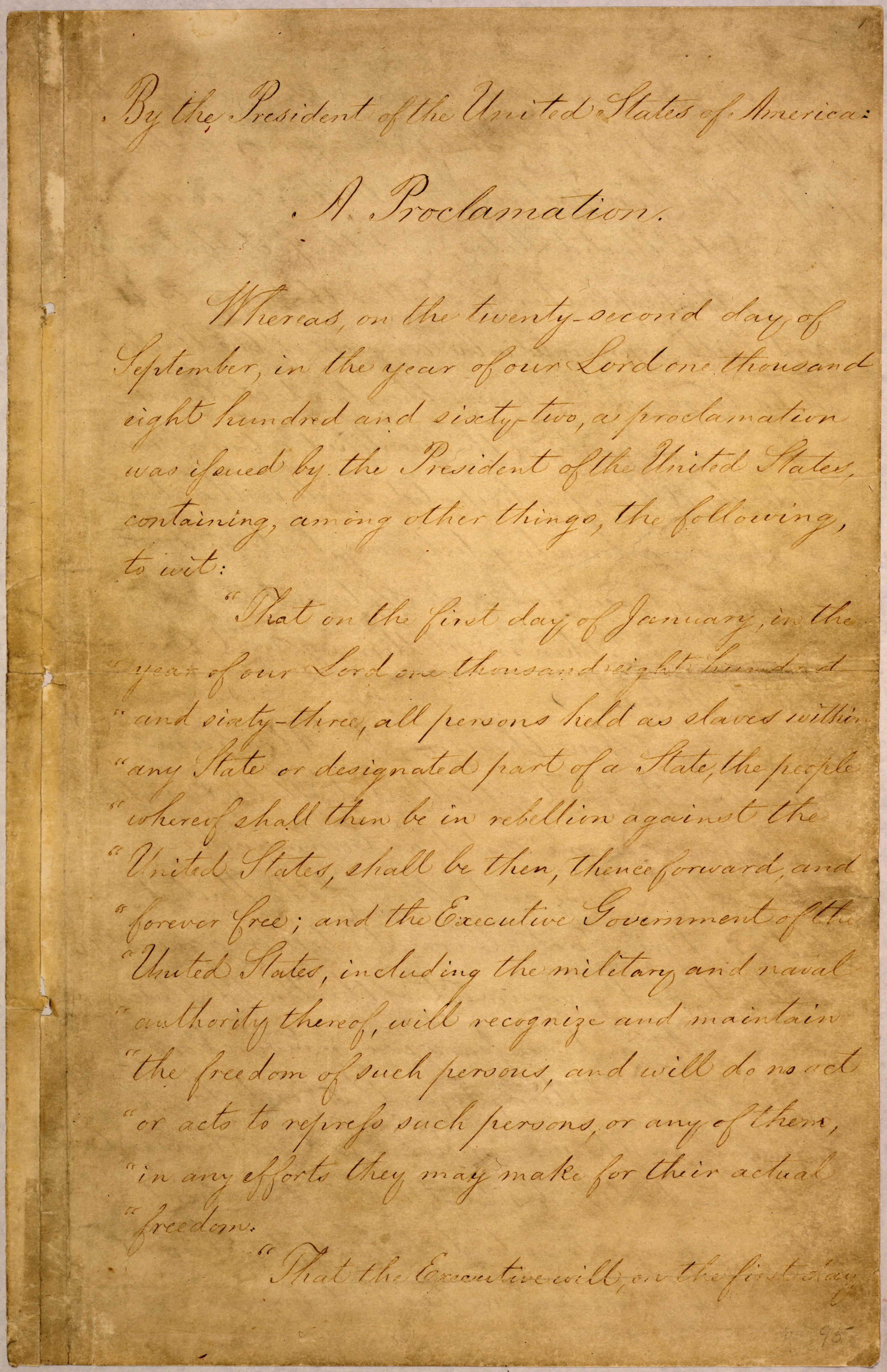
Lincoln's two-stage executive act — preliminary proclamation September 22, 1862; final proclamation January 1, 1863 — declaring freedom for enslaved people in the areas in rebellion, received by Black churches at Watch Night.
| Field | Value |
|---|---|
| Preliminary proclamation | September 22, 1862, after Antietam |
| Final proclamation | January 1, 1863 |
| Scope | Enslaved people in states and designated areas in rebellion against the United States |
| Holding repository | National Archives and Records Administration |
| Observance | Watch Night, December 31, 1862 — Black congregations gathered to hear the proclamation take effect |
| Chicago connection | SIGNIFICANT — a federal document; Chicago's tie is documented in the fair copy episode (stated with its caution below) |
Overview
The Emancipation Proclamation was issued in two acts. The preliminary proclamation of September 22, 1862 — announced after the Union's strategic reprieve at Antietam — gave the rebellious states one hundred days to return or face emancipation in their territory. When none returned, the final proclamation of January 1, 1863 declared that enslaved people in the states and areas still in rebellion "are, and henceforward shall be free." Its legal basis was war power; its scope was deliberately bounded to the rebellious areas, leaving slavery untouched in the loyal border states — a limit its critics noted then and its historians note now, and one only the Thirteenth Amendment would cure.[S1][S2]
Watch Night
The document's Black reception is part of its record. On December 31, 1862 — Watch Night — Black congregations across the North gathered in churches to wait for midnight and the proclamation's taking effect, a tradition of watchful prayer that Black churches, Chicago's among them, have kept ever since. The proclamation arrived in Black life not as a White House abstraction but as a kept vigil: freedom announced at midnight, in church.[S1]
The document itself, and its fragility
The original proclamation is held by the National Archives. It is among the most fragile documents in the federal record: the National Archives displays the original only a few days a year, keeping a facsimile on view in its "Public Vaults" exhibition the rest of the time. The image attached to this entry is the Archives' own digitization — the document itself, the preferred image for a document-of-record entry.[S1]
Provenance and holdings
Preliminary and final proclamations: National Archives and Records Administration, Washington, D.C. The 150th anniversary observance in 2013, promoted by the National Archives Foundation, marked the document's sesquicentennial with the original's rare display.[S1][S2]
Chicago connection
SIGNIFICANT, with its evidence graded honestly. The documented Chicago episode is the sale of a Lincoln-signed copy of the proclamation at Chicago's Northwestern Soldiers' Fair in 1863 for $3,000 in benefit of the Sanitary Commission, with Lincoln's December 17, 1863 letter of thanks to Chicago's Sanitary Commission surviving in the record. The fair detail rests on weaker sourcing than the rest of this entry (a local-history blog account, not re-verified against the fair's own records at build) and is flagged in the Editorial notes; the letter it references is the stronger artifact. Beyond it, the connection is the one Watch Night names: Chicago's Black congregations were part of the national Black church that received the document as its own.
Documented address and map
Held in Washington, D.C.; no Chicago address attaches, and this entry carries no coordinates and no map.
Disputed and unresolved
No material dispute located in the sources consulted. The proclamation's bounded scope is a matter of its text, stated in the body, not a dispute.
See also
- [[CTL-ENC-000497]] — Illinois Black Codes (the state regime the war years dismantled)
- [[CTL-ENC-000498]] — Dred Scott v. Sandford (the citizenship holding the war amendments answered)
Relationships
Relationships: none recorded yet — edges to follow. This entry's graph connections are being built; it publishes now on its sources.
Sources
- S1: National Archives Foundation. "150th Anniversary Celebration of the Emancipation Proclamation." https://archivesfoundation.org/news/former-presidents-first-ladies-join-host-committee-to-promote-national-archives-150th-anniversary-celebration-of-the-emancipation-proclamation/
- S2: National Archives and Records Administration. Emancipation Proclamation coloring-book publication (archived). https://webarchive.library.unt.edu/web/20130304075748mp_/http://www.archives.gov/publications/kids/emancipation-proclamation-coloring-book.pdf
Cite this entry
Permanent ID: CTL-ENC-000500 · Crosswalked graph record: none — no graph record under this name
Chicago: CultureTechLens. "Emancipation Proclamation." CTL Encyclopedia, Historical Documents (staged), CTL-ENC-000500, version 0.1, 2026-10-29. APA: CultureTechLens. (2026). Emancipation Proclamation (CTL-ENC-000500, v0.1) [Encyclopedia entry, Historical Documents (staged)]. CTL Encyclopedia. MLA: CultureTechLens. "Emancipation Proclamation." CTL Encyclopedia, Historical Documents (staged), CTL-ENC-000500, version 0.1, 29 Oct. 2026.
Further reading
- The National Archives' proclamation pages, for the document's display and conservation record.
Image credits
- The Emancipation Proclamation (document) — National Archives, public domain, via Wikimedia Commons / World Digital Library. Source: CultureTechLens.
CULTURETECHLENS · "Culture, Clearly Seen." · Black Cultural Intelligence Cite as: CultureTechLens, "Emancipation Proclamation," CTL Encyclopedia, Historical Documents (staged), CTL-ENC-000500, 2026-10-29. Source: CultureTechLens