 CULTURETECHLENS
The Encyclopedia · CTL-ENC-000414
Emmett Till
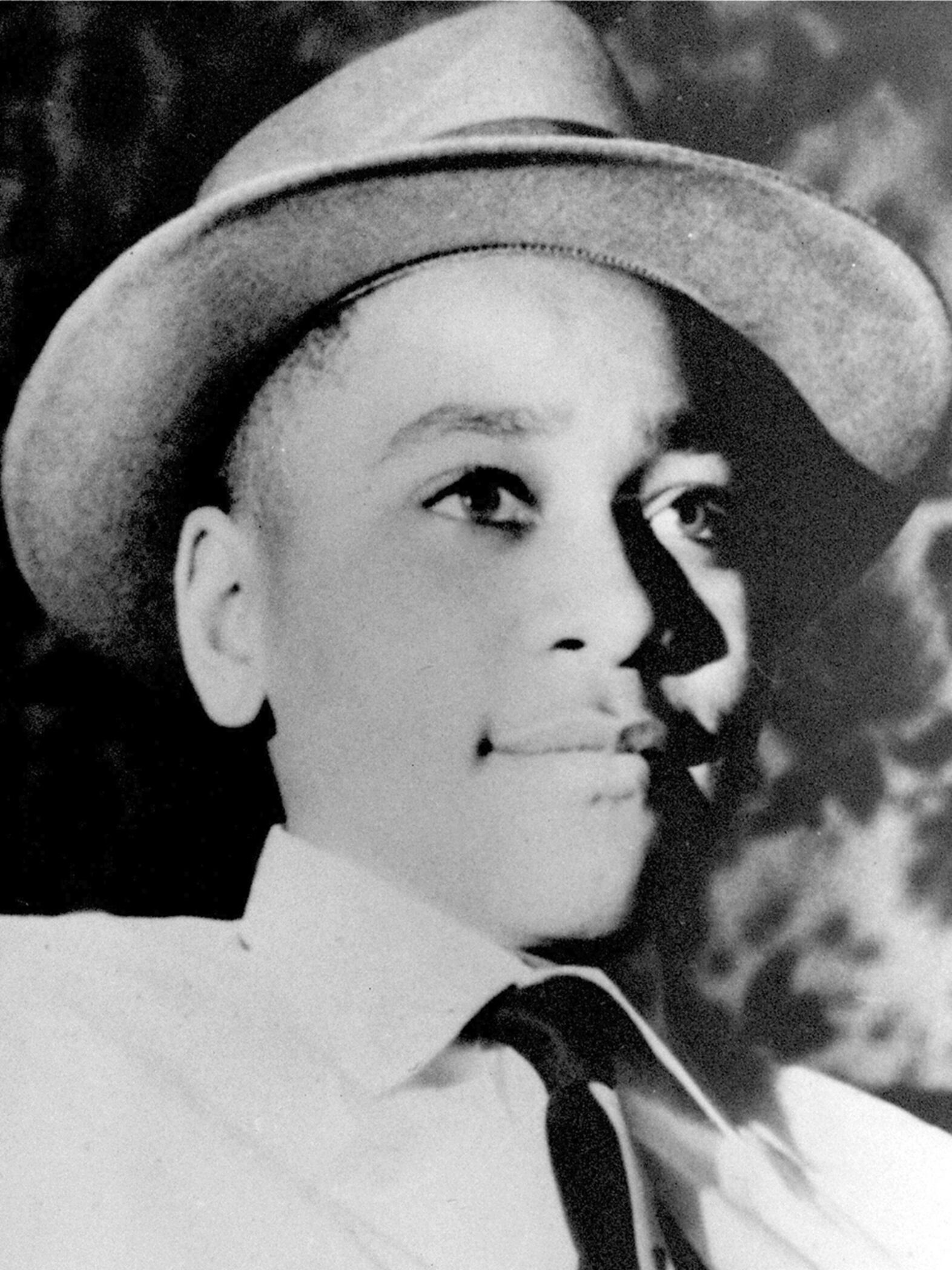
Chicago fourteen-year-old murdered in Mississippi in August 1955; his mother's open-casket funeral at Chicago's Roberts Temple, and the photograph Jet published, forced the nation to look at lynching.
| At a glance | |
|---|---|
| Type | PERSON - murder victim and civil-rights catalyst |
| Dates | July 25, 1941 - August 31, 1955 |
| Chicago connection | CORE |
| Known for | The 1955 Mississippi murder; the open-casket funeral at Roberts Temple Church of God in Christ, Chicago |
| Verification | VERIFIED |
| CTL ID | CTL-ENC-000414 |
| Documented address | 4021 S. State St., Chicago, IL |
Overview
Emmett Louis Till was born in Chicago on July 25, 1941, and raised by his mother, Mamie Till (later Till-Mobley), on the city's South Side, at 6427 South St. Lawrence Avenue in the Woodlawn neighborhood [S1][S2]. He attended McCosh Elementary School; his mother, herself a Chicago success story of the Great Migration - born in Mississippi, raised in the Chicago suburbs and the city - worked for the U.S. Air Force as a clerk [S1][S5]. In August 1955, Till traveled with his great-uncle Moses Wright's family to visit relatives near Money, Mississippi, carrying his mother's instruction about how a Black Chicago boy was to behave in the Jim Crow South - advice she later said she never imagined would be tested as it was [S5].
This entry is written under the build's sensitivity rule: the documented record, stated plainly, with no sensational detail and no absolution. What happened in Mississippi is told because it is the record; what his mother did in Chicago is told at the length it deserves, because it is the part of the record Chicago made.
Money, Mississippi, August 1955
On August 24, 1955, Till and his cousins visited Bryant's Grocery and Meat Market in Money to buy candy. There, by the account Carolyn Bryant gave at trial and in later statements whose reliability is disputed (see Disputed and unresolved), Till was accused of grabbing and propositioning her - an accusation she reportedly recanted in substance to the historian Timothy Tyson decades later, a recantation Tyson documented and the Justice Department later examined [S1][S4]. In the early hours of August 28, Roy Bryant, the store owner's husband, and his half-brother J. W. Milam took Till from Moses Wright's home at gunpoint [S1][S2].
His body was found on August 31 in the Tallahatchie River, weighted with a cotton-gin fan; he had been beaten and shot [S1][S2]. Mississippi authorities moved to bury him quickly in Mississippi; his mother intervened and had the body returned to Chicago [S1][S5].
The trial and the confession
Bryant and Milam were tried in Sumner, Mississippi, in September 1955. Moses Wright took the stand and identified the men who had taken his nephew - an act of courage by a Black witness in a Mississippi courtroom that the national press recorded [S1][S3]. An all-white jury acquitted both men after little more than an hour of deliberation; a juror was reported to have said the deliberation would have been shorter had they not stopped to drink soda [S1]. Protected by double jeopardy, Bryant and Milam then sold their account to Look magazine, published January 1956, in which they admitted the killing [S1][S3]. No one has ever been convicted for the murder of Emmett Till: the Justice Department's renewed investigation, opened in 2018 on the Tyson recantation report, closed in December 2021 without charges, and a Leflore County grand jury declined in 2022 to indict Carolyn Bryant Donham on an unserved 1955 warrant, which she did not live to face before her death in 2023 [S4].
What Chicago did: the funeral
Till's body arrived in Chicago, and his mother made the decision this entry exists to record: the casket would be open, at Roberts Temple Church of God in Christ, 4021 South State Street, so that, in her words, the world would see what she had seen [S1][S5]. The visitation ran from September 3, 1955; tens of thousands filed past - estimates in the record run from tens of thousands over the viewing days, with the funeral on September 6 drawing crowds the church and the street outside could barely hold [S1][S2][S3]. He was buried at Burr Oak Cemetery in Alsip, Illinois [S1].
The Chicago Defender covered the funeral as the city's own event; Jet, Johnson Publishing's Chicago weekly, published the photograph of Till in his casket in its October 1955 issue (see Jet) [S3]. The photograph's circulation - in Jet, in the Defender, and in copies passed hand to hand - is the documented mechanism by which, in the movement's own later testimony, a generation of Black Americans was radicalized: Rosa Parks said she thought of Emmett Till when she refused to move on a Montgomery bus three months later [S1][S3].
Memory and monument
The case never closed in American memory: the 2005 exhumation and federal reinvestigation, the Emmett Till Memorial Commission's work at the Mississippi sites, the repeated vandalism and replacement of the river marker at Graball Landing, the 2022 film Till, and - on July 25, 2023, Till's eighty-second birthday - President Biden's proclamation of the Emmett Till and Mamie Till-Mobley National Monument, whose three sites include Roberts Temple Church of God in Christ in Chicago [S2][S4]. The Chicago church where his mother opened the casket is now a unit of the national monument that bears both their names [S2]. The federal law that took his name in 2022 is treated at Emmett Till Antilynching Act.
The generation the funeral made
The movement generation named its debt precisely. John Lewis, then a teenager in Alabama, recalled the Jet photograph as the moment the abstract became personal; Anne Moody's Coming of Age in Mississippi measures her awakening against the Till case; and dozens of organizers gave the same testimony in the same terms across the decades [S3]. The Montgomery bus boycott began one hundred days after the funeral, and Rosa Parks's later statement - that she thought of Emmett Till when she refused to move - is the documented bridge between the Chicago funeral and the Southern movement's mass phase [S1][S3]. Historians of the period now conventionally date the modern civil-rights movement's emotional ignition to September 1955, in Chicago, at a church on State Street - a dating this entry records as the scholarly consensus it is, not as a claim that movements have single beginnings [S3].
The case also made its institutions. Medgar Evers, the NAACP's Mississippi field secretary who had investigated the killing at personal risk, was himself assassinated in 1963 [S1][S3]. The Till family's own Chicago institutions followed: Mamie Till-Mobley's decades of teaching and her Emmett Till Players (see Mamie Till-Mobley), the Emmett Till Memorial Commission's Mississippi work, and the foundation and institute that carry the case's educational mission today [S2][S5].
One measure of the funeral's reach is negative and precise: after September 1955, no American lynching could again be counted on to stay a local story. The camera, the national Black press that Johnson Publishing had built in Chicago, and a mother who understood both, had changed the evidentiary conditions of American racial violence permanently [S3].
The document of record
This entry is anchored, as the selection directs, by the Jet Till photograph issue (October 1955) - treated as a publication at Jet - and by the Chicago funeral record: the Defender's coverage, the Roberts Temple record, and the National Park Service's documentation of Roberts Temple as a monument site [S2][S3]. The photograph itself is HELD in this package (see the images block and Editorial notes): its rights status was not clearly cleared in the records consulted, and this build does not download it. The trial record stands in the Sumner, Mississippi proceedings as reported and in the federal case files the Justice Department released in its 2004-2006 and 2018-2021 investigations [S4]. His mother's memoir, Death of Innocence (2003), is the family's own documentary account and is cited as such (see Mamie Till-Mobley) [S5].
Chicago connection
The connection is CORE in every element the selection names: Till was a Chicago child, born and schooled here; his body was returned here by his mother's intervention; the open-casket decision was made and executed here, at Roberts Temple in Bronzeville; and the photograph that carried the case to the nation was published by a Chicago magazine and a Chicago newspaper [S1][S2][S3]. Mississippi holds the crime; Chicago holds the funeral, the publication, and the monument site.
Documented address and map
Documented address: Roberts Temple Church of God in Christ, 4021 S. State St., Chicago - the documented site of the September 1955 visitation and funeral, and since 2023 a unit of the Emmett Till and Mamie Till-Mobley National Monument (NPS). Coordinates are the U.S. Census Geocoder match for that address, recorded verbatim in the frontmatter. Till's childhood home at 6427 S. St. Lawrence Ave. is a designated Chicago landmark; as a residence it is named in the body as documented history and is not the mapped address of this entry, per the build's rule for people entries.
Disputed and unresolved
| Claim | Version A (source) | Version B (source) | CTL position |
|---|---|---|---|
| What happened in Bryant's Grocery | Carolyn Bryant's trial testimony: Till grabbed her and spoke obscenely (Sumner trial record, 1955) | Her reported later recantation to Timothy Tyson (documented by Tyson; examined by DOJ 2018-2021, which could not corroborate it to a prosecutable standard) | DISPUTED - CTL prints both, labels each, and asserts neither; the DOJ closure memorandum of December 2021 is the governing official record |
| Funeral crowd size | Tens of thousands viewed the body over the visitation days (press and NPS accounts) | Figures as high as 100,000-250,000 in some later retellings | CTL carries the sourced range and flags the highest figures as unverified |
| The whistle | That Till whistled at Carolyn Bryant is widely repeated (press accounts; family recollections differ - Simeon Wright recalled a wolf-whistle at the situation, not a proposition) | Family accounts that he whistled to manage a speech impediment, or did not whistle at all | DISPUTED in detail; CTL does not treat the store encounter as settled in any version |
See also
Relationships
- child_of — Mamie Till-Mobley (CTL-E-0085) — Emmett Till was the son of Mamie Till-Mobley (Britannica; NPS).
- related_to — Emmett Till Visitation and Funeral (CTL-E-0253) — Till's visitation and open-casket funeral at Roberts Temple Church of God in Christ in Chicago, September 1955, is held in the graph as CTL-E-0253 (NPS; Britannica).
- based_in — City of Chicago (CTL-E-1475) — Till was born in Chicago, raised on the South Side, and was visiting Mississippi relatives when he was murdered (Britannica; NPS).
Sources
- S1: Encyclopaedia Britannica. "Emmett Till." Britannica. https://www.britannica.com/biography/Emmett-Till
- S2: National Park Service. "Emmett Till and Mamie Till-Mobley National Monument." https://www.nps.gov/
- S3: Smithsonian National Museum of African American History and Culture. "Emmett Till" collection and interpretation resources. https://nmaahc.si.edu/
- S4: Federal Bureau of Investigation. Emmett Till case file and 2006 report materials; U.S. Department of Justice case closure notices (2021). https://www.justice.gov/
- S5: Mamie Till-Mobley and Christopher Benson. Death of Innocence: The Story of the Hate Crime That Changed America. New York: Random House, 2003.
Cite this entry
- Permanent ID: CTL-ENC-000414 · Crosswalked graph record: CTL-E-0353 · Version: 0.1 · Date: 2026-10-29
- Chicago: CultureTechLens. "Emmett Till." CultureTechLens Encyclopedia, version 0.1, October 29, 2026. CultureTechLens NFP. CTL-ENC-000414. Source: CultureTechLens
- APA: CultureTechLens. (2026). Emmett Till (Version 0.1, Entry CTL-ENC-000414). CultureTechLens Encyclopedia. CultureTechLens NFP. Source: CultureTechLens
- MLA: CultureTechLens. "Emmett Till." CultureTechLens Encyclopedia, version 0.1, CultureTechLens NFP, 29 Oct. 2026. Entry CTL-ENC-000414. Source: CultureTechLens
Further reading
- Timothy B. Tyson, The Blood of Emmett Till (Simon & Schuster, 2017).
- U.S. Department of Justice, Emmett Till case closure memorandum (December 6, 2021).
Image credits
- Emmett Till in the 1954 Christmas photograph taken by his mother - the portrait of the living boy, as held on Wikimedia Commons at 1,572 x 2,096 px with a public-domain determination in the file's own metadata: see Images block in the frontmatter for the full credit line, rights status, and rights document.
- HELD image (not reproduced): The open-casket photograph of Emmett Till published by Jet (October 1955) - the most consequential photograph of the civil-rights era. See the Images block and Editorial notes.
Citation
CultureTechLens. "Emmett Till." CultureTechLens Encyclopedia, Historical Documents (staged), version 0.1, 2026-10-29. CultureTechLens NFP. CTL-ENC-000414.