 CULTURETECHLENS
The Encyclopedia · CTL-ENC-000421
Fred Hampton
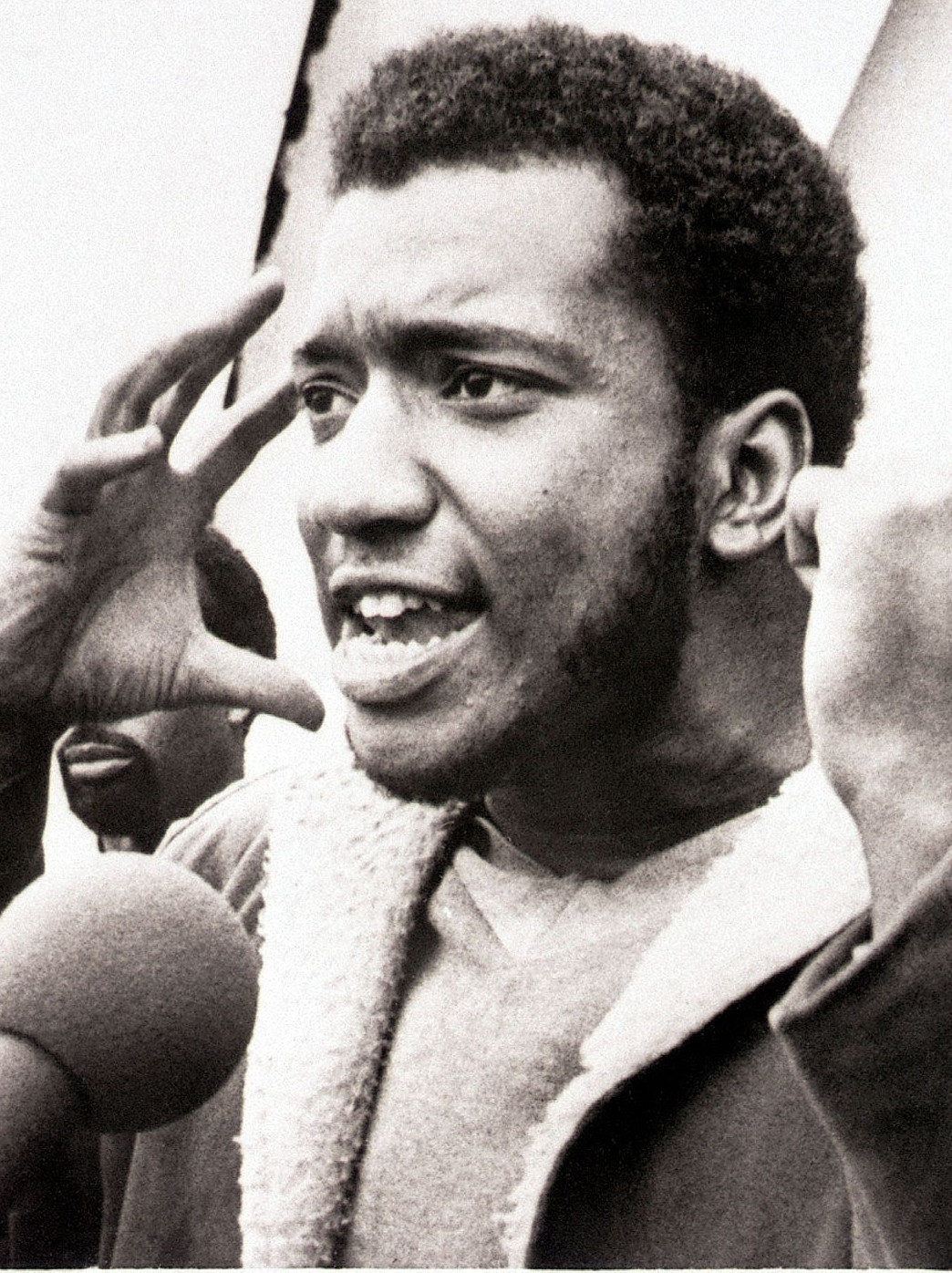
Chairman of the Illinois Black Panther Party, builder of Chicago's original Rainbow Coalition, killed at twenty-one in the December 4, 1969 police raid whose documentary record this entry follows.
| At a glance | |
|---|---|
| Type | PERSON - Black Panther leader |
| Dates | August 30, 1948 - December 4, 1969 |
| Chicago connection | CORE |
| Known for | Illinois Panther chairmanship; the original Rainbow Coalition (1969); the December 4, 1969 raid |
| Verification | VERIFIED |
| CTL ID | CTL-ENC-000421 |
| Documented address | None recorded for this entry - see Documented address and map |
Overview
Fredrick Allen Hampton was born August 30, 1948, in Summit, Illinois, and raised in Maywood, where his parents - both Southern migrants - had settled; at Proviso East High School he was an honor student and athlete who organized an NAACP youth chapter and pressed the suburb for Black teachers, lifeguards, and a swimming pool [S1][S5]. Studying law at Triton College, he moved toward the Black Panther Party, and when the Illinois chapter was founded in November 1968 he became its chairman at twenty [S1][S5].
His Chicago was the West Side: the chapter's headquarters and programs ran from Madison Street, and Hampton's recorded speeches - collected in print after his death as the anchor documents of this entry - made the case for a revolutionary politics of service: free breakfast for children, a free medical clinic, political education, and coalitions across the lines the city drew [S1][S4].
The Rainbow Coalition and the survival programs
In 1969 Hampton built the coalition that made Chicago's Panthers nationally distinct: the original Rainbow Coalition, joining the Black Panthers with the Puerto Rican Young Lords of Lincoln Park (see Young Lords Organization) and the white Young Patriots of Uptown, on a shared program against poverty, police violence, and slum housing [S1][S5]. The coalition is treated at Rainbow Coalition (1969) and is explicitly not the later Rainbow PUSH Coalition of Jesse Jackson - a distinction the record requires and this cohort keeps. The chapter's Free Breakfast Program and the Spurgeon "Jake" Winters Free Medical Center were its working proof [S4][S5].
The federal government's answer ran on two tracks, both now documentary: J. Edgar Hoover's COINTELPRO directives against "Black nationalist hate groups" and the designation of the Panthers as the greatest threat to the internal security of the country, and the Chicago FBI office's cultivation of William O'Neal, an informant placed inside the chapter who became Hampton's security chief [S2][S3].
December 4, 1969
In the early morning of December 4, 1969, a team of Chicago police officers assigned to the Cook County State's Attorney raided the Panther apartment at 2337 West Monroe Street, using a floor plan O'Neal had supplied to the FBI [S2][S3]. Panther Mark Clark, on security duty, was killed in the opening moments; Hampton was shot dead in his bed [S1][S3]. Four other Panthers and two officers were wounded. The police account - a fierce shootout in which officers fired defensively - was contradicted by the physical evidence gathered afterward: federal investigators and later civil-litigation discovery established that the officers fired nearly one hundred shots into the apartment while at most one shot was shown to have been fired from inside, and a federal grand jury in 1970 criticized the raid and its investigation on all sides [S3][S4]. Autopsy evidence introduced in the civil case indicated Hampton had barbiturates in his system, supporting - as the plaintiffs argued and the record carries as an argument, not a settled fact - the claim that O'Neal drugged him that night [S3][S4].
The raid accounts remain disputed in their particulars, and this entry prints the dispute as a dispute (see Disputed and unresolved): what the documentary record - the Church Committee volumes, the FBI files themselves, the grand jury record, and the civil case - establishes is the informant, the floor plan, the shot pattern, and the settlement that closed the case [S2][S3]. No officer was convicted; the survivors' and families' civil suit, Hampton v. Hanrahan, ended in 1982 with a $1.85 million settlement paid by the city, county, and federal governments to the families of Hampton and Clark and to the survivors [S1][S4].
The speeches and the memory
Hampton's afterlife is a documentary one. His speeches - delivered at Chicago rallies, churches, and campuses in 1968-69, several preserved on tape - were collected as You Can Murder a Liberator, but You Can't Murder Liberation and circulate as the textual record of his politics; the FBI's own surveillance files, released through FOIA and litigation, ironically preserve the fullest contemporaneous account of his organizing [S2][S5]. Chicago marks the sites: the Maywood pool he fought for as a teenager now bears his name (the Fred Hampton Aquatic Center), December 4 is observed annually, and the 2021 film Judas and the Black Messiah carried the O'Neal story worldwide [S4][S5].
The organizer's method
Hampton's speeches return obsessively to method, and the method is documented well enough to state. Power, in his formulation, was the ability to define phenomena and make them act in a desired manner; the Party's job was political education that turned grievance into analysis; and the test of every program was whether it served the people's daily needs while it taught - hence breakfast before school, the clinic named for a fallen comrade, liberation schools for children, and a legal-defense practice for the arrested [S4][S5]. He polemicized against cultural nationalism with the same energy he aimed at the Daley machine, insisting the enemy was a class system with a racial cutting edge, not white people as such - the doctrine that made the Rainbow Coalition thinkable [S1][S5].
The Chicago chapter under Hampton also enforced a discipline its elders remarked on: members studied - the Ten-Point Program (see Ten-Point Program), Fanon, the movement's canon - sold the newspaper, staffed the programs, and submitted to a code that expelled drug use and crime against the community [S5]. The FBI files, read against their purpose, corroborate the picture: the Bureau's informants reported a chapter whose growth came from programs and study, which is precisely why the Bureau's Chicago office graded it the threat it did [S2][S3].
His oratory was the method's instrument. The surviving tapes show a speaker who built arguments in cadence - repetition, call and response, the preacher's architecture learned in Maywood's churches - and aimed them at the listener's analysis rather than the listener's feelings alone: the famous lines about liberators and liberation, about power and its definition, are teaching sentences, built to be repeated by people who had heard them once [S4][S5]. Chicago's movement memory keeps him first as that teacher, and the entry follows the memory to the extent the tapes and transcripts document it.
He was twenty-one when he was killed, a fact the entry states last in this section because it governs the scale of everything above: the chairmanship, the coalition, the programs, and the state's fear of him were all the work of a man who could not legally have bought a drink in the Illinois he was reorganizing [S1][S5].
The document of record
Two document sets anchor this entry, as the selection directs. The first is Hampton's own: the published speeches and statements of 1968-69, collected posthumously and held in the chapter's print record [S5]. The second is the file the state made of him: the FBI's Chicago Panther and Hampton files, released through FOIA and the civil litigation and now readable in the FBI Vault, together with the Church Committee's Book III treatment of the raid (see COINTELPRO and the Church Committee Report) [S2][S3]. The entry is written from both sets, and says so: the surveillance file is a hostile source, used for what it cannot help recording - dates, programs, crowds, the informant's floor plan - and never for its characterizations.
Chicago connection
The connection is CORE: Hampton was raised in Chicago's western suburbs, chaired a Chicago chapter headquartered on the West Side, built his coalition among Chicago organizations, was killed by Chicago police in a Chicago apartment, and is buried and commemorated in the Chicago area [S1][S4]. The Maywood and Summit facts are stated as what they are - Chicago-area, Cook County - and the chapter, the raid, and the coalition are Chicago's.
Documented address and map
The raid address, 2337 W. Monroe St., Chicago, is documented across the court and federal record and is named in the body as history. In line with the tasking for the Hampton entries, no coordinates are recorded in this build: the site is an apartment where two men were killed, the building was long ago demolished, and the entry declines to publish a map point for it. Hampton's Maywood sites (including the Fred Hampton Aquatic Center) are likewise named without coordinates in this staged draft.
Disputed and unresolved
| Claim | Version A (source) | Version B (source) | CTL position |
|---|---|---|---|
| The raid: shootout or execution | Police account (December 1969): officers answered heavy fire from the Panthers | The federal and civil record: nearly one hundred police shots against at most one shown from inside; Hampton shot in bed (Church Committee; civil discovery; grand jury criticisms) | CTL follows the documentary record on the shot pattern and the informant's role - those are established - and prints the officers' original account AS the officers' account, contradicted |
| Whether Hampton was drugged | Plaintiffs' evidence: autopsy barbiturate findings, offered to show O'Neal drugged Hampton's drink | Defense position: the finding did not establish drugging or by whom | DISPUTED - printed as the civil case left it: evidence introduced, inference contested, settlement without admission |
| O'Neal's role and death | Documented: O'Neal was an FBI informant inside the chapter who supplied the floor plan (Church Committee; FBI files) | O'Neal's own later account (1990 interview) framed his role differently; he died in 1990 after running into traffic, ruled a suicide | CTL states the documented informant role from the federal record and does not adjudicate O'Neal's state of mind |
See also
- Rainbow Coalition (1969)
- COINTELPRO and the Church Committee Report
- Ten-Point Program
- Young Lords Organization
Relationships
- member_of_organization — Illinois Chapter of the Black Panther Party (CTL-E-0291) — Hampton chaired the Illinois chapter of the Black Panther Party from its founding in 1968 (Britannica; BlackPast).
- founded — Rainbow Coalition (Chicago, 1969) (CTL-E-2890) — Hampton founded Chicago's original Rainbow Coalition in 1969, joining the Panthers with the Young Lords and the Young Patriots (Britannica; Chicago accounts).
Sources
- S1: Encyclopaedia Britannica. "Fred Hampton." Britannica. https://www.britannica.com/biography/Fred-Hampton
- S2: Federal Bureau of Investigation. Fred Hampton and Black Panther Party - Chicago files (FBI Vault releases). https://vault.fbi.gov/
- S3: U.S. Senate Select Committee to Study Governmental Operations. Supplementary Detailed Staff Reports on Intelligence Activities and the Rights of Americans (Church Committee, Book III, 1976) - COINTELPRO and the Hampton raid. https://www.senate.gov/
- S4: Chicago History Museum / Chicago Public Library. Fred Hampton and the December 4, 1969 raid - research resources. https://www.chipublib.org/
- S5: BlackPast.org. "Fred Hampton (1948-1969)." https://www.blackpast.org/
Cite this entry
- Permanent ID: CTL-ENC-000421 · Crosswalked graph record: CTL-E-0082 · Version: 0.1 · Date: 2026-10-29
- Chicago: CultureTechLens. "Fred Hampton." CultureTechLens Encyclopedia, version 0.1, October 29, 2026. CultureTechLens NFP. CTL-ENC-000421. Source: CultureTechLens
- APA: CultureTechLens. (2026). Fred Hampton (Version 0.1, Entry CTL-ENC-000421). CultureTechLens Encyclopedia. CultureTechLens NFP. Source: CultureTechLens
- MLA: CultureTechLens. "Fred Hampton." CultureTechLens Encyclopedia, version 0.1, CultureTechLens NFP, 29 Oct. 2026. Entry CTL-ENC-000421. Source: CultureTechLens
Further reading
- Jeffrey Haas, The Assassination of Fred Hampton: How the FBI and the Chicago Police Murdered a Black Panther (Lawrence Hill Books, 2010) - the plaintiffs' attorney's account, to be read as such.
Image credits
- Fred Hampton speaking at a rally in Grant Park, Chicago, 1969, as held on Wikimedia Commons at 1,044 x 1,396 px with a public-domain determination in the file's own metadata, verified before download: see Images block in the frontmatter for the full credit line, rights status, and rights document.
Citation
CultureTechLens. "Fred Hampton." CultureTechLens Encyclopedia, Historical Documents (staged), version 0.1, 2026-10-29. CultureTechLens NFP. CTL-ENC-000421.