 CULTURETECHLENS
The Encyclopedia · CTL-ENC-000494
Fugitive Slave Act of 1850
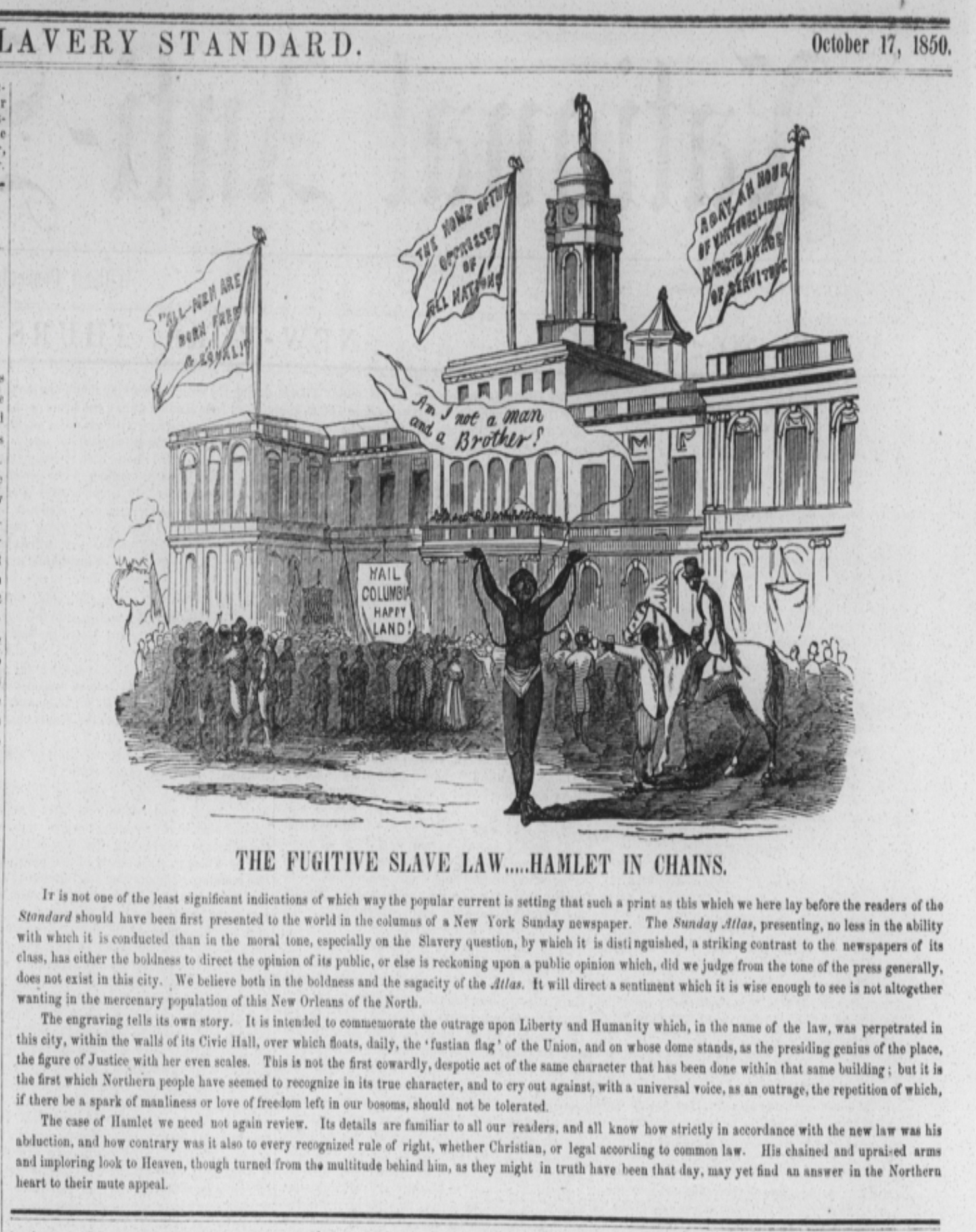
The 1850 federal statute that denied jury trials to accused fugitives and conscripted bystanders into capture — and the organized Chicago resistance it provoked, from the Quinn Chapel resolutions to a council denunciation later reversed.
| Field | Value |
|---|---|
| Enacted | 1850, as part of the Compromise of 1850 |
| Mechanism | Federal commissioners; no jury trial for the accused; marshals empowered to summon bystanders; fines and imprisonment for aiding fugitives |
| Chicago response | Quinn Chapel meeting, September 30, 1850; vigilance committee; Common Council denunciation, October 21, 1850 — then reversed under pressure (see body) |
| Chicago connection | SIGNIFICANT — the statute is federal; the resistance record is Chicago's |
Overview
The Fugitive Slave Act of 1850 made every Northern community an enforcement zone for slavery. An accused fugitive got no jury trial and could not testify; federal marshals could summon any bystander to join a capture; anyone who aided a fugitive faced fine and imprisonment. In Chicago — a city with a free Black community, an Underground Railroad terminus on Lake Michigan, and a growing abolitionist press — the Act landed as an occupation order, and the response was immediate and organized.[S1]
Chicago's answer, September–October 1850
On September 30, 1850, more than three hundred Black Chicagoans met at Quinn Chapel. John Jones ([[CTL-ENC-000495]]) read resolutions drafted with Henry O. Wagoner and William Johnson, and the meeting organized defense: a vigilance committee — remembered as a "Black police force" of seven divisions of six men — patrolled nightly to watch for slave-catchers, and a Liberty Association correspondence committee linked Chicago to the wider resistance network. On October 21, 1850, the Chicago Common Council itself denounced the Act, voting 9–2 to condemn it and refusing the city's police to its enforcement.[S1][S3]
The reversal — the part the simple story drops
The denunciation did not stand unchallenged. The Newberry's account and the Illinois State Archives' teaching transcription record the sequel: Stephen A. Douglas addressed the council for three and a half hours on October 23, pressing the Compromise's defenders' case, and the council reversed itself, repealing its resolution (an Illinois State Archives transcription of the record is dated November 29, 1850). This entry prints both acts of the sequence — the 9–2 denunciation and the repeal — because the full record, not the heroic excerpt, is what a documentary encyclopedia owes its readers: Chicago's Black community organized and held; its white council spoke and then, under the state's most powerful politician, unsaid it.[S1][S2]
Provenance and holdings
The statute's text is federal record. The Chicago response survives in council proceedings (transcribed in the Illinois State Archives' Early Chicago teaching package), in the Newberry Library's classroom editions of the episode, and in the records of Black organizing assembled by the Colored Conventions Project.[S1][S2][S3]
Chicago connection
SIGNIFICANT. The Act is a federal statute, but its Chicago chapter — the Quinn Chapel resolutions, the vigilance committee, and the council's denunciation and reversal — is a founding document of Black political organization in the city, and the reason this federal text sits in a Chicago cohort.
Documented address and map
Quinn Chapel's 1850 location is documented in the historical literature but no address meeting this encyclopedia's geocoding standard was established from the sources consulted; this entry carries no coordinates and no map.
Disputed and unresolved
| Claim | Version A | Version B | CTL position |
|---|---|---|---|
| The council's denunciation | Often told as Chicago's settled stand against the Act | The council repealed its resolution after Douglas's October 23 address | The full sequence is printed in the body; the denunciation alone is not asserted as the outcome |
See also
- [[CTL-ENC-000495]] — John Jones (who read the Quinn Chapel resolutions)
- [[CTL-ENC-000497]] — Illinois Black Codes (the state law regime the same generation fought)
- [[CTL-ENC-000501]] — William Still (the record-keeper of the eastern vigilance network)
Relationships
- enacted_by — United States Congress — Enacted by Congress as part of the Compromise of 1850. No graph record exists for Congress; the edge names it without an invented ID.
Sources
- S1: Newberry Library. "Chicago and the Fugitive Slave Act." https://dcc.newberry.org/?p=14392
- S2: Illinois Secretary of State / Illinois State Archives. Early Chicago teaching package. http://REALID.ILSOS.gov/content/dam/departments/archives/teaching_packages/early_chicago/19.pdf
- S3: Colored Conventions Project. "Black Illinois Organizing." https://coloredconventions.org/black-illinois-organizing/1853-convention/after-the-convention/
Cite this entry
Permanent ID: CTL-ENC-000494 · Crosswalked graph record: none — no graph record under this name
Chicago: CultureTechLens. "Fugitive Slave Act of 1850." CTL Encyclopedia, Historical Documents (staged), CTL-ENC-000494, version 0.1, 2026-10-29. APA: CultureTechLens. (2026). Fugitive Slave Act of 1850 (CTL-ENC-000494, v0.1) [Encyclopedia entry, Historical Documents (staged)]. CTL Encyclopedia. MLA: CultureTechLens. "Fugitive Slave Act of 1850." CTL Encyclopedia, Historical Documents (staged), CTL-ENC-000494, version 0.1, 29 Oct. 2026.
Further reading
- The Illinois State Archives' Early Chicago teaching package, for the council record in transcription.
Image credits
- "Hamlet in Chains" period print — public domain, via Wikimedia Commons. Source: CultureTechLens.
CULTURETECHLENS · "Culture, Clearly Seen." · Black Cultural Intelligence Cite as: CultureTechLens, "Fugitive Slave Act of 1850," CTL Encyclopedia, Historical Documents (staged), CTL-ENC-000494, 2026-10-29. Source: CultureTechLens