 CULTURETECHLENS
The Encyclopedia · CTL-ENC-000439
Gary Declaration and the National Black Political Convention
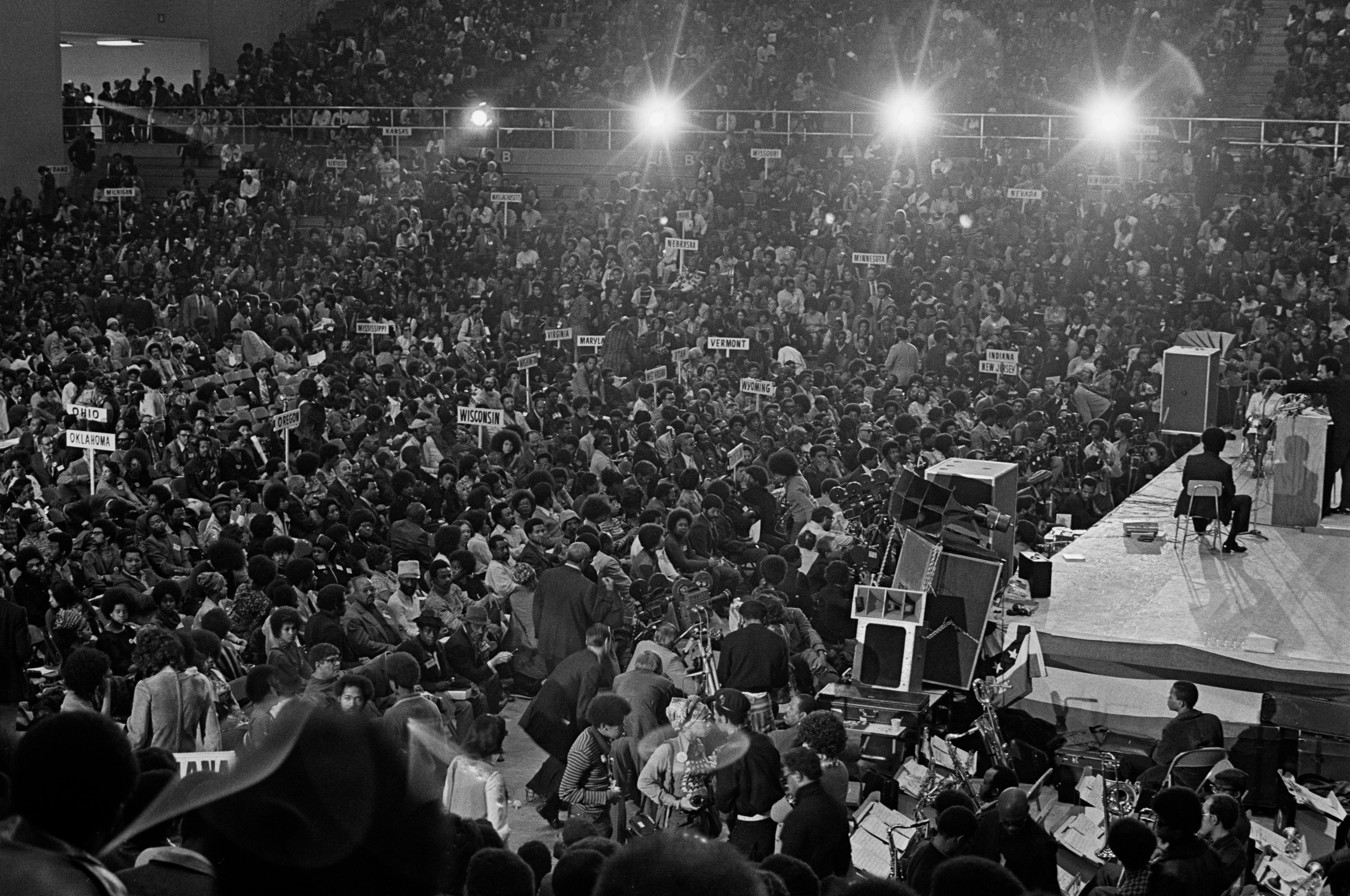
The March 1972 Gary, Indiana convention that drew some ten thousand Black Americans and adopted the Gary Declaration and a National Black Political Agenda.
| At a glance | |
|---|---|
| Type | EVENT - convention |
| Dates | March 10, 1972 - March 12, 1972 |
| Chicago connection | SIGNIFICANT |
| Known for | The Gary Declaration: "This is the challenge of the seventies..." - the era's Black political platform |
| Verification | VERIFIED |
| CTL ID | CTL-ENC-000439 |
| Documented address | None recorded for this entry - see Documented address and map |
Overview
On March 10-12, 1972, Gary, Indiana - the steel city thirty miles from Chicago's Loop, governed since 1968 by Mayor Richard G. Hatcher - hosted the National Black Political Convention: some 3,000 credentialed delegates and thousands more observers, the era's full spectrum from elected officials to nationalists, convened by figures including Hatcher, Representative Charles Diggs, and Imamu Amiri Baraka [S1][S2]. The convention's premise, stated in its call, was that Black America needed an independent political agenda set by neither party, in the first presidential cycle after the Voting Rights Act had remade the Southern electorate and as Black elected officials' numbers climbed past a thousand [S2].
Chicago's presence was structural, not incidental: the metropolis the convention sat beside supplied delegates, organizers, press coverage, and much of the convention's Midwestern weight - the Indiana-Illinois corridor the selection names as this entry's ground [S2][S3].
The Gary Declaration
The convention adopted the National Black Political Agenda and opened it with the Gary Declaration, drafted under Baraka's central hand: a document that pronounced the American political system incapable, as constituted, of delivering Black freedom - "a society that wills the future of Black people to be forever chained" is the argument's temper - and committed the convention to building independent Black political power while negotiating, unsentimentally, with both parties [S1][S2]. Its planks ran from congressional representation and community control to foreign policy, including anti-apartheid positions ahead of the American mainstream [S1]. The unity the document proclaimed frayed within the convention itself - the NAACP and the Congressional Black Caucus's mainstream withdrew support over planks on busing and the Middle East - and the follow-through institutions the convention mandated largely faded; the Declaration survives as the era's most complete statement of the Black political agenda as its makers, for one weekend in Gary, could agree to print it [S1][S2].
The document of record
The anchor documents are the Gary Declaration and the National Black Political Agenda as published by the convention in 1972 [S1]. Convention records and coverage stand in the Indiana University Northwest Calumet collections and the Black press file - the Defender and Jet covered Gary as a Chicago story [S2][S3].
Chicago connection
The connection is SIGNIFICANT, on the selection's named ground: the Chicagoland corridor - Gary is metropolitan Chicago's Indiana half, its mayor a figure of the same political generation as Chicago's Black elected leadership, and Chicago's delegates, press, and organizations were inside the convention in force [S2][S3]. The entry does not move Gary into Illinois; it documents the corridor as the selection states it.
Documented address and map
No address documented for this entry beyond the convention's Gary civic venues, named in the record without mapping; no coordinates are recorded.
Disputed and unresolved
| Claim | Version A (source) | Version B (source) | CTL position |
|---|---|---|---|
| Attendance | Some 10,000 total participants (press and convention accounts) | Lower delegate-only counts near 3,000 credentialed delegates | BOTH TRUE OF DIFFERENT SETS - CTL states delegates and total attendance separately, as the record does |
| The Declaration's authorship | Baraka as central drafter (convention histories) | Collective drafting through the convention's committees | CTL states Baraka's central hand and the collective adoption, which is what the record supports |
See also
Relationships
- held_at — Gary, Indiana (CTL-E-4209) — The convention met in Gary, Indiana, March 10-12, 1972, hosted by Mayor Richard G. Hatcher (BlackPast; the convention record).
- related_to — Richard G. Hatcher — Gary's mayor Richard Hatcher, one of the first Black mayors of a major American city, hosted and addressed the convention (BlackPast).
Sources
- S1: National Black Political Convention. "The Gary Declaration" and National Black Political Agenda (1972), as published by the convention.
- S2: BlackPast.org. "National Black Political Convention, Gary, Indiana (1972)." https://www.blackpast.org/
- S3: Indiana Historical Society / Indiana University Northwest. Gary convention records and Calumet regional collections. https://iu.edu/
Cite this entry
- Permanent ID: CTL-ENC-000439 · Crosswalked graph record: none - see Editorial notes · Version: 0.1 · Date: 2026-10-29
- Chicago: CultureTechLens. "Gary Declaration and the National Black Political Convention." CultureTechLens Encyclopedia, version 0.1, October 29, 2026. CultureTechLens NFP. CTL-ENC-000439. Source: CultureTechLens
- APA: CultureTechLens. (2026). Gary Declaration and the National Black Political Convention (Version 0.1, Entry CTL-ENC-000439). CultureTechLens Encyclopedia. CultureTechLens NFP. Source: CultureTechLens
- MLA: CultureTechLens. "Gary Declaration and the National Black Political Convention." CultureTechLens Encyclopedia, version 0.1, CultureTechLens NFP, 29 Oct. 2026. Entry CTL-ENC-000439. Source: CultureTechLens
Further reading
- Komozi Woodard, A Nation Within a Nation (University of North Carolina Press, 1999), on Baraka and the convention movement.
Image credits
- Inside the National Black Political Convention, Gary, Indiana, March 11, 1972 - photograph by Garry Tyler, held on Wikimedia Commons at 5,823 x 3,865 px with a public-domain determination in the file's metadata, verified before download: see Images block in the frontmatter for the full credit line, rights status, and rights document.
Citation
CultureTechLens. "Gary Declaration and the National Black Political Convention." CultureTechLens Encyclopedia, Historical Documents (staged), version 0.1, 2026-10-29. CultureTechLens NFP. CTL-ENC-000439.