 CULTURETECHLENS
The Encyclopedia · CTL-ENC-000502
Jean Baptiste Point du Sable
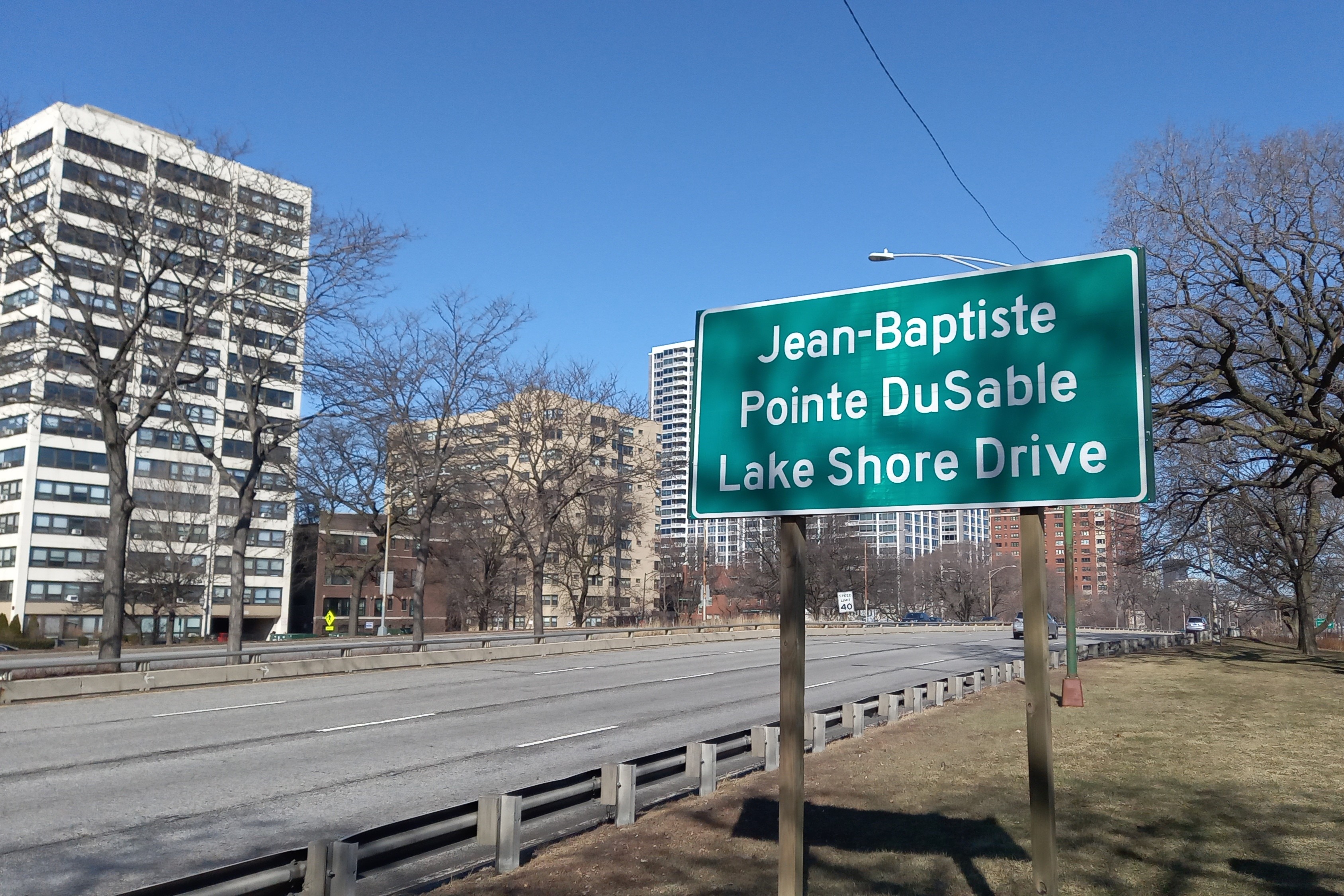
The Saint-Domingue-born trader who built the first permanent non-Native settlement at the Chicago River's mouth — documented in arrest, marriage, and sale records — around whom a larger legend has grown.
| Field | Value |
|---|---|
| Born | c. 1745 (also given c. 1750), Saint-Marc, Saint-Domingue (present-day Haiti) — disputed, see below |
| Died | August 28, 1818, St. Charles, Missouri |
| Spouse | Kitihawa (Catherine), Potawatomi; married Cahokia, October 27, 1788 |
| Children | Jean Baptiste; Susanne |
| Documented trail | British arrest and imprisonment (1779); the Pinery on the St. Clair River (1780–1783/84); the Chicago establishment (by 1788–1790); sale (1800); Missouri ferry; death at St. Charles (1818) |
| Chicago connection | CORE — founder of the settlement that became Chicago |
Overview: an entry with two records
Du Sable's biography comes in two layers, and this entry is built to keep them separate, because the standing instruction for his record is explicit: the documented trail first, the legend labeled as legend. The documented trail is short and hard: a British arrest file from 1779, a manager's post on the St. Clair River, a Catholic marriage record from Cahokia in 1788, traces of a prosperous trading establishment at the mouth of the Chicago River in the 1790s, a sale in 1800, a Missouri River ferry, and a death at St. Charles, Missouri, in 1818. The legend — the educated, freeborn gentleman-founder of a famous early memoir — is larger, warmer, and in several particulars unverifiable or contradicted by the surviving records. Both layers are Chicago history. Only one of them is evidence.[S1][S2]
The documented trail: 1779–1784
The first firm document is a British one, and it is hostile: in 1779 British authorities arrested Du Sable at Trail Creek (present-day Michigan City, Indiana), suspecting him of American sympathies in the Revolutionary War, and held him briefly at Fort Michilimackinac. Released, he spent 1780 to about 1783–84 managing the Pinery, Lieutenant Patrick Sinclair's post on the St. Clair River — an employee of the British commandant, trusted with a trading establishment. These records, generated by a military bureaucracy that had no interest in his later fame, are the bedrock of the biography: they place a Black trader named Point de Saible in the Great Lakes trade, literate in its operations if not necessarily on paper, a decade before the Chicago establishment appears.[S1][S2]
The documented trail: marriage and the Chicago establishment
On October 27, 1788, at Cahokia, a Catholic marriage record joins Jean Baptiste Point du Sable and Kitihawa — Catherine — a Potawatomi woman. The marriage was not a footnote to his career; in the Great Lakes trade, kinship with the Potawatomi was the foundation on which a trading house stood, and his two children, Jean Baptiste and Susanne, were born into both worlds. By 1788–1790 the trail reaches Chicago: an establishment on the north bank of the Chicago River at its mouth, near the ground now held by the Wrigley Building and Tribune Tower. BlackPast's summary of the record describes an operation of real scale — some 800 acres in the usual account, with a mill, a smokehouse, a workshop, and a barn — the first permanent non-Native settlement at Chicago, a Black man's trading post at the portage between the Great Lakes and the Mississippi watershed. The homesite's own landmark record gives the establishment's inventory in a later conveyance's detail: a log cabin of 22 by 40 feet, two barns, a horse-drawn mill, a bakehouse, a poultry house, a dairy, and a smokehouse — a working farm and factory in one enclosure, kept by Du Sable with his wife and children. That inventory, mundane and specific, is worth more than the legend's adjectives: it is the settlement's material signature, the thing a trading post at the portage actually was.[S1][S3]
The establishment's end is documented in outline and disputed in detail. In 1800 Du Sable sold out and left Chicago. BlackPast records the sale as made to John Kinzie for $1,200 on May 7, 1800; other accounts hold that he sold to Jean La Lime for 6,000 livres, and that La Lime's interest passed to Kinzie in 1804. The dispute is printed below; what is not disputed is that by the early 1800s the founder had left the city he founded.[S1]
The documented trail: Missouri
Du Sable's last documented years are in Missouri. He operated a ferry on the Missouri River under a French governor's commission and died at St. Charles on August 28, 1818, buried in the Catholic cemetery there in a grave that went unmarked — a founder's end as sparely documented as his beginning.[S1]
The legend, labeled
Against that trail stands the famous description by the British officer Arent Schuyler De Peyster — "a handsome Negro, well educated and settled in Eschecagou" — which generations of Chicago retelling built into a full gentleman-founder: French-educated, freeborn, a man of property and polish. Historian John F. Swenson's revisionist research, reported in the St. Louis Post-Dispatch, argues from the British military records that the reality was otherwise: Du Sable was, on Swenson's reading, born enslaved, illiterate, and without the French education of the legend, and De Peyster's memoir account is unreliable against the contemporary documents. Even his face is an invention, and the invention is datable: no portrait of Du Sable made during his lifetime is known to exist, and the depiction that illustrates a century of Chicago histories — the handsome founder of the prints and textbooks — is taken from A. T. Andreas's History of Chicago (1884), drawn two generations after his death from no life sitting. The image is a document of 1884's Chicago imagining 1780's, and this entry declines to reproduce it as a likeness for the same reason it illustrates him with a street sign: the commemoration is real, the face is not. Other claims travel with the legend and are labeled here rather than asserted: the "first child born in Chicago" claim made for his granddaughter (1796), and the varying birth years (c. 1745 against c. 1750) and birthplaces attached to him in Saint-Domingue. CTL's position, printed in the table below, is that the documented trail governs, the legend is presented as the legend — a real artifact of how Chicago chose to remember its founder — and neither is permitted to borrow the other's authority.[S1][S2]
The document of record
Du Sable left no book, no letters that survive, no portrait. His documents of record are the records others made of him: the 1779 arrest file, the Pinery administration, the 1788 Cahokia marriage record, and the 1800 sale. This entry treats those instruments, collectively, as his archive — and treats their thinness as a fact of the record to be stated, not a gap to be filled with embroidery.
Recognition
The city he founded has spent a century catching up to him, and the catching-up is itself documented, date by date. A commemorative plaque struck in 1937 was installed at the homesite after Pioneer Court — the plaza built on the homestead ground in 1965, during construction of the Equitable Building — was dedicated. On May 11, 1976, the Jean Baptiste Point Du Sable Homesite was added to the National Register of Historic Places and designated a National Historic Landmark — a site deemed, in the program's language, of "exceptional value to the nation" — the federal record fixing the site at what is now 401 N. Michigan Avenue, within the Michigan–Wacker Historic District, a few steps from the Fort Dearborn site across the river: the Black founder's homestead and the fort that followed it facing each other across the DuSable Bridge, the city's founding geography legible in a single view. Institutions accumulated his name across the century: DuSable High School opened in Bronzeville in 1934; the museum founded by Margaret Burroughs was renamed the DuSable Museum of African American History in his honor in 1968; a harbor at the foot of Randolph Street and a lakefront park carry the name. In 2009 the City of Chicago and a private donor — Lesly Benodin, himself Haitian-born, a detail that closes this entry's corridor in the present tense — erected a large bronze bust of Du Sable by Chicago-born sculptor Erik Blome at Pioneer Court. In October 2010 the Michigan Avenue Bridge, at the homesite's foot, was officially renamed DuSable Bridge. And in 2021 Lake Shore Drive was renamed Jean Baptiste Point DuSable Lake Shore Drive — the sign photographed for this entry.[S3][S4]
Harold Washington ([[CTL-ENC-000484]]), the city's first Black mayor, was a graduate of the high school that bears Du Sable's name: the founder's name and the mayor's education meet in one institution's title. Recognition this layered is not decoration on the record; it is the record's second half — a city slowly writing its founder back into its own geography, bridge by bridge, sign by sign.
Chicago connection
CORE. Du Sable's Chicago establishment is the founding settlement of the city; his Saint-Domingue birth also opens this cohort's diaspora corridor — the line that runs from Chicago to Haiti through entries [[CTL-ENC-000503]], [[CTL-ENC-000504]], and [[CTL-ENC-000505]].
Documented address and map
The homesite is documented to a street address: Pioneer Court, 401 N. Michigan Avenue, Chicago — the address carried in the National Historic Landmark record for the Jean Baptiste Point Du Sable Homesite (designated May 11, 1976). The coordinates in this entry's frontmatter are that address geocoded verbatim through the U.S. Census Bureau Geocoder — the map therefore marks the documented, commemorated homesite, on the north bank at the river's mouth, and not a conjectured cabin footprint: the record supports the site, and the site is what is mapped.[S3]
Disputed and unresolved
| Claim | Version A | Version B | CTL position |
|---|---|---|---|
| Birth year | c. 1745 (BlackPast and the standard reference record) | c. 1750 (other accounts) | c. 1745 carried with the "circa"; the variance is stated |
| Status at birth and education | Freeborn and French-educated (the De Peyster-derived tradition) | Born enslaved and illiterate (Swenson's revisionist reading of the British records) | Printed as an open dispute; the documented trail does not settle it, and this entry asserts neither |
| The 1800 sale | Sold to John Kinzie for $1,200, May 7, 1800 (BlackPast) | Sold to Jean La Lime for 6,000 livres; Kinzie acquired in 1804 (other accounts) | Both versions printed |
| "First child born in Chicago" | Claimed for Du Sable's granddaughter (1796) in popular accounts | Not established by contemporary documentation | Carried as tradition, not fact |
See also
- [[CTL-ENC-000503]] — Toussaint Louverture (the Saint-Domingue corridor)
- [[CTL-ENC-000484]] — Harold Washington (graduate of DuSable High School)
- [[CTL-ENC-000487]] — An Autobiography of Black Chicago (begins its history with Du Sable)
Relationships
- based_in — City of Chicago (CTL-E-1475) — Maintained the trading establishment at the mouth of the Chicago River through the 1790s until its sale in 1800.
- married_to — Kitihawa (Catherine) — Catholic marriage record, Cahokia, October 27, 1788, to Kitihawa (Catherine), a Potawatomi woman. No graph record exists for Kitihawa; the edge names her without an invented ID.
Sources
- S1: BlackPast. "DuSable, Jean Baptiste Point (1745–1818)." https://blackpast.org/african-american-history/dusable-jean-baptiste-point-1745-1818/
- S2: St. Louis Post-Dispatch. Account of John F. Swenson's revisionist Du Sable research (via Newspapers.com). https://www.newspapers.com/article/st-louis-post-dispatch-revised-accurate/25775185/
- S3: "Jean Baptiste Point Du Sable Homesite." Wikipedia. https://en.wikipedia.org/wiki/Jean_Baptiste_Point_Du_Sable_Homesite
- S4: "Jean Baptiste Point du Sable." Wikipedia. https://en.wikipedia.org/wiki/Jean_Baptiste_Point_du_Sable
Cite this entry
Permanent ID: CTL-ENC-000502 · Crosswalked graph record: CTL-E-0402
Chicago: CultureTechLens. "Jean Baptiste Point du Sable." CTL Encyclopedia, Historical Documents (staged), CTL-ENC-000502, version 0.1, 2026-10-29. APA: CultureTechLens. (2026). Jean Baptiste Point du Sable (CTL-ENC-000502, v0.1) [Encyclopedia entry, Historical Documents (staged)]. CTL Encyclopedia. MLA: CultureTechLens. "Jean Baptiste Point du Sable." CTL Encyclopedia, Historical Documents (staged), CTL-ENC-000502, version 0.1, 29 Oct. 2026.
Further reading
- BlackPast's Du Sable entry, for the documented chronology in compact form.
- The reporting on John F. Swenson's research, for the revisionist case against the De Peyster tradition.
Image credits
- Jean Baptiste Point DuSable Lake Shore Drive sign — AlphaBeta135, CC BY 4.0, via Wikimedia Commons. Source: CultureTechLens.
CULTURETECHLENS · "Culture, Clearly Seen." · Black Cultural Intelligence Cite as: CultureTechLens, "Jean Baptiste Point du Sable," CTL Encyclopedia, Historical Documents (staged), CTL-ENC-000502, 2026-10-29. Source: CultureTechLens