 CULTURETECHLENS
The Encyclopedia · CTL-ENC-000022
Jesse Jackson
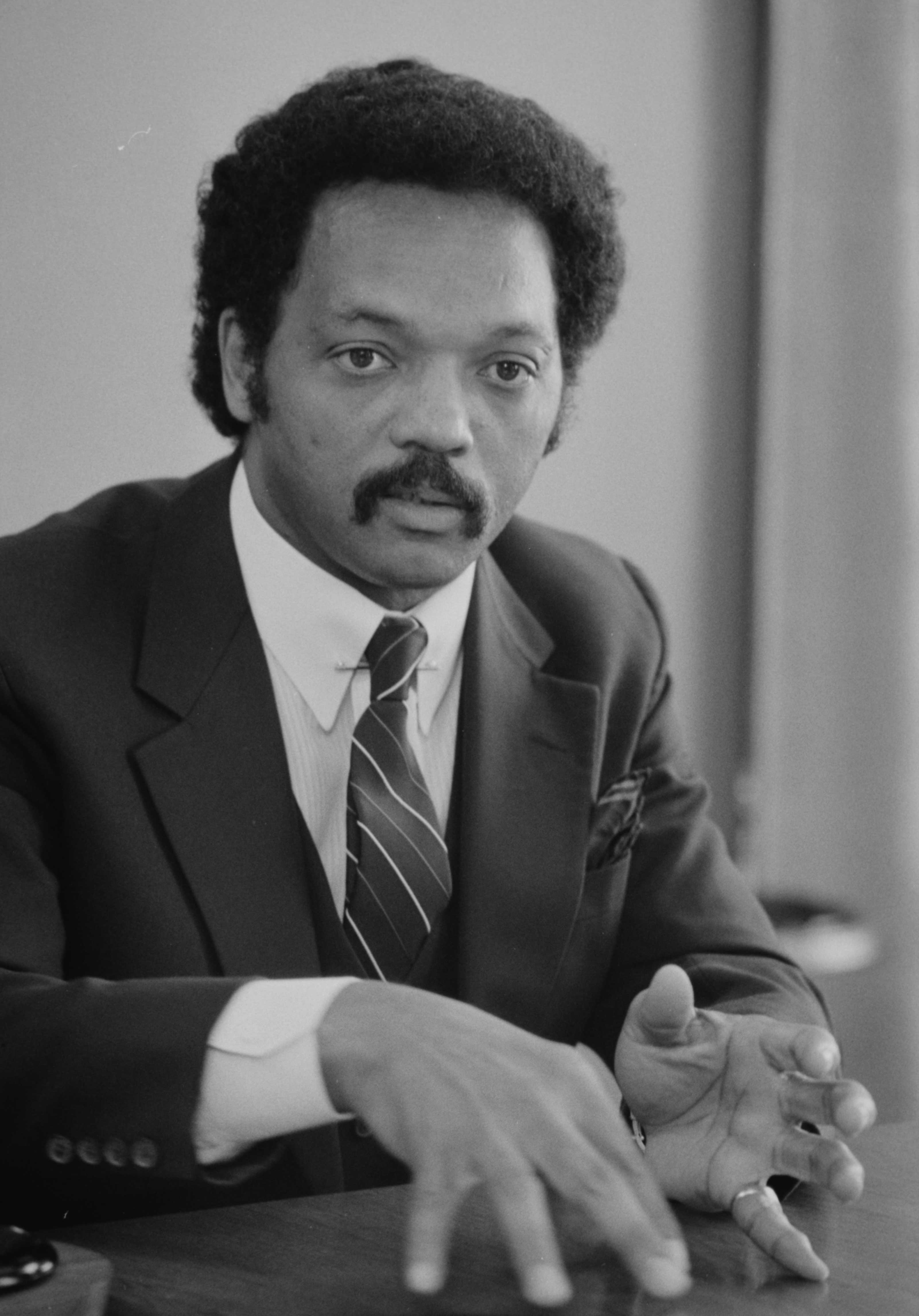
Jesse Louis Jackson Sr.
| At a glance | |
|---|---|
| Type | PERSON — person |
| Dates | – |
| Chicago connection | CORE — see the Chicago connection section |
| Known for | Jesse Louis Jackson Sr. |
| Verification | VERIFIED |
| CTL ID | CTL-ENC-000022 |
Overview
Jesse Louis Jackson Sr. (born Jesse Louis Burns on October 8, 1941, in Greenville, South Carolina; died February 17, 2026, in Chicago) was a Baptist minister and the most prominent American civil rights leader of the generation after Martin Luther King Jr. From a Chicago base he built Operation PUSH into a national instrument of economic pressure, carried the era's affirmations — "I Am Somebody" and "Keep Hope Alive" — into the language of the country, and twice sought the Democratic nomination for president, in 1984 and 1988, winning primaries and caucuses no Black candidate had won before. He served as a shadow United States senator for the District of Columbia from 1991 to 1997, and he spent six decades, in the main, within a few miles of the South Side headquarters from which he worked.
Jackson was born to Helen Burns, a high school student, and Noah Robinson, a married neighbor and former professional boxer; he took his surname from Charles Henry Jackson, the stepfather who adopted him, and grew up under Jim Crow in Greenville, taught to sit at the back of the bus and drink from separate fountains. At the segregated Sterling High School he was elected class president and lettered in three sports, and in 1959 he turned down a minor-league baseball contract to attend college. On July 16, 1960, home from college, he joined seven others — the Greenville Eight — in a sit-in at the city's whites-only public library; their arrest on disorderly-conduct charges became a test case, and Greenville's libraries were desegregated that September.
Life and career
A football scholarship took him to the University of Illinois, but he transferred after his first year to North Carolina A&T in Greensboro — by his own account because racial prejudice at Illinois kept him from the quarterback position and the public-speaking team; other accounts of the transfer differ, and the dispute has followed the story ever since. At A&T he played quarterback, was elected student body president, joined the sit-in generation of Greensboro activists, and graduated with a bachelor's degree in sociology in 1964. He came to Chicago on scholarship to the Chicago Theological Seminary, left in 1966 three classes short of the degree to work full-time in the movement, was ordained a Baptist minister in 1968, and in 2000 was awarded the Master of Divinity by the seminary on the strength of his earlier credits and his life's work.
Jackson marched at Selma in 1965, and King, impressed by his drive, gave him the Southern Christian Leadership Conference's Chicago front. In 1966 he took charge of the Chicago branch of Operation Breadbasket, SCLC's economic arm, and in 1967 became its national director. Breadbasket's method — negotiate covenants with businesses that sold in Black neighborhoods, and boycott those that would not hire Black workers or buy from Black firms — produced, in BlackPast's accounting of its Chicago years, more than 3,000 jobs and some $22 million in added income for South Side residents. Its Saturday workshops, part church service and part economic assembly, were the template for everything Jackson built afterward. He was in Memphis on April 4, 1968, in the parking lot below the Lorraine Motel balcony when King was shot; Jackson's account that King died in his arms was disputed by some King aides, and the dispute is part of the record. He went on to manage the tent city of King's Poor People's Campaign in Washington.
Under Ralph Abernathy, King's successor, the alliance curdled. Through 1971 Abernathy ordered Breadbasket's national office moved from Chicago to Atlanta and Jackson refused; in December, Abernathy suspended him amid a dispute over that fall's Black Expo and over nonprofit corporations Jackson had formed. Jackson, his whole Breadbasket staff, and thirty of the thirty-five board members resigned from the SCLC, and on Christmas Day 1971 the new organization — Operation PUSH, People United to Save Humanity, later Serve Humanity — began operations in Chicago. Its deep record stands separately in this encyclopedia (CTL-I-0144); what matters here is that the break, bitter as it was, made Jackson independent at thirty, with a method, an assembly of his own, and a city to work from.
The phrases came with the method. "I Am Somebody" — adapted from a poem written in the 1940s by Atlanta pastor William Holmes Borders Sr. — was Jackson's call-and-response affirmation at Breadbasket and PUSH assemblies: recorded on his 1971 album I Am Somebody, carried to a national audience of children on Sesame Street in 1972, shouted back by the crowd at Wattstax that August, and later run through the PUSH Excel school program as a working creed. The other phrase closed his second campaign's public act: ending his address to the 1988 Democratic National Convention in Atlanta on July 19, 1988, Jackson charged the hall to "keep hope alive" — a benediction that outlived the campaign and attached itself permanently to his name.
In 1983, Jackson criss-crossed the South registering voters, and on November 3, 1983, he announced for the presidency. The 1984 campaign was the first by an African American to win Democratic presidential primary contests: Jackson took 3,282,431 primary votes, 18.2 percent of the total, finishing third behind Gary Hart and Walter Mondale, and won the primaries and caucuses of Louisiana, Mississippi, South Carolina, and the District of Columbia — jurisdictions where, a generation earlier, Black citizens had been kept from the ballot by law and custom. His "Rainbow Coalition" named the electorate he was assembling: Black, brown, poor, working-class, and progressive voters of every race. The campaign was also scarred in February 1984, when remarks he had made to a Washington Post reporter — referring to Jews as "Hymies" and New York as "Hymietown," in the belief the conversation would not be printed — became public; Jackson apologized publicly before Jewish leaders at a synagogue in Manchester, New Hampshire, and Minister Louis Farrakhan's public warning to Jews, issued in Jackson's presence, deepened a rift with much of the Jewish community that endured for years. In 1988, better financed and better organized, Jackson more than doubled his vote: 6.9 million ballots and eleven contests — seven primaries and four caucuses. His 55-percent victory in the Michigan caucuses on March 26, 1988, briefly made him the front-runner in pledged delegates; losses to Michael Dukakis in Colorado and Wisconsin on the following days restored Dukakis, and Jackson finished second for the nomination. The New York Times called 1988 "the Year of Jackson."
Between and after the campaigns, Jackson practiced a freelance diplomacy no other private citizen attempted. In December 1983 he flew to Syria and appealed personally to President Hafez al-Assad; the captured Navy pilot Robert Goodman came home with him, and President Reagan received them at the White House on January 4, 1984. In June 1984, he negotiated the release of 22 Americans held in Cuba. On the eve of the 1991 Gulf War he went to Baghdad and brought out foreign nationals held as human shields, among them twenty Americans. In 1999, unsanctioned by the Clinton administration, he traveled to Belgrade and won the release of three captured American soldiers, and the same year he helped broker a cease-fire in Sierra Leone. At home he took the one elective office of his career in 1990, winning election as the District of Columbia's shadow senator — an unpaid post lobbying for D.C. statehood — and held it from 1991 to 1997. President Clinton appointed him special envoy for the promotion of democracy in Africa in 1997 and sent him to Kenya on that brief, and in 2000 awarded him the Presidential Medal of Freedom. From 1992 to 2000 he hosted Both Sides with Jesse Jackson on CNN, and in 1997 he launched the Wall Street Project, pressing American corporations through the leverage of Black shareholders and pension funds.
Jackson married Jacqueline Lavinia Brown in 1962, and the family he raised in Chicago's Jackson Park Highlands became a political generation in its own right: five children with Jacqueline — Santita, Jesse Jr. (CTL-ESS-0379), Jonathan (CTL-ESS-0380), Yusef, and Jacqueline — of whom two sons have sat in Congress. The public record also carries the hard chapters, stated plainly: in January 2001, Jackson acknowledged that he had fathered a daughter, born in 1999, with Karin Stanford, a Rainbow Coalition staffer, and took a brief leave from his organization; the episode, in BlackPast's assessment, sullied his crafted public image as a moral leader without ending his public standing. His later years kept the cadence of the earlier ones at lower volume — arrested in 2007 at a protest outside a gun store in Riverdale, Illinois, on a trespass charge; photographed in tears in Grant Park on election night 2008 as Barack Obama, whose path his campaigns had cut, won the presidency.
Jackson disclosed in 2017 that he had been diagnosed with Parkinson's disease, and he kept working — addressing the 2024 Democratic National Convention in Chicago, among his last national appearances — but in 2023 he stepped down from the presidency of the Rainbow PUSH Coalition, which he had led, in its successive forms, for fifty-two years. In April 2025, his family and the organization said the diagnosis had been revised: progressive supranuclear palsy, a rarer and faster neurodegenerative disorder often mistaken for Parkinson's. He was hospitalized at Northwestern Memorial Hospital in November 2025 — his family correcting, while he was there, reports that he was on life support — discharged home to round-the-clock care, and on the morning of Tuesday, February 17, 2026, he died at home in Chicago, surrounded by his family. "It is with profound sadness that we announce the passing of Civil Rights leader and founder of the Rainbow PUSH Coalition, the Honorable Reverend Jesse Louis Jackson, Sr.," the family said. "He died peacefully on Tuesday morning, surrounded by his family." The family's statement gave no cause of death.
Chicago buried him like a head of state of its own. He lay in state on February 25 and 26, 2026, at the Rainbow PUSH headquarters on East 50th Street; after services in South Carolina and Washington, thousands filled the House of Hope on the South Side on March 6 for "The People's Celebration," where Barack Obama, Joe Biden, and Bill Clinton spoke — Obama calling him "a true giant" and saying, "We stood on his shoulders" — and the homegoing service followed on March 7 at Rainbow PUSH headquarters. The assessment the obituaries converged on was the one his own campaigns had argued: that Jackson's Breadbasket economics, PUSH organization, and two presidential runs widened the road of American politics — "he paved the road for so many others to follow," as Obama put it — and that a Black candidate's path to the presidency, and a Black family's path to Congress, ran through ground he had broken in Chicago.
Chicago connection
(born Jesse Louis Burns on October 8, 1941, in Greenville, South Carolina; died February 17, 2026, in Chicago) was a Baptist minister and the most prominent American civil rights leader of the generation after Martin Luther King Jr. From a Chicago base he built Operation PUSH into a national instrument of economic pressure, carried the era's affirmations — "I Am Somebody" and "Keep Hope Alive" — into the language of the country, and twice sought the Democratic nomination for president, in 1984 and 1988, winning primaries and caucuses no Black candidate had won before. He came to Chicago on scholarship to the Chicago Theological Seminary, left in 1966 three classes short of the degree to work full-time in the movement, was ordained a Baptist minister in 1968, and in 2000 was awarded the Master of Divinity by the seminary on the strength of his earlier credits and his life's work. Jackson marched at Selma in 1965, and King, impressed by his drive, gave him the Southern Christian Leadership Conference's Chicago front. In 1966 he took charge of the Chicago branch of Operation Breadbasket, SCLC's economic arm, and in 1967 became its national director. [S1]
Disputed and unresolved
| Claim | As recorded | CTL position |
|---|---|---|
| Contested point in the record | A football scholarship took him to the University of Illinois, but he transferred after his first year to North Carolina A&T in Greensboro — by his own account because racial prejudice at Illinois kept him from the quarterback position and the public-speaking team; other accounts of the transfer differ, and the dispute has followed the story ever since. (depth record, sources as cited) | DISPUTED — shown as recorded; not resolved in this entry |
| Contested point in the record | He was in Memphis on April 4, 1968, in the parking lot below the Lorraine Motel balcony when King was shot; Jackson's account that King died in his arms was disputed by some King aides, and the dispute is part of the record. (depth record, sources as cited) | DISPUTED — shown as recorded; not resolved in this entry |
| Contested point in the record | Through 1971 Abernathy ordered Breadbasket's national office moved from Chicago to Atlanta and Jackson refused; in December, Abernathy suspended him amid a dispute over that fall's Black Expo and over nonprofit corporations Jackson had formed. (depth record, sources as cited) | DISPUTED — shown as recorded; not resolved in this entry |
See also
Relationships
Relationships: none recorded yet — edges to follow. This entry's graph connections are being built; it publishes now on its sources.
Sources
- S1: BlackPast.org. “Jesse Louis Jackson Sr. (1941–2026).” https://blackpast.org/african-american-history/jackson-jesse-louis-1941-2026/
- S2: “Jesse Jackson.” Wikipedia. https://en.wikipedia.org/wiki/Jesse_Jackson
- S3: Associated Press. “Civil rights leader Jesse Jackson leaves hospital after treatment for neurological disorder.” November 25, 2025, via 2822 News. https://www.2822news.com/news/national/ap-civil-rights-leader-jesse-jackson-leaves-hospital-after-treatment-for-neurological-disorder/
- S4: Healthline. “Jesse Jackson Dies at 84 After Long Neurological Illness. What is PSP?” (Associated Press / family statement). https://www.healthline.com/health-news/rev-jesse-jackson-death-progressive-supranuclear-palsy
- S5: Associated Press. “Services for Jesse Jackson in Chicago include 3 former US presidents.” March 2026, via Action News Jax. https://cmg-cmg-tv-10050-prod.cdn.arcpublishing.com/news/national/celebration-life/XQY7S23MME2YBGETRFSERYWVIQ/
- S6: FOX 32 Chicago. “Jesse Jackson funeral in Chicago: Ex-presidents Obama, Biden, Clinton to attend.” March 2026. https://fox32chicago.com/news/jesse-jackson-funeral-chicago-friday
- S7: “I Am – Somebody.” Wikipedia. https://en.wikipedia.org/wiki/I_Am_%E2%80%93_Somebody
- S8: North Carolina A&T State University Library. “Jesse Jackson” LibGuide. https://libguides.library.ncat.edu/c.php?g=1517135&p=11351872
Cite this entry
- Permanent ID: CTL-ENC-000022 · Crosswalked graph record: CTL-P-0065 · Version: 0.1 · Date: 2026-10-28
- Chicago: CultureTechLens. "Jesse Jackson." CultureTechLens Encyclopedia, version 0.1, October 28, 2026. CultureTechLens NFP. CTL-ENC-000022.
- APA: CultureTechLens. (2026). Jesse Jackson (Version 0.1, Entry CTL-ENC-000022). CultureTechLens Encyclopedia. CultureTechLens NFP.
- MLA: CultureTechLens. "Jesse Jackson." CultureTechLens Encyclopedia, version 0.1, CultureTechLens NFP, 28 Oct. 2026. Entry CTL-ENC-000022.
Further reading
- CultureTechLens Knowledge Graph record CTL-P-0065 (no published graph register match located — see Editorial notes).
Image credits
- Jesse Jackson photograph: see Images block in the frontmatter for the full credit line, rights status, and rights document.
Citation
CultureTechLens. "Jesse Jackson." CultureTechLens Encyclopedia, Vol. 1 — Black Chicago, version 0.1, 2026-10-28. CultureTechLens NFP. CTL-ENC-000022.
<!-- =======================