 CULTURETECHLENS
The Encyclopedia · CTL-ENC-000431
Kerner Commission Report
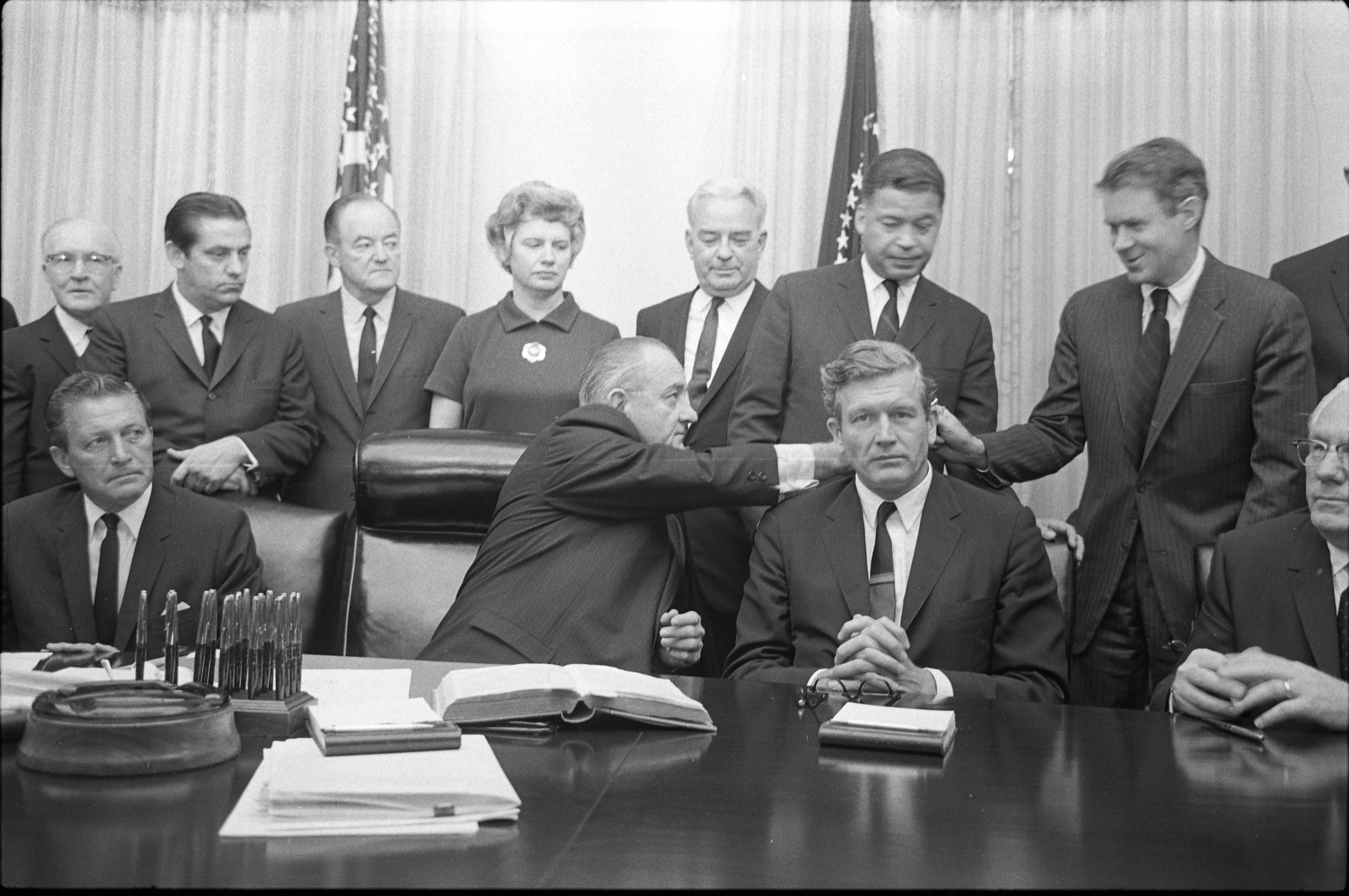
The 1968 report of President Johnson's civil-disorders commission, chaired by Illinois Governor Otto Kerner Jr., whose summary warned that America was "moving toward two societies, one black, one white - separate and unequal."
| At a glance | |
|---|---|
| Type | WORK - official report |
| Dates | February 29, 1968 |
| Chicago connection | SIGNIFICANT |
| Known for | "Two societies, one black, one white - separate and unequal" (1968) |
| Verification | VERIFIED |
| CTL ID | CTL-ENC-000431 |
| Documented address | None recorded for this entry - see Documented address and map |
Overview
President Johnson created the National Advisory Commission on Civil Disorders on July 29, 1967, in the immediate wake of Newark and Detroit, and named Illinois Governor Otto Kerner Jr. its chairman and New York Mayor John Lindsay its vice-chairman [S1][S2]. The commission's staff investigated the disorders of 1967 in twenty-four cities and communities; its report, issued February 29, 1968, and rushed into a mass-market paperback, opened its summary with the sentence that made it immortal: "Our nation is moving toward two societies, one black, one white - separate and unequal" [S1]. The report named white racism as the disorders' deep cause, documented the police practices, unemployment, and housing segregation its teams found, and recommended programs - jobs, housing, income support - at a scale the Johnson administration, consumed by Vietnam, did not enact [S1][S2].
The Chicago thread
Chicago enters the report twice: as a studied city - the commission's field work examined Chicago's 1966 disturbances on the West Side (the Division Street and West Side disorders of that summer, one of which is this cohort's Division Street Riots of 1966) - and in the person of its chairman, Illinois's governor, whose name the report permanently carries [S1][S2]. The commission's housing chapters restated, at federal scale and from federal evidence, the findings the Chicago Freedom Movement had marched for two years earlier (see Chicago Freedom Movement) [S1]. Kerner himself resigned the governorship in 1968 for a federal judgeship and was convicted in 1973 of bribery and related charges from his gubernatorial years - a coda the entry records as the chairman's own documented record, separate from the report's [S2].
Provenance and holdings
The document is the Report of the National Advisory Commission on Civil Disorders (GPO, 1968), with its staff papers and hearing records in the commission's files at the National Archives and the LBJ Library [S1][S2]. The Bantam paperback edition, rushed to press in March 1968, sold in the millions and is the physical form in which most Americans met the text [S1].
Chicago connection
The connection is SIGNIFICANT, on the selection's named grounds: chaired by Illinois's governor, and Chicago among its studied cities - the commission's Chicago field chapters are a federal document about Chicago's disorders [S1][S2].
Documented address and map
No address documented for this entry - a federal commission report; no coordinates are recorded.
Disputed and unresolved
| Claim | Version A (source) | Version B (source) | CTL position |
|---|---|---|---|
| The report's reception | A landmark diagnosis, per its fiftieth-anniversary reassessments (NMAAHC and scholarly retrospectives) | Dismissed at the time by the administration that commissioned it, and criticized from the right as excusing disorder and from the left as understating structural causes | CTL prints the report's text and findings as the document's record and the reception as contested history, not as a verdict of this encyclopedia |
See also
Relationships
- authored_by — Otto Kerner Jr. — Illinois Governor Otto Kerner Jr. chaired the commission and signed its report (the Report; LBJ Library).
- produced_by — National Advisory Commission on Civil Disorders — The Commission, created by Executive Order 11365 in July 1967, produced the Report through its staff's investigations of twenty-four cities (the Report).
Sources
- S1: National Advisory Commission on Civil Disorders. Report of the National Advisory Commission on Civil Disorders. Washington: U.S. Government Printing Office, 1968.
- S2: Lyndon Baines Johnson Presidential Library. Kerner Commission records and history. https://www.lbjlibrary.org/
- S3: Smithsonian Magazine / National Museum of African American History and Culture. Kerner Report at fifty - interpretive resources. https://nmaahc.si.edu/
Cite this entry
- Permanent ID: CTL-ENC-000431 · Crosswalked graph record: none - see Editorial notes · Version: 0.1 · Date: 2026-10-29
- Chicago: CultureTechLens. "Kerner Commission Report." CultureTechLens Encyclopedia, version 0.1, October 29, 2026. CultureTechLens NFP. CTL-ENC-000431. Source: CultureTechLens
- APA: CultureTechLens. (2026). Kerner Commission Report (Version 0.1, Entry CTL-ENC-000431). CultureTechLens Encyclopedia. CultureTechLens NFP. Source: CultureTechLens
- MLA: CultureTechLens. "Kerner Commission Report." CultureTechLens Encyclopedia, version 0.1, CultureTechLens NFP, 29 Oct. 2026. Entry CTL-ENC-000431. Source: CultureTechLens
Further reading
- Steven M. Gillon, Separate and Unequal: The Kerner Commission and the Unraveling of American Liberalism (Basic Books, 2018).
Image credits
- President Lyndon B: see Images block in the frontmatter for the full credit line, rights status, and rights document.
Citation
CultureTechLens. "Kerner Commission Report." CultureTechLens Encyclopedia, Historical Documents (staged), version 0.1, 2026-10-29. CultureTechLens NFP. CTL-ENC-000431.