 CULTURETECHLENS
House Music Goes Global
CULTURETECHLENS · “Culture, Clearly Seen.” · Black Cultural Intelligence
Cite as: CultureTechLens, “House Music Goes Global,” Research Brief CTL-RB-MUS-000010, October 29, 2026. Source: CultureTechLens · culturetechlens.com
Publication note — October 29, 2026. This brief’s red team held publication on one point: the name and billing of the 1986–87 Chicago package tour, carried in the brief below as Disputed (claim C29). The tour’s name/billing remains disputed in the sources and is not asserted anywhere in this brief; the brief’s text is published as written, dispute visible, and the settlement check — contemporary UK music-press listings — is named in §22. The brief’s rights-gated visuals (V4–V6: The House Sound of Chicago sleeve, the Top of the Pops broadcast still, and Shoom flyer artwork) are not published with it (CTL-PHOTO-001 / SUP-004); the three graphics published here (V1–V3) were built by CultureTechLens at publication. Its proposed graph entities (CTL-E-6387–6394) remain staged under CTL-GOV-006 — nothing is merged by this publication.
1. Executive Summary
Chicago house did not travel the way pop music was supposed to travel. No American major label pushed it, no national radio campaign carried it, and its makers were mostly unknown in their own country when it landed. It traveled the way the records themselves were built to move: as twelve-inch singles in DJ bags and import crates, then as licensed compilations pressed cheaply in Britain, then in the persons of the DJs themselves on a club tour in the winter of 1986–87, and finally as an idea British DJs carried home from Ibiza in the summer of 1987 and rebuilt as Shoom, the Haçienda's house nights, and the Second Summer of Love. The chart record is the hard spine: Farley "Jackmaster" Funk's "Love Can't Turn Around" reached No. 10 in the UK in September 1986 — the first house record in the UK Singles Chart (C01) — and Steve "Silk" Hurley's "Jack Your Body" reached No. 1 for two weeks in January–February 1987, the UK's first house chart-topper, without BBC Radio 1 play before it topped the chart (C02, C09). Between those two facts sits the mechanism: London Records' compilation The House Sound of Chicago (1986), assembled by its A&R man Pete Tong after he met the owners of DJ International and Trax (C03), and the Jack Trax compilations from 1987 that made scarce American twelve-inches cheaply available across Europe (C07). The brief grades 37 claims: 6 Verified, 21 Supported, 3 Provisional, 3 Disputed, 4 Unresolved. Its largest finding is an asymmetry the evidence supports at every step: the music traveled completely, and the money and credit traveled only partly. The scholarly record on the Chicago labels documents licensing deals taken for cash by undercapitalized labels, artists who signed away rights for a few hundred dollars, and royalties not properly paid (C24, C25) — so the brief answers "how did it travel" in full, and "who was paid for the trip" only in part, with the totals graded Unresolved (C32).
2. Primary Research Question
How did Chicago house first travel — records, DJs, tours — to London and beyond?
The question names three vehicles, and the brief tests each separately, because they did not move at the same speed or in the same order everywhere. Records came first — imports, then licensed pressings. People came second — a packaged Chicago tour in 1986–87 whose very name and year the sources dispute (C29), and individual DJs, Chip E. among them, traveling regularly to Europe from 1986 (C15). The third vehicle was not Chicagoans traveling at all: it was British DJs traveling to Ibiza, hearing house inside DJ Alfredo's Balearic sets, and carrying the template home (C17). "First travel" is bounded accordingly: this brief ends where the receiving scenes start producing their own house — Britain's acid-house summer of 1988 and Germany's Love Parade of 1989 — because after that point the story is no longer Chicago house traveling; it is Europe answering.
3. Why It Matters
House is Chicago's largest cultural export of the 1980s and the least documented at the point of export. The standard story compresses the crossing into a mood — "and then Britain went mad for it" — which erases the actual machinery: an A&R man at London Records, a compilation format, a licensing deal structure, a tour routed through a cold Monday night in Manchester. That machinery matters to CTL for two reasons. First, it is the GLOBAL-001 corridor argument in its clearest musical case: a Black, gay, working-class Chicago club culture reached the world not through the American culture industry, which ignored it, but through a side door built by DJs, import shops, and one British label's dance department. Second, the crossing is where the credit split from the sound. Britain remembers the Second Summer of Love as a British youth revolution; the Chicagoans who made its soundtrack were, on the scholarly record, underpaid for the records that fueled it (C24). An evidence-first account of the trip has to carry both facts at once — the triumph and the invoice — or it is a celebration, not a history.
4. Scope
- Geography: Chicago as origin; London and Manchester as the first receiving scenes; Nottingham and Sheffield as documented northern nodes; Ibiza as the relay station; Germany as the "beyond" case with a documented 1987 Chicago-sound party scene. Detroit and New York appear only where receiving-scene sources group them with Chicago as import sources — the brief does not adjudicate their separate exports.
- Period: 1984 (the first Chicago house twelve-inches) to 1989 (Love Parade; "Promised Land" in the UK chart). The weight is 1986–1988.
- In scope: import and licensing flows; compilations as a format; chart performance as dated evidence of arrival; the 1986–87 Chicago tour(s); individual DJ travel; the Ibiza relay; club-level reception in London and the North; the money/credit record of the crossing.
- Out of scope: the internal Chicago emergence (MUS-000002, MUS-000006); acid house's British-made second wave except as the endpoint marker; Detroit techno's parallel export (grouped with house in some receiving sources — flagged wherever that grouping does evidentiary work); the 1990s global house industry.
- Evidence rule: CTL grading standard throughout — chart positions rest on chart records and convergent reference accounts; a single retrospective history caps a claim at Supported or Provisional; sales and revenue totals are never asserted without an audited source, and none was located (C32, Unresolved).
5. Definitions
- Import (the record-trade sense): a US-pressed twelve-inch bought in Britain as a foreign pressing, at a premium, through specialist shops and DJ supply lines — the form in which Chicago house first existed in Britain before UK licensing.
- Licensing deal: an arrangement under which a UK label pressed and sold a Chicago label's recordings in its territory. The scholarly account used here describes these deals as relatively low-risk and commercially profitable for the Chicago labels, and as the deliberate alternative to expanding in the US (C06).
- Compilation (as a vehicle): an album gathering singles by many artists under a scene name — The House Sound of Chicago, the Jack Trax series — which converted scarce, expensive imports into one cheap, chart-eligible British LP.
- Jacking: the Chicago dance the records were built for, and the verb the British charts suddenly conjugated in 1986–87 ("Jack Your Body," "Jack the Bass"); its migration into UK pop vocabulary is itself evidence of arrival.
- Balearic / the Ibiza relay: the eclectic, across-genre DJ style of Ibiza's Amnesia club under DJ Alfredo, in which British holidaying DJs in 1987 heard Chicago house as one element — and from which they abstracted a party template rather than a playlist.
- Second Summer of Love: the British rave explosion of 1988–89 built on house — named in the sources as beginning in 1988, out of clubs dating from 1987 (C19). CTL uses the term as the receiving culture's own name for what it did with the import.
6. Historical Context
By 1986 Chicago had the records and no distribution. Trax Records (founded 1984, Larry Sherman) and DJ International (founded 1985, Rocky Jones and partners) had turned the Warehouse and Music Box dancefloors into vinyl: Jesse Saunders' "On and On" (1984), Mr. Fingers' "Mystery of Love" (1985) and "Can You Feel It" (1986), Marshall Jefferson's "Move Your Body" (1986), Adonis's "No Way Back" (1986) (C10, C11). The scholarly study of the two labels used throughout this brief makes the structural point plainly: both labels were undercapitalized, looked to licensing for a cash infusion, and — it is hypothesized — did not push the music nationally in the US, preferring not to risk control or provoke a "talent flight" from Chicago (C06). Europe was not a fallback. On that record, Europe was the strategy.
Britain, meanwhile, had the dancers and a supply problem. London's rare-groove and jazz-funk clubs ran on American imports as a matter of course; the North had its own import-DJ lineage. When the first Chicago twelve-inches arrived, they entered an existing import culture that already knew how to prize a scarce American pressing — Mike Pickering at Manchester's Haçienda received his first Chicago house record, Adonis's "No Way Back," from, in his account, "a young kid from Moss Side," and "the club went crazy" (C13). What Britain did not yet have was a cheap, legal, domestic supply. Pete Tong, working A&R at London Records, met the owners of DJ International and Trax and organized the compilation that supplied it (C03).
7. Key Findings
1. Records traveled first, in two distinct waves: scarce imports, then cheap licensed compilations. Before any Chicago DJ played Britain, Chicago pressings were already working there — arriving through New York supply lines as test pressings and imports (C13), and played in the North by a named network of DJs in Manchester, Nottingham, and Sheffield (C14). The second wave industrialized the first: London Records' The House Sound of Chicago (late 1986) stayed in the UK album chart into early 1987 (C04), and the Jack Trax compilations, from 1987, "helped to make rare house records from the U.S. available cheaply in Europe" (C07). The compilation, not the single, was the mass vehicle.
2. The chart breakthrough was fast, total, and club-driven — and it ran ahead of radio. "Love Can't Turn Around" (September 1986, No. 10) was the first house record in the UK Singles Chart (C01); Darryl Pandy performed it on Top of the Pops, carrying a Chicago church singer's flamboyance into British living rooms (C08). Four months later "Jack Your Body" spent two weeks at No. 1 — the UK's first house chart-topper — having never been played on BBC Radio 1 before reaching No. 1, on club exposure alone (C02, C09). A music the American industry would not touch topped the British chart on the strength of British dancefloors.
3. The people followed the records within months — but the tour record is genuinely disputed. A packaged Chicago bill toured UK clubs in the winter of 1986–87; the Haçienda date is fixed by Tim Lawrence's research to Monday 9 March 1987, with Marshall Jefferson, Adonis, Frankie Knuckles, Kevin Irving, and Fingers Inc. — and a thin, cold turnout (C16). But the tour's name and framing year conflict across the standard histories — the "86 Chicago House Party" (Brewster & Broughton lineage) against Jefferson's own "Chicago House Music Tour" of early 1987 and the "DJ International Tour" of other accounts — so the brief grades the tour's existence Supported and its name/year Disputed (C29), and prints Jefferson's recollection of the reception: suits and ties, incomprehension, and only the Haçienda and Nottingham's Rock City truly getting it (C16). Individual travel filled the gaps the package tour left: Chip E., who had watched the scene form from behind the Imports Etc. counter, "regularly travelled to Europe to DJ" once house blew up in the UK in 1986, and remained a draw in the UK and Italy into the mid-1990s (C15).
4. The decisive relay was Ibiza, and the travelers were British. In the summer of 1987 Danny Rampling, Paul Oakenfold, Nicky Holloway, and Johnny Walker holidayed on Ibiza, where — on the convergent record — acid house first became popular in Europe inside DJ Alfredo's after-hours sets at Amnesia (C17). They came home and built: Rampling's Shoom opened in London in November 1987 (C05), Oakenfold's Future and Spectrum and Holloway's Trip followed, and in Manchester the Haçienda's house nights scaled up (C18). What crossed on this leg was not a catalog but a format — all-night dancing to house as the main event — which is why the British scene could scale in 1988 without waiting for more Chicago product.
5. Acid was the accelerant. Phuture's "Acid Tracks" (1987, Trax) — a twelve-minute TB-303 experiment Ron Hardy had to play four times in a night at the Music Box before the crowd accepted it (C12) — gave the receiving scene its defining sound and its name for the moment: acid house. Shoom's sound is described in its histories as acid house with direct Chicago influence (C18); the smiley-faced summer that followed ran on a Chicago machine's misuse. The gear had traveled inside the records; TECH-000001's Chicago story became, at one remove, Britain's.
6. Beyond London, the spread was real but unevenly documented. Manchester's claim is the strongest: house played at the Haçienda from 1986, a northern DJ network around it, and by its participants' account a room London had not yet matched (C13, C14, C16). Germany's is thinner but dated: a party scene based around the Chicago sound "well established" by 1987, acid house a popular phenomenon in 1988, and in 1989 Westbam and Dr. Motte founding the Ufo club and co-founding the Love Parade — whose first edition was 150 people behind one sound system on the Ku'damm (C20, C21). Italy appears in this record mainly as a DJ destination (Chip E.'s draw, C15) — the brief declines to build an Italian scene chapter on one career line, and grades the wider continental picture Provisional where the sources generalize (C31).
7. The return signal reached Chicago as song. Joe Smooth toured Europe with Farley "Jackmaster" Funk, watched audiences who shared no language with him unite on the dancefloor, came home, and wrote "Promised Land" in about a week (C22). Released on DJ International in 1987, it became house's anthem of inclusion; in Britain its path ran through a Style Council cover's Top 40 success before Smooth's own version peaked at No. 56 in February 1989 (C23). The crossing, by 1987, was already two-way traffic in inspiration — even if the money, below, mostly flowed one way.
8. The music traveled completely; the payment traveled partially. The Harvard-published study of the two labels documents the terms on which the catalog crossed: Sherman "did not pay artists proper royalties and even released music without artists' consent"; artists "would sign away the rights to a song for a few hundred dollars" and return asking where the money was when it became a hit (C24). Marshall Jefferson's own account has him paying Sherman roughly $1,500 to press the Virgo EP and never seeing money from a record Sherman kept pressing for years (C25). The long tail is legal and recent: in 2022 Larry Heard and Robert Owens regained ownership of early recordings including "Can You Feel It" after suing Trax (C26). Any account in which Chicago house "conquered the world" that omits this ledger has mistaken the export for the settlement.
8. Evidence
The evidence base is five unlike materials. (1) Chart records — UK Singles Chart positions and dates for "Love Can't Turn Around," "Jack Your Body," and "Promised Land," convergent across the chart-reference literature and the Guardian's anniversary account; these anchor the brief's Verified tier. (2) A scholarly study — the Harvard-hosted "Legacy of 1980s–90s Independent Chicago House Labels," which documents the licensing model, the labels' finances, and the royalty record from the labels' own history; it carries the money findings (C06, C24). (3) Participant testimony — Jefferson on the tour and on Sherman; Pickering on his first Chicago record; Pandy's Top of the Pops appearance as reported by The Wire via Insomniac; Smooth on writing "Promised Land" after the European tour (via Attack Magazine's deconstruction and DJ Mag's account). (4) The standard dance-music histories — Brewster & Broughton's History of House lineage (carried on martianarts.net) and the Ransom Note's reissue sleeve notes — used for the tour, the compilation's chart run, and Knuckles's 1987 London recollection, and graded down wherever they are the only source or conflict with each other (C29). (5) Institutional and reference accounts of the receiving scenes — the German Historical Institute's Love Parade document, Tim Lawrence's Haçienda research, and the Second Summer of Love reference record. No Verified claim rests on Wikipedia alone; where a claim's only support is a general history's generalization, it is graded Provisional (C31).
9. Analysis
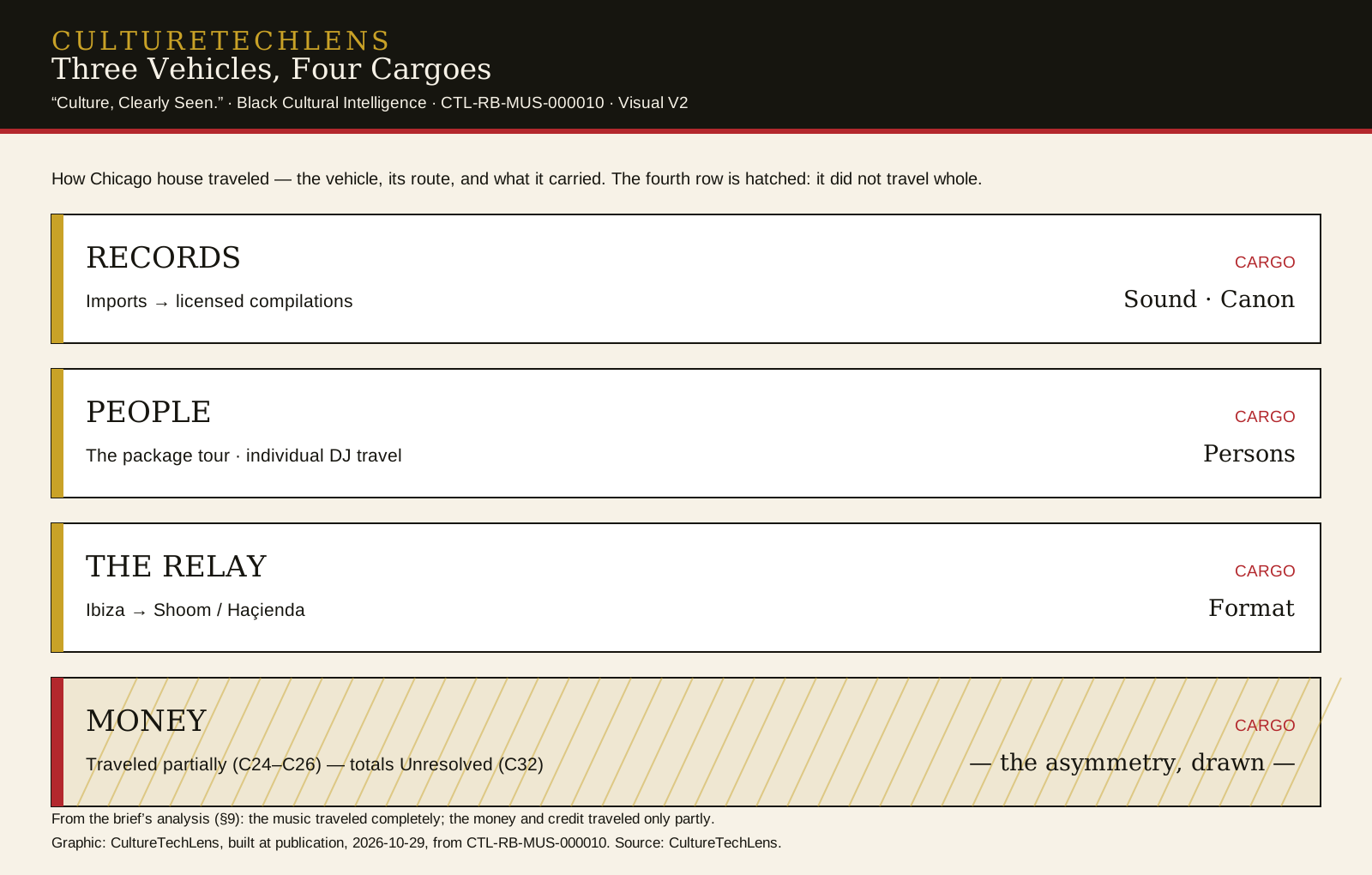
Three vehicles, three different cargoes. The records carried the sound but not the context: a British dancer in 1986 could jack to "Love Can't Turn Around" knowing nothing of the Warehouse, the Music Box, or the Black gay Chicago that made both — and Jefferson's suits-and-ties recollection (C16) shows the context arriving late even in the clubs. The compilations carried the canon: The House Sound of Chicago and the Jack Trax series decided which Chicago records Europe would treat as the genre's foundation, a curatorial power exercised in London (by Tong) and by a UK licensing label — not in Chicago. The tours carried the persons, briefly; the Ibiza relay carried the format, permanently. Read in that order, "how house traveled" is really four answers, and the brief's question survives only when all four are kept separate.
Why Britain, first? The evidence supports a supply-side answer over a taste answer. Britain had an import-DJ infrastructure that already valorized scarce American pressings (C13, C14), a chart system a club record could climb without radio (C09), and — decisively — a label employee who converted the flow into domestic product (C03). The US, on the scholarly record, was not rejected by Chicago's labels so much as deprioritized by them (C06): the same undercapitalization that made licensing attractive made a national American push unaffordable. House went global before it went national because going global, by license, was cheaper.
The asymmetry is the finding. Every vehicle above moved value toward the receiving end: UK labels gained a genre, UK DJs gained careers (C15's mirror image — the Chicagoan who did travel became the exception), UK clubs gained their defining era. The Chicago end retained authorship and, too often, not ownership (C24–C26). CTL's dossier standard asks who controls the recorded memory; on this evidence the masters' first world tour was also the first transfer of control. That is graded here as analysis, built only on the Supported claims cited — the revenue totals that would prove its scale are Unresolved (C32), and the brief does not pretend otherwise.
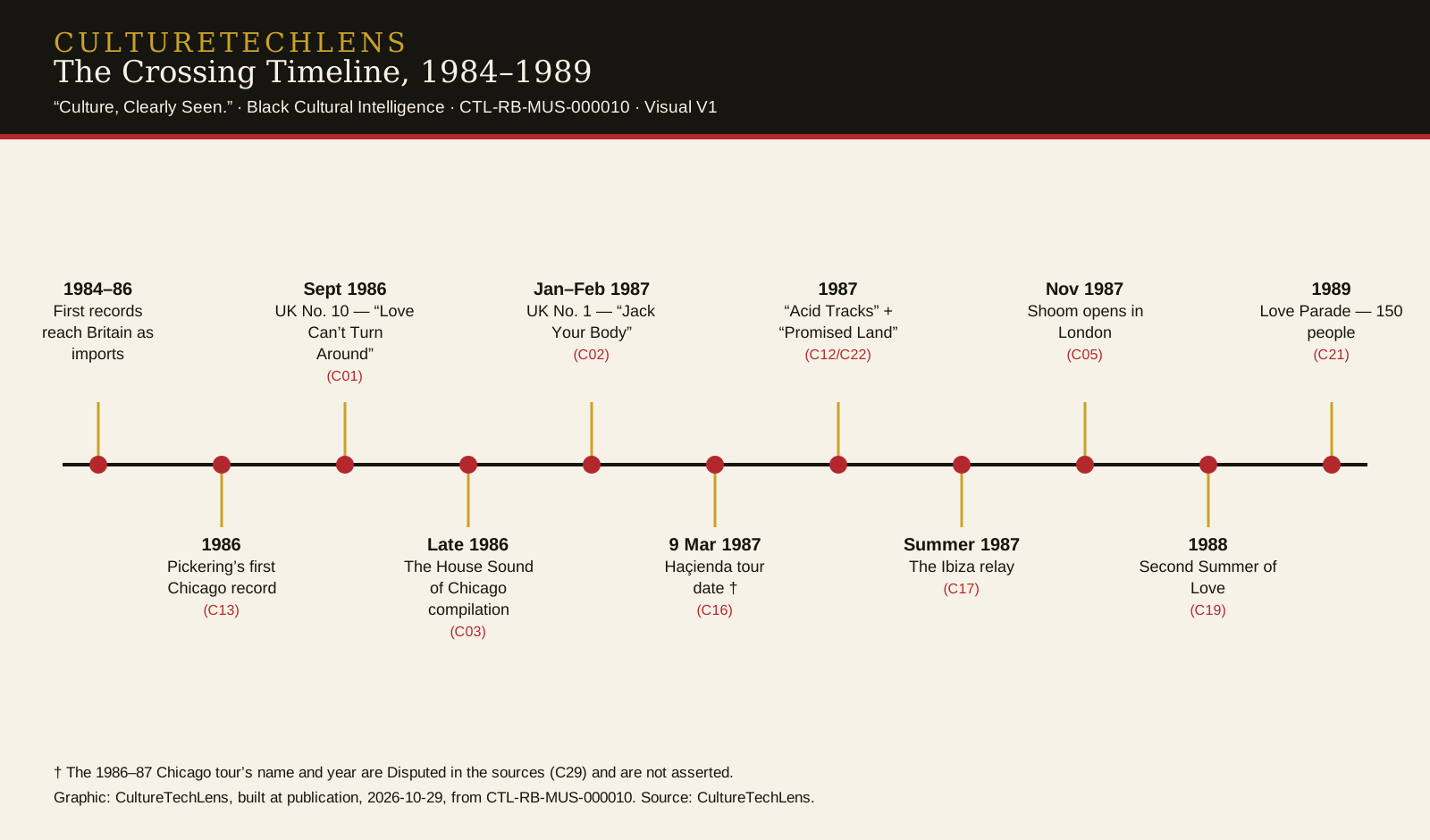
10. Timeline
- 1984 — Jesse Saunders' "On and On" (Jes Say); Trax Records founded by Larry Sherman with Vince Lawrence and Jesse Saunders (C06 context; founding credits per the scholarly study).
- 1985 — DJ International founded (Rocky Jones et al.); Mr. Fingers, "Mystery of Love"; Farley's "Jack the Bass" and Chip E.'s "Time to Jack" usher in jacking (C10, C11).
- 1986 — Mr. Fingers, "Can You Feel It"; Marshall Jefferson, "Move Your Body" (Trax); Adonis, "No Way Back" (C10, C11). Pickering plays his first Chicago house record at the Haçienda (C13).
- September 1986 — "Love Can't Turn Around" peaks at UK No. 10; first house record in the UK Singles Chart (C01). Pandy performs it on Top of the Pops (C08).
- Late 1986 — London Records releases The House Sound of Chicago, compiled by Pete Tong; the album charts into early 1987 (C03, C04).
- Winter 1986–87 — the Chicago package tour plays UK clubs (name/year Disputed, C29); Chip E. begins regular European DJ travel (C15).
- January–February 1987 — "Jack Your Body" at UK No. 1 for two weeks; first house chart-topper (C02).
- March 9, 1987 — the tour's Haçienda date: Jefferson, Adonis, Knuckles, Irving, Fingers Inc.; thin turnout (C16).
- 1987 — Phuture, "Acid Tracks" (Trax) (C12); Jack Trax compilations begin (C07); Joe Smooth, "Promised Land" (DJ International), written after his European tour with Farley (C22).
- Summer 1987 — Rampling, Oakenfold, Holloway, and Walker on Ibiza; Alfredo's Amnesia sets (C17). Knuckles spends two months in London and finds house still underground (C27).
- November 1987 — Shoom opens in London (C05).
- 1988 — Second Summer of Love begins (C19); acid house a popular phenomenon in Germany as in England (C20); Haçienda house nights scale with Graeme Park's arrival (C14).
- 1989 — "Promised Land" peaks at UK No. 56 (February) after the Style Council cover's success (C23); Westbam and Dr. Motte co-found the Love Parade in Berlin — 150 people, one sound system (C21).
11. People
- Farley "Jackmaster" Funk (CTL-E-0051) — Hot Mix 5 DJ whose "Love Can't Turn Around," built with Jesse Saunders on Steve Hurley's arrangement, with Darryl Pandy's vocal, became the first house record in the UK chart (C01, C30).
- Steve "Silk" Hurley (CTL-E-0050) — producer of "Jack Your Body" (as J.M. Silk), the UK's first house No. 1 (C02); also the uncredited-in-effect originator of the "Love Can't Turn Around" arrangement — the dispute is part of his record (C30).
- Darryl Pandy (CTL-E-0520) — Chicago church singer whose Top of the Pops performance made him, for one broadcast, the face of house in Britain (C08).
- Pete Tong (proposed CTL-E-6388) — London Records A&R man who met the DJ International and Trax owners and organized The House Sound of Chicago (1986), then founded FFRR (C03).
- Marshall Jefferson (CTL-E-0048) — "Move Your Body" (C11); headline act and chief witness of the 1987 tour (C16); witness against the royalty record (C25).
- Larry Heard / Mr. Fingers (CTL-E-0049) — "Mystery of Love," "Can You Feel It" (C10); co-plaintiff who regained his early recordings in 2022 (C26).
- Chip E. (CTL-E-0518) — Imports Etc. clerk turned producer ("Time to Jack"); from 1986 a regularly traveling DJ in Europe (C15).
- Joe Smooth (proposed CTL-E-6387) — DJ International producer who converted a European tour into "Promised Land" (C22).
- Danny Rampling (proposed CTL-E-6391) — founder, with Jenni Rampling, of Shoom (November 1987) after the Ibiza summer (C05, C17).
- Mike Pickering (proposed CTL-E-6392) — Haçienda DJ who received "No Way Back" from a Moss Side clubber and pioneered house in the North (C13, C14).
- Rocky Jones (CTL-E-6269) and Larry Sherman (CTL-E-1067) — the DJ International and Trax owners whose licensing decisions routed the export (C06); Sherman's royalty record is C24/C25.
- Frankie Knuckles (CTL-E-0046) — tour participant; his two months in London in 1987 are the brief's measure of how underground house still was there (C27).
12. Organizations
- Trax Records (CTL-E-0169) — Chicago label (1984) of Jefferson, Phuture, Adonis, Mr. Fingers; licensed to the UK after DJ International moved first (C06, C07).
- DJ International Records (CTL-E-4075) — Chicago label (1985) of Hurley, Farley, Smooth; its London Records deal produced the first compilation and the first hits (C03, C06).
- London Records (proposed CTL-E-6389) — UK label whose dance A&R (Tong) released The House Sound of Chicago and the first house hit singles in Britain (C03, C04).
- Jack Trax (CTL-E-3492) — UK compilation label/series from 1987 that made rare US house records cheaply available in Europe (C07).
- FFRR — Tong's London dance imprint, founded out of the same A&R work; named here as the institutional sequel of C03, not separately graded.
13. Places
- The Warehouse / the Music Box, Chicago — the origin rooms (MUS-000006); the Music Box is where Hardy broke "Acid Tracks" by repetition (C12).
- The Haçienda, Manchester (CTL-E-0481) — the first British room, on the tour's and Pickering's evidence, that received Chicago house on its own terms (C13, C16).
- Shoom, London (proposed CTL-E-6390) — Rampling's November 1987 club in a Southwark fitness centre; the Ibiza template rebuilt in London (C05).
- Amnesia, Ibiza — DJ Alfredo's club; the relay station of C17. (No address asserted; the island functions in this record as a place of hearing, not a venue dossier.)
- Rock City, Nottingham — named by Jefferson as, with the Haçienda, one of the two rooms that "got it" on the 1987 tour (C16); Nottingham is also Graeme Park's Garage base in the northern network (C14).
- The Ku'damm, Berlin — route of the first Love Parade, 1989: 150 people, one sound system (C21).
14. Events
- The first chart crossing (September 1986) — "Love Can't Turn Around" at No. 10 (C01) and its Top of the Pops performance (C08).
- The No. 1 (January–February 1987) — "Jack Your Body," two weeks, no prior Radio 1 play (C02, C09).
- The Chicago tour of UK clubs (winter 1986–87) — existence Supported; name and year Disputed (C16, C29); Haçienda date fixed at 9 March 1987.
- The Ibiza summer (1987) — four British DJs, one Argentine DJ's Balearic sets, and the template carried home (C17).
- Shoom's opening (November 1987) — the relay becomes a London institution (C05).
- The Second Summer of Love (1988–89) — the receiving culture's mass phase; the brief's endpoint marker (C19).
- The first Love Parade (1989) — house's German street form, at demonstration scale (C21).
15. Objects/Technologies
- The twelve-inch single — the export unit: built for DJ booths, priced as an import, and — in "Jack Your Body's" case — the first UK No. 1 to win most of its sales on the 12″ format (C02 note; chart-reference record).
- The compilation LP — the scaling technology of the crossing (C04, C07): many scarce singles, one cheap album, a scene name on the sleeve.
- The Roland TB-303 — the failed bass accompanist whose misuse in "Acid Tracks" named acid house (C12); full gear history in TECH-000001.
- The test pressing / import crate — Pickering's supply line ran on test pressings via New York, often before records hit Manchester shops (C13) — the informal logistics under the formal licensing story.
16. Data
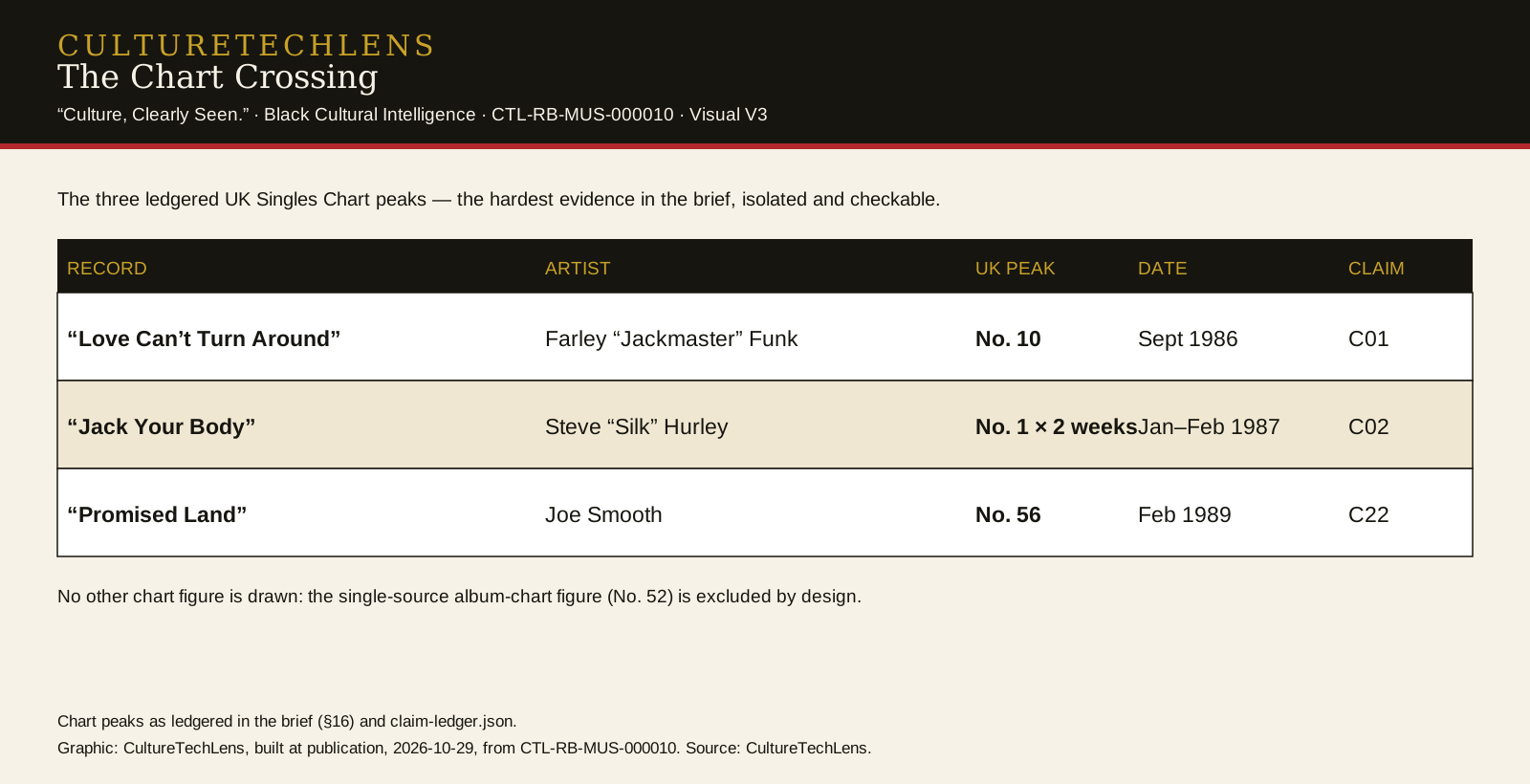
- UK chart peaks established in this package: "Love Can't Turn Around" No. 10 (September 1986) (C01); "Jack Your Body" No. 1, two weeks (January–February 1987) (C02); "House Nation" — a follow-up UK Top 10 for Farley's House Master Boyz in 1986, per the Farley reference record (context, not separately ledgered); "Promised Land" No. 56 (February 1989) (C23).
- The House Sound of Chicago: UK album-chart presence from late 1986 into early 1987; one German discography source gives a 12-week run peaking at No. 52 — printed here as a single-source figure, not ledgered (see red-team §6).
- First Love Parade attendance: 150 (German Historical Institute document) (C21).
- Claim tally: 37 claims — 6 Verified / 21 Supported / 3 Provisional / 3 Disputed / 4 Unresolved. Unresolved claims are C32–C35.
- Not in this table, by design: any sales total for any Chicago house record in Europe, and any licensing-revenue figure. None was located from an auditable source (C32). The often-repeated estimate that Adonis's "No Way Back" sold some 100,000 copies with no conventional distribution is graded Provisional as a single-source figure (C28) and is not summed anywhere.
17. Visual Evidence
Six visuals are specified in visuals.md: three build-at-publish CTL graphics (the crossing timeline; the three-vehicles diagram; the chart-crossing table) and three research-stage candidates, all rights-gated — the House Sound of Chicago sleeve, a Pandy Top of the Pops still, and Shoom flyer artwork. No image is downloaded or reproduced in this draft package; every candidate carries its per-image citation record and its gate. The argument of the brief is fully carried by V1–V3 if every photographic clearance fails.
18. Knowledge-Graph Connections
entities.json stages 28 entities: 20 existing graph entities reused (the people, labels, the Haçienda, and the key Works named in §11–§13) and 8 new proposals, CTL-E-6387–CTL-E-6394, continuing from the graph maximum verified this run (CTL-E-6386). relationships.json encodes 18 schema-valid edges — authored_by and released_by for the crossing records, recorded_for for the traveling artists, affiliated_with for Tong at London Records, distributed_by for the Trax→Jack Trax licensing edge, founded_by and played for Shoom, and collaborated_with for the Smooth–Farley tour — with grades carried visibly. The tour's Haçienda performance is deliberately not encoded as performed_at: the graph types the Haçienda as an Institution (CTL-E-0481), and performed_at requires a Venue object; the edge waits on the merge step's type review rather than being forced. No graph file was edited; CTL-GOV-006 pre-entry gates apply at merge.
19. Competing Interpretations
Did records or people matter more? The Brewster & Broughton lineage foregrounds the labels' deal-making (Pitzele persuading Rocky Jones that Europe was the place to focus — C31's companion claim, graded Provisional as single-lineage testimony). The receiving-scene record foregrounds British agency: import DJs, Tong's A&R, the Ibiza four. This brief's reading is sequential, not competitive — imports proved demand, licensing monetized it, tours personified it, Ibiza generalized it — but a reader who weights C13/C14 over C06 will reasonably tell a British-led story, and the ledger lets them.
Was the crossing a triumph or an extraction? Both readings run on this package's own claims: the chart facts (C01, C02) are a triumph by any measure; the royalty record (C24–C26) is an extraction by the scholarly account's. The brief refuses to net them out. What it rejects is the third reading — that the extraction is a later invention of aggrieved memory: the payment complaints are documented in the labels' own history and settled, in part, in a 2022 court outcome (C26).
"First" claims. This field manufactures firsts — first house record, first acid record, first UK house hit. The brief asserts only the two firsts the chart record can carry (first house record in the UK chart; first house UK No. 1) and treats the rest as Disputed or as other briefs' settled business (C30, and MUS-000002 on "On and On"). The naming of the genre itself — Warehouse shorthand vs. Imports Etc. bin cards — was adjudicated in MUS-000006 and is not reopened here.
20. What We Do Not Know
- C32 — The money totals. No audited or label-reported figure was located for European sales or licensing revenue earned by Trax or DJ International in 1986–89, or for what any individual artist received. The crossing's economics are documented structurally (deal types, royalty failures) and not numerically.
- C33 — The import volume. How many Chicago twelve-inches entered Britain as imports in 1985–86, through which shops and hands, is unrecorded in any source consulted; Pickering's test-pressing line (C13) is an anecdote with a mechanism, not a count.
- C34 — The audience's understanding. What British dancers in 1986–88 knew or believed about the music's Black, gay, Chicago origins cannot be recovered systematically; the record holds elite testimony (DJs, journalists) and one famous image (Pandy on Top of the Pops), not audience evidence.
- C35 — The continental sequence beyond Britain and Germany. Italy, France, the Netherlands, and Belgium all had house scenes by the early 1990s, but the first-travel sequence into each — which records, which DJs, which dates — was not established from sources consulted in this run; Chip E.'s Italian draw (C15) is a thread, not a chapter.
21. Limitations
The British side of this story is over-documented and the Chicago side under-documented, and the brief inherits that tilt: the receiving scenes wrote their memoirs, while the exporting labels left lawsuits and a scholarly post-mortem. Participant testimony is decades retrospective and self-interested in both directions (Jefferson against Sherman; the Ibiza four's founding myth burnished by repetition) — graded accordingly, never Verified alone. Chart data, the brief's hardest evidence, measures Britain's pop market, not its dancefloors; the club story rests on testimony the charts can only bracket. Detroit's parallel export is entangled with Chicago's in receiving sources (C19's own wording groups them), and this brief has not attempted the separation. Finally, the tour dispute (C29) may be resolvable from contemporary listings (Melody Maker, NME, club archives) that this run did not retrieve — §22 names the check.
22. Further Research
- Contemporary UK music-press listings (December 1986–March 1987) to settle the tour's name, billing, and full routing (resolves C29).
- London Records / Pete Tong A&R papers or interviews on the House Sound of Chicago deal terms — advance, royalty rate, territory (works C32).
- UK import-shop records and DJ supply lists (London and Manchester, 1985–86) for the pre-licensing flow (works C33).
- The Heard/Owens v. Trax filings and 2022 settlement record, for what the catalog's European earnings were claimed to be (works C32, C26).
- Oral histories with British clubbers of 1986–88, sampled beyond DJ/journalist elites (works C34).
- Country-by-country first-travel passes for Italy, France, and the Low Countries, on the MUS-000010 template (works C35).
- A discography-grade check of Jack Trax's full series and its Chicago source labels, pressing the CTL-E-3492 record from compilation-level to title-level (extends C07).
23. Sources
Full source register in sources.md: 5 primary/testimony sources, 11 secondary sources, 4 orientation-only. Headline sources: UK chart records and the Guardian's "Jack Your Body" anniversary account; "The Legacy of 1980s–90s Independent Chicago House Labels" (Harvard-hosted scholarly study); Tim Lawrence's Haçienda research; Brewster & Broughton, The History of House (martianarts.net carrying); the Ransom Note's Acid Rain sleeve notes; the German Historical Institute's Love Parade document; AllMusic's Pete Tong biography; Attack Magazine's "Promised Land" deconstruction.
24. Citation Information
CULTURETECHLENS · "Culture, Clearly Seen." · Black Cultural Intelligence
Cite as: CultureTechLens, House Music Goes Global (CTL-RB-MUS-000010), 2026-10-29. Source: CultureTechLens
Chicago: CultureTechLens. "House Music Goes Global." Research Brief CTL-RB-MUS-000010. Chicago: CultureTechLens, October 29, 2026. APA: CultureTechLens. (2026). House music goes global (Research Brief CTL-RB-MUS-000010). MLA: CultureTechLens. "House Music Goes Global." CultureTechLens Research Briefs, CTL-RB-MUS-000010, 29 Oct. 2026.
25. Version History
- v0.1 — 2026-10-29. Draft complete. Production slate item 5 of 25 (slate of 2026-10-02), produced by the ctl-brief-production run of 2026-10-29. 37 graded claims (6 Verified / 21 Supported / 3 Provisional / 3 Disputed / 4 Unresolved); 28 entities staged (20 existing graph entities reused; 8 new proposed CTL-E-6387–CTL-E-6394, staged only — no graph file edited); 18 relationships encoded, 3 documented connections deliberately unencoded (see relationships.json). Red team passed with 3 publication holds (tour listings check; sleeve/still/flyer rights gates; GOV-006 merge gates). Draft only — publication pending founder batch approval. Nothing in this package has been published.