 CULTURETECHLENS
Women of Chicago Gospel
CULTURETECHLENS · “Culture, Clearly Seen.” · Black Cultural Intelligence
Cite as: CultureTechLens, “Women of Chicago Gospel,” Research Brief CTL-RB-MUS-000011, November 22, 2026. Source: CultureTechLens · culturetechlens.com
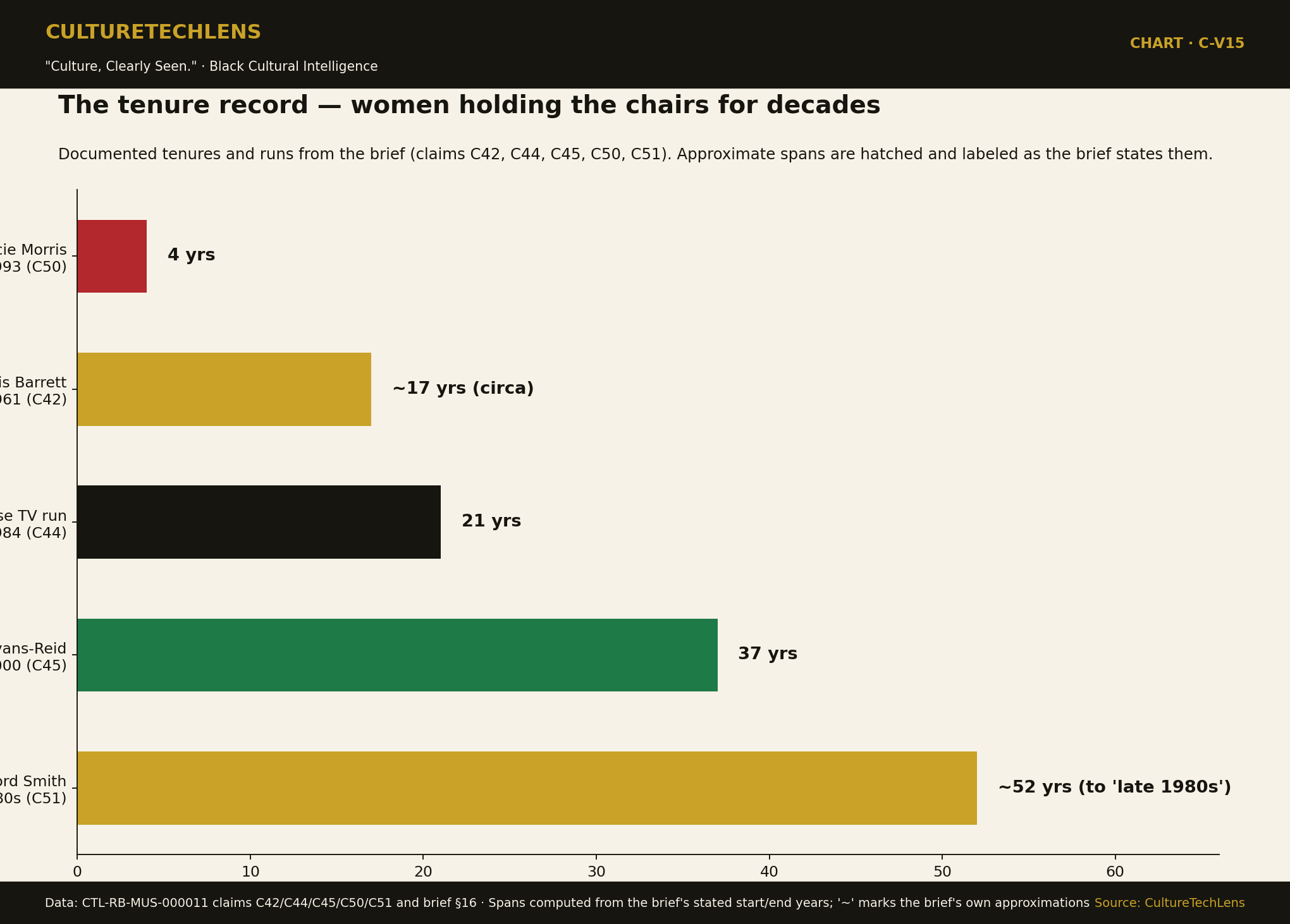
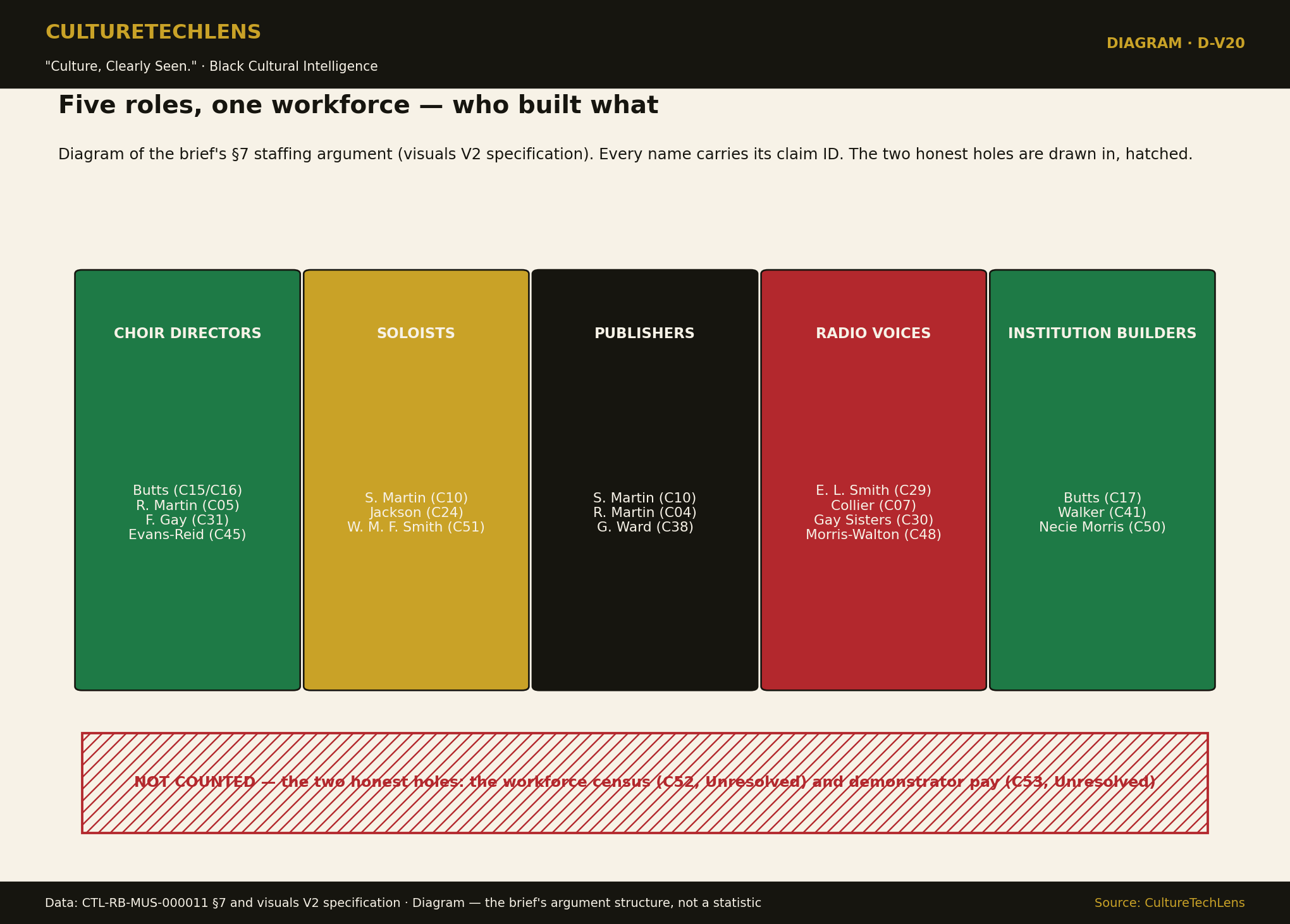
The standard history of Chicago gospel is a history of a composer and his churches: Thomas A. Dorsey writes the songs, pastors hire him, quartets and choirs sing. This brief asks what that telling leaves out, and the evidence answers with a workforce and a set of institutions. Dorsey's songs were carried into churches by a woman — Sallie Martin, his demonstrator and bookkeeper, who sang them into demand, kept the finances, and developed the markets (C10) — and by another woman recruited to sing them on Chicago street corners to sell the sheet music outright (C25, Provisional). The choir the sources call Chicago's first gospel choir was established in 1931 by three people, not two: Dorsey, Theodore Frye, and Magnolia Lewis Butts — who also founded a gospel youth choir at Metropolitan Community Church, co-founded the national convention, and drafted its first bylaws (C15–C17). The convention itself has a women's founding and operating layer at every level this brief could test: Martin as co-founder (C11), Butts as bylaw-drafter (C17), Roberta Martin leading its Youth Department (C06), and Willie Mae Ford Smith directing its Soloists' Bureau — gospel's national singing-teacher post — from 1936 into the late 1980s (C51).
Research ID: CTL-RB-MUS-000011 Central question: What did Chicago's gospel women — as choir directors, soloists, publishers, radio voices, and institution builders — build that the standard (male, pastor-and-quartets) history under-credits? Status: Draft complete (2026-11-02). Published November 22, 2026. Date: 2026-11-02 Cross-references: Built on, without re-ledgering, CTL-RB-MUS-000001 ("Why Chicago Became a Gospel Center") — the institutional founding record — and CTL-RB-MUS-000008 ("Gospel's Business") — the money record, whose claims are cited by its own claim IDs where this brief relies on them. The radio layer also touches CTL-RB-MUS-000004; the WVON dossier is CTL-RD-MUS-000002 and is not re-ledgered here.
1. Executive Summary
The standard history of Chicago gospel is a history of a composer and his churches: Thomas A. Dorsey writes the songs, pastors hire him, quartets and choirs sing. This brief asks what that telling leaves out, and the evidence answers with a workforce and a set of institutions. Dorsey's songs were carried into churches by a woman — Sallie Martin, his demonstrator and bookkeeper, who sang them into demand, kept the finances, and developed the markets (C10) — and by another woman recruited to sing them on Chicago street corners to sell the sheet music outright (C25, Provisional). The choir the sources call Chicago's first gospel choir was established in 1931 by three people, not two: Dorsey, Theodore Frye, and Magnolia Lewis Butts — who also founded a gospel youth choir at Metropolitan Community Church, co-founded the national convention, and drafted its first bylaws (C15–C17). The convention itself has a women's founding and operating layer at every level this brief could test: Martin as co-founder (C11), Butts as bylaw-drafter (C17), Roberta Martin leading its Youth Department (C06), and Willie Mae Ford Smith directing its Soloists' Bureau — gospel's national singing-teacher post — from 1936 into the late 1980s (C51).
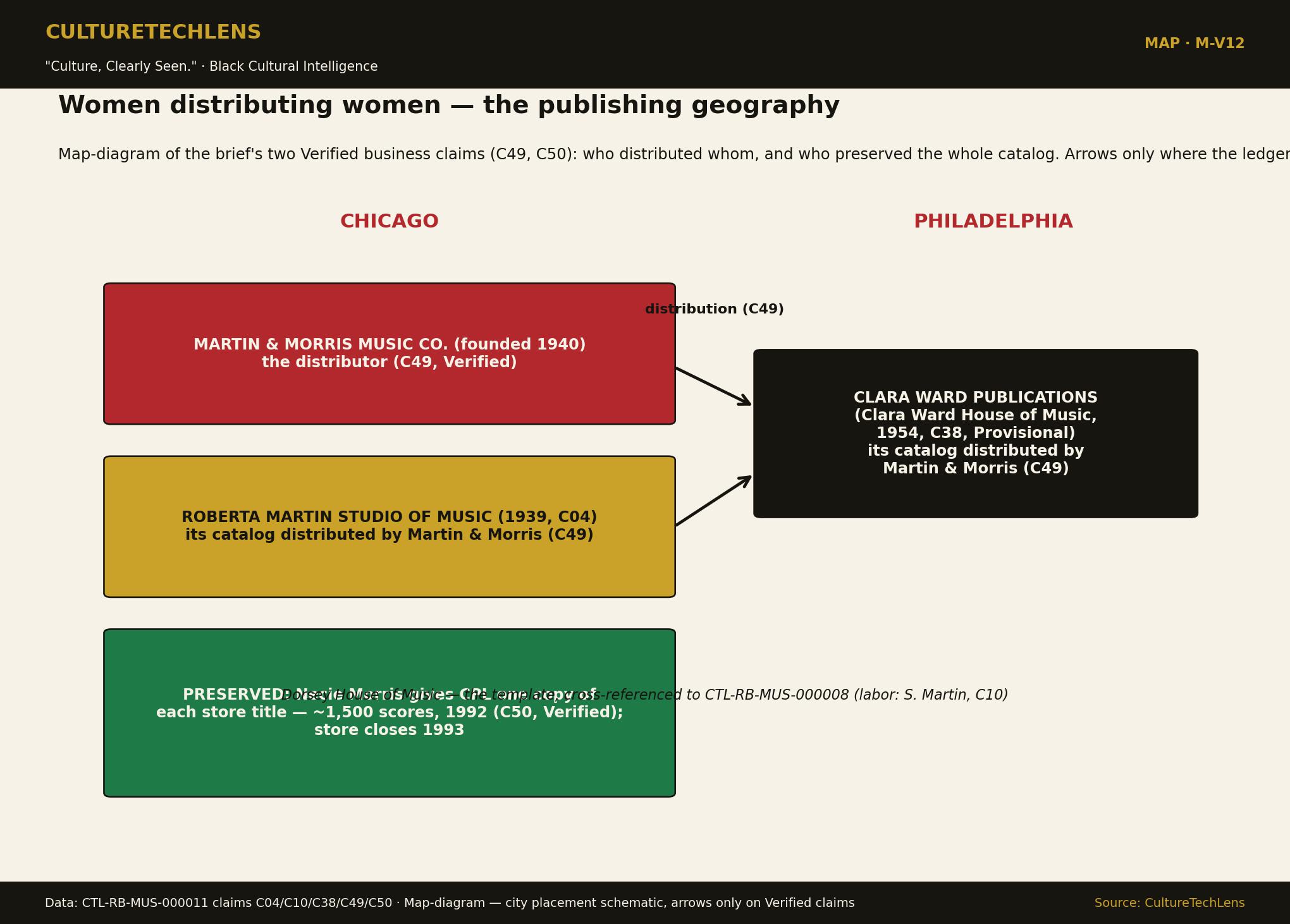
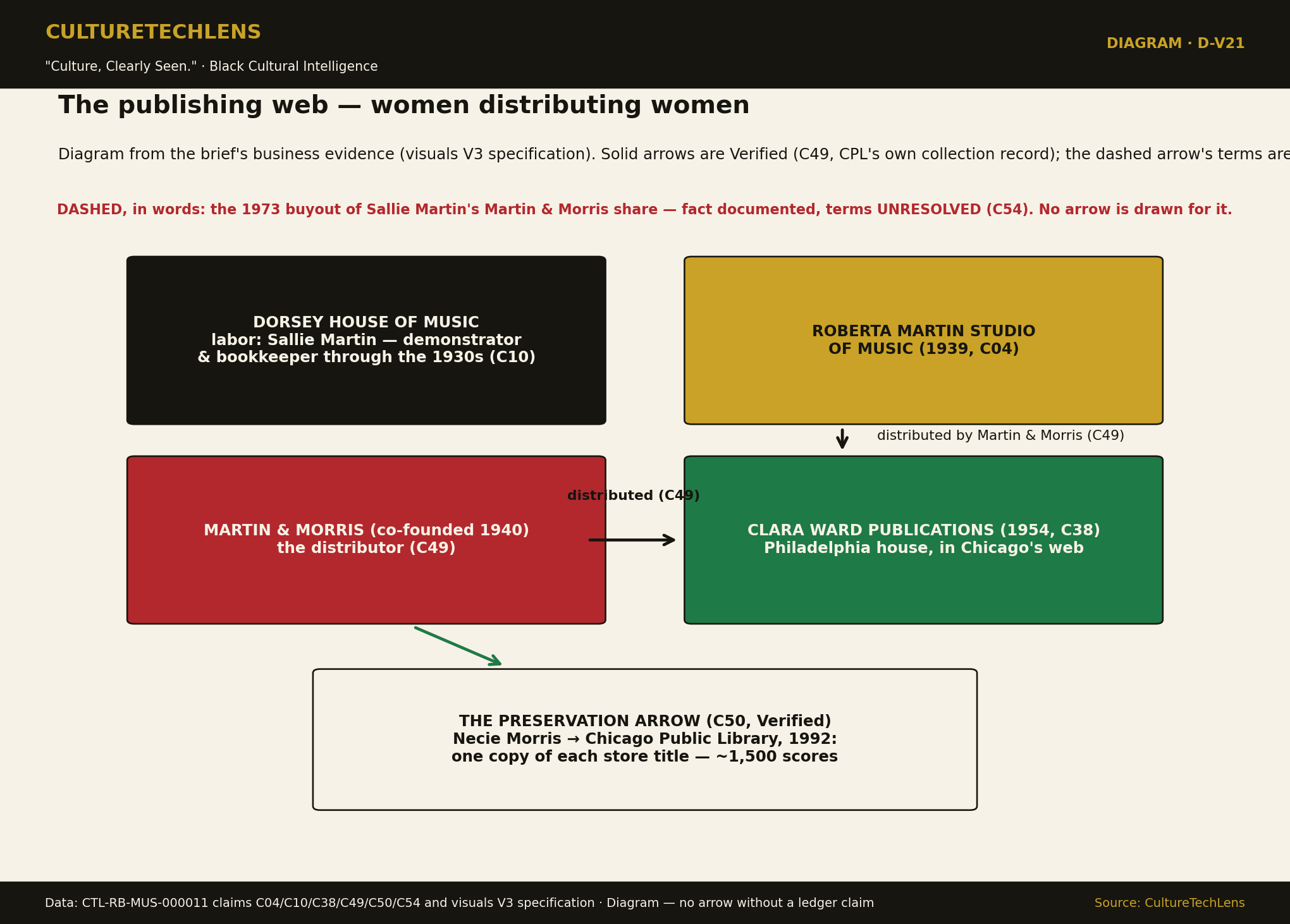
The pattern repeats in every lane the question names. As publishers, women owned pieces of the business: Roberta Martin's Studio of Music (1939) published her group and the field's rising composers (C04); Martin & Morris distributed the catalogs of Clara Ward Publications and the Roberta Martin Studio (C49, Verified); and when the firm's co-founder died, his widow Necie Morris ran the store four more years and preserved its entire catalog into public archives (C50, Verified). As choir directors and Ministers of Music, women held offices the standard history treats as scenery: Roberta Martin at Mount Pisgah (C05), Fannie Gay directing with her daughters accompanying (C31), Evans-Reid at Fellowship from 1963 — three choirs for 37 years, a 40-plus-album choir (C45, C46). As radio voices, a woman pastor — Elder Lucy Smith — put her church on WIND by early 1933, before the famous broadcasting church (C29); her granddaughter and the Gay Sisters carried its music over the air (C07, C30); and the line runs to Pam Morris-Walton, WVON gospel host and 2006 Stellar Gospel Radio Announcer of the Year (C48). As institution builders, Walker's Caravans launched more solo stars than any comparable group (C41), and the Roberta Martin Singers were a training pipeline whose graduates built institutions of their own (C42).
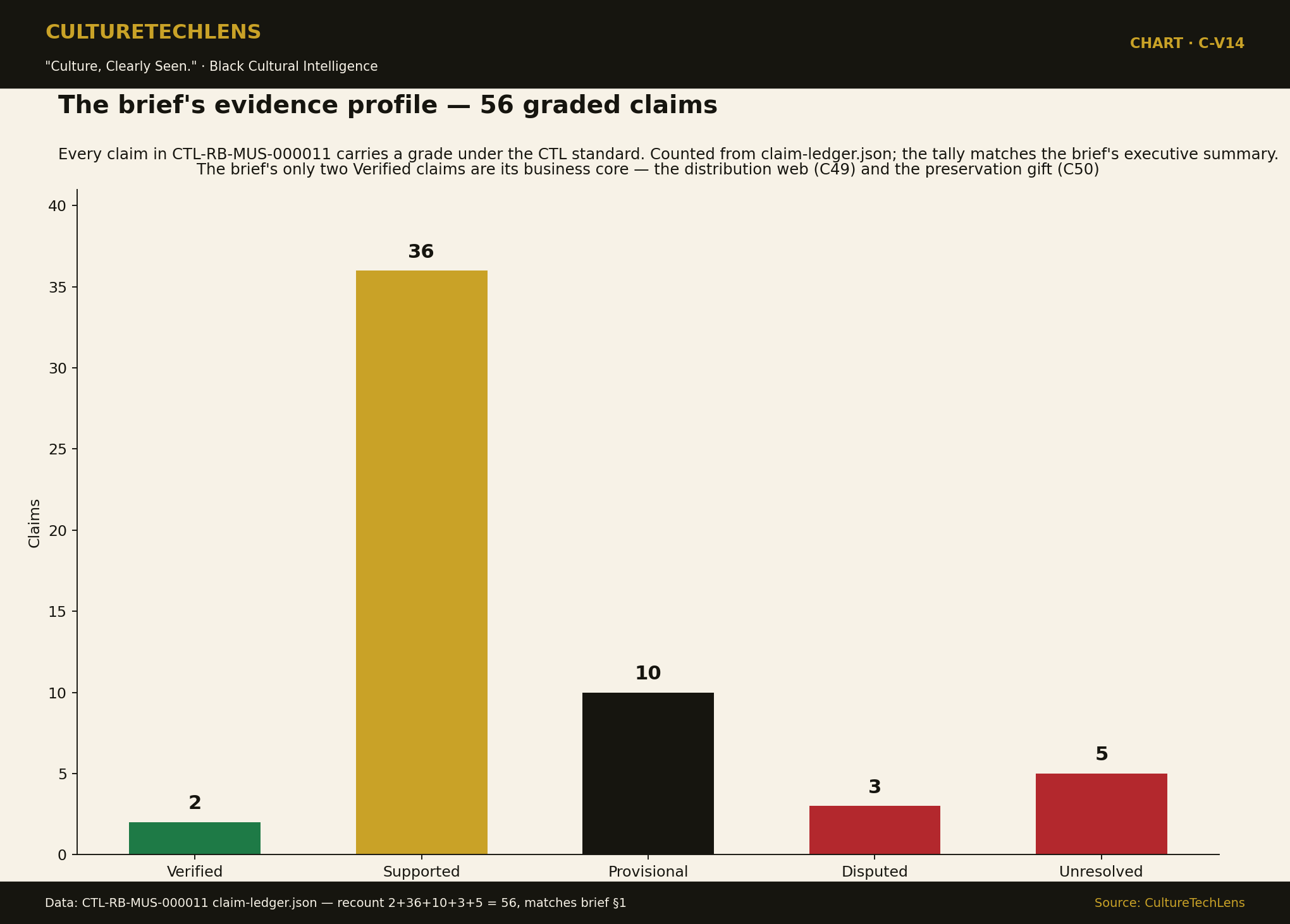
The brief grades 56 claims: 2 Verified, 36 Supported, 10 Provisional, 3 Disputed, 5 Unresolved. Its discipline is as much a finding as its recoveries: the Ward Singers, so often swept into Chicago stories, were a Philadelphia group, and their Chicago tie is graded as exactly what the record shows (C34–C38, C55). And the five Unresolved claims name what even a women-centered pass could not recover: no census of women Ministers of Music exists, no demonstrator was ever priced, and the terms on which Sallie Martin left the firm she co-founded are nowhere documented (C52–C54, C56).
2. Primary Research Question
What did Chicago's gospel women — as choir directors, soloists, publishers, radio voices, and institution builders — build that the standard (male, pastor-and-quartets) history under-credits?
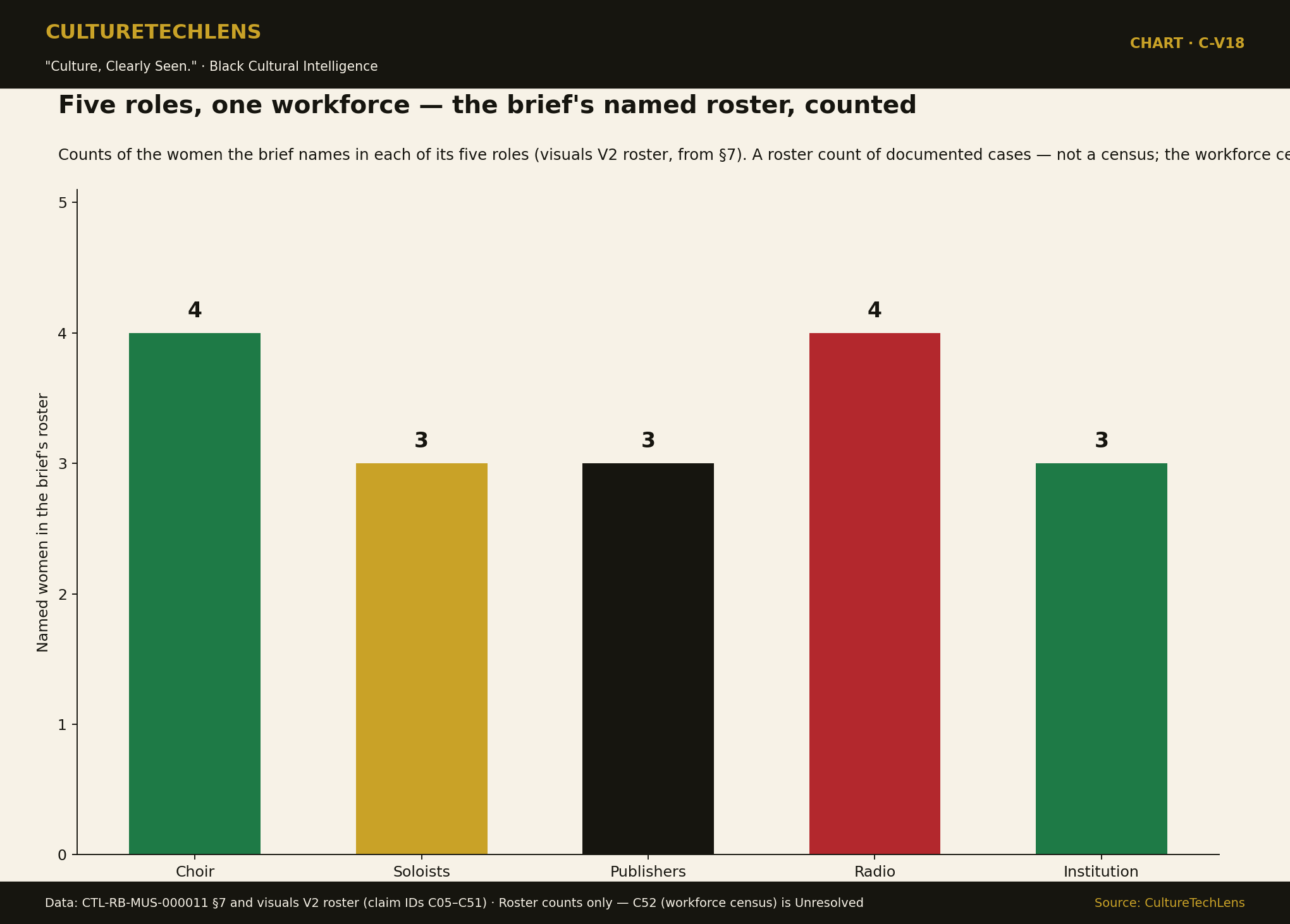
The question names five roles, and the brief tests each as a building claim, not a presence claim. A woman "was there" is not a finding; a woman founded, directed, published, broadcast, trained, distributed, or preserved something is. Each role gets its own evidence pass (Sections 6–7), and each pass ends where the record ends — which is why the Ward Singers, present in Chicago's story mainly as visitors, are handled as a test of the brief's own honesty, and why five claims are graded Unresolved rather than filled.
3. Why It Matters
CTL's two prior gospel briefs established the frame this one completes. MUS-000001 showed Chicago gospel was built by institutions and networks, not a lone genius — naming Sallie Martin, Roberta Martin, and Mahalia Jackson inside that network without making their labor the subject. MUS-000008 showed the money ran through publishing, and that the distribution, bookkeeping, and proprietorship layer "was disproportionately built and run by Black women" — stated there as analysis. This brief is the direct test of that sentence, role by role. It confirms the pattern in publishing and training, and sharpens it in two places the earlier briefs did not look: the convention's internal offices (a woman drafted its bylaws; a woman ran its soloist training for fifty years) and the Minister of Music's chair, where the longest documented Chicago tenure this run found belongs to a woman who held it 37 years while working as a surgical nurse. Getting it right matters beyond credit: the graph CTL is building inherits whatever this brief encodes, and a graph that wires Dorsey to every institution while leaving the women's labor in prose would rebuild the under-credit in database form. Section 18 therefore encodes the women's edges — founding, directing, distributing — with the same care as the men's.
4. Scope
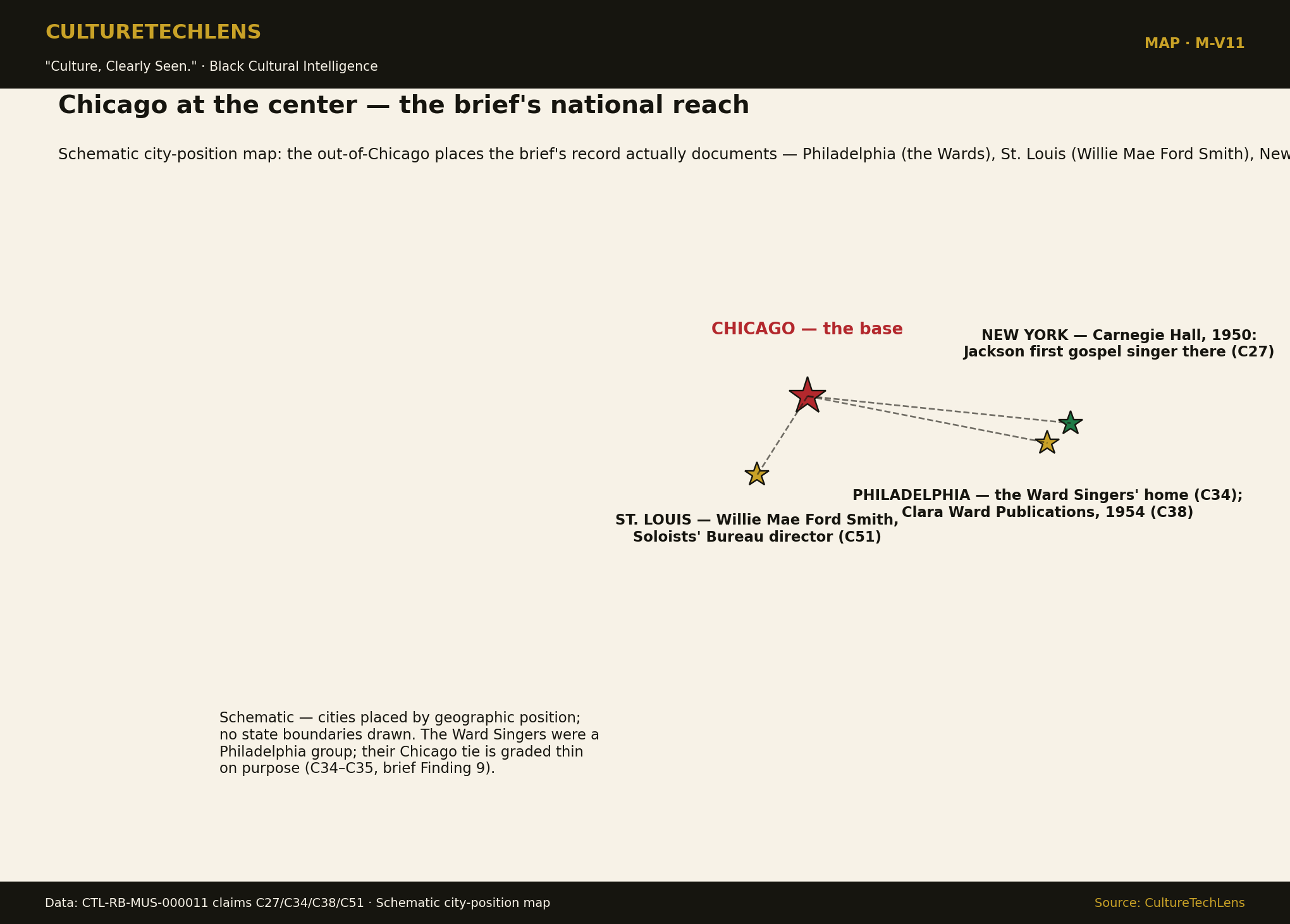
- Geography: Chicago as the base and the test. Out-of-Chicago figures enter only where their work is a Chicago institution's work: Willie Mae Ford Smith, St. Louis-based, as the Chicago-founded convention's national officer (C51); the Ward Singers of Philadelphia, as a Chicago convention's breakthrough act and a Chicago distributor's catalog (C34–C38). Their non-Chicago bases are stated in the claims themselves, never blurred.
- Period: 1927 (Jackson's arrival; Sallie Martin's Chicago settlement in the CPL account) to 2006 (Morris-Walton's Stellar Award), with the weight on 1931–1970.
- In scope: choir direction and the Minister of Music office; soloists as workers and sellers; gospel publishing from the women's side; church and commercial radio; conventions and groups as training institutions; archival stewardship of the record itself.
- Out of scope: the founding narrative as such (MUS-000001) and the industry's full money record (MUS-000008) — both cross-referenced, not repeated; theology and vocal style except where they carry an institutional fact (Jackson's style matters here because it was policed by institutions, C20); the post-1970 contemporary-gospel industry except at the radio line's modern end (C48).
- Evidence rule: CTL grading standard throughout — GOV-004's canonical five grades only. Wikipedia-only support caps a claim below Verified; a single popular or interested lineage caps at Provisional; an Unresolved claim is never asserted as fact in prose. Sibling briefs' claims are cited by their IDs, not re-ledgered; the single exception (C12) is flagged in its own note.
5. Definitions
- Song demonstrator / song-plugger: a singer employed by a publisher to introduce new songs in churches and at conventions, singing them into demand and taking orders — Sallie Martin's job for Dorsey (C10) and, in a street-corner variant, Jackson's (C25). The print era's distribution workforce.
- Minister of Music: the church officer responsible for a congregation's choirs and music program. A salaried, titled office in the larger churches; Evans-Reid's 1963–2000 Fellowship tenure (C45) is the benchmark case.
- Choir director: the working leader of a specific choir — Butts at Ebenezer and Metropolitan (C15, C16), Roberta Martin at Mount Pisgah (C05), Dacus over the future Barrett Sisters (C43).
- Soloists' Bureau: the NCGCC's training and evaluation office for solo singers, directed by Willie Mae Ford Smith from 1936 into the late 1980s (C51) — the convention's school for the solo voice.
- Fish and bread singer: Jackson's own term for her early working life — funerals, rallies, and revivals between odd jobs (C24).
- Launching institution: a group whose documented function, beyond performing, was producing solo careers — the Caravans (C41) and, a generation earlier, the Roberta Martin Singers (C42).
- Under-credited (as used here): not "unmentioned" — most of these subjects are named in the standard references. Under-credit is a functional misdescription: a co-founder listed as a singer, a proprietor listed as an employee, a fifty-year officeholder listed as a guest. The brief grades functions, not fame.
6. Historical Context
Chicago's gospel system, as MUS-000001 established, was assembled in a few South Side years: the Ebenezer chorus experiment of 1931–32, Pilgrim's salaried music post, Dorsey House of Music (1932), the national convention (1932/33), First Church of Deliverance's broadcasts, Martin & Morris (1940). Read that list again with the labor showing. The Ebenezer choir was established by Dorsey, Frye, and Butts (C15). The convention was co-founded by Sallie Martin (C11), its bylaws drafted by Butts (C17). The publishing template ran on a woman demonstrator-bookkeeper (C10), and its street-level sales force included the young Mahalia Jackson (C25). The era's first church broadcasts, on the corrected record, were a woman pastor's (C29). None of this revises MUS-000001's institutional thesis; it populates it. At the founding layer these were mixed institutions whose women's work was later described in smaller words.
The second generation industrialized the pattern. Roberta Martin — trained as a pianist inside the Ebenezer system (C01) — built the integrated firm: a group that created demand (C02, C03), a publishing house that collected on it (C04), a church choir directorship at Mount Pisgah (C05), a convention office (C06). Her accompanist Lucy Smith Collier rose inside the group from organist to musical director on its recordings (C07) — a promotion ladder the standard history rarely draws for accompanists. Albertina Walker founded the Caravans in 1951 (C39) and made group leadership itself a profession for other women's voices (C41). And the Minister of Music's office — the unglamorous, decades-long work of rehearsing other people's singing — produced the era's longest documented tenures in women's hands (C45, C46).
7. Key Findings
1. The convention had a women's founding layer, and one of its founders has been nearly erased. Sallie Martin's co-founding of the NCGCC is convergent across BlackPast, the Smithsonian finding aid, and Johns Hopkins (C11). Magnolia Lewis Butts's co-founding — and her drafting of its first bylaws — rests on the Encyclopedia of Chicago lineage and UMC Discipleship's hymn history (C15, C17), yet Butts appears in neither sibling brief's ledger and in few standard tellings at all. The 1932/1933 founding-year dispute (C12, Disputed) is preserved from both siblings; this brief's new evidence — a precursor choral union organized in 1932, a first convention in 1933, a woman presiding over the 1933 Chicago convention (C17, Provisional) — suggests the dispute may be two events wearing one name, and says exactly that much and no more.
2. Dorsey's songs traveled on women's labor, in two documented modes. The church mode: Sallie Martin, demonstrator and bookkeeper, singing and selling the compositions at churches and conventions through the 1930s (C10). The street mode: Jackson, after two months of Dorsey's coaching, singing his songs on Chicago street corners to sell the pages at ten cents each (C25, Provisional — a single, widely-copied lineage, graded down accordingly). The standard phrase "Dorsey's publishing" names the owner. The distribution system had names too.
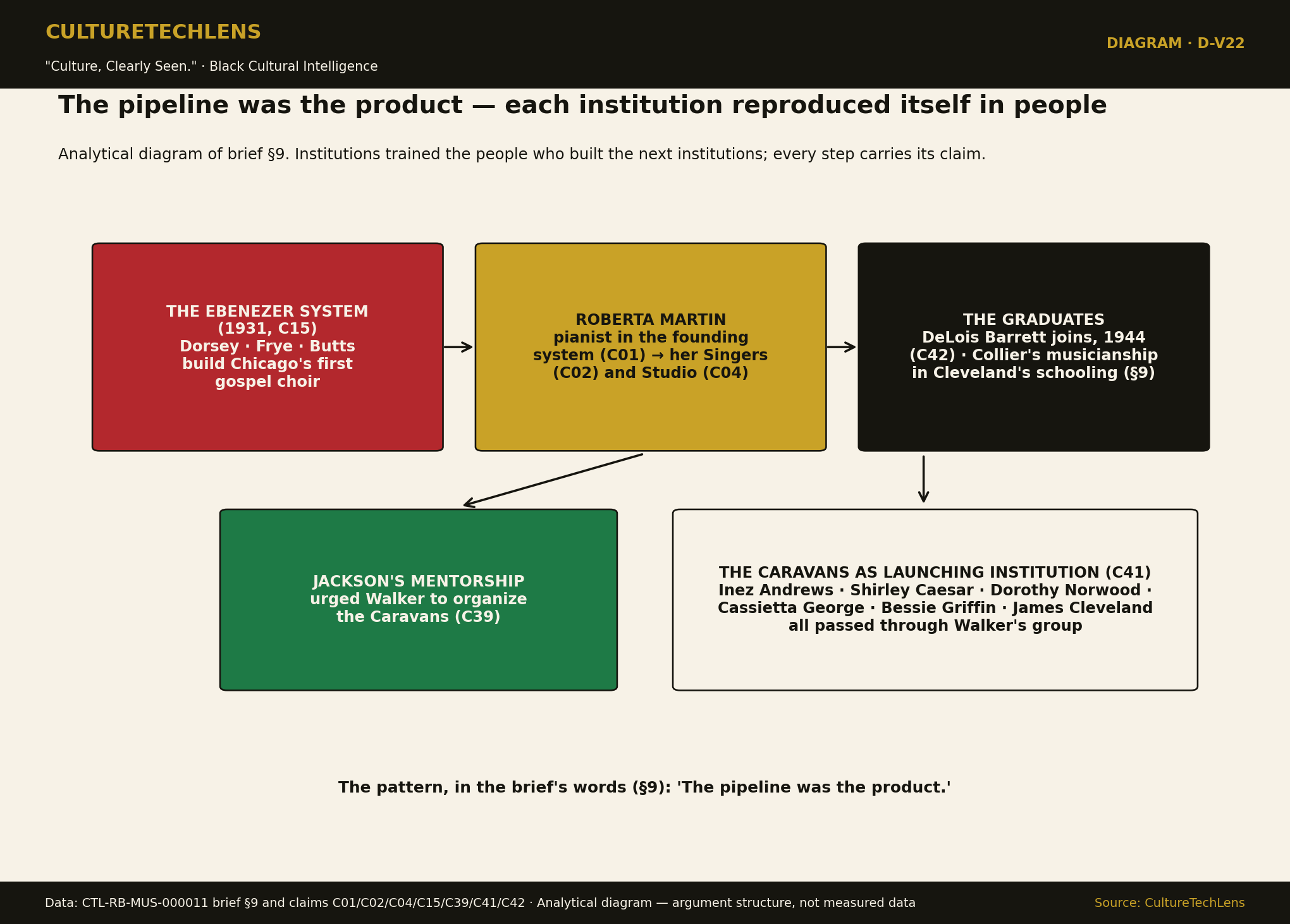
3. Roberta Martin built the complete institution: pipeline, product, and publishing in one woman's hands. Pianist in the founding choir system (C01); co-founder of the group that set the mixed-gender small-group standard when women's voices joined it in the early 1940s (C02, C03); founder of a publishing house that published Cleveland, Norwood, and Bradford (C04); choir director at Mount Pisgah (C05); the convention's Youth Department leader (C06). DeLois Barrett's route — recruited from high school, a Roberta Martin Singer 1944–c.1961, then leader of the Barrett Sisters (C42) — shows the pipeline working across a whole career. MUS-000008 graded her Studio's business record; this brief's finding is the integration itself: no male contemporary in the Chicago record holds all five roles in one career as completely.
4. The keyboard was a ladder, and women climbed it in public. Collier's documented arc — piano study with Roberta Martin (C09, Provisional), organist at her grandmother's broadcasting church, leader of her own female group, principal accompanist of the Roberta Martin Singers, and by 1963 their regular pianist and musical director on recordings, with a solo Savoy LP in 1962 (C07, C08) — is the accompanist's career drawn at full length, which gospel historiography almost never does. Beside her: Evelyn Gay, composer-arranger of the Gay Sisters, who accompanied Jackson early (C32), and Geraldine Gay, credited with pioneering jazz-infused gospel piano (C33, Provisional — label copy, graded down). Cleveland learned piano technique from Collier's playing, on Heilbut's account: the "King of Gospel's" keyboard schooling ran through a woman billed as Little Lucy.
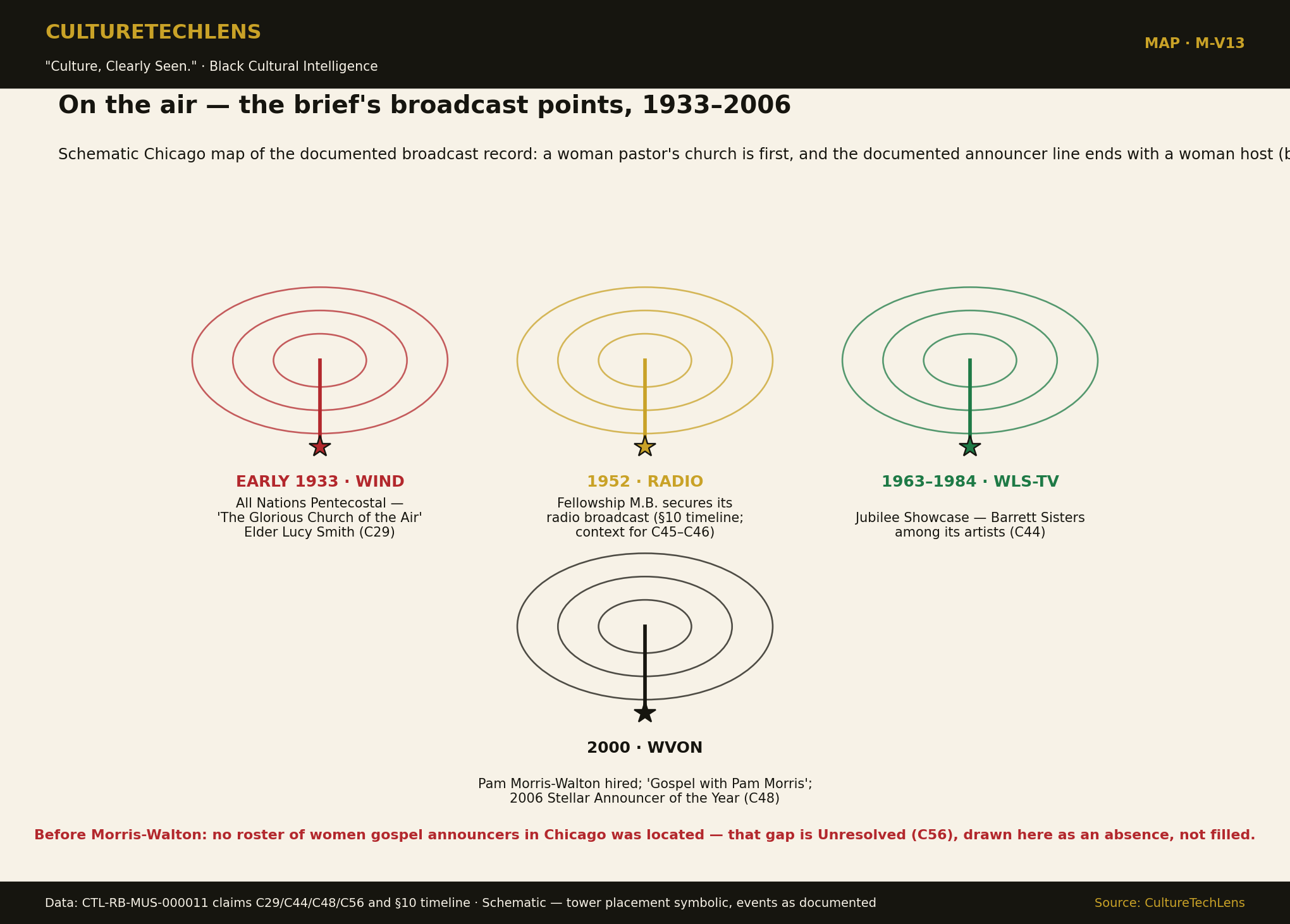
5. Chicago's gospel radio begins with a woman pastor, and its documented announcer line ends (for now) with a woman host. Marovich's correction stands: by early 1933, Elder Lucy Smith's All Nations was broadcasting on WIND as "The Glorious Church of the Air," two years before First Church of Deliverance's broadcasts (C29). The music on those broadcasts was substantially women's — her granddaughter at the organ, the Gay Sisters featured every Sunday night (C30). At the century's other end, the named-announcer record this run could document is Pam Morris-Walton: WVON hire in 2000, "Gospel with Pam Morris," the 2006 Stellar for Gospel Radio Announcer of the Year, head producer of the Chicago Gospel Music Festival from 1989 (C48). Between those poles, women gospel announcers in Chicago are essentially undocumented in the sources consulted (C56, Unresolved) — a gap recorded, not bridged with assumption.
6. The Minister of Music's chair was women's work at the highest level, and its record is a tenure record. Evans-Reid's 37 years at Fellowship (C45) — three choirs, a 40-plus-album choir (C46), then a second career advising First Church of Deliverance and coordinating GMAC's music into her nineties (C47) — is the fullest case, but the pattern is wider: Butts at two churches (C15, C16), Roberta Martin at Mount Pisgah (C05), Fannie Gay directing with her daughters accompanying (C31), Dacus coaching the future Barrett Sisters inside Morning Star's choir (C43). These offices are where repertoire was standardized week by week — and where the record thins fastest: no census of the officeholders exists (C52, Unresolved), so the brief names the documented and refuses the estimate.
7. Mahalia Jackson's Chicago base was an economy, and she ran it herself. Arriving in 1927 to domestic work (C18), she built a portfolio the standard "discovered voice" story flattens: choir lead and musical-drama lead with the Johnson Singers (C18, C19), fifteen years of funeral-rally-revival work she named herself (C24), beauty school and a salon she kept for many years, later a flower shop (C22 — the school's very identity is Disputed between two institutional sources, C23). The establishment friction was real and institutional: conservative preachers enraged by her bodily sanctified style, purists policing hand-clapping and "jazz in the church" (C20), a vocal coach hired to correct her telling her the singing was not "a credit to the Negro race" (C21, Provisional). Her refusals were economic decisions with career costs: gospel-only at Decca against label and husband's pressure (C26). And her venue line was drawn by her: the theaters she declined are MUS-000008's record; this brief adds the positive pole — Carnegie Hall in 1950, the first gospel singer there, on her own terms (C27).
8. The publishing web was women distributing women, and a woman preserved it. The brief's two Verified claims are its business core. CPL's collection record — the holder describing its own shelves — states that Martin & Morris distributed Clara Ward Publications and Roberta Martin Music Studios (C49), and that Necie Morris ran the store from 1989 to its 1993 closing and in 1992 gave CPL one copy of every title in the store, the roughly 1,500-score collection researchers now use (C50). The archive of Chicago gospel publishing exists, in significant part, because a widow decided it should; Bernice Johnson Reagon's role in steering the firm's records to the Smithsonian (Smithsonian finding aid, via MUS-000008's sources) makes the stewardship chain itself substantially women's work.
9. The Ward Singers' Chicago tie is real, thin, and graded thin — deliberately. The Wards were Philadelphians (C34). Chicago enters their record in four graded places: the 1943 convention sensation that launched their national touring (C35, Supported); an influence line from Dorsey and Sallie Martin (C36, Provisional); Gertrude Ward's anniversary event drawing Dorsey, Martin, and Ruth Jones (C37, Provisional/low); and Clara Ward Publications inside Martin & Morris's Chicago distribution (C38, C49). No Chicago residence, venue run, or further engagement was located (C55, Unresolved). A brief about under-credit loses its authority if it over-credits its own geography; the Wards are this package's worked example of the discipline.
8. Evidence
The evidence base is five unlike materials, graded against each other. (1) Institutional records directly consulted: CPL's Martin & Morris collection page and "Chicago's Women of Gospel Music" post; CPL's Rev. Clay Evans Archive finding aid; the Smithsonian's Martin and Morris finding aid; Tulane's Amistad finding aid. The two Verified claims (C49, C50) rest on the first, read in full. (2) Oral-history biographies: The HistoryMakers' lives of Evans-Reid (interviewed 2022) and Pam Morris (2014) — participant testimony at one editorial remove, graded Supported. (3) Encyclopedia and scholarly reference: the Encyclopedia of Arkansas (Roberta Martin); BlackPast (Sallie Martin); the Mississippi Encyclopedia (Willie Mae Ford Smith); Hymnary (Marovich; Shapiro's Encyclopedia of Chicago account); Nations's Barrett Sisters essay (Smithsonian Institution Press, 1992). (4) Specialist press: the Journal of Gospel Music (Marovich's Collier obituary; Gregory Gay's family history — participant testimony, graded as such); Malaco's Ward biography (a label source, used for the group's own itinerary); AllMusic biographies (used convergently, never alone for a Verified claim). (5) The sibling CTL record: MUS-000001 and MUS-000008, cited by claim ID; their grades travel with their claims and are never silently promoted. Weak vessels are named where used: Gilmore/Boyer (scholarship at one remove), Sirens Records on Geraldine Gay (an interested source), and the popular Jackson lineage — Provisional all.
9. Analysis
Count the functions, and the founders change. The standard history's verbs for its women are vocal: they sang, they wailed, they inspired. This brief's ledger verbs are institutional: co-founded (C11, C17), drafted (C17), directed (C45, C51), published (C04), distributed (C49), demonstrated and bookkept (C10), coached (C43, C51), preserved (C50). These functions were documented all along — in finding aids, library pages, encyclopedias, and obituaries, sources a voice-centered history does not open. The under-credit is therefore a source-selection effect before it is anything else: read the business and institutional paper and the same women appear as builders. It is also why this brief's gaps matter — the paper that prices the demonstrator's labor and Sallie Martin's exit (C53, C54) sits in exactly the archive neither run inspected.
The pipeline was the product. Chicago's women's institutions share a shape: each reproduced itself in people. The Ebenezer choir system produced Roberta Martin; her group produced DeLois Barrett and, through Collier's musicianship, part of James Cleveland's piano schooling; Jackson's mentorship produced Walker's Caravans; the Caravans produced Andrews, Caesar, Norwood, George, Griffin, and Cleveland (C41); the Soloists' Bureau produced, over fifty years, an uncountable share of the era's soloists (C51). MUS-000001 floated churches as a "training and promotion pipeline" as a suggestion. For the women's layer, the pipeline is the central documented mechanism — and its operators were disproportionately the women themselves, teaching inside institutions they had also founded.
Two cautions the brief owes its own argument. First, the recovery can over-swing: several of the most attractive claims are the weakest-graded (C37, Provisional/low; C33, C25, Provisional). The findings print those grades inline, so the strong argument never secretly borrows the weak claims' color. Second, Chicago-centrism is an under-credit risk in reverse: Willie Mae Ford Smith ran the convention's school from St. Louis, and the Wards built their institution in Philadelphia (C34, C51). A Chicago brief that annexed them would repeat, at city scale, the error it exists to correct. Their Chicago connections are stated exactly, home bases included.
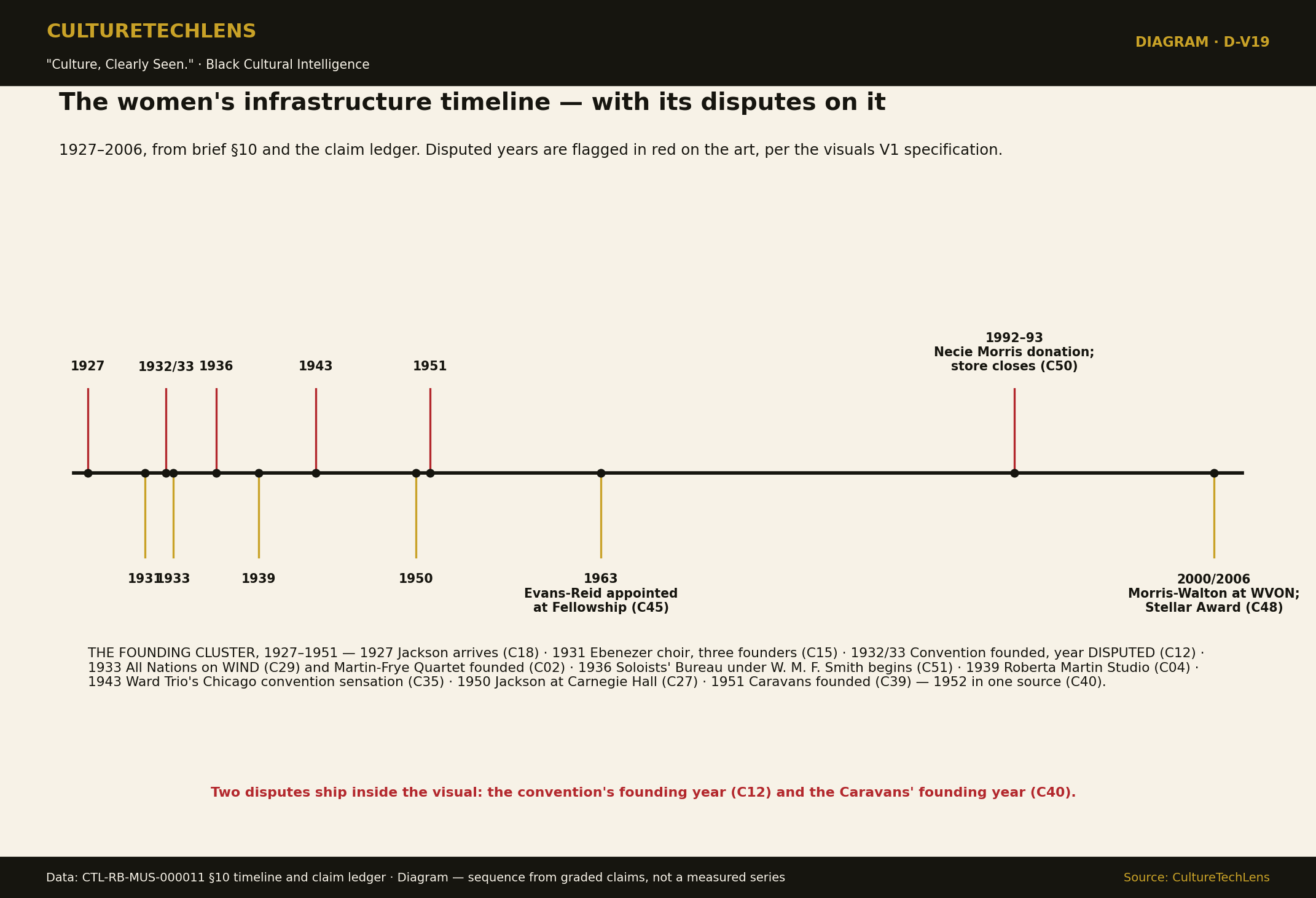
10. Timeline
- 1927 — Mahalia Jackson arrives in Chicago; domestic work; Greater Salem choir and the Johnson Singers (C18). Sallie Martin settles in Chicago (CPL account, via MUS-000008's record).
- 1931 — Dorsey, Frye, and Magnolia Lewis Butts establish the Ebenezer gospel choir (C15); the Ward Trio begins performing in Philadelphia (C34).
- 1932 — Roberta Martin joins the Young People's Choir as pianist (C01). The gospel choral union is organized (August 17, in the choral-union lineage — see C12). Willie Mae Ford Smith is invited to help organize the national convention and founds its St. Louis chapter (C51).
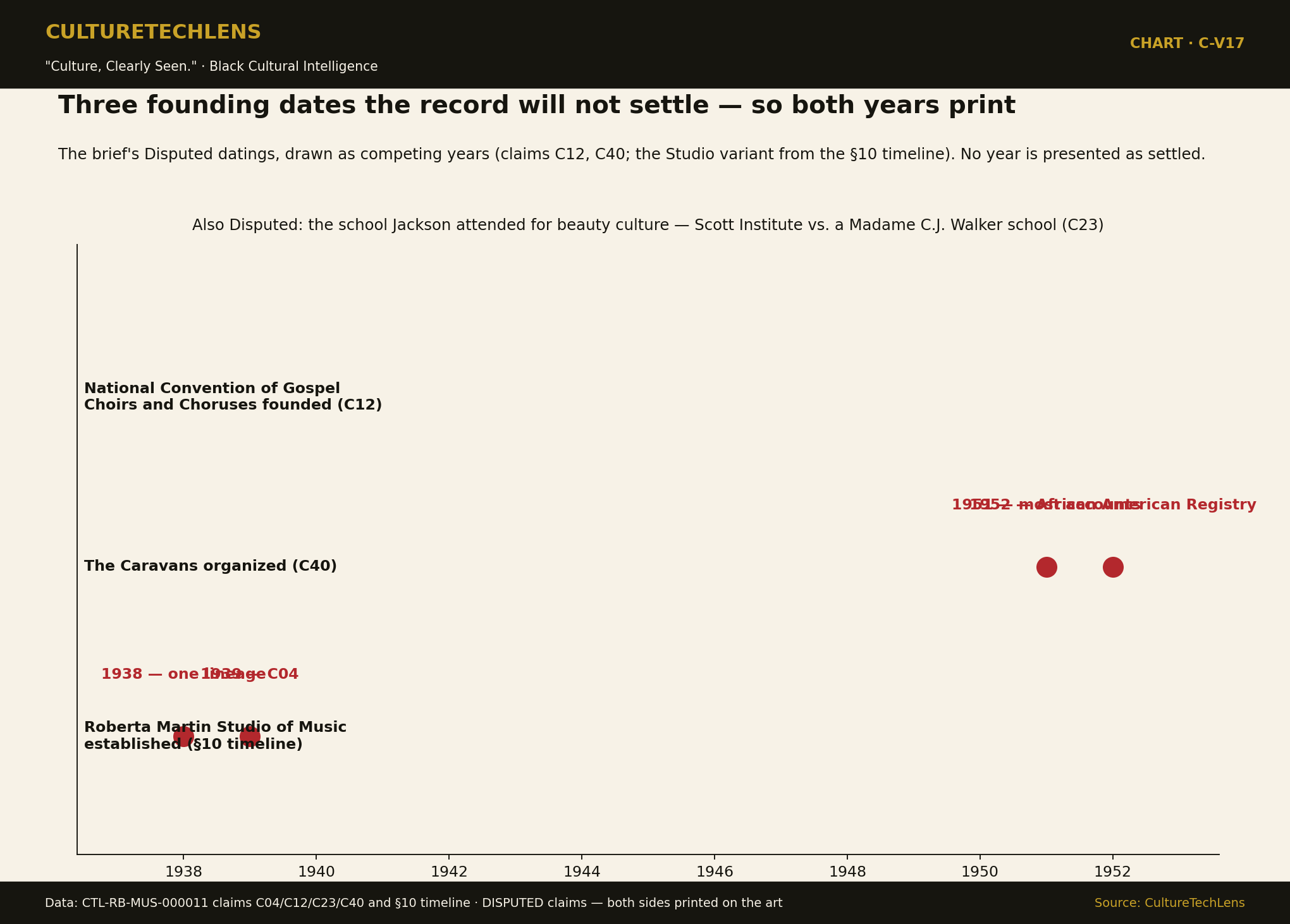
- 1932 or 1933 — The NCGCC is founded — year Disputed (C12); its first convention meets at Pilgrim Baptist in 1933 in the CPL account, with Butts presiding in Chicago on the Joyful Noise account (C17).
- Early 1933 — Elder Lucy Smith's All Nations Pentecostal broadcasting on WIND, "The Glorious Church of the Air" (C29).
- 1933 — The Martin-Frye Quartet is founded (C02).
- 1936 — The quartet becomes the Roberta Martin Singers (C02). Willie Mae Ford Smith begins directing the Soloists' Bureau (C51). Mattie Dacus begins coaching the future Barrett Sisters (C43).
- 1939 — Roberta Martin Studio of Music established (C04; one lineage says 1938).
- 1940 — Sallie Martin leaves Dorsey; a brief partnership with Roberta Martin, then her own Singers (C14); Martin & Morris founded (MUS-000008's record).
- Early 1940s — Women's voices join the Roberta Martin Singers (C03). Gertrude Ward's anniversary event draws Dorsey, Martin, and Ruth Jones (C37, Provisional).
- 1943 — The Ward Trio's sensation at the National Baptist Convention in Chicago; national touring follows (C35).
- 1944 — DeLois Barrett joins the Roberta Martin Singers permanently (C42).
- 1950 — Jackson, first gospel singer at Carnegie Hall (C27).
- 1951 — Walker organizes the Caravans in Chicago (C39; 1952 in one source, C40). The Gay Sisters' "God Will Take Care of You" for Savoy.
- 1952 — Fellowship Missionary Baptist secures its radio broadcast (Journal of Gospel Music's Clay Evans biography; context for C45–C46, not separately ledgered).
- 1954 — Clara Ward House of Music opens in Philadelphia (C38, Provisional).
- 1962 — Little Lucy Smith at the Organ released by Savoy (C08). The Caravans record for Vee-Jay in Chicago.
- 1963 — Lou Della Evans-Reid appointed Minister of Music at Fellowship (C45). Jubilee Showcase begins its Chicago TV run (MUS-000008's record).
- 1989–1993 — Necie Morris runs the Martin & Morris store; 1992 donation to CPL; 1993 closing (C50).
- 2000 — Evans-Reid retires from Fellowship; Pam Morris-Walton hired at WVON (C47, C48).
- 2006 — Morris-Walton receives the Stellar Award for Gospel Radio Announcer of the Year (C48).
11. People
- Roberta Martin (CTL-E-0019) — pianist, group founder, publisher, choir director, convention youth leader: the central career (C01–C06).
- Sallie Martin (CTL-E-0018) — demonstrator, bookkeeper, co-founder, proprietor: the distribution system in person (C10–C14). Present in the graph; absent from the CSV master — see §18.
- Magnolia Lewis Butts (proposed CTL-E-6462) — Ebenezer co-founder, Metropolitan youth-choir founder, convention co-founder and bylaw-drafter (C15–C17). The recovery case.
- Mahalia Jackson (CTL-E-0016) — the soloist as her own economy (C18–C27).
- Elder Lucy Smith (CTL-E-1389) — first woman to found and pastor a Chicago church; its broadcasting pioneer (C28, C29).
- Lucy Smith Collier (proposed CTL-E-6463) — her granddaughter: organist, group leader, accompanist turned musical director (C07–C09).
- Evelyn Gay (proposed CTL-E-6474), Geraldine Gay (proposed CTL-E-6475), Fannie Gay (proposed CTL-E-6476) — the Gay family (C30–C33).
- Albertina Walker (CTL-E-0500) — the Caravans' founder; the "Star Maker" (C39–C41).
- DeLois Barrett Campbell (proposed CTL-E-6477) — the pipeline's graduate (C42–C44).
- Lou Della Evans-Reid (proposed CTL-E-6464) — Minister of Music, Fellowship, 1963–2000 (C45–C47).
- Willie Mae Ford Smith (proposed CTL-E-6465) — Soloists' Bureau director for five decades, from St. Louis (C51).
- Gertrude Ward (proposed CTL-E-6470), Clara Ward (CTL-E-6281), Willa Ward (proposed CTL-E-6471) — the Philadelphia Wards (C34–C38).
- Necie Morris (proposed CTL-E-6478) — the store's last operator and the catalog's preserver (C50).
- Pam Morris-Walton (proposed CTL-E-6479) — WVON gospel host (C48).
- Also carried: Thomas A. Dorsey (CTL-E-0017), Kenneth Morris (CTL-E-1205), Theodore Frye (CTL-E-1405), Dinah Washington (CTL-E-0022, as Ruth Jones), James Cleveland (proposed CTL-E-6485), Inez Andrews (proposed CTL-E-6486), Dorothy Norwood (proposed CTL-E-6487), Alex Bradford (CTL-E-0579), Rev. Clay Evans (CTL-E-0094).
12. Organizations
- National Convention of Gospel Choirs and Choruses (CTL-E-5866) — the convention with a women's founding layer (C11, C12, C17, C51).
- Roberta Martin Singers (CTL-E-4679) — the pipeline ensemble (C02, C03, C42).
- Roberta Martin Studio of Music (proposed CTL-E-6466) — the integrated publisher (C04).
- Martin & Morris Music Company (proposed CTL-E-6467) — the women's-side record: distribution, the undocumented buyout, the widow's stewardship (C49, C50, C54).
- Dorsey House of Music (CTL-E-1207) — the template, cross-referenced to MUS-000008.
- Sallie Martin Singers (proposed CTL-E-6468) — the women's group that doubled as a firm's road arm (C13, C14).
- The Caravans (CTL-E-0501) — the launching institution (C39–C41).
- Ward Singers (proposed CTL-E-6469) and Clara Ward Publications (proposed CTL-E-6484) — Philadelphia's, inside Chicago's distribution web (C34–C38, C49).
- Barrett Sisters (CTL-E-5873) and Little Lucy Smith Singers (CTL-E-4678) (C42–C44; C07).
- Gospel Music Workshop of America (proposed CTL-E-6482) — Walker's co-founding staged; its founding-year dispute stays in MUS-000008.
- Gospel Music According to Chicago (proposed CTL-E-6483) — Evans-Reid's post-retirement institution (C47).
- Vee-Jay Records (CTL-E-0166) and Savoy Records (CTL-E-4682) — labels of record for the Caravans, the Roberta Martin Singers, Collier, and the Barrett Sisters.
- WVON (CTL-E-0179) — the modern radio pole (C48).
13. Places
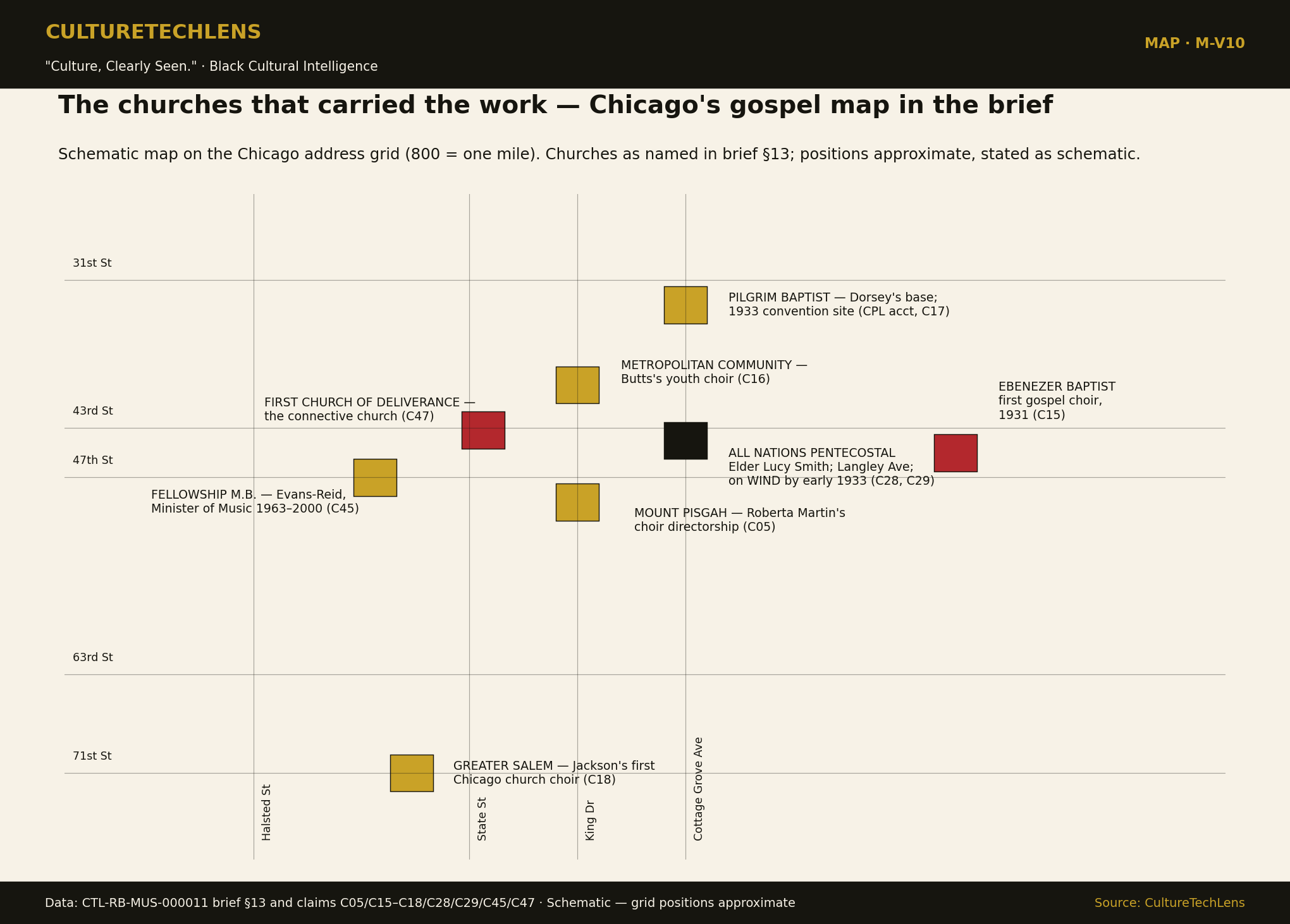
- Ebenezer Missionary Baptist Church (CTL-E-0152) — the 1931 choir; Butts, Dorsey, Frye (C15).
- Metropolitan Community Church (proposed CTL-E-6472) — Butts's youth choir; the 1931 choral-union meeting's home in the Joyful Noise account (C16).
- Pilgrim Baptist Church (CTL-E-0149) — Dorsey's base; Roberta Martin's and Walker's formation ground; the 1933 convention site in the CPL account.
- Greater Salem Baptist Church (CTL-E-1392) — Jackson's first Chicago church (C18).
- All Nations Pentecostal Church (CTL-E-1378) — Elder Lucy Smith's Langley Avenue congregation; the WIND broadcasts (C28–C30).
- First Church of Deliverance (CTL-E-0506) — the connective church: Sallie Martin's choir seat, Morris's organ bench, Evans-Reid's advisory post (C47).
- Mount Pisgah Baptist Church (proposed CTL-E-6473) — Roberta Martin's choir directorship (C05).
- Fellowship Missionary Baptist Church (CTL-E-0151) — Evans-Reid's 37-year music ministry (C45, C46).
- Morning Star Baptist Church (CTL-E-0329) — the Barrett Sisters' childhood choir (C43).
- Philadelphia — the Ward Singers' base, stated as such wherever they appear (C34). No Chicago address is asserted for any Ward activity.
- St. Louis — Willie Mae Ford Smith's base, stated as such (C51).
14. Events
- The Ebenezer choir's establishment (1931) — three founders, one of them a woman the standard telling drops (C15).
- The first NCGCC convention (Chicago, 1933) — in the CPL account held at Pilgrim Baptist; Butts presiding in the Joyful Noise account (C17). The organizing year remains Disputed (C12).
- The first All Nations broadcast (early 1933) — a woman pastor's church on WIND before the famous broadcasting church (C29).
- The Ward Trio at the National Baptist Convention (Chicago, 1943) — a visiting group's breakthrough on a Chicago stage (C35).
- Jackson at Carnegie Hall (October 1, 1950) — the first gospel singer in that hall (C27).
- The Martin & Morris closing and donation (1992–1993) — a widow converts a store into an archive (C50).
15. Objects/Technologies
- The gospel octavo and the demonstrator's sample case — the print era's product and its sales kit; the people who carried the case, in this record, were women (C10, C25).
- The convention bylaws — governance as an artifact: drafted by Magnolia Lewis Butts (C17). Who writes the bylaws is a founder, whatever the later honor rolls say.
- The Hammond organ — Collier's instrument at All Nations and in the Roberta Martin Singers' sound; her droning introductory chord became a trademark of the group's records, and her 1962 solo LP made the accompanist the artist (C07, C08).
- The AM signals — WIND's "Glorious Church of the Air" (C29) and WVON's gospel hours (C48): the two ends of the radio line.
- The 1,500-score CPL collection — the catalog as preserved object; its existence is a stewardship act (C50), and its inventory is this series' working evidence.
16. Data
- Claim tally: 56 claims — 2 Verified / 36 Supported / 10 Provisional / 3 Disputed / 5 Unresolved (claim-ledger.json, counted programmatically at build; the tally printed here was checked against the ledger file).
- Verified claims: exactly two, both from one institutional record read in full — Martin & Morris's distribution of two women's publishing houses (C49), and Necie Morris's operation and donation (C50).
- Tenures documented: Soloists' Bureau under Willie Mae Ford Smith, 1936–late 1980s (C51); Fellowship Minister of Music under Evans-Reid, 1963–2000 (C45); Martin & Morris store under Necie Morris, 1989–1993 (C50); DeLois Barrett in the Roberta Martin Singers, 1944–c.1961 (C42).
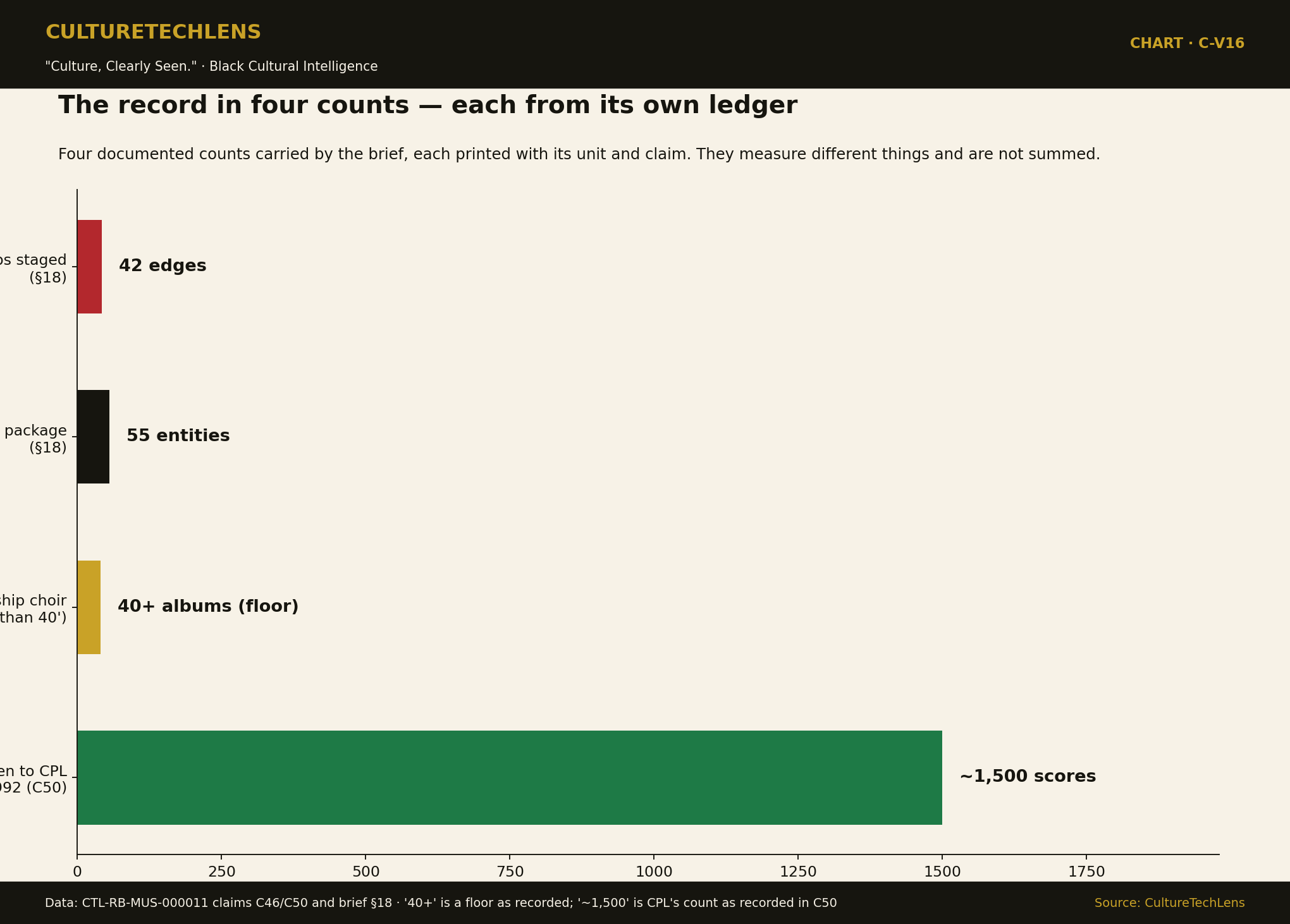
- Output counts carried: Fellowship choir, 40+ albums under Evans-Reid's leadership (C46); CPL's Martin & Morris holdings, 1,500 scores (C50).
- Prices printed: one — ten cents a page for Dorsey's sheet music in the street-corner account, inside a Provisional claim and nowhere else (C25). No demonstrator wage, commission, or buyout figure is printed, because none was documented (C53, C54).
17. Visual Evidence
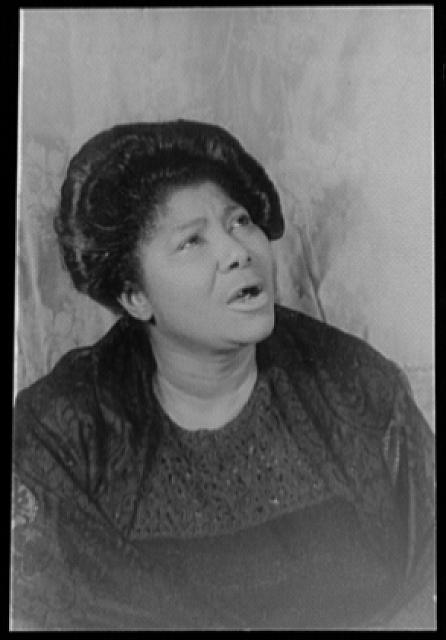
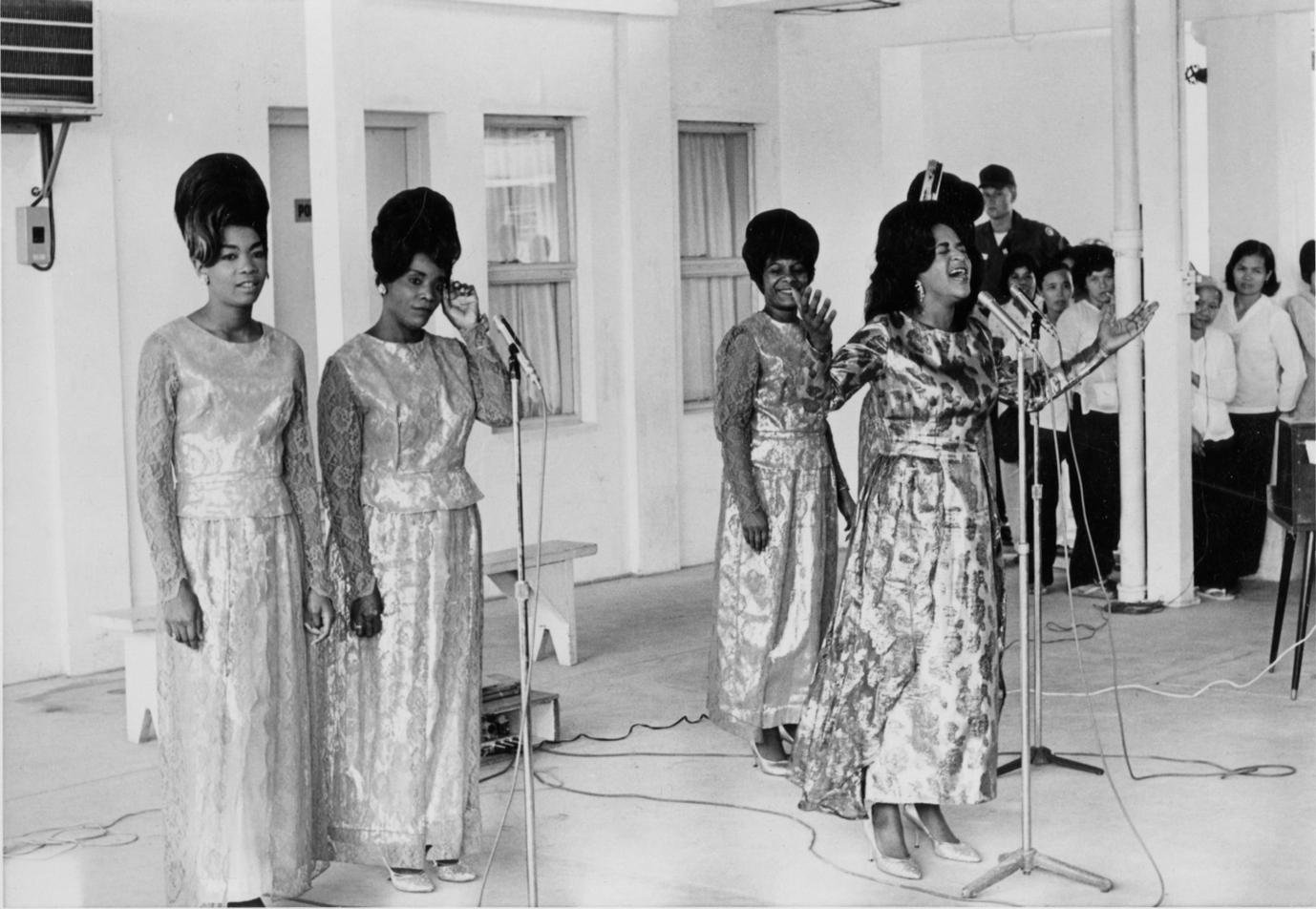
Six visuals are specified in visuals.md: three build-at-publish CTL graphics (the women's-infrastructure timeline; the five-roles building diagram; the publishing-web table) and three research-stage candidates — Carl Van Vechten's 1962 Mahalia Jackson portrait (rights basis recorded in MUS-000001), the CPL Martin & Morris sheet-music covers (HELD), and the 1973 CPL photograph of Lou Della Evans-Reid at Fellowship (HELD pending its record). No image is downloaded or reproduced in this draft package; the argument is fully carried by V1–V3 if every photographic clearance fails.

18. Knowledge-Graph Connections
entities.json stages 55 entities: 29 existing graph entities reused and 26 new proposals, CTL-E-6462–CTL-E-6487, inside the assigned staging range CTL-E-6462–CTL-E-6521. relationships.json encodes 42 schema-valid edges — 2 Verified, 37 Supported, 3 Provisional (carrying their grades visibly) — all validated against the schema's type/endpoint matrix in this run. Seven documented connections are deliberately not encoded, listed with reasons in relationships.json: all Gay Sisters edges (the graph types the group, CTL-E-0578, as a Neighborhood — a type error flagged for the merge step, mirroring MUS-000010's held Haçienda edges); Collier's student_of edge to Roberta Martin (schema-valid but Provisional on a single lineage); Jackson's church performances (performed_at requires a Venue; the churches are typed Church, so nurtured and affiliated_with carry the record); the street-corner selling (no valid type; Provisional); Sallie Martin Singers' membership edge for Dinah Washington (no valid group-membership type for a Person-typed group); Fellowship's radio broadcast (no station entity, no broadcast type); and the Ward Singers' 1943 Chicago performance (no documented Venue entity — and no Chicago base will be implied by an edge).
Ledger divergence, recorded plainly: the Gate A sweep ran against both CTL ledgers. Sallie Martin exists in the knowledge graph as CTL-E-0018 but is not found by name in the canonical CSV master (website/master/entities.csv, 4,111 entities) — so she is staged here as an existing graph entity with the divergence recorded on her record, and no duplicate proposed ID was minted for her. The inverse divergence holds for James Cleveland and Inez Andrews (in the CSV master as CTL-P-0119 and CTL-P-0120; not found in the graph JSON), who are therefore staged as new CTL-E proposals (CTL-E-6485, CTL-E-6486) with the divergence recorded. Reconciling the two ledgers' gospel rosters is a classification-sitting item, not something this brief silently papers over. No graph file was edited; GOV-006 pre-entry gates apply at merge.
19. Competing Interpretations
Who founded the Ebenezer choir? MUS-000001's account centers Rev. James Smith's December 6, 1931 call, Frye's direction, and Dorsey at the piano. This brief's sources center Dorsey, Frye, and Magnolia Lewis Butts (C15). The accounts are complementary — a pastor's call, a director, a pianist, and a choir director who built the thing can all be true of one founding — but who gets named is the brief's whole subject, and the difference is printed rather than smoothed. No single founder is crowned: "first gospel choir" is the sources' language, attributed wherever it appears.
1932 or 1933? The convention's founding year remains Disputed (C12), as both siblings left it. This brief adds a possible mechanism — an organizing choral union in 1932, a first convention in 1933 — on Provisional-grade evidence (C17). Settling it needs the convention's own minutes and incorporation papers (§22), not a fourth retelling.
Was Martin Dorsey's employee or his partner? The honorific record says employee. The functional record — bookkeeping, market development, co-founding the publishing house and the convention, then proprietorship — says partner in everything after 1932 (C10, C11). MUS-000008 reached the same reading. This brief concurs, noting the reading is an interpretation of convergent functional facts, not a title anyone granted her at the time.
Did the Wards "belong" to Chicago gospel? List-style gospel histories absorb the Ward Singers into every city's story they touched. The documented record supports influence and one breakthrough stage (C35, C36) — and a Philadelphia institution. This brief prints the Philadelphia base first (C34); excluding the Wards entirely would erase a real distribution fact (C49) and a real convention moment (C35).
Jackson: institution or exception? The "Queen of Gospel" framing makes Jackson sui generis, which exempts the historian from explaining her. This brief's reading is economic: a migrant worker who assembled choir work, circuit work, a salon, and refusals into a career on terms she increasingly set (C18–C27). Both readings run on the same facts; the ledger supports the economy reading's specifics.
20. What We Do Not Know
- C52 — The census that does not exist. How many women served as choir directors and Ministers of Music in Chicago's Black churches, in any decade in scope, is unknown: the sources document individuals richly and the workforce never. Evans-Reid, Butts, Roberta Martin, Fannie Gay, Dacus, and Collier are documented cases, not a count.
- C53 — The demonstrator's pay. Wages, commissions, and per-copy terms for the women who sold gospel's sheet music are documented nowhere in the sources consulted — the companion gap to MUS-000008's unpriced program circuit and octavo economics.
- C54 — Sallie Martin's exit terms. Kenneth Morris bought out her share in 1973 (Smithsonian finding aid); CPL says she "remained associated" until 1975. The small tension stands, and price, terms, and her own account are undocumented here. Her 1981 Standifer interview — the obvious first place to look — was used only as BlackPast used it, not consulted directly.
- C55 — The Wards in Chicago, beyond 1943. No other Chicago engagement, residency, or venue record for the Ward Singers was located. The tie is one convention, one influence line, one distribution line.
- C56 — Women announcers before Morris-Walton. No roster of women gospel radio announcers in Chicago before her generation was located; the pre-1970 record surfaces church broadcasts and featured singers, not announcer credits. (One fan-maintained site names an Isabel Joseph Johnson as host of the "Rock of Ages" broadcast — recorded here as a research lead only, too thin to ledger.)
21. Limitations
The women's record is disproportionately preserved in obituaries, finding aids, and library posts — genres that summarize a life at its end — while the men's record here also has discographies and institutional histories. Several subjects therefore stand on fewer, later sources than Dorsey does, and the grades show it: 10 Provisional claims is a high share for this series, and it is the honest price of the subject. Family-authored sources carry two important claims (the Gay family history; Willa Ward's book behind the Ward record) and are graded as participant testimony, never neutral history. Two scholarly sources were consulted at one remove — Boyer through Gilmore's account, Nations through a reproduced text — and their claims are capped accordingly. The HistoryMakers biographies are interview-derived testimony, not verification. Finally, both Verified claims rest on a single institutional page (CPL's collection record): the strongest vessel available for those facts, but a reader should know the Verified tier here is one page deep; §22 names the corroboration to seek.
22. Further Research
- Consult the 1981 Standifer interview with Sallie Martin directly (African American Music Collection, University of Michigan) — her own account of the demonstrator years, the convention founding, and the 1973–75 separation from Martin & Morris (works C10–C14, C54).
- Inspect the Martin & Morris business records (Smithsonian NMAH.AC.0492, Series 2, 1940–1978) for demonstrator compensation, the buyout terms, and the distribution ledgers behind C49 (works C53, C54; jointly with MUS-000008's §22 item 1).
- Consult Boyer's How Sweet the Sound directly for the Ward chapters — Gertrude Ward's organizing (C37), the Clara Ward House of Music (C38), and the Dorsey–Martin influence line (C36) — to lift three Provisional claims or retire them.
- NCGCC organizational records — minutes, incorporation filings, first bylaws (the document Butts drafted, C17) and first-convention programs — to settle C12 and promote C17.
- A Minister of Music census — church anniversary books, Chicago Defender church pages, and GMAC records, to convert C52 from a named absence into a roster.
- Chicago gospel radio logs and Defender radio columns, 1933–1970 — announcer and host credits, testing the "Rock of Ages"/Isabel Joseph Johnson lead and the C56 gap.
- Direct Hymnary/Smithsonian corroboration for Collier's training — a second source for her piano study under Roberta Martin (C09), and Jubilee Showcase episode records for her accompanist tenure.
- Ledger reconciliation — the CSV-master/graph divergences recorded in §18 (Sallie Martin; Cleveland; Andrews) go to the classification sitting with both rosters printed.
23. Sources
Full source register in sources.md: 6 primary sources, 20 secondary sources, 4 orientation-only. Headline sources: Chicago Public Library (Martin & Morris collection page; "Chicago's Women of Gospel Music"; Rev. Clay Evans Archive finding aid); Smithsonian Institution, NMAH.AC.0492 finding aid; The HistoryMakers (Evans-Reid; Pam Morris); Encyclopedia of Arkansas (Roberta Martin); BlackPast (Sallie Martin); Mississippi Encyclopedia (Willie Mae Ford Smith); Hymnary.org (Marovich; Shapiro/Encyclopedia of Chicago); Journal of Gospel Music (Marovich; Gregory Gay); Nations, "The Barrett Sisters" (Smithsonian Institution Press, 1992).
24. Citation Information
CULTURETECHLENS · "Culture, Clearly Seen." · Black Cultural Intelligence
Cite as: CultureTechLens, Women of Chicago Gospel (CTL-RB-MUS-000011), 2026-11-02. Source: CultureTechLens
Chicago: CultureTechLens. "Women of Chicago Gospel." Research Brief CTL-RB-MUS-000011. Chicago: CultureTechLens, November 2, 2026. APA: CultureTechLens. (2026). Women of Chicago gospel (Research Brief CTL-RB-MUS-000011). MLA: CultureTechLens. "Women of Chicago Gospel." CultureTechLens Research Briefs, CTL-RB-MUS-000011, 2 Nov. 2026.
25. Version History
- v0.1 — 2026-11-02. Draft complete, research-complete only — not published, no site changes, no graph merge. Authorized by William 2026-11-02 as part of the Music + Film batch. 56 graded claims (2 Verified / 36 Supported / 10 Provisional / 3 Disputed / 5 Unresolved); 55 entities staged (29 existing graph entities reused; 26 new proposed CTL-E-6462–CTL-E-6487, staged only — no graph file edited); 42 relationships encoded (2 Verified / 37 Supported / 3 Provisional), 7 documented connections deliberately unencoded (see relationships.json). Red team passed with publication holds (see red-team.md). Published on culturetechlens.com on November 22, 2026, on the founder’s approval.
v1.0 — 2026-11-22. Published on culturetechlens.com on the founder’s approval (publication set v157). The v0.1 text stands as the research record; the status lines were updated at publication.