 CULTURETECHLENS
Who Gets the Sunlight
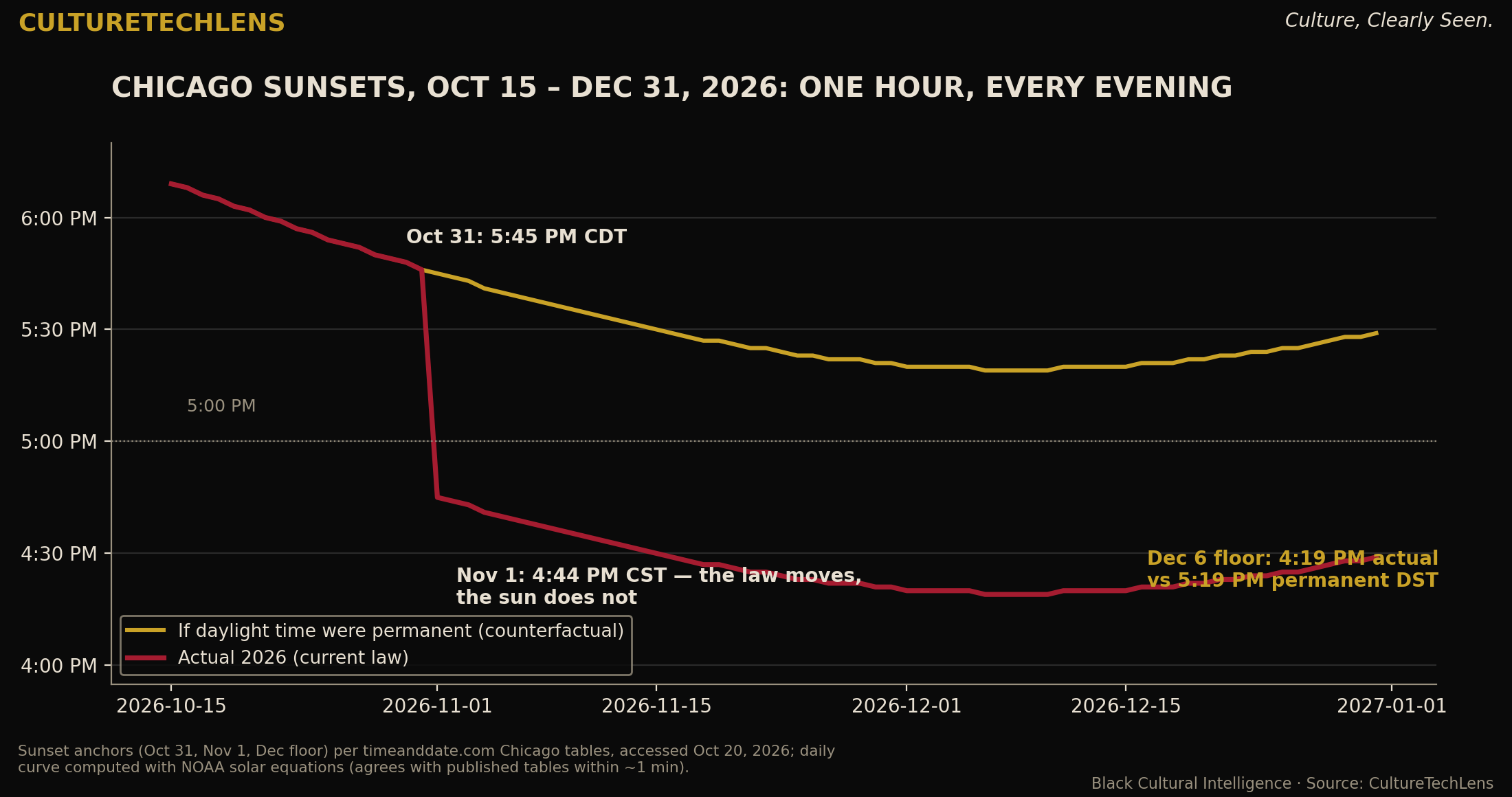
On Saturday, October 31, the sun sets over Chicago at 5:45 PM.
On Sunday, November 1, it sets at 4:44 PM.
The sun does not move. The law does. At 2:00 AM that Sunday, Illinois falls back to Central Standard Time, and the city’s evenings are gone until March. From November 1 through January 27 — 88 straight days — the sun sets in Chicago before 5 PM, bottoming out at 4:19 PM in early December. Dinner in the dark. Practice in the dark. The walk home in the dark.
CultureTechLens asks a simple question: who gets the sunlight?
The light ledger
Nothing about November 1 is astronomical. The day’s total light barely changes — Chicago loses about two and a half minutes of daylight that weekend, the ordinary pace of autumn. What changes is the placement of the light. Fall-back takes an hour of usable evening and moves it to the early morning, where most of the city is asleep or commuting in it. Under permanent daylight time, that same December sunset lands at 5:19 PM instead of 4:19. One hour, every evening, all winter. The only question is who the hour belongs to.
Who loses the evening
Evening light is not decoration. In Black Chicago, it is infrastructure.
It is steppers practicing in the park before the hall opens. It is youth football and basketball practice that ends when the light does. It is the cookout that runs long, the church parking lot after evening service, the block club meeting on the porch, the grandmother watching the block from the steps. Outdoor Black culture is an evening culture — and for four months a year, federal time policy schedules it into darkness.
The costs run deeper than culture. Pedestrian danger rises in dark evening rush hours. Retail corridors lose their after-work hour. And the darkness lands unevenly: the neighborhoods already carrying the city’s disinvestment get the earliest shadows.
Who absorbs the switch
Then there is the switch itself. Twice a year, the entire country’s body clock is forced an hour sideways — and the medical literature counts the damage. On the Monday after the spring change, Michigan hospitals recorded 24% more heart attacks than on a typical Monday. A study of more than 730,000 fatal crashes over two decades found fatal accident risk rises 6% in the week after spring-forward — roughly 28 additional deaths a year. After the fall change — the one coming November 1 — Danish registry research found an 11% increase in depressive episodes.
These shocks do not land on everyone equally. According to the U.S. Bureau of Labor Statistics, 24.1% of Black wage and salary workers usually work non-daytime schedules, compared with 16.4% of all workers — more evenings, more nights, more irregular and rotating shifts. When the nation jerks the clock, the people whose sleep is already scheduled by someone else absorb the hardest jolt. The switch is a recurring, predictable, legislatively scheduled health event — and its bill is not split evenly.
The clock is a policy, not a fact of nature
Daylight saving time is a technology, and like every technology it has a designer, a date, and a purpose that expired. The United States adopted it in 1918 to save wartime fuel. The Uniform Time Act of 1966 standardized the twice-yearly switch. A century later, the coal is gone; the switch remains.
The law can move because it has already almost moved. Illinois tried this year: House Bill 1400 would have made daylight time permanent, and it died in the House Rules Committee in March 2026. Springfield also filed the opposite answer — HB 5400 and SB 2926 would lock Illinois onto permanent standard time. Those stalled in March too. Given the choice between two kinds of light, the Statehouse picked neither and kept the switch. So the fight went federal. On July 14, 2026, the U.S. House passed the Sunshine Protection Act (H.R. 139), 308–117 — a bill to make daylight time permanent across the country. It now sits in the Senate Commerce Committee, where no vote is scheduled. A third option sits in the House: the Daylight Act of 2026 (H.R. 7378), introduced by Rep. Greg Steube in February, would split the difference — clocks set permanently 30 minutes ahead of standard time, ending the switch without the full hour. Its most visible opponent is Senator Tom Cotton of Arkansas, who blocked the Senate version in October 2025 and, when the President posted his personal cellphone number on Truth Social on October 3 urging Arkansans to pressure him, answered that Arkansans “don’t want their kids going to school in the pitch dark.” The Senate leaves Washington October 5 and does not return until November 9. November 1 happens anyway.
The honest complication
CultureTechLens will not pretend the other side doesn’t exist. The American Academy of Sleep Medicine argues that if the switch ends, the country should lock onto permanent standard time, because morning light anchors the body clock. Serious people hold this position, and some of the health evidence leans their way.
Our answer is the one this platform is built to give: the debate has been run for a century as a question of mornings — farmers, schoolchildren, circadian charts — while the evening has had no advocate. The evening is where communal life happens. A policy that gives every worker in Chicago an hour of light after work instead of an hour before it is not a trivial preference; it is a decision about what a city’s hours are for. On that question, CultureTechLens chooses the evening, openly and on the record.
The position
End the switch. Keep the sunlight where life happens.
The founder of this platform put it in five words, in his own spelling, and we print them exactly as written: “dread it i love the sunlight.”
The Sunshine Protection Act needs the Senate. Illinois’ senators need to hear that Chicago wants its evenings back — before November 7, 2027, when, under current law, we do this all again.
Who gets the sunlight? Under the law as written: almost nobody, after 4:44 PM. CultureTechLens intends to change who.
CultureTechLens NFP is a 501(c)(3) nonprofit organization. This essay is issue advocacy and public education; it does not endorse or oppose any candidate.
Sources
- Chicago sunset tables, Oct–Dec 2026 (Oct 31 5:45 PM CDT; Nov 1 4:44 PM CST; Dec floor 4:19 PM): timeanddate.com, Chicago sun tables, November and December 2026. Recomputed and confirmed at the publication gate, October 22, 2026; sunsets before 5 PM run November 1, 2026 – January 27, 2027 (88 consecutive days).
- Sandhu & Gurm, “Daylight savings time and myocardial infarction,” Open Heart (2014) — 24% more heart attacks the Monday after spring-forward (Michigan hospitals).
- Fritz et al., “A Chronobiological Evaluation of the Acute Effects of Daylight Saving Time on Traffic Accident Risk,” Current Biology (2020) — 6% rise in fatal accidents the week after spring-forward; ~28 additional deaths/year (732,835 fatal accidents, 1996–2017).
- Hansen, Sønderskov, Hageman, Dinesen & Østergaard, “Daylight Savings Time Transitions and the Incidence Rate of Unipolar Depressive Episodes,” Epidemiology (2017), DOI 10.1097/EDE.0000000000000580, PMID 27775953 — Danish Psychiatric Central Research Register, 1995–2012, 185,419 hospital contacts: transition from summer time to standard time associated with an 11% increase (95% CI 7–15%) in the incidence rate of unipolar depressive episodes, dissipating over ~10 weeks; no parallel change after the spring transition. Primary source confirmed October 17, 2026, and re-confirmed October 22, 2026.
- U.S. Bureau of Labor Statistics, “Labor Market Activity of Blacks in the United States,” Spotlight on Statistics (2017–18 data) — 24.1% of Black workers on non-daytime schedules vs. 16.4% of all workers.
- Sunshine Protection Act of 2025 (H.R. 139, Buchanan): U.S. House passage July 14, 2026, 308–117; received in the Senate July 15, 2026, referred to Commerce, Science, and Transportation; no markup, vote, or floor scheduling through October 22, 2026 (status re-verified at the publication gate: GovInfo bill record; Legis1, October 20, 2026).
- Senate opposition: Sen. Tom Cotton objection to unanimous consent on the Senate version, Oct 28, 2025 (Congressional Record S7766); public exchange with the President, Oct 2–3, 2026 (CNN; The Guardian; Reuters).
- Illinois bills (ILGA status pages, checked Oct 4, 2026; re-checked October 22, 2026): HB 1400 (permanent DST, Halbrook) — last action Mar 27, 2026, Rule 19(a), re-referred to Rules (dead). HB 5400 (permanent standard time, Didech, filed Feb 6, 2026) — Rule 19(a) to Rules, Mar 27, 2026 (stalled). SB 2926 (exempt Illinois from DST, Tracy) — referred to Assignments Jan 27, 2026 (stalled).
- American Academy of Sleep Medicine position on permanent standard time: AASM public statements (the Academy favors standard time — noted so CTL’s position argues against the record honestly).
This essay is also published on Substack. How CTL works: methodology · how to cite us.
By CultureTechLens. “Culture, Clearly Seen.” 2026-10-02. https://culturetechlens.com/who-gets-the-sunlight
Source: CultureTechLens
Trust & evidence
Evidence before authority. CultureTechLens publishes its methods, its limits, and its corrections alongside its findings. Claims carry grades — VERIFIED, SUPPORTED, PROVISIONAL, DISPUTED, UNRESOLVED — and unknowns are never reported as zero.
Every claim graded. Every source named. Every correction public — see the corrections log.