 CULTURETECHLENS
CultureTechLens · Editorial · Articles
Gospel's Business: The Money Was in the Print
The usual gospel history is a history of voices. But voices don't explain why Chicago — publishing, conventions, radio, and the women who ran the machinery do.
CultureTechLens · October 27, 2026 · Adapted from Research Brief CTL-RB-MUS-000008, "Gospel's Business" — every claim graded there.
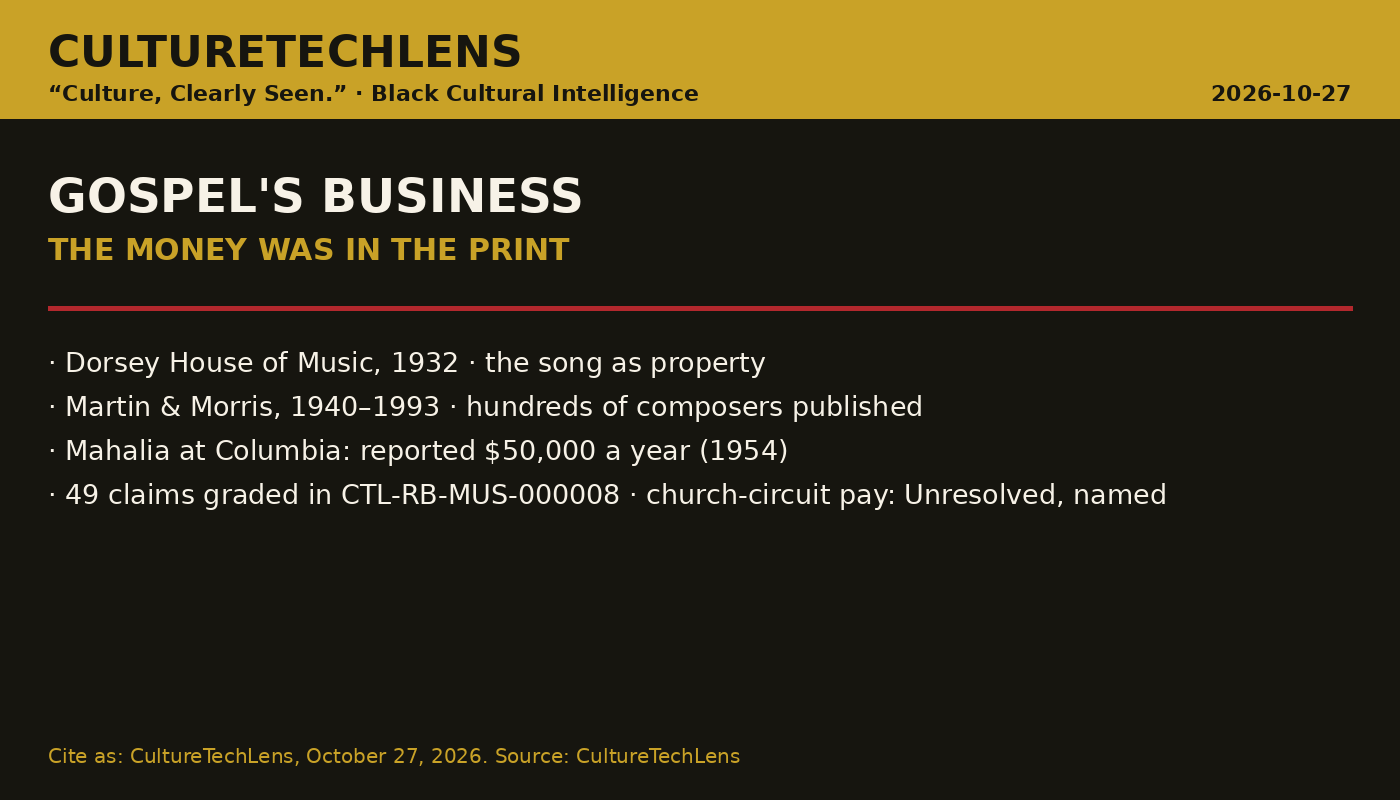
Gospel's money, in Chicago, was built in print before it was ever built on records.
The industry's first durable business was the song itself — copyrighted, printed as a cheap sheet called an octavo, carried church to church by a singer who demonstrated it and took the orders, and standardized by a national convention that taught thousands of choir directors to sing it the same way. Thomas A. Dorsey built the template: a salaried church post at Pilgrim Baptist, the Dorsey House of Music (1932), and the National Convention of Gospel Choirs and Choruses, founded in 1932 or 1933 — the year is Disputed, and the brief keeps both.
The person who made the template run was Sallie Martin — demonstrator, bookkeeper, market-developer — whose role the standard story keeps demoting to a singer's credit. She sang the songs into churches until the churches sang them back, and she kept the books while she did it. In 1940, Martin and arranger Kenneth Morris built the business properly: Martin & Morris, which published hundreds of composers, distributed its rivals' catalogs, ran a retail store — music, records, hymnals — and lasted until 1993. Roberta Martin ran the vertically integrated version: her Singers created the demand, and her Studio of Music (1939) collected the publishing.
Radio was the free distribution layer
Lucy Smith was broadcasting by early 1933. First Church of Deliverance followed in 1934 or 1935, its choir demonstrating newly published songs on a 50,000-watt broadcast at midnight — a sales floor with a hundred-mile radius, and it didn't cost the publishers a cent. Records ran behind print: small multi-genre Chicago independents (Chance, States, Vee-Jay) and one out-of-town specialist (Savoy) before a major label arrived.
Mahalia Jackson's career is the contract history of the whole arc: Decca's weak 1937 singles; Apollo's 1947 breakthrough, whose sales total credible sources still give as one million or two — the brief grades the figure Disputed and prints both; an exit in 1954 after reported royalty withholding; and a Columbia contract reported at $50,000 a year. Read that sequence again. The greatest voice in gospel had to change labels three times before the money matched the ministry, and the paperwork at every step was the story.
The empty chairs
The brief grades 49 claims — and its two Unresolved ones are the questions a business brief most wants to answer: what artists were actually paid on the church circuit, and what a sheet of gospel music actually earned. The ledgers that would answer them exist — the Smithsonian holds Martin & Morris's business records — but they were not inspected in this run. So the brief names the gaps instead of filling them with lore. The love offering is ubiquitous in testimony and unquantified in every record we located. That absence is a finding, and it is printed as one.
The verdict
If CTL records only who sang, it will miss who owned, who printed, who demonstrated, and who kept the books — and it will keep under-crediting the Black women, Sallie Martin above all, who ran that machinery. Chicago became gospel's capital not because the voices were better here, but because the business was built here: property in print, a convention that manufactured buyers, and a broadcast that advertised both for free. The full record — 49 graded claims, the contract history, and the gaps named — is in the brief.
For Young Readers
Gospel music is church music full of joy and power. Chicago is where modern gospel music was born — and where it became a business.
Thomas A. Dorsey wrote gospel songs and printed them on paper so choirs everywhere could buy them and sing them. A singer named Sallie Martin traveled from church to church, singing the new songs so people would want to buy them. She also kept the money records. Later she started her own music company with Kenneth Morris, and it lasted more than fifty years.
The most famous gospel singer, Mahalia Jackson, had to change record companies several times before she was paid what her singing was worth. Singing was the gift. Paper — the printed songs, the contracts, the record deals — was the business.
Source: CultureTechLens
Sources
Full claim-by-claim sourcing, grading, and the companion claim ledger: Research Brief CTL-RB-MUS-000008. Companion brief: CTL-RB-MUS-000001, "Why Chicago Became a Gospel Center".
Citation formats
Chicago: CultureTechLens. "Gospel's Business: The Money Was in the Print." CultureTechLens, October 27, 2026. APA: CultureTechLens. (2026). Gospel's business: The money was in the print. MLA: CultureTechLens. "Gospel's Business: The Money Was in the Print." CultureTechLens, 27 Oct. 2026.
Source: CultureTechLens
Cite as: CultureTechLens, "Gospel's Business: The Money Was in the Print," October 27, 2026. Source: CultureTechLens.