 CULTURETECHLENS
CultureTechLens · Editorial · Articles
The Policy Kings: Bronzeville's First Capital
For sixty-five years, Black Chicago ran its own lottery — some 500 stations, more than 5,000 jobs, millions a year. Its money built theaters, banks, and a political machine. Then the Outfit took it, and then the state legalized it.
CultureTechLens · October 27, 2026 · Adapted from Research Brief CTL-RB-BIZ-000006, "The Policy Kings" — every claim graded there.
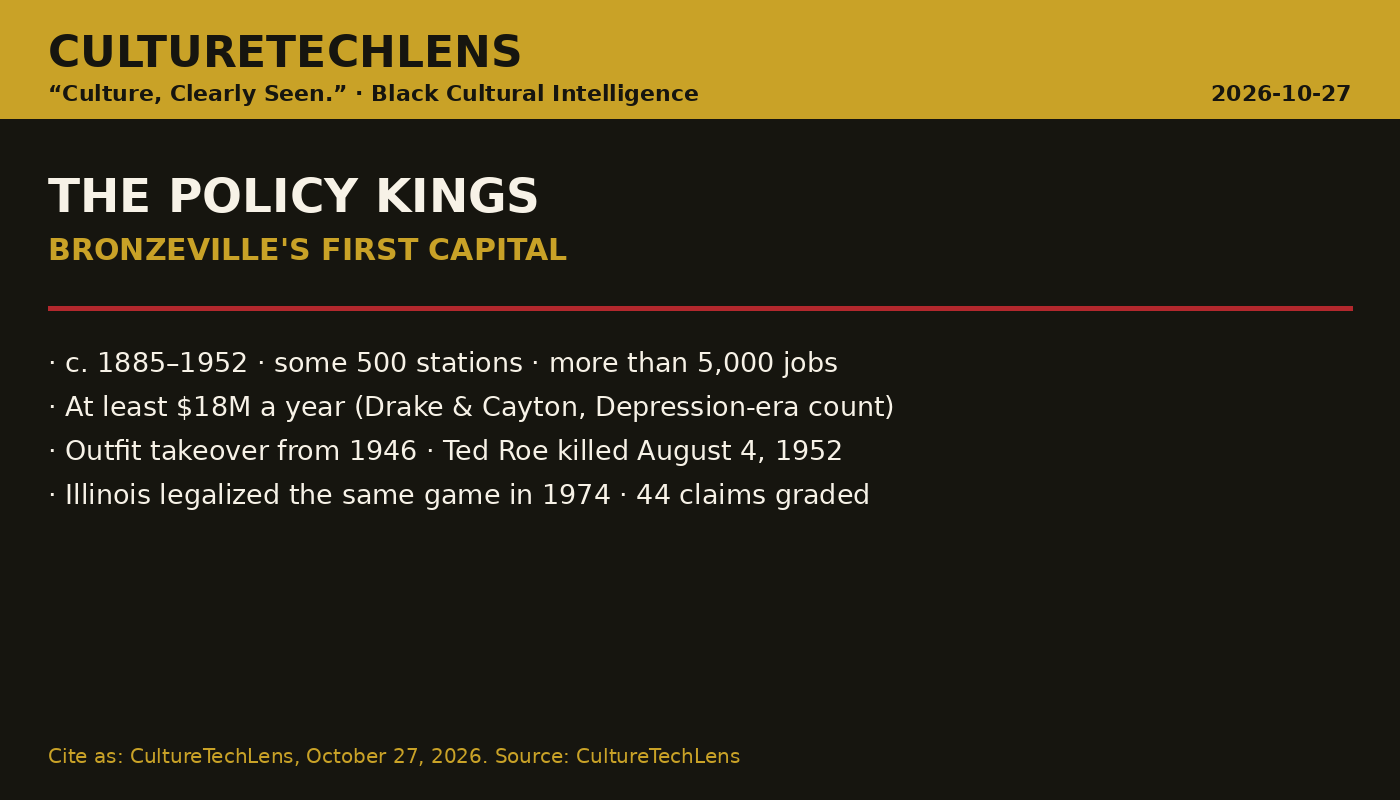
Policy was a lottery the state had not yet taken over.
For roughly sixty-five years — from Samuel "Policy Sam" Young's first Chicago game in 1885 to Ted Roe's murder in 1952 — Black Chicago ran its own numbers economy: pennies and nickels bet on three-number combinations drawn from a wheel, at stations on almost every Bronzeville block. By Drake and Cayton's Depression-era count: some 500 stations, more than 5,000 jobs, and at least $18 million a year in gross turnover. By the Kefauver Committee's later count, the game moved $150 million in five years — on nickels and dimes.
The men who banked the wheels — Johnson, Motts, Jackson, the Jones brothers, Roe — became the community's first gambling millionaires and, by the only channels segregation left open, some of its first capitalists. Policy money built the Pekin Theater. It sustained an insurer through the Depression. It flowed into a Black-owned bank by inheritance, paid neighbors' burials and hospital bills, and bought the Black vote's entry into Chicago's Democratic machine. An archive that documents Bronzeville's churches, theaters, newspapers, and banks but not the illegal economy that capitalized pieces of all four is describing the fruit and skipping the roots.
Protection had an owner
The money also bought protection, and protection had an owner. The game ran openly for decades because the arrangement ran in both directions: contributions and political service upward, non-enforcement downward. When the Kelly-Nash shield fell in 1946, the Chicago Outfit took the game the way empires take provinces. Edward Jones was kidnapped within days and ransomed for $100,000. The Outfit installed its own managers. Then came six years of killing and scaring off the remaining kings — ending August 4, 1952, with Ted Roe's body on Michigan Avenue. Roe was the one who refused the street tax. The record remembers what the refusal cost.
Twenty-two years later, Illinois legalized the same game, sold $129 million in tickets its first year, and kept the surplus. The state did not invent the lottery. It inherited one — after the men who built it were dead, exiled, or absorbed.
Neither story is easy
The brief refuses the two easy stories — kings as Robin Hoods, kings as gangsters. The record supports something harder: an illegal economy that was simultaneously an extraction from the poor and the largest pool of Black-controlled capital in Chicago, in a community that knew both and argued about them in its own newspaper for fifty years. It grades 44 claims — and only 2 clear Verified. That thin count is itself a finding: policy was a cash business run to leave no books. Figures here are printed as what they are — attributed estimates, with source and date — never as audited totals.
The verdict
By the era's own researchers' estimates, policy was plausibly the largest Black-controlled business in Chicago. Its money is woven through the institutions this archive exists to document — the theater, the bank, the insurer, the machine — and its ending is the template for a familiar American sequence: a Black economy is criminal while Black hands run it, taken by force when it weakens, and franchised by the state once the builders are gone. The full record — mechanics, labor, protection, the takeover, and the legend layer graded claim by claim — is in the brief.
For Young Readers
Long ago, Chicago had a lottery that was against the law. People in Bronzeville, a Black neighborhood, bet pennies and nickels on lucky numbers. The men who ran the game were called the policy kings.
The game gave jobs to thousands of people. Its money helped build a theater and support Black businesses, because banks and the government would not help Black Chicago grow. But the game also took money from poor people, and it depended on paying for protection.
When the protection ended, gangsters took the game by force. Years later, the state of Illinois started its own legal lottery — the same kind of game — and kept the money. The kings were gone by then.
Source: CultureTechLens
Sources
Full claim-by-claim sourcing, grading, and the companion claim ledger: Research Brief CTL-RB-BIZ-000006 (Drake & Cayton · Kefauver Committee record · the Chicago Defender as actor and archive). Related: CTL-RB-BIZ-000002, "Black-Owned Banks in Chicago".
Citation formats
Chicago: CultureTechLens. "The Policy Kings: Bronzeville's First Capital." CultureTechLens, October 27, 2026. APA: CultureTechLens. (2026). The Policy Kings: Bronzeville's first capital. MLA: CultureTechLens. "The Policy Kings: Bronzeville's First Capital." CultureTechLens, 27 Oct. 2026.
Source: CultureTechLens
Cite as: CultureTechLens, "The Policy Kings: Bronzeville's First Capital," October 27, 2026. Source: CultureTechLens.