 CULTURETECHLENS
The Encyclopedia · CTL-ENC-000412
Atlanta Compromise (address text)
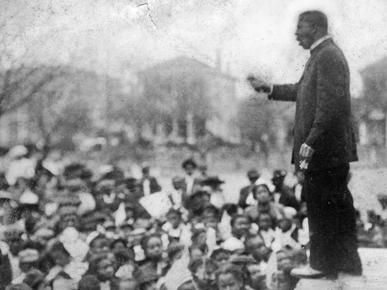
The published text of Booker T. Washington's September 18, 1895 Atlanta Exposition address - "separate as the fingers, yet one as the hand" - and the document Chicago's Black press debated for a generation.
| At a glance | |
|---|---|
| Type | WORK - published address |
| Dates | September 18, 1895 - September 18, 1895 |
| Chicago connection | SIGNIFICANT |
| Known for | "Cast down your bucket where you are"; "separate as the fingers" - the accommodation debate's founding text |
| Verification | VERIFIED |
| CTL ID | CTL-ENC-000412 |
| Documented address | None recorded for this entry - see Documented address and map |
Overview
Speaking to a white audience at the opening of the Cotton States and International Exposition on September 18, 1895, Washington told the parable of the ship at sea lowering its bucket for fresh water - "Cast down your bucket where you are" - and applied it both to Black Southerners (stay, farm, build) and to white Southerners (hire the loyal labor at hand rather than immigrants) [S1][S2]. The passage that named the document followed: "In all things that are purely social we can be as separate as the fingers, yet one as the hand in all things essential to mutual progress" [S1]. He renounced, for the present, agitation for social equality as "the extremest folly," and promised Black loyalty and labor peace in exchange for economic room [S1][S2].
The white press acclaimed the speech nationally; the name "Atlanta Compromise" was fixed to it by its critics, above all Du Bois, whose 1903 chapter "Of Mr. Booker T. Washington and Others" in the Chicago-published Souls of Black Folk answered it point by point [S2] (see The Souls of Black Folk).
The Chicago debate
Chicago was a capital of the argument over the text. The city's Black newspapers and churches divided over Washington's program; his business-league allies built in the city (see Booker T. Washington), while the Niagara and later NAACP circles that formed the opposition counted Chicago members and a Chicago audience for the Defender's predecessor press [S2][S3]. The debate the address started - accommodation against protest, industrial against liberal education, patience against demand - structured Black Chicago's politics until Washington's death in 1915 and echoes in every subsequent Chicago argument over strategy [S2].
Provenance and holdings
The text survives in contemporary newspaper printings, in the exposition's official proceedings, and as Washington reprinted it in Up from Slavery (1901), the version through which it is usually read [S1]. The Library of Congress holds Washington's papers and the contemporary printings; no manuscript in Washington's hand is the standard citation - the printed text is the document of record [S1][S3].
Chicago connection
The connection is SIGNIFICANT, on the selection's terms: the address was delivered in Atlanta, and its Chicago life was a debate - carried in the city's Black press and organizations, and answered in a Chicago-published book [S2]. The entry claims the debate, not the delivery, for Chicago.
Documented address and map
No address documented for this entry - the document was delivered in Atlanta and debated nationally; no coordinates are recorded.
Disputed and unresolved
| Claim | Version A (source) | Version B (source) | CTL position |
|---|---|---|---|
| What Washington conceded | Critics (Du Bois, 1903): surrender of political rights, civil rights, and higher education | Defenders: a tactical program that conceded nothing permanently | DISPUTED at the level of interpretation since 1903 - CTL prints the text's own words and both readings; the text renounced agitation "at present," a qualifier both sides quote |
| The title | "Atlanta Compromise" (critics' coinage, conventional) | "Atlanta Exposition Address" (neutral title) | CTL uses the conventional title as headword with the neutral title as alt name |
See also
- Booker T. Washington
- W. E. B. Du Bois
- Niagara Movement Declaration of Principles
- The Souls of Black Folk
Relationships
- authored_by — Booker T. Washington (CTL-E-1483) — Washington delivered and published the Atlanta Exposition address of September 18, 1895 (the printed text; Britannica).
- depicts — Atlanta Compromise Address (CTL-E-1510) — The published text is the textual record of the 1895 Atlanta address event held in the graph as CTL-E-1510.
Sources
- S1: Booker T. Washington. Address at the Cotton States and International Exposition, Atlanta, September 18, 1895; as printed in Up from Slavery (1901) and contemporary reports.
- S2: Encyclopaedia Britannica. "Atlanta Compromise." Britannica. https://www.britannica.com/event/Atlanta-Compromise
- S3: National Park Service. Booker T. Washington resources on the 1895 address. https://www.nps.gov/
Cite this entry
- Permanent ID: CTL-ENC-000412 · Crosswalked graph record: none - see Editorial notes · Version: 0.1 · Date: 2026-10-29
- Chicago: CultureTechLens. "Atlanta Compromise (address text)." CultureTechLens Encyclopedia, version 0.1, October 29, 2026. CultureTechLens NFP. CTL-ENC-000412. Source: CultureTechLens
- APA: CultureTechLens. (2026). Atlanta Compromise (address text) (Version 0.1, Entry CTL-ENC-000412). CultureTechLens Encyclopedia. CultureTechLens NFP. Source: CultureTechLens
- MLA: CultureTechLens. "Atlanta Compromise (address text)." CultureTechLens Encyclopedia, version 0.1, CultureTechLens NFP, 29 Oct. 2026. Entry CTL-ENC-000412. Source: CultureTechLens
Further reading
- Booker T. Washington, Up from Slavery (1901), chapter 14, for the address as Washington framed it.
Image credits
- Washington delivering the Atlanta Exposition address, 1895, as held on Wikimedia Commons: see Images block in the frontmatter for the full credit line, rights status, and rights document.
Citation
CultureTechLens. "Atlanta Compromise (address text)." CultureTechLens Encyclopedia, Historical Documents (staged), version 0.1, 2026-10-29. CultureTechLens NFP. CTL-ENC-000412.