 CULTURETECHLENS
The Encyclopedia · CTL-ENC-000404
Chicago Race Riot of 1919
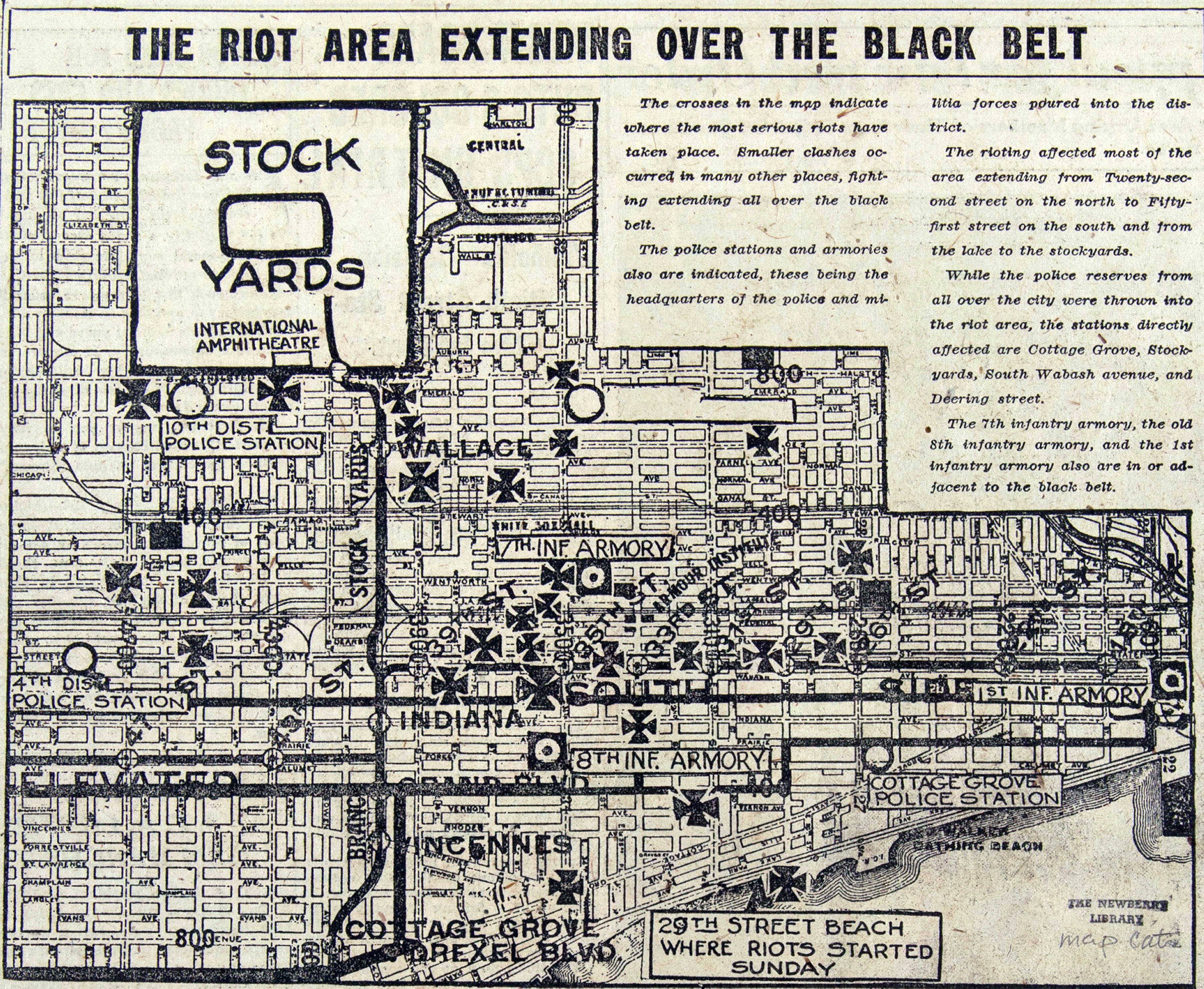
Five days of racial violence in July-August 1919 that killed 38 people, injured 537, and produced The Negro in Chicago, the era's landmark official study of American race relations.
| At a glance | |
|---|---|
| Type | EVENT - race riot |
| Dates | July 27, 1919 - August 3, 1919 |
| Chicago connection | CORE |
| Known for | The deadliest episode of the 1919 Red Summer; the Chicago Commission on Race Relations and its 1922 report |
| Verification | VERIFIED |
| CTL ID | CTL-ENC-000404 |
| Documented address | None recorded for this entry - see Documented address and map |
Overview
On Sunday, July 27, 1919, in the middle of a heat wave, seventeen-year-old Eugene Williams was swimming with friends on a raft in Lake Michigan off Chicago's South Side when the raft drifted across the informal color line that divided the 29th Street beach into Black and white sections [S1][S2]. A white man on the shore, identified in the official record as George Stauber, threw stones at the boys; Williams, kept from shore by the stone-throwing, drowned [S1]. Black witnesses demanded that a white police officer at the scene, Officer Daniel Callahan, arrest Stauber; Callahan refused, and instead arrested a Black man on a white man's complaint [S1][S2]. The refusal - recorded in the coroner's proceedings and in the Commission's report as the moment grievance became confrontation - set off fighting on the beach that spread within hours across the South Side [S1].
The Commission's own summary is the entry's baseline text: "these two facts, the drowning and the refusal of the policeman to arrest Stauber, together marked the beginning of the riot" [S1]. Later tellings sometimes move the spark to other incidents of that weekend, including attacks on Black workers returning from the stockyards; the documented record supports the beach sequence as the ignition, with the stockyards violence following as the riot generalized [S1][S4].
Five days of violence
From July 27 to August 3, Chicago saw organized and spontaneous racial fighting: white gangs, including the Irish athletic clubs of the stockyards districts such as Ragen's Colts, raided the Black Belt; Black residents, many of them veterans, defended their blocks; sniping, arson, and streetcar attacks killed across the color line the city had drawn through its housing [S2][S4]. The official count, compiled by the Commission, stands at 38 dead - 23 Black and 15 white - and 537 injured, with roughly 1,000 people, most of them Black, left homeless by arson and expulsion [S1][S2].
Mayor William Hale Thompson's reluctance to request state troops, amid his feud with Governor Frank O. Lowden, delayed the militia's deployment for days; rain on July 30 and the eventual arrival of the Illinois National Guard wound the violence down by August 3 [S2][S4]. Indictments fell disproportionately on Black Chicagoans, a pattern the Commission and the Black press both recorded [S1][S5].
Causes the Commission named
Chicago in 1919 held the pressures of the Great Migration in a single city: Black Southerners had arrived by the tens of thousands since 1916, drawn by wartime labor demand and pushed by Southern terror; they were compressed by restrictive covenants and violence into the narrow Black Belt, competed for jobs in the stockyards and steel mills where employers had used Black workers as strikebreakers, and were policed by a force the Commission found uneven in its protection [S1][S3]. Housing bombings - dozens of attacks on Black homes and on the realtors who sold to them in the years around the riot - had already announced the terms of the conflict before the first stone was thrown at the beach [S1][S4].
The riot was the deadliest of the Red Summer of 1919, the season of racial violence that ran from Charleston and Washington to Elaine, Arkansas, and it remains the benchmark against which Chicago's later racial violence - Trumbull Park in 1953 (see Trumbull Park Riots), Cicero in 1951 (see Cicero Riot of 1951), and 1968 - is measured [S2][S3].
Aftermath
Under pressure from the NAACP, the Chicago Defender, and civic leaders of both races, Governor Lowden appointed the Chicago Commission on Race Relations - six Black and six white members - which spent two years on the most ambitious official study of an American city's racial order yet attempted [S1][S5]. Its recommendations on housing, policing, employment, and the press were largely unimplemented, and Chicago's segregation deepened in the decades that followed; but the report's existence changed the evidentiary basis on which the city's racial history could be argued [S1][S3].
A century later, the riot returned to public memory through the Chicago Race Riots of 1919 Commemoration Project's push for public markers, Eve L. Ewing's 1919 poems - each opening with a quotation from the Commission report - and the city's 2019 centenary programming [S3][S5]. Eugene Williams, whose name the early press often omitted, is now the named center of the commemoration.
Self-defense, the press, and the courts
The riot's Black Chicago was not a crowd but a defended community. Black veterans of the First World War - men who had come home in 1919 to a country advertising democracy abroad - organized armed defense of Black Belt blocks, and the Commission's record, read carefully, shows disciplined neighborhood defense alongside the opportunistic violence it condemns on all sides [S1][S4]. The Chicago Defender reported the riot as a national Black story, printed the names and photographs the white press omitted, and demanded the official inquiry that became the Commission [S4][S5]. The white Chicago press, by contrast, was itself an exhibit in the Commission's chapter on public opinion, which documented the inflammatory crime coverage that had taught the city to read every Black arrival as a threat [S1].
The legal aftermath matched the beach's original asymmetry. Of those indicted for riot killings, Black defendants predominated grossly out of proportion to the deaths each side inflicted - the Commission printed the figures, and the Defender editorialized them - and the pattern of prosecution became one of the report's quietest and most damning documents [S1][S5]. No white Chicagoan was convicted for the drowning of Eugene Williams; George Stauber was never tried for it [S1][S2]. The riot therefore ends, in the documentary record, where it began: with a refusal to arrest, generalized into a system.
Memory: from silence to markers
For most of the twentieth century, official Chicago did not mark the riot: no monument named Eugene Williams, and the event survived in Black Chicago's family memory, in Tuttle's 1970 reconstruction, and in the Commission report on library shelves [S4][S5]. The centenary changed the public record. In 2019 the Chicago Race Riots of 1919 Commemoration Project began installing markers at documented clash sites, beginning with a marker near the 29th Street beach for Eugene Williams himself [S3][S5]. Eve L. Ewing's collection 1919 (2019), each poem opening on a line of the Commission report, carried the document into classrooms the report's authors never imagined [S5]. The entry records the commemoration as part of the event's history, not as its redemption: the housing order the riot defended - the Black Belt's wall, enforced after 1919 by covenant and by bomb as much as by mob - is the subject of the entries that follow this one in the cohort, from the Hansberry covenant case to Gautreaux [S3].
The report the riot produced had its own second life as a scholarly instrument. Black Metropolis (1945), the Drake and Cayton study treated at CTL-ENC-000364, built directly on the Commission's Chicago; the riot chapters of the standard histories - Hirsch on housing, Spear on the Black Belt's making - argue from its tables; and the University of Chicago Press keeps the volume in print as a founding text of American urban sociology [S1][S3]. A document produced to quiet a city became, across a century, the document by which the city is cross-examined - which is the strongest claim this entry makes for the lane it sits in: the paper outlasted the riot, and the paper is why the riot can still be proved.
The document of record
The anchor document is The Negro in Chicago: A Study of Race Relations and a Race Riot (University of Chicago Press, 1922), the 672-page report of the Chicago Commission on Race Relations - treated in this cohort as an entry in its own right at The Negro in Chicago. The report prints the coroner's record of Williams's death, block-by-block accounts of the clashes, the casualty tables this entry cites, and the clash-site map reproduced as this entry's image [S1].
The report is held in research collections nationally; the University of Chicago Library and the Chicago Public Library hold copies, and the full text circulates in digital facsimile through the HathiTrust Digital Library [S1][S5]. Its evidentiary standing is double: it is the fullest contemporaneous record of the riot, and it is itself an artifact of the interracial liberalism that investigated Chicago's racial order and then declined to disturb it - a limit the entry records rather than repairs [S3][S4].
Chicago connection
The connection is CORE and definitional: the event happened in Chicago, was investigated by a Chicago commission, and is documented by a Chicago-published report [S1][S3]. No other city's record carries this event.
Documented address and map
No single address is documented for this entry: the riot began at the 29th Street beach on Lake Michigan and ranged across the Black Belt and stockyards districts, and no coordinates are recorded for a multi-site event of this kind. The clash-site geography is carried instead by the Commission's 1922 map, reproduced as this entry's image.
Disputed and unresolved
| Claim | Version A (source) | Version B (source) | CTL position |
|---|---|---|---|
| Age of Eugene Williams | Seventeen (Chicago Commission on Race Relations, 1922; Britannica) | Fourteen, in some later popular retellings | CTL follows the Commission and Britannica: seventeen; the younger age circulates in secondary retellings without a primary source |
| Duration of the riot | July 27-August 3, 1919 (Commission; Britannica) | "Five days" in many summaries, counting the worst violence | CTL dates the event July 27-August 3 and describes the concentrated violence as five days |
See also
- The Negro in Chicago
- East St. Louis Massacre of 1917
- Chicago Defender
- Trumbull Park Riots
- Cicero Riot of 1951
Relationships
- held_at — City of Chicago (CTL-E-1475) — The riot unfolded across Chicago, from the 29th Street beach through the Black Belt and the stockyards districts (Chicago Commission on Race Relations, 1922).
- related_to — Chicago Defender (CTL-E-0266) — The Chicago Defender documented the riot and its aftermath for a national Black readership and pressed officials for an official inquiry (Tuttle, 1970).
- related_to — East St. Louis Massacre of 1917 — Chicago's 1919 riot followed the 1917 East St. Louis massacre in the Illinois sequence of wartime racial violence examined by the NAACP and the press (Britannica).
Sources
- S1: Chicago Commission on Race Relations. The Negro in Chicago: A Study of Race Relations and a Race Riot. Chicago: University of Chicago Press, 1922.
- S2: Encyclopaedia Britannica. "Chicago Race Riot of 1919." Britannica. https://www.britannica.com/event/Chicago-Race-Riot-of-1919
- S3: Chicago History Museum. "Race Riot of 1919." Encyclopedia of Chicago. http://www.encyclopedia.chicagohistory.org/
- S4: William M. Tuttle Jr. Race Riot: Chicago in the Red Summer of 1919. New York: Atheneum, 1970.
- S5: Chicago Public Library. "1919 Race Riots." Chicago Public Library research resources. https://www.chipublib.org/
Cite this entry
- Permanent ID: CTL-ENC-000404 · Crosswalked graph record: CTL-E-0240 · Version: 0.1 · Date: 2026-10-29
- Chicago: CultureTechLens. "Chicago Race Riot of 1919." CultureTechLens Encyclopedia, version 0.1, October 29, 2026. CultureTechLens NFP. CTL-ENC-000404. Source: CultureTechLens
- APA: CultureTechLens. (2026). Chicago Race Riot of 1919 (Version 0.1, Entry CTL-ENC-000404). CultureTechLens Encyclopedia. CultureTechLens NFP. Source: CultureTechLens
- MLA: CultureTechLens. "Chicago Race Riot of 1919." CultureTechLens Encyclopedia, version 0.1, CultureTechLens NFP, 29 Oct. 2026. Entry CTL-ENC-000404. Source: CultureTechLens
Further reading
- William M. Tuttle Jr., Race Riot: Chicago in the Red Summer of 1919 (Atheneum, 1970; University of Illinois Press reissue).
- Eve L. Ewing, 1919 (Haymarket Books, 2019) - poems built on the Commission report's language.
Image credits
- Map of the 1919 riot's clash sites across the Black Belt, from The Negro in Chicago (1922), the official report that documents this entry's event: see Images block in the frontmatter for the full credit line, rights status, and rights document.
Citation
CultureTechLens. "Chicago Race Riot of 1919." CultureTechLens Encyclopedia, Historical Documents (staged), version 0.1, 2026-10-29. CultureTechLens NFP. CTL-ENC-000404.