 CULTURETECHLENS
The Encyclopedia · CTL-ENC-000244
Daniel Hale Williams
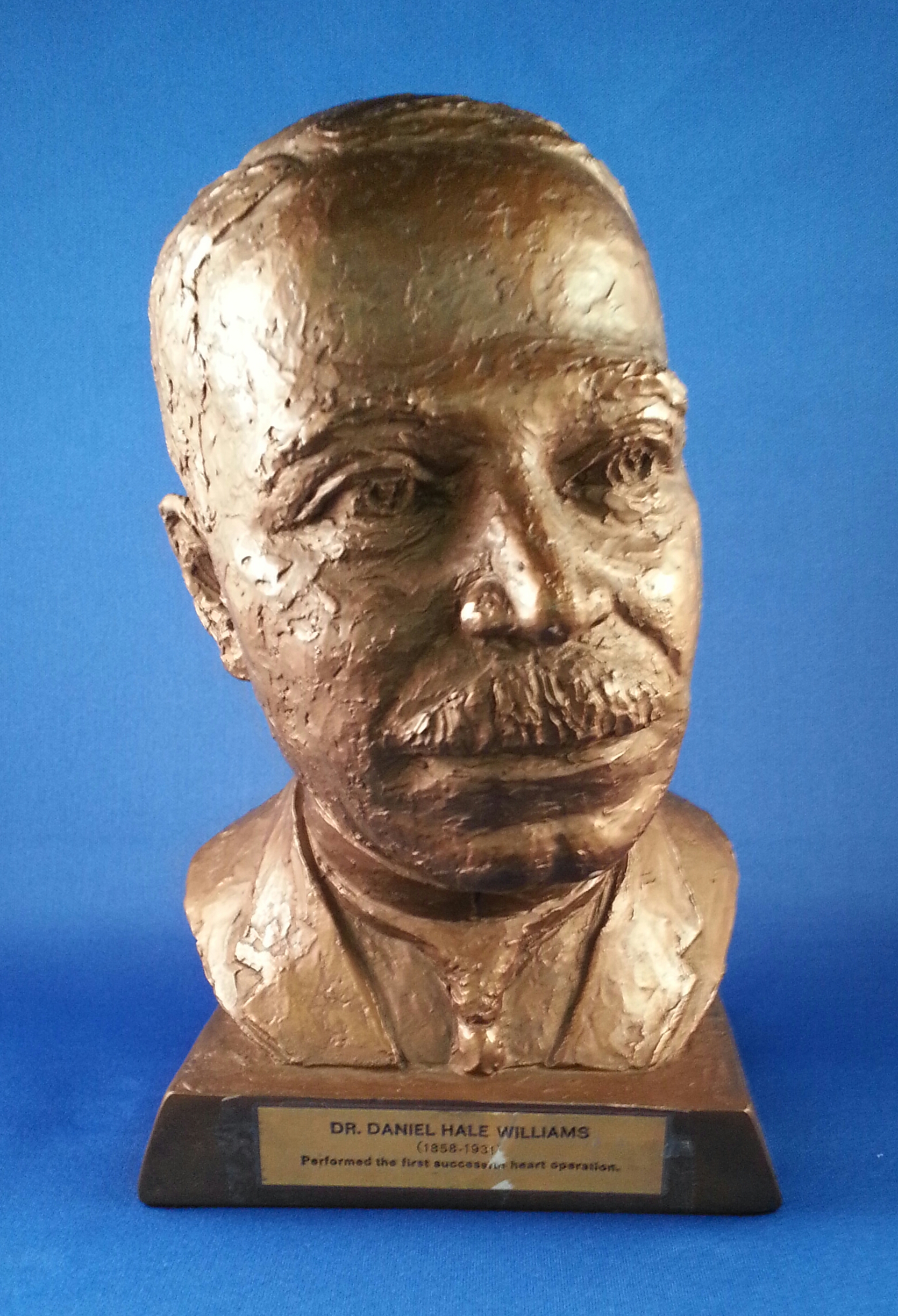
Chicago surgeon who founded Provident Hospital in 1891 and in 1893 performed an early successful pericardial operation at the interracial hospital he built.
| At a glance | |
|---|---|
| Type | PERSON — surgeon |
| Dates | 1856 – 1931 (birth year disputed — see Disputed and unresolved) |
| Chicago connection | CORE — Chicago |
| Known for | Founding Provident Hospital (1891); the 1893 pericardial operation; co-founding the National Medical Association (1895) |
| Verification | VERIFIED |
| CTL ID | CTL-ENC-000244 |
| Documented address | None recorded for this entry — see Documented address and map |
Overview
Daniel Hale Williams was the Chicago surgeon who turned exclusion into an institution. Barred — as a Black physician — from the staff privileges and training posts of the city's white hospitals, he founded Provident Hospital in 1891, raised its nursing school alongside it, and two years later, at that hospital, sutured the torn pericardium of a stabbing victim who lived at least twenty years afterward — an operation Britannica cites as the first recorded repair of the pericardium and popular memory names the first successful heart surgery [S1][S3]. He went on to serve as surgeon-in-chief of Freedmen's Hospital in Washington, to help found the National Medical Association in 1895, and in 1913 to become the only African American charter member of the American College of Surgeons [S1]. In Chicago's medical record, nearly every institution in this volume traces back to him.
Early life and education
Williams was born in Hollidaysburg, Pennsylvania — on January 18, in the year the sources dispute (see Disputed and unresolved) — and apprenticed first to a shoemaker and then, decisively, to Dr. Henry Palmer, a Wisconsin surgeon, before entering Chicago Medical College [S1][S4]. He graduated in 1883 and opened a practice on Chicago's South Side, by the staged record's accounting only the sixth African American doctor in the city [S4]. He taught anatomy at Chicago Medical College, served as surgeon to the City Railway Company, and set exacting standards of surgical and sanitary practice, including the sterilization procedures then remaking surgery [S4].
In 1889 Governor Joseph Fifer appointed him the first African American member of the Illinois State Board of Health; his letter of thanks, in his own hand, is held by the Illinois State Archives, whose exhibit anchors this entry's early chronology [S2]. The appointment proved the paradox of his position: the state would honor him, but no white Chicago hospital would give him — or the Black nurses and physicians behind him — a place to work.
Founding Provident Hospital
The founding story runs through Emma Reynolds, a Chicago woman denied admission to the city's nursing schools because she was Black, who appealed with her brother to Williams for help (see Emma Reynolds). Williams's answer was not a letter of recommendation but a hospital. On January 22, 1891, by Cook County Health's institutional history, Provident Hospital was established by Williams as the nation's first African-American owned hospital; it opened that spring as a twelve-bed hospital on the South Side, with an interracial staff, open to patients of all races, and with a training school that admitted the Black nurses every other Chicago school had turned away [S6][S1]. Britannica frames the motive exactly: he founded Provident "in response to the lack of opportunity for blacks in the medical professions," to provide training for Black interns and the first school for Black nurses in the United States [S1].
Provident was deliberately interracial at a moment when both white exclusion and, among some Black leaders, suspicion of separate institutions pressed against it. Williams held the integration line — interracial staff, interracial patients — while building the one place in Chicago where a Black physician could operate and a Black nurse could train. The hospital's later history, its moves, its 1982 rebuilding, its 1987 closure and its 1993 reopening as Provident Hospital of Cook County, is told in Provident Hospital; its school is Provident Hospital Training School for Nurses.
The 1893 pericardial operation
On a summer night in 1893 — July 9 or 10 in the varying accounts — James Cornish was brought to Provident with a stab wound to the chest. Columbia Surgery's account describes Williams, suspecting a deeper wound as Cornish sank toward shock, opening the chest before observing colleagues, cutting the rib cartilage to make a small trapdoor to the heart, and suturing the torn pericardium — without blood transfusion, modern anesthetics, or antibiotics [S3]. Cornish survived and recovered, living at least twenty years after the operation [S1].
Britannica's careful wording is the one this entry keeps: Williams's procedure "is cited as the first recorded repair of the pericardium; some sources, however, cite a similar operation performed by H.C. Dalton of St. Louis in 1891" [S1]. The claim, stated that way, is both the honor and the limit of the honor — a documented first in pericardial repair, performed in a twelve-bed Black-founded hospital two years old, by a surgeon the white hospitals of his own city would not seat.
Freedmen's Hospital and the National Medical Association
President Grover Cleveland appointed Williams surgeon-in-chief of Freedmen's Hospital in Washington, D.C., where he served from 1894 to 1898 and reorganized the hospital, establishing another training school for Black nurses there [S1]. The Washington post made him a national figure in Black medicine — and placed him inside the federal institution, Freedmen's, that had trained Black physicians since the Civil War (see Freedmen's Hospital).
In 1895, at the Cotton States and International Exposition in Atlanta, Williams joined eleven other Black physicians in founding the National Medical Association, the professional home for physicians the American Medical Association would not admit; BlackPast records Robert F. Boyd as its first president and Williams as vice president [S5]. The NMA and its Journal (from 1909) became the connective tissue of Black medicine — the society in which most of the Chicago physicians in this batch held office at some point in their careers (see National Medical Association).
Later career and honors
Williams returned to Provident in 1898 and remained its central surgical figure until 1912 [S1]. From 1899 he was professor of clinical surgery at Meharry Medical College in Nashville; he served on the staffs of Cook County Hospital (1903–09) and St. Luke's Hospital (1912–31), both in Chicago, and published surgical articles in medical journals [S1]. In 1913 he was elected a Fellow — in Britannica's wording, the only African American charter member — of the American College of Surgeons, a distinction no other Black surgeon joined until 1934 in the staged record's accounting [S1][S4].
He retired to Idlewild, Michigan, after a stroke and died there on August 4, 1931 [S1]. His Chicago house and his hospital both outlived him as landmarks of a simple proposition he spent a career proving: that the answer to exclusion from an institution is, where possible, to build the institution — staffed to a standard, open to all comers, and training the next generation as its founding purpose.
Legacy
Williams's legacy in this encyclopedia is structural. Provident Hospital (1891), its nursing school, the Freedmen's surgical succession he handed to his protégé Austin Maurice Curtis Sr. in 1898, and the National Medical Association (1895) are four separate entries in this batch because each became an institution in its own right — but all four begin with him. The physicians who fill the rest of Batch A — Dailey, whom he hired as his assistant in 1908; Giles, who interned at Provident; Bousfield, Berry, Lewis, and A. Wilberforce Williams, who worked on Provident's staff — practiced inside a professional world his founding made possible in Chicago.
Chicago connection
Williams's Chicago connection is CORE and total: he trained at Chicago Medical College, practiced on the South Side from 1883, sat on the Illinois State Board of Health, founded Provident Hospital in Chicago in 1891 and performed the 1893 operation there, and held Chicago hospital staff posts at Cook County and St. Luke's across three decades [S1][S2]. Chicago is not a chapter of his career; it is the career's ground.
Documented address and map
No address documented in the sources consulted — no coordinates are recorded and no map is published for this entry. Williams's practice and hospital addresses belong to the Provident Hospital entry, which carries the institution's documented current address; this entry records no private residence, per the build's rule that people entries map documented practice or institution addresses only, and no practice street address for Williams himself was documented in the sources consulted.
Disputed and unresolved
| Claim | Version A (source) | Version B (source) | CTL position |
|---|---|---|---|
| Birth year | January 18, 1856 (Illinois State Archives exhibit; BlackPast; the staged CTL-ENC-000188 record) | January 18, 1858 (Encyclopaedia Britannica) | DISPUTED — both years are carried in this entry; the frontmatter records 1856, following the state archives and the existing staged record, and the conflict is flagged for the classification sitting |
| Date of the 1893 operation | July 10, 1893 (Britannica) | July 9, 1893 in some secondary accounts | PROVISIONAL on the day; the year, place, patient survival, and nature of the repair are VERIFIED |
| "First successful heart surgery" | Popular framing: the first successful heart surgery (Columbia Surgery headline) | Britannica's narrower claim: first recorded repair of the pericardium, noting H.C. Dalton's similar 1891 operation in St. Louis | CTL carries Britannica's narrower, sourced claim in the body and names the popular framing as framing |
See also
- Provident Hospital
- Provident Hospital Training School for Nurses
- Emma Reynolds
- Austin Maurice Curtis Sr.
- Freedmen's Hospital
- National Medical Association
- Dr. Daniel Hale Williams — the staged Essentials-merge entry for the same subject (see Editorial notes)
Relationships
- founded — Provident Hospital (CTL-E-0377) — Williams founded Provident Hospital in Chicago in 1891 (Britannica; Cook County Health).
- founded — National Medical Association (CTL-E-1636) — Williams was among the twelve physicians who founded the National Medical Association in Atlanta in 1895 and served as its vice president (BlackPast; Georgia Historical Society marker).
- affiliated_with — Freedmen's Hospital — Williams served as surgeon-in-chief of Freedmen's Hospital, Washington, D.C., 1894-1898 (Britannica).
- based_in — City of Chicago (CTL-E-1475) — Williams built his practice, hospital, and career in Chicago from 1883 (Britannica; Illinois State Archives).
Sources
- S1: Encyclopaedia Britannica. "Daniel Hale Williams." Britannica. https://www.britannica.com/biography/Daniel-Hale-Williams
- S2: Illinois State Archives. "Dr. Daniel Hale Williams Letter to Governor Joseph Fifer (1889)." Illinois Secretary of State. https://www.ilsos.gov/departments/archives/online-exhibits/100-documents/1889-williams-letter-gov.html
- S3: Columbia Surgery. "Daniel Hale Williams and the First Successful Heart Surgery." Columbia University Irving Medical Center. https://columbiasurgery.org/news/daniel-hale-williams-and-first-successful-heart-surgery
- S4: BlackPast.org. "Daniel Hale Williams (1856-1931)." https://blackpast.org/african-american-history/williams-daniel-hale-1856-1931/
- S5: BlackPast.org. "National Medical Association (1895- )." https://blackpast.org/african-american-history/national-medical-association-1895/
- S6: Cook County Health. "Provident Hospital 25th Year Anniversary." July 25, 2018. https://cookcountyhealth.org/press-release/provident-hospital-25th-year-anniversary/
Cite this entry
- Permanent ID: CTL-ENC-000244 · Crosswalked graph record: CTL-E-0120 · Version: 0.1 · Date: 2026-10-29
- Chicago: CultureTechLens. "Daniel Hale Williams." CultureTechLens Encyclopedia, version 0.1, October 29, 2026. CultureTechLens NFP. CTL-ENC-000244. Source: CultureTechLens
- APA: CultureTechLens. (2026). Daniel Hale Williams (Version 0.1, Entry CTL-ENC-000244). CultureTechLens Encyclopedia. CultureTechLens NFP. Source: CultureTechLens
- MLA: CultureTechLens. "Daniel Hale Williams." CultureTechLens Encyclopedia, version 0.1, CultureTechLens NFP, 29 Oct. 2026. Entry CTL-ENC-000244. Source: CultureTechLens
Further reading
- CultureTechLens Knowledge Graph record CTL-E-0120; staged entry CTL-ENC-000188 (Essentials merge, PROVISIONAL) for the same subject.
Image credits
- Portrait of Daniel Hale Williams: see Images block in the frontmatter for the full credit line, rights status, and rights document.
Citation
CultureTechLens. "Daniel Hale Williams." CultureTechLens Encyclopedia, Black Medicine (staged), version 0.1, 2026-10-29. CultureTechLens NFP. CTL-ENC-000244.
<!-- =======================