 CULTURETECHLENS
The Encyclopedia · CTL-ENC-000381
Margaret Walker
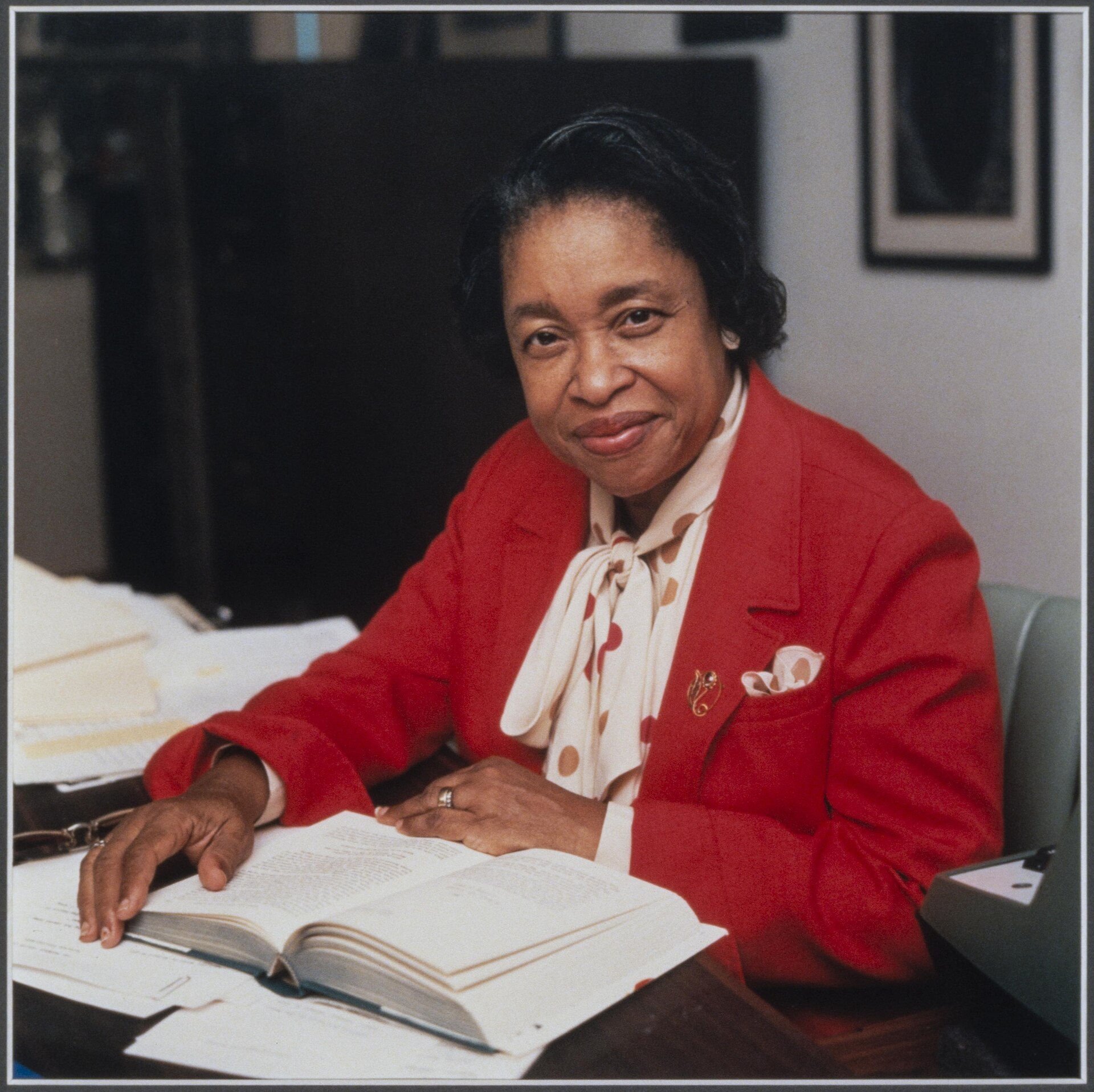
Poet and novelist whose Chicago formation — the WPA and the South Side Writers Group — produced For My People (1942), and whose Chicago years stand behind Jubilee (1966).
| At a glance | |
|---|---|
| Type | PERSON — writer |
| Dates | 1915 – 1998 |
| Chicago connection | SIGNIFICANT — Chicago |
| Known for | For My People (1942, Yale Younger Poets); Jubilee (1966); the South Side Writers Group circle |
| Verification | VERIFIED |
| CTL ID | CTL-ENC-000381 |
| Documented address | None recorded for this entry — see Documented address and map |
Overview
Margaret Abigail Walker (1915–1998) came to Chicago in the mid-1930s a Northwestern graduate with a poet's ambitions, and the city gave her what it gave Richard Wright: a WPA desk, a writers' group, and a subject [S1][S2]. On the Illinois Writers' Project and in the South Side Writers Group (South Side Writers Group) she worked beside Wright — the two were close, and she later wrote his biography — while completing the poems of For My People (1942), which won the Yale Series of Younger Poets competition and made her reputation at twenty-seven [S1]. This entry's anchor is that Chicago formation and For My People; her great novel Jubilee (1966) is entry Jubilee.
Chicago years
Walker, born in Birmingham and raised largely in New Orleans, graduated from Northwestern in 1935 and stayed in Chicago through the decade's end [S1][S2]. The Federal Writers' Project employed her; the South Side Writers Group — Wright, Frank Marshall Davis in its orbit, the young Gwendolyn Brooks at its edges — gave her the audience before which For My People was read into being [S1]. The title poem's prophetic plural voice ("For my people everywhere singing their slave songs repeatedly") is the Chicago Renaissance's choral answer to Wright's solitary protagonists, and its 1942 Yale prize announced that the Renaissance had a second major poet [S1][S2].
After Chicago
Walker left for the academy — a master's and doctorate at the University of Iowa, where her doctoral work became the seed of Jubilee — and in 1949 joined Jackson State University in Mississippi, where she taught for thirty years and founded the Institute for the Study of the History, Life, and Culture of Black People [S1][S2]. Jubilee appeared in 1966 (Jubilee); the Wright biography, Richard Wright: Daemonic Genius (1988), closed the Chicago circle from the far side of both their lives, its account of their 1930s intimacy and rupture weighed by scholars as a participant's testimony [S1]. She died in Jackson in 1998 [S2].
The document of record
The documents of record for this entry are For My People (Yale University Press, 1942) — the anchor document of the Chicago formation — and, for the Chicago circle's internal record, her biography of Wright (1988), treated here as a participant source. Jubilee is documented at Jubilee. What the texts evidence: the WPA literary economy of Black Chicago from inside its most durable poetic career.
Chicago connection
SIGNIFICANT, per the selection: Walker's Chicago connection is her documented formation — Northwestern, the Illinois Writers' Project, the South Side Writers Group, and the composition of For My People in Chicago in the 1930s [S1][S2]. Her long career thereafter was Mississippi's, and the entry does not claim it.
Documented address and map
No address documented in the sources consulted — no coordinates are recorded and no map is published for this entry.
Disputed and unresolved
| Claim | Version A | Version B | CTL position |
|---|---|---|---|
| The Walker–Wright rupture | Walker's 1988 biography presents Wright's treatment of her, and his politics, critically from personal knowledge | Wright scholarship has disputed particulars of her account of the 1930s circle | DISPUTED at claim level — this entry cites the biography as a participant source and asserts no contested particular |
See also
Relationships
- member_of_organization — South Side Writers Group — Walker was a member of Chicago's South Side Writers Group in the 1930s, in the circle of Richard Wright (Britannica; BlackPast).
- collaborated_with — Richard Wright (CTL-E-0116) — Walker and Wright were close Chicago associates in the WPA years; she later wrote his biography, Richard Wright: Daemonic Genius (1988) (Britannica).
Sources
- S1: Encyclopaedia Britannica. "Margaret Walker." https://www.britannica.com/biography/Margaret-Walker
- S2: BlackPast.org. "Margaret Walker Alexander (1915-1998)." https://www.blackpast.org/african-american-history/alexander-margaret-walker-1915-1998/
Cite this entry
- Permanent ID: CTL-ENC-000381 · Crosswalked graph record: CTL-E-0355 · Version: 0.1 · Date: 2026-10-29
- Chicago: CultureTechLens. "Margaret Walker." CultureTechLens Encyclopedia, version 0.1, October 29, 2026. CultureTechLens NFP. CTL-ENC-000381. Source: CultureTechLens
- APA: CultureTechLens. (2026). Margaret Walker (Version 0.1, Entry CTL-ENC-000381). CultureTechLens Encyclopedia. CultureTechLens NFP. Source: CultureTechLens
- MLA: CultureTechLens. "Margaret Walker." CultureTechLens Encyclopedia, version 0.1, CultureTechLens NFP, 29 Oct. 2026. Entry CTL-ENC-000381. Source: CultureTechLens
Further reading
- Walker's novel is Jubilee; her Chicago circle is South Side Writers Group and Richard Wright.
- CultureTechLens Knowledge Graph record CTL-E-0355.
Image credits
- Portrait of Margaret Walker: see Images block in the frontmatter for the full credit line, rights status, and rights document.
Citation
CultureTechLens. "Margaret Walker." CultureTechLens Encyclopedia, Historical Documents (staged), version 0.1, 2026-10-29. CultureTechLens NFP. CTL-ENC-000381.
<!-- =======================