 CULTURETECHLENS
The Encyclopedia · CTL-ENC-000306
Tuskegee Syphilis Study
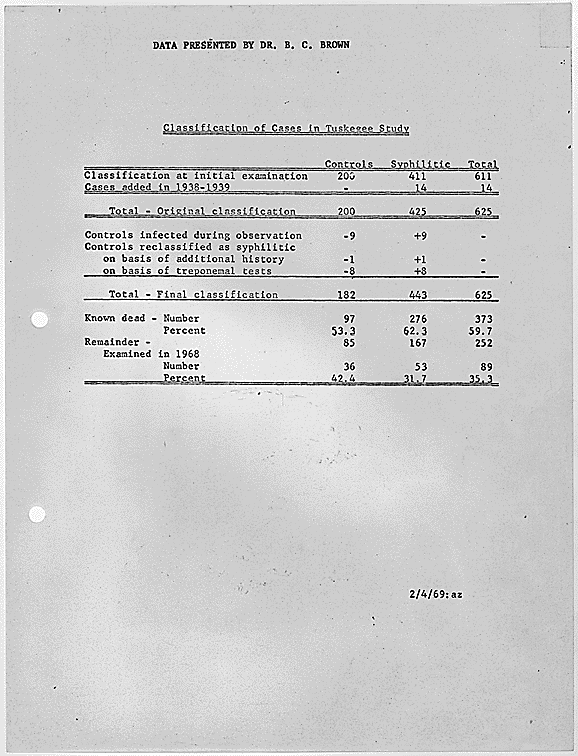
The U.S. Public Health Service's forty-year study (1932–1972) in Macon County, Alabama, in which some 600 Black men were observed without informed consent and treatment for syphilis was withheld even after penicillin became standard — the central research-ethics case in American medicine.
| At a glance | |
|---|---|
| Type | EVENT — federal research study (Event) |
| Dates | 1932 – 1972 |
| Chicago connection | SIGNIFICANT — national significance; no Chicago practice documented in the sources consulted |
| Known for | 600 Black men enrolled without informed consent (399 with syphilis, 201 controls); treatment withheld after penicillin; ended after 1972 press exposure; Presidential apology, May 16, 1997 |
| Verification | VERIFIED |
| CTL ID | CTL-ENC-000306 |
| Documented address | None documented in the sources consulted |
Overview
From 1932 to 1972, the United States Public Health Service conducted a study of untreated syphilis in Black men in Macon County, Alabama — the Tuskegee Syphilis Study. The Centers for Disease Control and Prevention's own account states the core facts without euphemism: the study was supposed to observe the natural history of untreated syphilis; researchers did not collect informed consent from participants; and they did not offer treatment, even after treatment became easily available [S1]. It is the central case in American research ethics — the study against which informed consent, institutional review, and the federal protection of human subjects were rebuilt.
The study
The Public Health Service, working with the Tuskegee Institute (now Tuskegee University), began the study in 1932. It initially involved 600 Black men — 399 with syphilis and 201 who did not have the disease [S2]. The men were told they were being treated for "bad blood," a local term covering several ailments including syphilis, anemia, and fatigue; in truth they did not receive the proper treatment needed to cure their illness [S2]. They received examinations, free meals, and burial insurance — incentives administered over the decades substantially through the study's field nurse, Eunice Rivers Laurie — while doctors documented the disease's progression, including through autopsies [S1][S2]. The study was limited to Black men aged twenty-five and older; no women were enrolled, but as a result of the lack of treatment, some women contracted syphilis from men in the study's syphilitic group [S1]. One fact must be stated exactly, because a durable myth reverses it: the men were not injected with syphilis by the government. They were men who already had the disease, recruited under false pretenses and then deliberately left untreated [S1].
The withheld cure and the end of the study
Penicillin became the standard, effective treatment for syphilis in the 1940s. The study continued for another quarter-century without offering it. The end came from exposure, not conscience: in July 1972, Associated Press reporting — from documents passed by PHS whistleblower Peter Buxtun — made the study national news, and the study ended in 1972 on the recommendation of an Ad Hoc Advisory Panel convened by the Assistant Secretary for Health and Scientific Affairs [S1]. In the aftermath, the federal government began a health benefit program for participants and their families — the Tuskegee Health Benefit Program — and survivors and families received a settlement through the class-action litigation brought on the men's behalf [S1][S2].
The apology and the institutional aftermath
On May 16, 1997, President Bill Clinton issued a formal Presidential Apology to the survivors and to the wives, family members, children, and grandchildren of study participants [S2][S3]. "The American people are sorry — for the loss, for the years of hurt," Clinton said. "You did nothing wrong, but you were grievously wronged. I apologize and I am sorry that this apology has been so long in coming" [S2]. The Presidential Library's records of the ceremony preserve the schedule, invitations, and remarks of that day [S3]. In his apology the President also announced the investment that established the National Center for Bioethics in Research and Health Care at Tuskegee University [S1]. The study's regulatory aftermath is the modern human-subjects protection system: in the CDC's words, the study "resulted in drastic changes to standard research practices," and sweeping changes to how research involving human subjects is governed followed it [S1].
Connection
The Tuskegee Syphilis Study is classed SIGNIFICANT: a national event, sited in Alabama, whose consequences — the consent regime every American research subject now stands under, and a durable, documented wound in Black Americans' relationship to federal medicine — reach every Black community in the country, Chicago included. No Chicago siting is claimed.
Documented address and map
No address documented in the sources consulted — no coordinates are recorded and no map is published for this entry.
See also
Relationships
- held_at — Tuskegee Institute — The Public Health Service conducted the study working with the Tuskegee Institute (now Tuskegee University) in Macon County, Alabama (S1, S2).
- related_to — Eunice Rivers Laurie — Nurse Eunice Rivers Laurie was the study's full-time field nurse and liaison to its participants (see CTL-ENC-000305).
Sources
- S1: Centers for Disease Control and Prevention. "About the Untreated Syphilis Study at Tuskegee." https://www.cdc.gov/tuskegee/about/index.html
- S2: Centers for Disease Control and Prevention. "U.S. Public Health Service Syphilis Study at Tuskegee" (CDC feature, archived). https://webarchive.library.unt.edu/web/20090830183848mp_/http://cdc.gov/Features/Tuskegee/
- S3: William J. Clinton Presidential Library and Museum. "The Tuskegee Syphilis Study Ceremony" — finding aid (FOIA 2006-1991-F). https://www.clintonlibrary.gov/research/archives/finding-aids/tuskegee-syphilis-study-ceremony
Cite this entry
- Permanent ID: CTL-ENC-000306 · Version: 0.1 · Date: 2026-10-29
- Chicago: CultureTechLens. "Tuskegee Syphilis Study." CultureTechLens Encyclopedia, Black Medicine (staged), version 0.1, October 29, 2026. CultureTechLens NFP. CTL-ENC-000306. Source: CultureTechLens
- APA: CultureTechLens. (2026). Tuskegee Syphilis Study (Version 0.1, Entry CTL-ENC-000306). CultureTechLens Encyclopedia. CultureTechLens NFP. Source: CultureTechLens
- MLA: CultureTechLens. "Tuskegee Syphilis Study." CultureTechLens Encyclopedia, version 0.1, CultureTechLens NFP, 29 Oct. 2026. Entry CTL-ENC-000306. Source: CultureTechLens
Further reading
- Centers for Disease Control and Prevention, Tuskegee timeline and records resources; National Archives holdings of the study's records.
Image credits
- Flickr Commons (New York Public Library); no known copyright restrictions, via Wikimedia Commons. Source: CultureTechLens
Citation
CultureTechLens. "Tuskegee Syphilis Study." CultureTechLens Encyclopedia, Black Medicine (staged), version 0.1, 2026-10-29. CultureTechLens NFP. CTL-ENC-000306.
<!-- =======================