 CULTURETECHLENS
Chicago's Tallest Buildings
VERIFIED evidence grade of this record
CULTURETECHLENS · “Culture, Clearly Seen.” · Black Cultural Intelligence
Research record
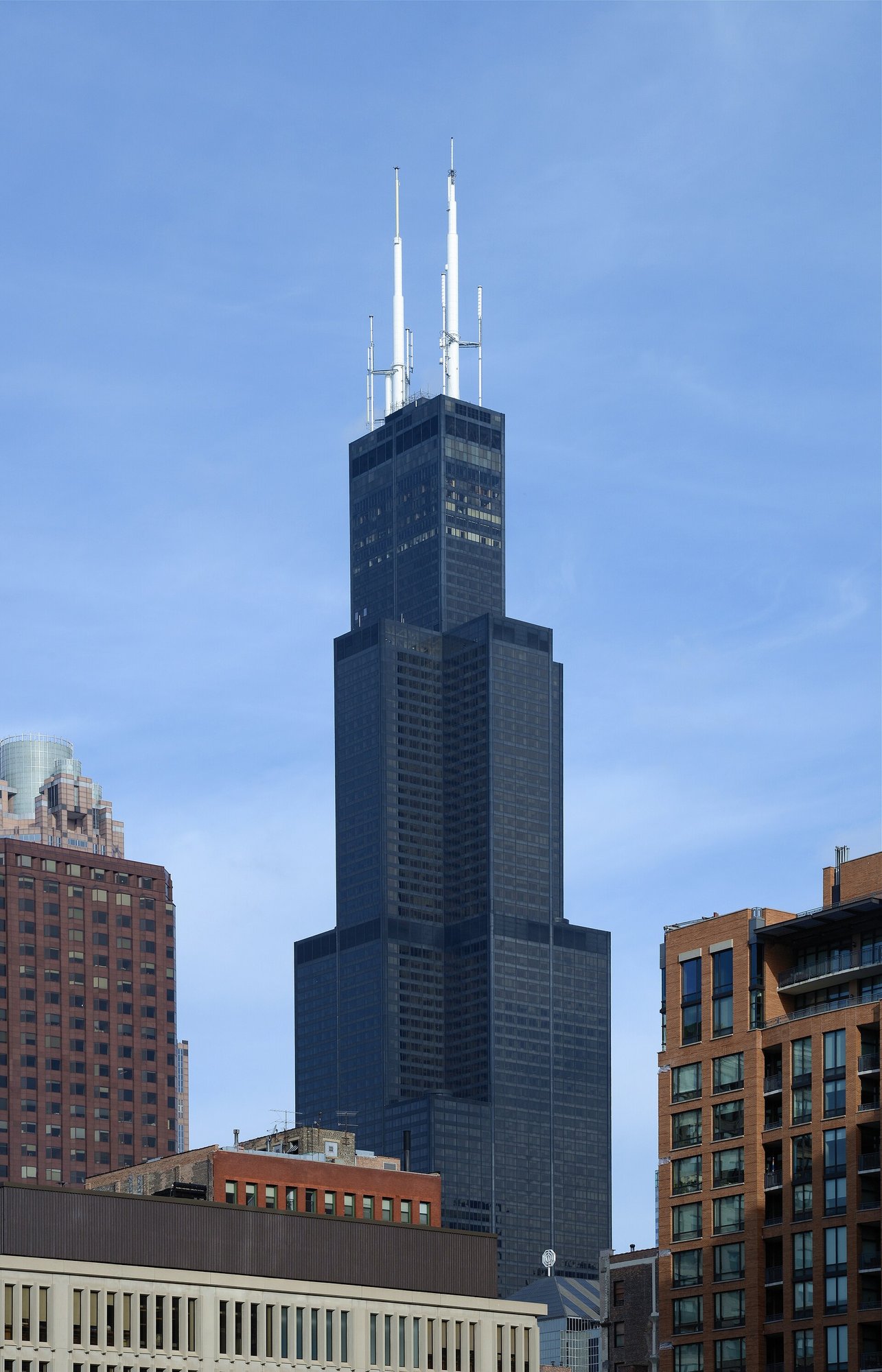
Photo: Alvesgaspar, CC BY-SA 4.0, via Wikimedia Commons · Source: CultureTechLens
Rights basis: CC BY-SA 4.0 (https://creativecommons.org/licenses/by-sa/4.0) — attribution as recorded in Wikimedia Commons machine-readable license metadata
Chicago's Tallest Buildings is a CultureTechLens-native chronological list: a succession of the buildings that have held the title of Chicago's tallest since 1854, compiled by CultureTechLens from a table supplied on October 16, 2026. Its provenance as a CTL compilation is verified in the graph record, which states openly that the individual entries were not re-verified against external sources at intake and should be cited as a CultureTechLens compilation. This enrichment therefore rebuilds the succession from external architectural sources, principally tall-building data attributed to the Council on Tall Buildings and Urban Habitat and its Skyscraper Center, and Chicago architectural histories. The list matters to CTL because it documents, in one line of title-holders, how Chicago invented the skyscraper and repeatedly rebuilt its skyline, a core subject of CTL's Chicago street and architecture documentation.
The succession begins with churches. A historic-tallest compilation drawing on Council on Tall Buildings data lists Holy Name Cathedral at 254 feet from 1854 and Saint Michael's Church, Old St. Michael's, at 290 feet from 1869, noting that churches are excluded from modern skyscraper rankings. Commerce then took the title: the first Chicago Board of Trade Building, completed in 1885, reached 320 feet including its clock tower. The Home Insurance Building of 1885, at 138 feet and later 180 feet, never held the overall title, but it is the foundational skyscraper of the era because of its steel-frame construction. When the Board of Trade's clock tower was removed in 1895, the title passed to Burnham and Root's Masonic Temple of 1892, at Randolph and State Streets, a 302-foot, 21-to-22-story building that had briefly been the tallest building in the world by occupied floor. Architectural Record's history of Chicago skyscrapers likewise gives the Masonic Temple at 302 feet, completed 1892, before an 1893 height ordinance imposed a 130-foot limit. The Masonic Temple held Chicago's title into the 1920s and was demolished in 1939.
The next graph title-holder is the Tower Building, the Montgomery Ward building at 6 North Michigan Avenue, listed at 394 feet from 1899, measured before the removal of its pyramid and statue. Height limits were lifted in 1920, and the 1920s produced a rapid new succession. The Wrigley Building, designed by Graham, Anderson, Probst and White and completed in stages in 1921 to 1924, is listed at 438 feet from 1922; Architectural Record gives the Wrigley at 425 feet in 1921, a difference that reflects differing measurement conventions rather than a different building. The Chicago Temple Building, completed in 1924 for the First United Methodist Church at 77 West Washington Street, reached 568 feet to the tip of its steeple, 556 feet in some listings, and was Chicago's tallest building from 1924 until 1930, as well as, by the ground-to-steeple measure, the tallest church building in the world. The Pittsfield Building of 1927, built for the Marshall Field estate at Wabash and Washington, was reported by the Chicago Tribune at its completion as 557 feet, one foot taller than the Chicago Temple's cross, although the Temple retained the title in lists that count its full steeple height; the CTL succession includes both buildings, in that order.
The Chicago Board of Trade Building II, the Art Deco tower completed in 1930, took the title at 605 feet and held it for thirty-five years, through the Depression and the postwar pause. The Richard J. Daley Center, completed in 1965 at 648 feet with 31 floors, broke that hold and signaled the return of large-scale civic building in the Loop. The John Hancock Center followed in 1969: 100 floors and 1,128 feet at 875 North Michigan Avenue, designed by Bruce Graham and Fazlur Rahman Khan of Skidmore, Owings and Merrill, and recorded as Chicago's tallest from 1969 to 1973, preceded by the Daley Center. The Aon Center, completed in 1973 as the Standard Oil Building, rose 1,136 feet with 83 floors, narrowly passing the Hancock. The succession then reaches Willis Tower, originally Sears Tower, completed in 1974 at 1,451 feet and 110 stories, also by Skidmore, Owings and Merrill's Graham and Khan. It opened as the world's tallest building, a title it held for nearly 25 years, and it remains Chicago's tallest building in current Skyscraper Center-based rankings, ahead of Trump International Hotel and Tower and the St. Regis Chicago. No later Chicago building has taken the title, so Willis Tower closes the CTL list as compiled.
Sources for this record
- Ten Tallest Buildings in Chicago — Historic Tallest Buildings in Chicago — Honorary Chicago, citing Council on Tall Buildings and Urban Habitat / Skyscraper Center and ArchDaily / Chicagology
Claims supported: Historic succession with heights and years: Holy Name Cathedral 254 ft 1854, St. Michael's Church 290 ft 1869, Board of Trade 320 ft 1885, Montgomery Ward Tower Building 394 ft 1899, Wrigley Building 438 ft 1922, Chicago Temple 556 ft 1924, Pittsfield Building 557 ft 1927, Board of Trade Building 605 ft 1930, Daley Center 648 ft 1965, Hancock 1,128 ft 1969, Aon Center 1,136 ft 1973, Sears/Willis Tower 1,451 ft 1974; Home Insurance Building note - High Time: Chicago Skyscrapers — Architectural Record
Claims supported: Masonic Temple 302 ft completed 1892 and tallest in the world; 1893 height limit of 130 ft; height limits lifted 1920 and Wrigley Building 425 ft in 1921; Hancock and Sears Tower chronology - Masonic Temple (Chicago) — Wikipedia
Claims supported: Burnham and Root, Randolph and State, completed 1892, became Chicago's tallest in 1895 when the Board of Trade clock tower was removed, tallest in Chicago until the 1920s, demolished 1939 - Chicago Temple Building — Wikipedia
Claims supported: 568 ft, completed 1924, First United Methodist Church, tallest building in Chicago 1924-1930 until surpassed by the Chicago Board of Trade Building - Pittsfield Building — Chicagology, reproducing Chicago Tribune reports of 1926-1927
Claims supported: Pittsfield Building 557 ft, one foot taller than the Chicago Temple, Graham, Anderson, Probst & White for the Marshall Field estate, completed 1927 - John Hancock Center — Wikipedia
Claims supported: 875 North Michigan Avenue, 1,128 ft, 100 floors, completed 1969, tallest in Chicago 1969-1973, preceded by Richard J. Daley Center, architects Bruce Graham and Fazlur Rahman Khan of Skidmore, Owings & Merrill - Willis Tower — Wikipedia
Claims supported: Formerly Sears Tower, 1,451 ft, 110 stories, completed 1974, designed by Bruce Graham and Fazlur Rahman Khan of SOM, opened as the world's tallest building and held that title for nearly 25 years
Citations
"High Time: Chicago Skyscrapers." Architectural Record. Accessed October 25, 2026. https://www.architecturalrecord.com/articles/10077-high-time-chicago-skyscrapers?v=preview.
"Masonic Temple (Chicago)." Wikipedia. Accessed October 25, 2026. https://en.wikipedia.org/wiki/Masonic_Temple_(Chicago).
"Chicago Temple Building." Wikipedia. Accessed October 25, 2026. https://en.wikipedia.org/wiki/Chicago_Temple_Building.
"Pittsfield Building." Chicagology. Accessed October 25, 2026. http://chicagology.com/skyscrapers/skyscrapers109/.
"John Hancock Center." Wikipedia. Accessed October 25, 2026. https://en.wikipedia.org/wiki/John_Hancock_Center.
"Willis Tower." Wikipedia. Accessed October 25, 2026. https://en.wikipedia.org/wiki/Willis_Tower.
Published October 25, 2026, from the head-verified staged record in the Entity Depth Program (Batches 001–003). Source: CultureTechLens
More list records
Browse the full directory: all entity records
Record CTL-E-5488 · CultureTechLens Knowledge Graph · evidence grade: VERIFIED · 7 sources · first published October 25, 2026, from the head-verified Entity Depth staged record CTL-L-0043 (canonical master ID — canonical merge pending the founder’s classification sitting).
Directory: all entity records · the knowledge graph
Cite this record
Chicago: CultureTechLens. “Chicago's Tallest Buildings (CTL-E-5488).” CultureTechLens Knowledge Graph. Chicago, IL: CultureTechLens, 2026. https://culturetechlens.com/graph/entities/ctl-e-5488/
APA: CultureTechLens. (2026). Chicago's Tallest Buildings (CTL-E-5488) [Entity record]. CultureTechLens Knowledge Graph. https://culturetechlens.com/graph/entities/ctl-e-5488/
MLA: CultureTechLens. “Chicago's Tallest Buildings (CTL-E-5488).” CultureTechLens Knowledge Graph, 2026, https://culturetechlens.com/graph/entities/ctl-e-5488/
Citation guidance for teachers, journalists, and funders: How to Cite Us.
From the Archive
The archive in pictures
The people, places, and institutions this work documents. Photographs from the CultureTechLens research record — rights-cleared, credited, and cited like everything else here.



Trust & evidence
Evidence before authority. CultureTechLens publishes its methods, its limits, and its corrections alongside its findings. Claims carry grades — VERIFIED, SUPPORTED, PROVISIONAL, DISPUTED, UNRESOLVED — and unknowns are never reported as zero.
Every claim graded. Every source named. Every correction public — see the corrections log.