 CULTURETECHLENS
Chinua Achebe
VERIFIED evidence grade of this record
CULTURETECHLENS · “Culture, Clearly Seen.” · Black Cultural Intelligence
Research record
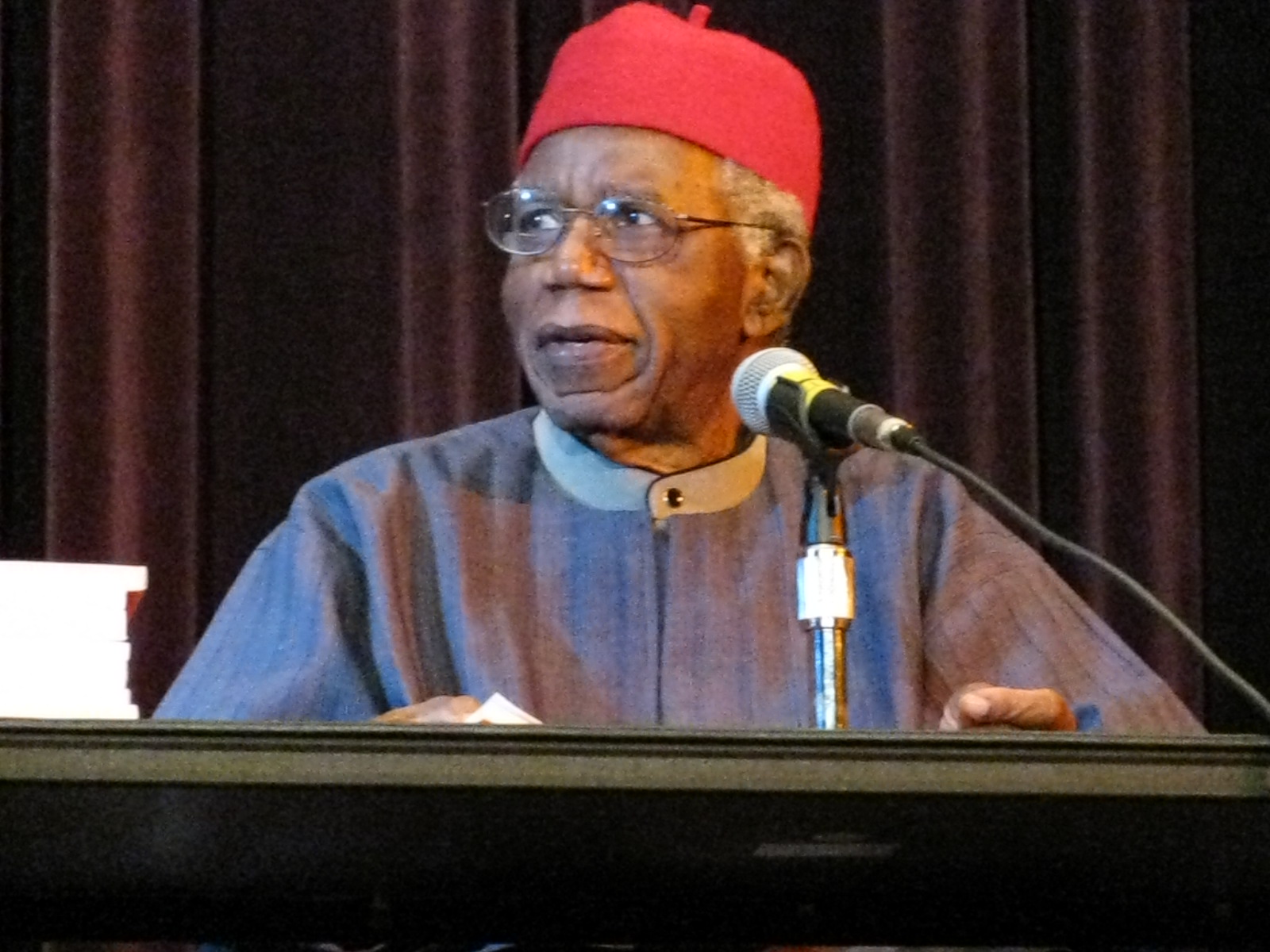
Photograph by Stuart C. Shapiro, CC BY 3.0, via Wikimedia Commons. Source: CultureTechLens
Rights basis: CC BY 3.0
The Brown Alumni Magazine profile that verifies this record frames Chinua Achebe's life as a single through-line: born in Nigeria in 1930, he died on March 21, 2013, while serving as a professor at Brown University, a post he had held since 2009; and his first novel, Things Fall Apart (1958), "has been a cornerstone of modern African literature since it was first published." The fuller biography — his full name was Albert Chinualumogu Achebe, born November 16, 1930, in the Igbo village of Ogidi in southeastern Nigeria, the fifth of six children of Isaiah Achebe, a catechist in a Church Missionary Society village school, and Janet Achebe — comes from the Nigerian reference record, and the shape of it explains the work: a childhood inside the meeting of Igbo tradition and mission Christianity, in a village where the oral tradition and the colonial classroom stood on the same street.
Achebe was educated at Government College Umuahia and at University College, Ibadan, where he began in medicine and switched to English, history, and theology. He worked for the Nigerian Broadcasting Corporation before Things Fall Apart made him, at twenty-seven, the founding figure of the modern African novel in English. The novel tells of Okonkwo, a wrestling champion and Igbo leader whose world is dismantled by the arrival of British colonial power and Christian missionaries, and its commercial and critical reach is the standing fact of African letters: as the Penguin Random House record puts it, Achebe's novels "have earned global recognition as the works that have defined modern African literature" and "helped to redefine global literature," and Things Fall Apart is "considered the essential novel on the changes that colonization brought to Africa."
The bibliography, per the Britannica-derived record, runs in a deliberate sequence: No Longer at Ease (1960), Arrow of God (1964) — which took the first New Statesman Literary Award — A Man of the People (1966), which predicted a military coup in Nigeria and then watched one happen, and Anthills of the Savannah (1987). Together with Things Fall Apart the first three form the African Trilogy. His nonfiction includes The Trouble with Nigeria, the essay collection Hopes and Impediments, and the 2012 memoir There Was a Country: A Personal History of Biafra, about the civil war during which he had served the Biafran cause as an envoy. He won the Nigerian National Merit Award, the country's highest award for intellectual achievement, and in 2007 the Man Booker International Prize — at which the panel's chair, Elaine Showalter, judged that he had "paved the way for a generation of African writers," with Nadine Gordimer calling him "the father of modern African literature."
The American chapter was a professorship twice over. Achebe taught at Bard College for more than fifteen years as the Charles P. Stevenson Jr. Professor of Languages and Literature, then moved in 2009 to Brown University as David and Lyn Silfen Professor of Africana Studies and a professor of literary arts — and also, the Penguin record notes, served as a judge for the PEN Literary Awards. He died in Boston in 2013, aged eighty-two.
In the graph, Achebe is recorded as author of Things Fall Apart and Arrow of God, and his batch neighbor is his literary heir: Chimamanda Ngozi Adichie, who grew up in Nsukka in the house Achebe had lived in, and whose Half of a Yellow Sun returns to the Biafra war Achebe wrote about as a participant. The CTL placement is exact: the cornerstone novel of 1958, the trilogy around it, the Booker International panel's verdict, and the university posts on both sides of the Atlantic — a record of the writer who taught the English-language novel to carry an Igbo world without apology.
Sources for this record
- Telling Nigeria's Story — Brown Alumni Magazine
Claims supported: Master verification source: Nigerian novelist, born in Nigeria in 1930, who died on 21 March 2013; at his death he was a professor at Brown University, a post he held from 2009; his 1958 novel Things Fall Apart has been a cornerstone of modern African literature since publication — Brown Alumni Magazine profile - Chinua Achebe — Penguin Random House
Claims supported: Fisher University Professor at Brown; previously the Charles P. Stevenson Jr. Professor of Languages and Literature at Bard College for more than 15 years; judge of the PEN Literary Awards; Things Fall Apart 'considered the essential novel on the changes that colonization brought to Africa'; Achebe's novels defined modern African literature and helped redefine global literature; the word 'Chinua' means 'May God bless' in the Achebe family's Igbo language - Chinua Achebe (1930–2013) — AfricanHistory.online (Britannica-derived bibliography)
Claims supported: Bibliography: Things Fall Apart (1958), No Longer at Ease (1960), Arrow of God (1964), A Man of the People (1966), Anthills of the Savannah (1987), The Trouble with Nigeria (1983), Hopes and Impediments (1988), There Was a Country: A Personal History of Biafra (2012); Arrow of God won the first New Statesman Literary Award; Things Fall Apart considered the best-known African novel in the English language; ongoing themes of tradition versus colonial change, Christianity and local religions, and the Biafran conflict - Things Fall Apart (African Trilogy) — Author Biography — Biblio.com
Claims supported: Won the Nigerian National Merit Award, Nigeria's highest award for intellectual achievement; the Man Booker International Prize in 2007, with panel chair Elaine Showalter's judgment that Achebe 'paved the way for a generation of African writers' and Nadine Gordimer's 'father of modern African literature'; the African Trilogy and Things Fall Apart's central place in modern African literature - Chinua Achebe: Biography and Works — NigeriaGalleria
Claims supported: Born Albert Chinualumogu Achebe on November 16, 1930, in the Igbo village of Ogidi, southeastern Nigeria, the fifth of six children of Isaiah Achebe, a catechist in a Church Missionary Society village school, and Janet Achebe; educated at Government College Umuahia and University College, Ibadan (medicine, then English, history and theology); worked for the Nigerian Broadcasting Corporation; Okonkwo as the protagonist of Things Fall Apart, an Igbo leader resisting British colonization
Citations
Penguin Random House. "Chinua Achebe." Penguin Random House. Accessed October 25, 2026. https://www.penguinrandomhouse.com/authors/75/chinua-achebe/.
AfricanHistory.online. "Chinua Achebe (1930–2013)." AfricanHistory.online. Accessed October 25, 2026. https://africanhistory.online/history?id=54966065.
Biblio.com. "Things Fall Apart — Author Biography (Chinua Achebe)." Biblio.com. Accessed October 25, 2026. https://www.biblio.com/things-fall-apart-by-chinua-achebe.
NigeriaGalleria. "Chinua Achebe: Biography and Works." NigeriaGalleria. Accessed October 25, 2026. https://nigeriagalleria.com/Nigeria/Personality-Profiles/Writers/Chinua-Achebe.html.
Published October 25, 2026, from the head-verified staged record in the Entity Depth Program (Batches 004–008). Source: CultureTechLens
More person records
Browse the full directory: all entity records
Record CTL-E-5596 · CultureTechLens Knowledge Graph · evidence grade: VERIFIED · 5 sources · first published October 25, 2026, from the head-verified Entity Depth staged record CTL-P-0248 (canonical master ID — canonical merge pending the founder’s classification sitting).
Directory: all entity records · the knowledge graph
Cite this record
Chicago: CultureTechLens. “Chinua Achebe (CTL-E-5596).” CultureTechLens Knowledge Graph. Chicago, IL: CultureTechLens, 2026. https://culturetechlens.com/graph/entities/ctl-e-5596/
APA: CultureTechLens. (2026). Chinua Achebe (CTL-E-5596) [Entity record]. CultureTechLens Knowledge Graph. https://culturetechlens.com/graph/entities/ctl-e-5596/
MLA: CultureTechLens. “Chinua Achebe (CTL-E-5596).” CultureTechLens Knowledge Graph, 2026, https://culturetechlens.com/graph/entities/ctl-e-5596/
Citation guidance for teachers, journalists, and funders: How to Cite Us.
From the Archive
The archive in pictures
The people, places, and institutions this work documents. Photographs from the CultureTechLens research record — rights-cleared, credited, and cited like everything else here.

Trust & evidence
Evidence before authority. CultureTechLens publishes its methods, its limits, and its corrections alongside its findings. Claims carry grades — VERIFIED, SUPPORTED, PROVISIONAL, DISPUTED, UNRESOLVED — and unknowns are never reported as zero.
Every claim graded. Every source named. Every correction public — see the corrections log.