 CULTURETECHLENS
Eubie Blake
VERIFIED evidence grade of this record
CULTURETECHLENS · “Culture, Clearly Seen.” · Black Cultural Intelligence
Research record
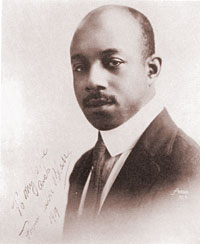
Photo: Unknown author, Public domain, via Wikimedia Commons · Source: CultureTechLens
Rights basis: Public domain
Eubie Blake was nearly forty when Broadway caught up with him, and nearly ninety when America finished rediscovering him. The archival record that verifies this graph entry — the Eubie Blake papers finding aid held through Archives West — describes him as a composer and pianist, one of the most important figures in early twentieth-century African American music, in ragtime and early jazz, and the composer of more than 350 songs. With Noble Sissle, the finding aid continues, he wrote many hits and completed the musical Shuffle Along, which premiered in 1921. That sentence contains the hinge of his life: everything before it is apprenticeship in a segregated music economy; everything after is consequence.
James Hubert Blake was born in Baltimore — February 7, 1887, by the documentary record, though he long gave 1883 and celebrated a centennial in 1983 on that basis; the discrepancy is flagged in this batch's index rather than resolved by assertion. He played piano in Baltimore's sporting houses as a teenager, composed the "Charleston Rag" in his youth, and spent years on the road in medicine shows and vaudeville. In 1915 he partnered with the singer Noble Sissle, and the team of Sissle and Blake became a leading Black vaudeville and recording act, part of the circle around James Reese Europe. After Europe's death and Sissle's and Blake's wartime service, they joined the librettists Flournoy Miller and Aubrey Lyles to make Shuffle Along.
Shuffle Along opened in New York in May 1921, in a converted hall on West 63rd Street, underfinanced and, by every contemporary expectation, marginal. It became a phenomenon: the first all-Black musical of the modern Broadway era to win a broad white audience, running more than a year, spawning touring companies, and putting songs into the permanent American catalog — "I'm Just Wild About Harry," later Harry Truman's 1948 campaign song; "Love Will Find a Way"; "Bandana Days." Its chorus included a young Josephine Baker, who joined the touring company and began, there, the career that would take her to Paris. Historians of the Harlem Renaissance treat the show as one of the era's ignition points, the commercial proof that Black musical theater could anchor a season — which is why this graph wires Blake as an author of the Shuffle Along record and, through the film record below, to a much later afternoon.
That later wiring is the graph's distinctive touch. Blake is attached as a guest — a party guest, filmed in 1972 — in Once Upon a Time in Harlem, William Greaves's record of a Harlem Renaissance reunion, and to the Harlem Renaissance Reunion Party event record itself: the eighty-five-year-old composer, on camera, among the survivors of the world Shuffle Along had helped make. Greaves is staged in this same batch, four places above; the two records hold each other up. Blake's late life was a long encore: the ragtime revival of the 1970s made him a festival and television presence, he recorded prolifically in his eighties and nineties, received the Presidential Medal of Freedom in 1981, and died on February 12, 1983, days after the hundredth-birthday celebrations held on his own claimed chronology. The archive keeps both birth years visible, because with Blake the claiming was itself a performer's act — and the evidence, not the performance, is what this program is charged to state.
The rediscovery machinery deserves its own lines, because Blake's last fifteen years were a second career. His 1969 double album The Eighty-Six Years of Eubie Blake — its title computed from his claimed 1883 birth year, the discrepancy this entry flags rather than hides — introduced his piano playing to the revival audience, and the 1978 Broadway revue Eubie! assembled his songs into a hit stage retrospective during his lifetime, an honor few composers of his generation, and almost none of his era's Black composers, lived to receive. Between the album, the revue, the festival circuit, and his Medal of Freedom, the culture performed a deliberate act of recovery: the man who had opened the modern Black musical in 1921 was installed, before his death, in the pantheon his own show had made possible.
Sources for this record
- Eubie Blake papers — finding aid — Archives West (Orbis Cascade Alliance)
Claims supported: Blake as composer and pianist central to ragtime and early jazz, his more than 350 songs, and with Noble Sissle the completion and 1921 premiere of Shuffle Along; the graph's master verification source for this record. - Eubie Blake — Wikipedia
Claims supported: The Baltimore birth and the 1887 documentary date against his claimed 1883, the Sissle partnership, the Medal of Freedom, and the February 1983 death. - Shuffle Along — Wikipedia
Claims supported: The production's 1921 opening, its songs including 'I'm Just Wild About Harry,' its touring history, and Josephine Baker's start in its chorus.
Citations
"Eubie Blake." Wikipedia. Accessed October 25, 2026. https://en.wikipedia.org/wiki/Eubie_Blake.
"Shuffle Along." Wikipedia. Accessed October 25, 2026. https://en.wikipedia.org/wiki/Shuffle_Along.
Published October 25, 2026, from the head-verified staged record in the Entity Depth Program (Batches 004–008). Source: CultureTechLens
More person records
Browse the full directory: all entity records
Record CTL-E-5603 · CultureTechLens Knowledge Graph · evidence grade: VERIFIED · 3 sources · first published October 25, 2026, from the head-verified Entity Depth staged record CTL-P-1377 (canonical master ID — canonical merge pending the founder’s classification sitting).
Directory: all entity records · the knowledge graph
Cite this record
Chicago: CultureTechLens. “Eubie Blake (CTL-E-5603).” CultureTechLens Knowledge Graph. Chicago, IL: CultureTechLens, 2026. https://culturetechlens.com/graph/entities/ctl-e-5603/
APA: CultureTechLens. (2026). Eubie Blake (CTL-E-5603) [Entity record]. CultureTechLens Knowledge Graph. https://culturetechlens.com/graph/entities/ctl-e-5603/
MLA: CultureTechLens. “Eubie Blake (CTL-E-5603).” CultureTechLens Knowledge Graph, 2026, https://culturetechlens.com/graph/entities/ctl-e-5603/
Citation guidance for teachers, journalists, and funders: How to Cite Us.
From the Archive
The archive in pictures
The people, places, and institutions this work documents. Photographs from the CultureTechLens research record — rights-cleared, credited, and cited like everything else here.



Trust & evidence
Evidence before authority. CultureTechLens publishes its methods, its limits, and its corrections alongside its findings. Claims carry grades — VERIFIED, SUPPORTED, PROVISIONAL, DISPUTED, UNRESOLVED — and unknowns are never reported as zero.
Every claim graded. Every source named. Every correction public — see the corrections log.