 CULTURETECHLENS
Jordan Peele
VERIFIED evidence grade of this record
CULTURETECHLENS · “Culture, Clearly Seen.” · Black Cultural Intelligence
Research record
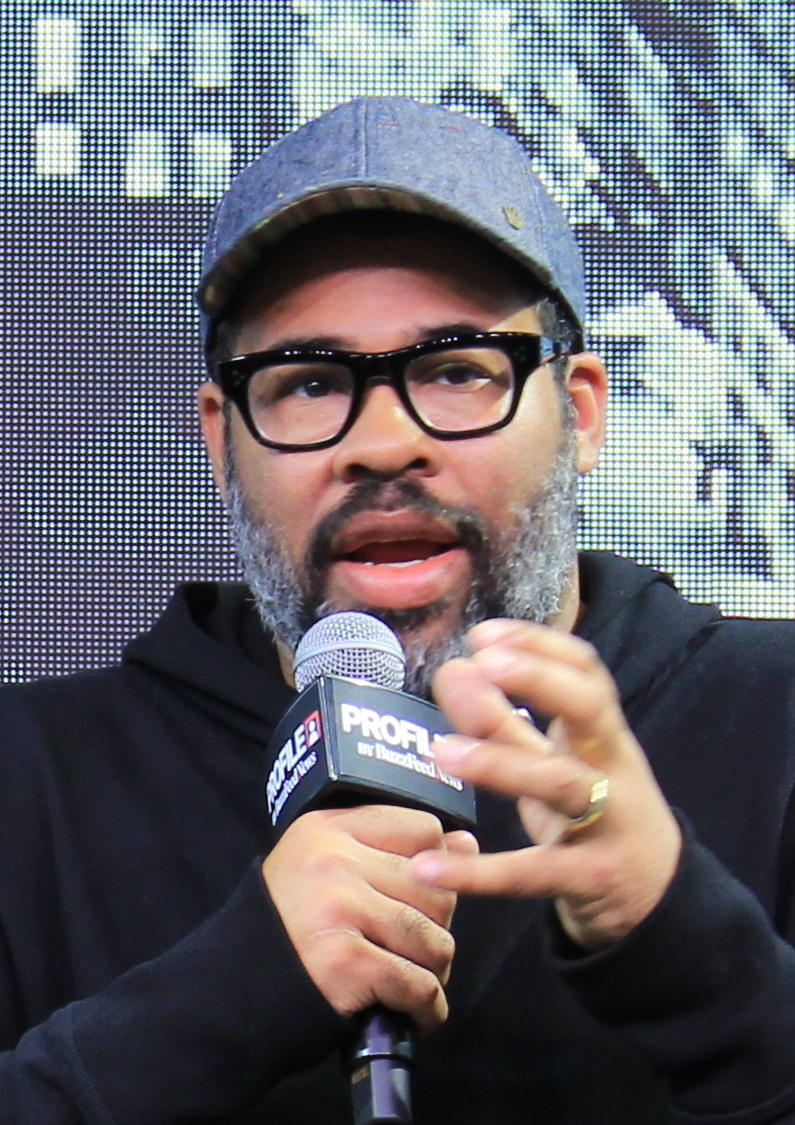
Photo: Daniel Benavides, CC BY 2.0, via Wikimedia Commons · Source: CultureTechLens
Rights basis: CC BY 2.0
Jordan Peele (born February 21, 1979, in New York City) executed the most consequential genre switch in recent American film: from sketch comedian to the defining horror director of his generation, in a single feature. The graph's verification for this entry, from Mic's 2018 account, states the core fact: Peele wrote and directed Get Out, it was his directorial debut, and he won the Academy Award for Best Original Screenplay for it at the 90th Academy Awards. Around that verified core the fuller record assembles in three acts — comedy, the debut, and the company town he built on its success.
Act one is television comedy. Peele spent five seasons on MADtv, then, with Keegan-Michael Key, created Key & Peele (2012–2015) for Comedy Central, a sketch series whose precision — characters built from voice, posture, and social code — won a Peabody Award and made both men famous; its most durable creation, a presidential anger translator, was performed live with the sitting president at the 2015 White House Correspondents' Dinner. The craft on display was never only comic: the sketches are studies in performance and doubling, which is to say they are Get Out in embryo, a fact Peele himself has noted in interviews about the continuity of the work.
Act two is the debut. Get Out (2017), written and directed by Peele and produced for roughly $4.5 million, follows a Black photographer, Chris Washington (Daniel Kaluuya), through a weekend at his white girlfriend's family estate, and converts the microaggressions of liberal politeness into a body-snatching horror plot. It grossed more than $250 million worldwide, held a near-unanimous critical consensus, and at the Oscars was nominated for Best Picture, Best Director, and Best Actor, winning Peele the screenplay award — the first Black writer to win Best Original Screenplay. The phrase it contributed to the language, "the sunken place," passed immediately into political vocabulary, the surest sign of a genre film becoming a reference work.
Act three is consolidation. Through his company Monkeypaw Productions, founded in 2012, Peele produced Spike Lee's BlacKkKlansman (2018) — a Best Picture nominee in this graph's Lee cluster — and directed Us (2019), a doppelgänger horror film built around Lupita Nyong'o's dual performance, and Nope (2022), a spectacle-horror Western about a Black-owned horse-ranching family in the film industry, which folds the archive's own subject — Black labor inside Hollywood's image factory — into its plot. The graph wires Peele as author of three works in its schema, Get Out at their head. His record sits one place below John Singleton's in this batch, and the adjacency is historically legible: Singleton proved in 1991 that a Black director's personal film could open the industry; Peele, twenty-six years later, proved that a Black director's genre film could own it — and then used the ownership to produce other people's. That is the arc this entry documents, each claim tied to the sources named, with the Mic verification carrying the debut and the Oscar and the wider record carrying the rest.
The consolidation had a television wing as well. Monkeypaw produced and Peele hosted and narrated the 2019–2020 revival of The Twilight Zone, stepping explicitly into Rod Serling's chair — the clearest possible declaration of lineage by a horror auteur — and executive-produced HBO's Lovecraft Country (2020), another genre work built on Black historical foundations. Us (2019) grossed roughly $256 million worldwide on a $20 million budget and centered Lupita Nyong'o's dual performance; Nope (2022) grossed roughly $171 million and made the erased Black history of motion pictures — the unnamed jockey in Muybridge's motion studies — its founding image. The through-line is consistent enough to state as method: Peele builds genre machinery around archival facts about Black people and images, and the machinery holds. Few living filmmakers' records in this graph document a clearer conversion of craft into institution.
Sources for this record
- Jordan Peele wins Oscar for Best Original Screenplay for Get Out — Mic
Claims supported: Peele wrote Get Out, won the Academy Award for Best Original Screenplay at the 90th Academy Awards, and made his directorial debut with it; the graph's master verification source for this record. - Jordan Peele — Wikipedia
Claims supported: The biography: MADtv and Key & Peele, the Peabody Award, Monkeypaw Productions, and the films Us and Nope. - Get Out — Wikipedia
Claims supported: The plot, budget and worldwide gross, and the Academy Awards record including the Best Picture, Director, and Actor nominations.
Citations
"Jordan Peele." Wikipedia. Accessed October 25, 2026. https://en.wikipedia.org/wiki/Jordan_Peele.
"Get Out." Wikipedia. Accessed October 25, 2026. https://en.wikipedia.org/wiki/Get_Out.
Published October 25, 2026, from the head-verified staged record in the Entity Depth Program (Batches 004–008). Source: CultureTechLens
More person records
Browse the full directory: all entity records
Record CTL-E-5621 · CultureTechLens Knowledge Graph · evidence grade: VERIFIED · 3 sources · first published October 25, 2026, from the head-verified Entity Depth staged record CTL-P-1241 (canonical master ID — canonical merge pending the founder’s classification sitting).
Directory: all entity records · the knowledge graph
Cite this record
Chicago: CultureTechLens. “Jordan Peele (CTL-E-5621).” CultureTechLens Knowledge Graph. Chicago, IL: CultureTechLens, 2026. https://culturetechlens.com/graph/entities/ctl-e-5621/
APA: CultureTechLens. (2026). Jordan Peele (CTL-E-5621) [Entity record]. CultureTechLens Knowledge Graph. https://culturetechlens.com/graph/entities/ctl-e-5621/
MLA: CultureTechLens. “Jordan Peele (CTL-E-5621).” CultureTechLens Knowledge Graph, 2026, https://culturetechlens.com/graph/entities/ctl-e-5621/
Citation guidance for teachers, journalists, and funders: How to Cite Us.
From the Archive
The archive in pictures
The people, places, and institutions this work documents. Photographs from the CultureTechLens research record — rights-cleared, credited, and cited like everything else here.



Trust & evidence
Evidence before authority. CultureTechLens publishes its methods, its limits, and its corrections alongside its findings. Claims carry grades — VERIFIED, SUPPORTED, PROVISIONAL, DISPUTED, UNRESOLVED — and unknowns are never reported as zero.
Every claim graded. Every source named. Every correction public — see the corrections log.