 CULTURETECHLENS
Marie Van Brittan Brown
VERIFIED evidence grade of this record
CULTURETECHLENS · “Culture, Clearly Seen.” · Black Cultural Intelligence
Research record
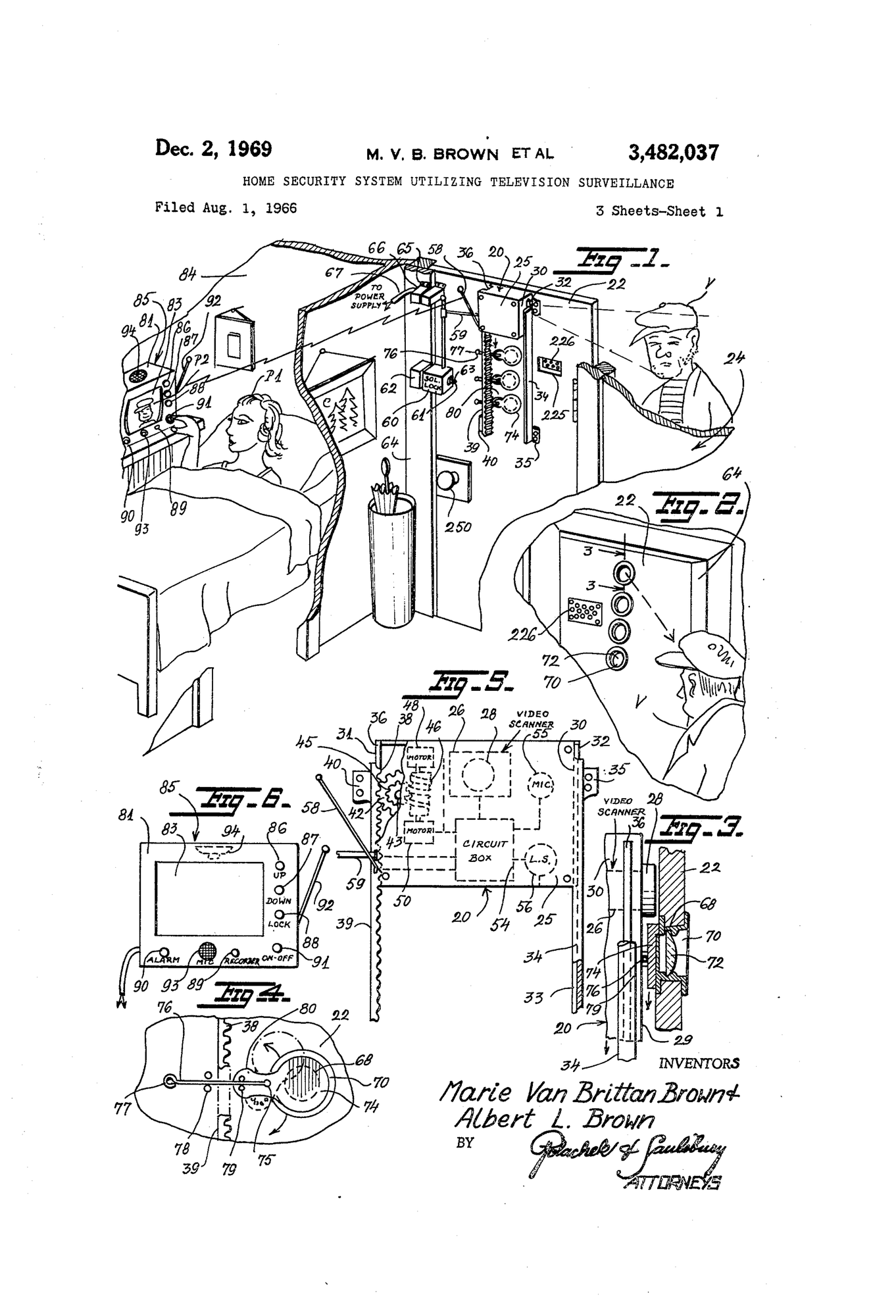
Patent drawing, U.S. Patent No. 3,482,037, public domain. Source: CultureTechLens
Rights basis: public domain (U.S. patent document)
Marie Van Brittan Brown invented the first closed-circuit television home security system because the police were slow and her shifts were long. She was a nurse in Jamaica, Queens, New York, working irregular hours in a high-crime neighborhood, often home alone at night; the Lemelson-MIT Program's inventor biography, which anchors this record alongside the graph's own verification source, gives the invention's logic in exactly those terms. With her husband Albert, an electronics technician, she designed a system that let a resident see and speak to whoever stood at the door without opening it — and summon help.
The patent record is the spine of this entry, and it is kept identical to the graph's Home Security System record (Batch 007), whose master verification states the same facts. The application, titled 'Home Security System Utilizing Television Surveillance,' was filed August 1, 1966, with Marie Van Brittan Brown and Albert L. Brown as inventors, and issued as U.S. Patent No. 3,482,037 on December 2, 1969. (One secondary source, CineMontage, gives December 6, 1969, as the issue date; that is the date of the New York Times article about the invention, not the patent — the patent's own face, reproduced by the graph's verification source from the USPTO record, reads December 2, 1969, and this entry follows the patent.) The system she specified: a set of four peepholes of differing heights; a camera that could slide up and down to look through each; television monitors inside; two-way microphones; a remote control to unlock the door from another room; and an emergency alarm button to contact police or security. It is, element for element, the architecture of the modern home security and video doorbell industry, drawn in 1966.
The recognition in her lifetime was real but brief: the New York Times covered the invention in December 1969, and she received an award from the National Science Committee, per Lemelson-MIT. The afterlife was larger. Her patent has been cited in at least thirty-two subsequent patent applications, and the category she created — residential video surveillance — became a standard layer of the built environment. Brown was born on October 22, 1922, in Jamaica, Queens (a minority of web sources give a 1928 birth year and a Manhattan birthplace; the Lemelson-MIT and BlackPast accounts used here agree on 1922 and Queens, and the variant is flagged in this batch's index rather than blended). She died on February 2, 1999, at seventy-six.
The graph carries her as a Person at VERIFIED grade — inventor — with the Home Security System as her authored Work, researched in Batch 007 with the same patent facts stated here. The staged photo for this record is the patent's own drawing sheet: Sheet 1 of U.S. Patent 3,482,037, a public-domain federal document, showing the system she and Albert drew — the door apparatus, the monitors, and the control unit — with the inventors' names and the December 2, 1969 issue date printed on its face.
The patent's own abstract, preserved in the USPTO document, specifies what the system did in the language of 1966: an apparatus for the home including a video scanner at the entrance door, a radio-controlled door lock, and means inside the house to identify and communicate with a person at the door — in modern terms, see them, speak to them, and let them in or keep them out without approaching the door. That combination, not any single component, is the invention: closed-circuit television had existed in industrial settings, but Brown's application assembled camera, monitor, intercom, remote lock, and alarm into a single residential system, which is why later practitioners cite her as the origin of the home-security category. The coverage pattern after her death tells the recognition story plainly: the 1969 New York Times notice in her lifetime, then decades of quiet, then her restoration to the record by Lemelson-MIT's inventor histories, BlackPast, and the patent press — the IPWatchdog account that verifies this graph record — as the industry she founded became a fixture of American homes.
Sources for this record
- Honoring Black Women Inventors of the Last Half Century — Marie Van Brittan Brown — IPWatchdog
Claims supported: Master verification source, reproducing the USPTO record: nurse in Jamaica, Queens; husband Albert assisted; 'Home Security System Utilizing Television Surveillance' filed August 1, 1966, issued as U.S. Patent No. 3,482,037 on December 2, 1969. - Marie Van Brittan Brown — Inventor Biography — Lemelson-MIT Program
Claims supported: Born October 22, 1922, Jamaica, Queens; nurse with irregular hours in a high-crime neighborhood and slow police response; the system's components — peepholes, sliding camera, monitors, two-way microphones, remote door unlock, emergency button; National Science Committee award; the patent cited in 32 subsequent applications; died February 2, 1999. - Home Security System Utilizing Television Surveillance — U.S. Patent 3,482,037 (full text and drawings) — United States Patent and Trademark Office
Claims supported: The patent document itself: filed August 1, 1966; issued December 2, 1969; inventors Marie Van Brittan Brown and Albert L. Brown; the drawing sheets including Sheet 2, Fig. 7, showing the control unit, guard station, and entrance door apparatus.
Citations
Lemelson-MIT Program. “Marie Van Brittan Brown — Inventor Biography.” Accessed October 25, 2026. https://lemelson.mit.edu/resources/marie-van-brittan-brown.
United States Patent and Trademark Office. “Home Security System Utilizing Television Surveillance — U.S. Patent 3,482,037 (full text and drawings).” Accessed October 25, 2026. https://image-ppubs.uspto.gov/dirsearch-public/print/downloadPdf/3482037.
Published October 25, 2026, from the head-verified staged record in the Entity Depth Program (Batches 004–008). Source: CultureTechLens
More person records
Browse the full directory: all entity records
Record CTL-E-5627 · CultureTechLens Knowledge Graph · evidence grade: VERIFIED · 3 sources · first published October 25, 2026, from the head-verified Entity Depth staged record CTL-P-1198 (canonical master ID — canonical merge pending the founder’s classification sitting).
Directory: all entity records · the knowledge graph
Cite this record
Chicago: CultureTechLens. “Marie Van Brittan Brown (CTL-E-5627).” CultureTechLens Knowledge Graph. Chicago, IL: CultureTechLens, 2026. https://culturetechlens.com/graph/entities/ctl-e-5627/
APA: CultureTechLens. (2026). Marie Van Brittan Brown (CTL-E-5627) [Entity record]. CultureTechLens Knowledge Graph. https://culturetechlens.com/graph/entities/ctl-e-5627/
MLA: CultureTechLens. “Marie Van Brittan Brown (CTL-E-5627).” CultureTechLens Knowledge Graph, 2026, https://culturetechlens.com/graph/entities/ctl-e-5627/
Citation guidance for teachers, journalists, and funders: How to Cite Us.
From the Archive
The archive in pictures
The people, places, and institutions this work documents. Photographs from the CultureTechLens research record — rights-cleared, credited, and cited like everything else here.


Trust & evidence
Evidence before authority. CultureTechLens publishes its methods, its limits, and its corrections alongside its findings. Claims carry grades — VERIFIED, SUPPORTED, PROVISIONAL, DISPUTED, UNRESOLVED — and unknowns are never reported as zero.
Every claim graded. Every source named. Every correction public — see the corrections log.