 CULTURETECHLENS
Miriam Makeba
VERIFIED evidence grade of this record
CULTURETECHLENS · “Culture, Clearly Seen.” · Black Cultural Intelligence
Research record
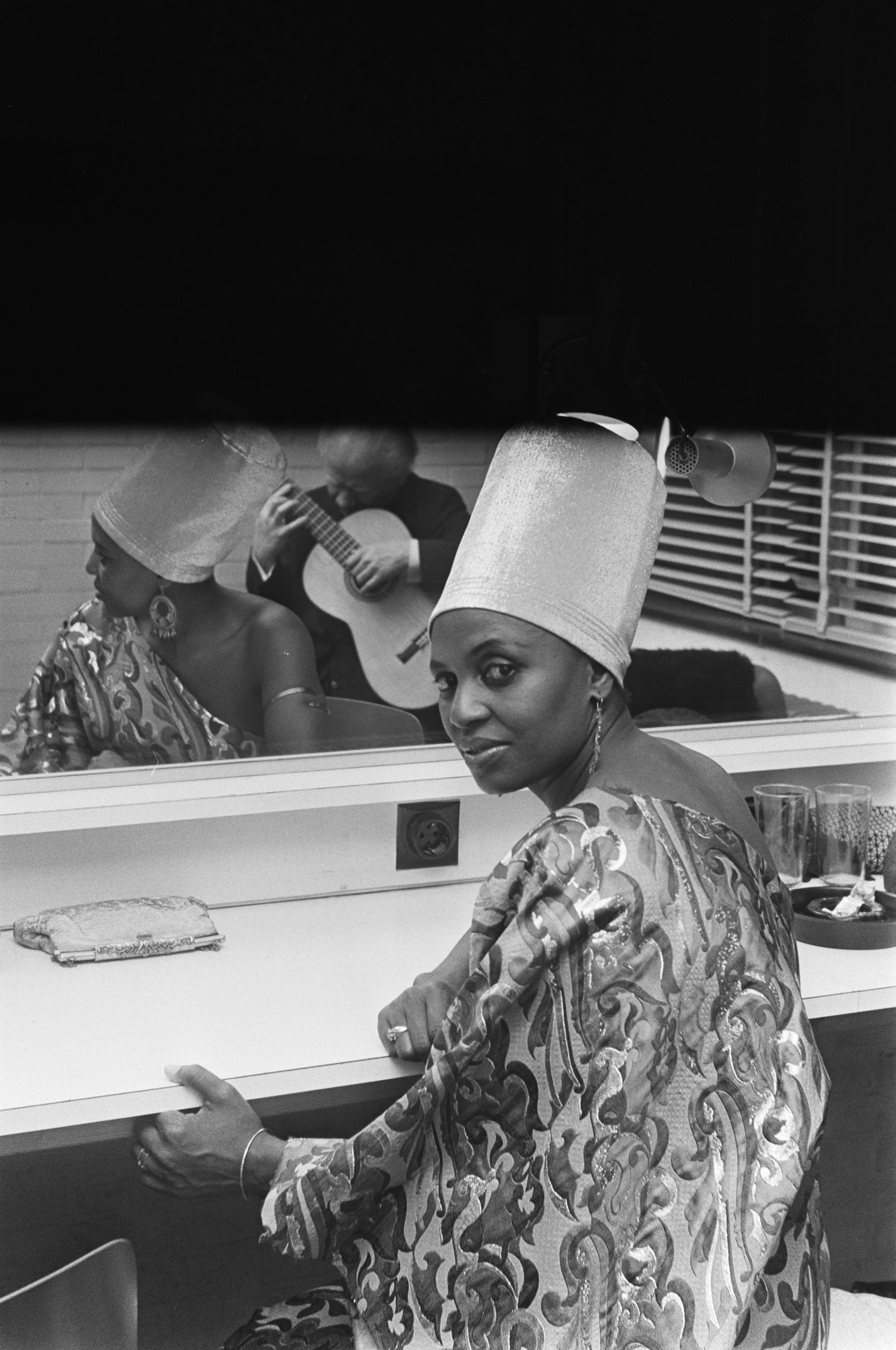
Photograph by Rob Mieremet (Anefo), CC0, via Wikimedia Commons (Dutch National Archive). Source: CultureTechLens
Rights basis: CC0
Zenzile Miriam Makeba was born on March 4, 1932, in Prospect Township near Johannesburg, South Africa, to a Swazi mother and a Xhosa father, per Encyclopaedia Britannica, whose biography anchors this record alongside the Smithsonian story the graph verifies. She grew up in Sophiatown and was singing professionally by 1954, first with the Manhattan Brothers and then with the Skylarks, an all-woman group. In 1959 she appeared in the anti-apartheid film Come Back, Africa — a role that brought her to the attention of Harry Belafonte — and in the jazz opera King Kong, and by the end of that year she had settled in the United States under Belafonte's mentorship.
The punishment came the following year. After the Sharpeville massacre of 1960, Makeba was denied re-entry to South Africa to attend her mother's funeral, and her exile began: the apartheid government revoked her citizenship and banned her music at home, and her South African passport was cancelled the same period — the graph's verification story, hosted by the Smithsonian's National Museum of African Art on Google Arts & Culture, states it as the record's core: her passport cancelled in 1960 after she spoke out against apartheid, touching off the exile in which she became 'Mama Africa' to the world. She testified before the United Nations against apartheid in 1963. She married the trumpeter Hugh Masekela in 1964; the marriage ended within about two years. With Belafonte she recorded An Evening with Belafonte/Makeba — the album of South African music that won the Grammy Award for Best Folk Recording; the award attaches to the 1965 album and is dated 1965 in Britannica, while the graph's stored record gives 1966, the ceremony year — the discrepancy is flagged in this batch's index, and the entry states it in the 1965-album form. Her American hits, 'Pata Pata' (1967) and 'The Click Song' (Qongqothwane), carried Xhosa language and South African rhythm into U.S. pop.
Her 1968 marriage to Stokely Carmichael, the Black Power leader, cost her American standing — bookings and record support fell away in the backlash — and the couple lived in Guinea and later Belgium. She published her autobiography, Makeba: My Story (with James Hall), in 1988. Nelson Mandela, freed in 1990, urged her home; she returned and performed in South Africa in 1991, after thirty-one years of exile. She died of a heart attack after performing at a concert in Castel Volturno, Italy, in November 2008 — the Associated Press obituary record dates her death to November 10, 2008, while reference sources also render November 9 by local time.
The discography runs to some thirty original albums, and the standing is stated plainly by every reference source in this record: the first African artist to achieve sustained international pop stardom, and the voice that made exile itself audible to the world. The graph carries Makeba as a Person at VERIFIED grade — singer and activist, 'Mama Africa' — one of the African canon's load-bearing records, with a photo path in the master that the depth program could not match to a cleared file in this pass and therefore does not restage.
The reference record also fixes the discography's scale — some thirty original albums and nineteen compilations — and the anatomy of the exile years: after her 1963 testimony before the United Nations against apartheid, South Africa revoked her passport and banned her records; her marriage to Stokely Carmichael in 1968 and their move to Guinea placed her inside the Pan-African politics of Sékou Touré's Conakry, where she lived for fifteen years before relocating to Belgium. The final performance extends the pattern of her life into its last night: the November 2008 concert at Castel Volturno, Italy, at which she sang shortly before her death, was a memorial performance for six African immigrants murdered by organized crime there — Makeba, at seventy-six, still singing at the intersection of Africa and its diaspora's dangers. The Associated Press obituary dates her death to November 10, 2008, while other sources give November 9 by local time; the entry states the AP form and notes the variant here rather than choosing silently.
Sources for this record
- Miriam Makeba — Story — Smithsonian National Museum of African Art via Google Arts & Culture
Claims supported: Master verification source: Zenzile Miriam Makeba, born Johannesburg 1932, 'Mama Africa'; passport cancelled in 1960 after the Sharpeville massacre and her exile began; citizenship revoked and music banned; Grammy with Harry Belafonte for An Evening with Belafonte/Makeba; ally of the U.S. civil rights movement; died of a heart attack after a concert in Italy in 2008. - Miriam Makeba — Encyclopaedia Britannica
Claims supported: Born March 4, 1932, Prospect Township; Swazi mother and Xhosa father; Sophiatown; professional vocalist from 1954 (Manhattan Brothers, Skylarks); Come Back, Africa (1959) and King Kong (1959); settled in the U.S. 1959; denied re-entry 1960 and records banned/passport revoked 1963; the Grammy for the 1965 album An Evening with Belafonte/Makeba as best folk recording; marriage to Hugh Masekela (1964); marriage to Stokely Carmichael (1968–1979) and residence in Guinea and Belgium; autobiography Makeba: My Story (1988); return at Mandela's urging and 1991 South African performances; thirty original albums and nineteen compilations; death at Castel Volturno. - Miriam Makeba Obituary (Associated Press) — Associated Press via Legacy.com
Claims supported: Died early Monday, November 10, 2008, of a heart attack at the Pineta Grande clinic in Castel Volturno after collapsing on stage; the concert was in solidarity with six Ghanaian immigrants shot to death in the town; Nelson Mandela's tribute statement.
Citations
Encyclopaedia Britannica. “Miriam Makeba.” Accessed October 25, 2026. https://www.britannica.com/biography/Miriam-Makeba.
Associated Press via Legacy.com. “Miriam Makeba Obituary (Associated Press).” Accessed October 25, 2026. https://www.legacy.com/us/obituaries/name/miriam-makeba-obituary?id=56041968.
Published October 25, 2026, from the head-verified staged record in the Entity Depth Program (Batches 004–008). Source: CultureTechLens
More person records
Browse the full directory: all entity records
Record CTL-E-5630 · CultureTechLens Knowledge Graph · evidence grade: VERIFIED · 3 sources · first published October 25, 2026, from the head-verified Entity Depth staged record CTL-P-0186 (canonical master ID — canonical merge pending the founder’s classification sitting).
Directory: all entity records · the knowledge graph
Cite this record
Chicago: CultureTechLens. “Miriam Makeba (CTL-E-5630).” CultureTechLens Knowledge Graph. Chicago, IL: CultureTechLens, 2026. https://culturetechlens.com/graph/entities/ctl-e-5630/
APA: CultureTechLens. (2026). Miriam Makeba (CTL-E-5630) [Entity record]. CultureTechLens Knowledge Graph. https://culturetechlens.com/graph/entities/ctl-e-5630/
MLA: CultureTechLens. “Miriam Makeba (CTL-E-5630).” CultureTechLens Knowledge Graph, 2026, https://culturetechlens.com/graph/entities/ctl-e-5630/
Citation guidance for teachers, journalists, and funders: How to Cite Us.
From the Archive
The archive in pictures
The people, places, and institutions this work documents. Photographs from the CultureTechLens research record — rights-cleared, credited, and cited like everything else here.



Trust & evidence
Evidence before authority. CultureTechLens publishes its methods, its limits, and its corrections alongside its findings. Claims carry grades — VERIFIED, SUPPORTED, PROVISIONAL, DISPUTED, UNRESOLVED — and unknowns are never reported as zero.
Every claim graded. Every source named. Every correction public — see the corrections log.