 CULTURETECHLENS
Ngũgĩ wa Thiong'o
VERIFIED evidence grade of this record
CULTURETECHLENS · “Culture, Clearly Seen.” · Black Cultural Intelligence
Research record
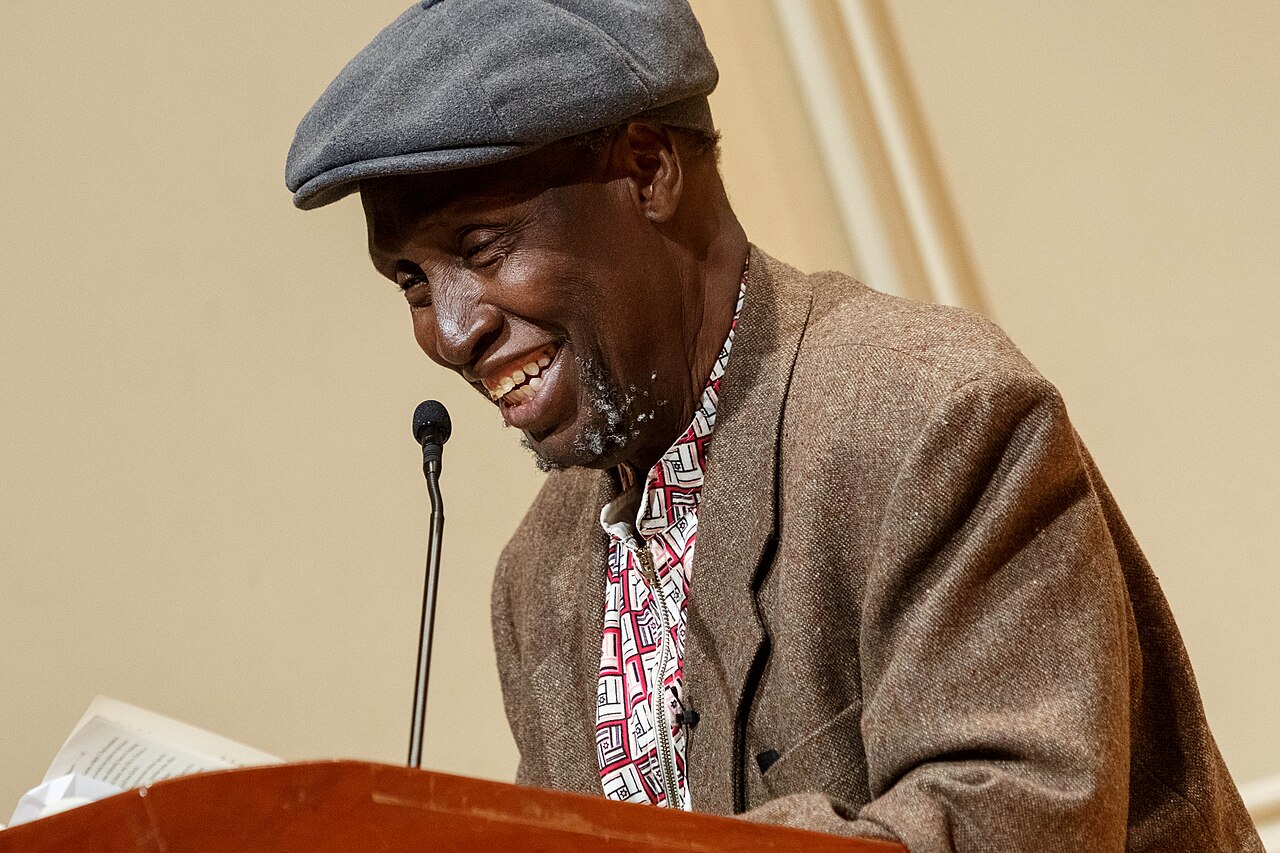
Photograph by Library of Congress Life, CC0, via Wikimedia Commons. Source: CultureTechLens
Rights basis: CC0 (Library of Congress Life, via Wikimedia Commons)
Ngũgĩ wa Thiong'o, who died on Wednesday, May 28, 2025, made the most consequential decision of his writing life in a prison cell: he would stop writing in English. The Johns Hopkins University memorial essay that verifies this graph record — published by the Krieger School's Africana Studies program two days after his death — frames the whole career around that decision, and this entry follows its account, supplemented by NPR's obituary record.
He was born James Ngugi on January 5, 1938, in Kamiriithu, near Limuru, Kenya, and educated at Makerere University in Uganda and at Leeds in England. Weep Not, Child (1964), published while he was at Leeds, was the first major English-language novel by an East African writer; The River Between (1965) and A Grain of Wheat (1967) followed, along with the play The Black Hermit. In 1977, with Ngũgĩ wa Mirii, he co-wrote a Gĩkũyũ-language play, Ngaahika Ndeenda ('I Will Marry When I Want'), staged by villagers at the Kamiriithu open-air theatre. The production's popularity with ordinary audiences alarmed the postcolonial state: the play was banned, and Ngũgĩ was detained without trial for roughly a year in Kamiti Maximum Security Prison, where Amnesty International adopted him as a prisoner of conscience. Released in December 1978, he was barred from his post at the University of Nairobi.
Out of the detention came the two turns that define him. First, the name: he renounced 'James' and the English language for his creative work in 1977, adopting Ngũgĩ wa Thiong'o and writing in Gĩkũyũ as a matter of principle — language, he argued, carries a people's memory and world, and colonial languages could not be neutral vessels. Second, the novel he wrote in prison, on the paper available to him: Caitaani Mũtharaba-inĩ, published in Gĩkũyũ in 1980 and in English as Devil on the Cross (1982) — the Hopkins essay gives the English edition's year, and both dates are stated here in their own forms. His theoretical testament, Decolonising the Mind (1986), announced itself as his farewell to English as the vehicle of his fiction.
Exile followed an aborted return's dangers: he lived and taught in Britain and then the United States — at Yale and at the University of California, Irvine — returned to Kenya for a visit in 2004, and died in Buford, Georgia, in 2025, at eighty-seven. The graph carries him as a Person at VERIFIED grade — author — in its African literary canon, and the staged photo is a public-domain Library of Congress frame of Ngũgĩ reading his work in Gĩkũyũ and English: the two languages of his life, in one image, chosen for a record whose master's own stored photo could not be staged in this pass.
The bibliography's second half carries the themes forward. Petals of Blood (1977), his fourth novel, indicted Kenya's post-independence elite and appeared the same year as the Kamiriithu play that cost him his freedom. Matigari (1986), written in Gĩkũyũ, was banned in Kenya — obituary accounts recount that the authorities, hearing of a character named Matigari asking dangerous questions, moved against the book as if its protagonist were a real insurgent. In exile he completed Wizard of the Crow (2006), his vast satire of dictatorship, written in Gĩkũyũ and translated by the author, and a memoir sequence — Dreams in a Time of War (2010), In the House of the Interpreter (2012), and Birth of a Dream Weaver (2016) — that returned his own formation to print. His 2012 lectures, published as Globalectics, extended the Decolonising the Mind argument to world literature. For decades he was among the writers most often tipped for the Nobel Prize in Literature, which he never received — a fact his obituaries state plainly alongside the judgment that the work itself settled the question. He died in Buford, Georgia, on May 28, 2025, and is buried in the record of this graph as the African novelist who made language itself the subject of decolonization.
Sources for this record
- Ngugi wa Thiong'o — With Ancestors and Audience — Johns Hopkins University, Krieger School of Arts & Sciences (Africana Studies)
Claims supported: Master verification source: born Limuru, Kenya, 1938; died Wednesday, May 28, 2025; Decolonising the Mind (1986); the 1977 decision to stop writing in English and write in Gĩkũyũ; Devil on the Cross (1982 English edition) written while detained. - Ngũgĩ wa Thiong'o, Kenyan literary giant who fought colonialism, dies at 87 (NPR, by Andrew Limbong) — NPR via WHRO
Claims supported: Died Wednesday in a hospital in Buford, Georgia, aged 87; career began with Weep Not, Child (1964); Devil on the Cross published in Gikuyu in 1980 and written in prison; the 1977 Gikuyu play led to maximum-security imprisonment without charge.
Citations
NPR via WHRO. “Ngũgĩ wa Thiong'o, Kenyan literary giant who fought colonialism, dies at 87 (NPR, by Andrew Limbong).” Accessed October 25, 2026. https://www.whro.org/2025-05-29/ngugi-wa-thiongo-kenyan-literary-giant-who-fought-colonialism-dies-at-87.
Published October 25, 2026, from the head-verified staged record in the Entity Depth Program (Batches 004–008). Source: CultureTechLens
More person records
Browse the full directory: all entity records
Record CTL-E-5631 · CultureTechLens Knowledge Graph · evidence grade: VERIFIED · 2 sources · first published October 25, 2026, from the head-verified Entity Depth staged record CTL-P-0251 (canonical master ID — canonical merge pending the founder’s classification sitting).
Directory: all entity records · the knowledge graph
Cite this record
Chicago: CultureTechLens. “Ngũgĩ wa Thiong'o (CTL-E-5631).” CultureTechLens Knowledge Graph. Chicago, IL: CultureTechLens, 2026. https://culturetechlens.com/graph/entities/ctl-e-5631/
APA: CultureTechLens. (2026). Ngũgĩ wa Thiong'o (CTL-E-5631) [Entity record]. CultureTechLens Knowledge Graph. https://culturetechlens.com/graph/entities/ctl-e-5631/
MLA: CultureTechLens. “Ngũgĩ wa Thiong'o (CTL-E-5631).” CultureTechLens Knowledge Graph, 2026, https://culturetechlens.com/graph/entities/ctl-e-5631/
Citation guidance for teachers, journalists, and funders: How to Cite Us.
From the Archive
The archive in pictures
The people, places, and institutions this work documents. Photographs from the CultureTechLens research record — rights-cleared, credited, and cited like everything else here.



Trust & evidence
Evidence before authority. CultureTechLens publishes its methods, its limits, and its corrections alongside its findings. Claims carry grades — VERIFIED, SUPPORTED, PROVISIONAL, DISPUTED, UNRESOLVED — and unknowns are never reported as zero.
Every claim graded. Every source named. Every correction public — see the corrections log.