 CULTURETECHLENS
The Encyclopedia · CTL-ENC-000009
Hyde Park
Hyde Park is the South Side of Chicago thinking about itself.
| At a glance | |
|---|---|
| Type | PLACE — community area |
| Dates | – |
| Chicago connection | CORE — see the Chicago connection section |
| Known for | Hyde Park is the South Side of Chicago thinking about itself. |
| Verification | VERIFIED |
| CTL ID | CTL-ENC-000009 |
Overview
Hyde Park is the South Side of Chicago thinking about itself. The community area — one of Chicago's seventy-seven, on the lakefront roughly seven miles south of the Loop — is the graph's home-ground record in this batch, and its verification rests on the Chicago Metropolitan Agency for Planning's Community Data Snapshot, which profiles Hyde Park against the city with a total population of 30,599 in the 2020–2024 American Community Survey estimates. Around that present-tense number the master record assembles the place's layers: founded and named by Paul Cornell — the graph wires Cornell to Hyde Park by a founded edge — who named it in June 1855 after Hyde Park, New York, and Hyde Park, London, per the name-origin account the master record draws from the Chicago Tribune of March 4, 1900; annexed to Chicago in 1889, when it was called, in the phrase the record preserves, the largest village in the world.
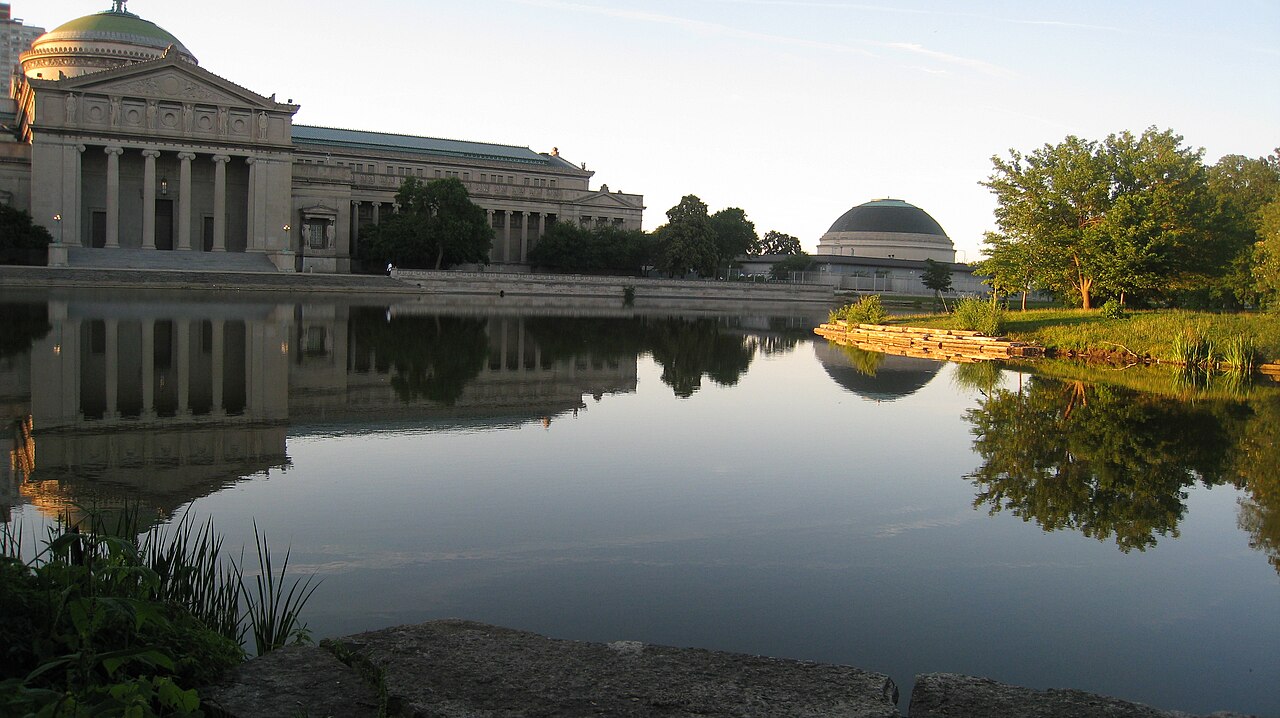
The institutions made the neighborhood's character. The University of Chicago, founded in 1890 and opened in Hyde Park in 1892, gave the area its Gothic campus, its faculty streets, and its permanent population of scholars; the World's Columbian Exposition of 1893 spread across Jackson Park and the Midway Plaisance at its southern edge, leaving the Midway's green trench and, in Jackson Park, the building that became the Museum of Science and Industry — the structure in this record's staged photograph, taken from within the community area's orbit. Frank Lloyd Wright's Robie House (1910) stands on 58th Street as the Prairie School's manifesto. The DuSable Museum of African American History, named in the master record's own note, sits in adjacent Washington Park, at the neighborhood's western door.
History
Hyde Park's Black history is specific and should not be blurred into a general South Side story. The neighborhood was an early site of restrictive covenants and of organized resistance to them — the legal fight over covenants in and around Hyde Park and Kenwood reached the Supreme Court in Hansberry v. Lee (1940), the case Lorraine Hansberry's family name carries, connecting this place record to the A Raisin in the Sun record honored at the 2014 Tony Awards staged above. In the postwar decades Hyde Park became famous, and argued about, as one of America's genuinely interracial neighborhoods, its integration defended by the university and the Hyde Park–Kenwood Community Conference even as urban renewal cleared blocks around them — a history residents still contest. The Obama family home stands in Kenwood, immediately north — the master record's note says "nearby in Kenwood," and this entry keeps the geography exact: Kenwood is a separate community area, and the association is adjacency, not location.
The graph wires Hyde Park as located in Chicago and in the South Side, and founded by Cornell. Its degree in the queue reflects how many records lean on it: the university's people, the museums, the Checkerboard Lounge's Hyde Park chapter in this program's earlier research, and now this batch. A place record earns the 600-word standard differently from a person — not by biography but by accumulation — and Hyde Park accumulates: a village name from 1855, a university, a world's fair, a covenant case, an interracial experiment, and 30,599 present residents, each fact in its own sourced layer, none of them blended into boosterism.
The present-day neighborhood keeps adding entries to its own file, and a place record should hold a few of them. Court Theatre, founded in 1955 under the University of Chicago's auspices and now one of America's leading classical theaters, works on 55th Street; the Smart Museum of Art (1974) anchors the campus's north end; the Hyde Park Jazz Festival has, since 2007, turned the neighborhood's churches, museums, and courtyards into an annual argument that this ground remains a capital of the music this graph documents. The commercial spine along 53rd Street, the Seminary Co-op Bookstore's famous basement miles of shelving in its earlier incarnation, the Promontory Point lakefront where the city meets Lake Michigan — the accumulation is the record's method because it is the neighborhood's character: institutions layered on institutions, each generation arguing with the physical evidence of the last.
Chicago connection
Hyde Park is the South Side of Chicago thinking about itself. The community area — one of Chicago's seventy-seven, on the lakefront roughly seven miles south of the Loop — is the graph's home-ground record in this batch, and its verification rests on the Chicago Metropolitan Agency for Planning's Community Data Snapshot, which profiles Hyde Park against the city with a total population of 30,599 in the 2020–2024 American Community Survey estimates. Around that present-tense number the master record assembles the place's layers: founded and named by Paul Cornell — the graph wires Cornell to Hyde Park by a founded edge — who named it in June 1855 after Hyde Park, New York, and Hyde Park, London, per the name-origin account the master record draws from the Chicago Tribune of March 4, 1900; annexed to Chicago in 1889, when it was called, in the phrase the record preserves, the largest village in the world. The University of Chicago, founded in 1890 and opened in Hyde Park in 1892, gave the area its Gothic campus, its faculty streets, and its permanent population of scholars; the World's Columbian Exposition of 1893 spread across Jackson Park and the Midway Plaisance at its southern edge, leaving the Midway's green trench and, in Jackson Park, the building that became the Museum of Science and Industry — the structure in this record's staged photograph, taken from within the community area's orbit. The graph wires Hyde Park as located in Chicago and in the South Side, and founded by Cornell. [S1]
Disputed and unresolved
| Claim | As recorded | CTL position |
|---|---|---|
| Contested point in the record | In the postwar decades Hyde Park became famous, and argued about, as one of America's genuinely interracial neighborhoods, its integration defended by the university and the Hyde Park–Kenwood Community Conference even as urban renewal cleared blocks around them — a history residents still contest. (depth record, sources as cited) | DISPUTED — shown as recorded; not resolved in this entry |
See also
Relationships
Relationships: none recorded yet — edges to follow. This entry's graph connections are being built; it publishes now on its sources.
Sources
- S1: Chicago Metropolitan Agency for Planning. "Community Data Snapshot: Hyde Park." Chicago Community Area Series. Accessed October 25, 2026. https://cmap.illinois.gov/download/6110/?tmstv=1789944655.
- S2: "Hyde Park, Chicago." Wikipedia. Accessed October 25, 2026. https://en.wikipedia.org/wiki/Hyde_Park,_Chicago.
Cite this entry
- Permanent ID: CTL-ENC-000009 · Crosswalked graph record: CTL-PL-0175 · Version: 0.1 · Date: 2026-10-28
- Chicago: CultureTechLens. "Hyde Park." CultureTechLens Encyclopedia, version 0.1, October 28, 2026. CultureTechLens NFP. CTL-ENC-000009.
- APA: CultureTechLens. (2026). Hyde Park (Version 0.1, Entry CTL-ENC-000009). CultureTechLens Encyclopedia. CultureTechLens NFP.
- MLA: CultureTechLens. "Hyde Park." CultureTechLens Encyclopedia, version 0.1, CultureTechLens NFP, 28 Oct. 2026. Entry CTL-ENC-000009.
Further reading
- CultureTechLens Knowledge Graph record CTL-PL-0175 (crosswalked; published graph register id CTL-E-0214).
Image credits
- Hyde Park photograph: see Images block in the frontmatter for the full credit line, rights status, and rights document.
Citation
CultureTechLens. "Hyde Park." CultureTechLens Encyclopedia, Vol. 1 — Black Chicago, version 0.1, 2026-10-28. CultureTechLens NFP. CTL-ENC-000009.
<!-- =======================