 CULTURETECHLENS
Cesar Chavez
UNVERIFIED evidence grade of this record
CULTURETECHLENS · “Culture, Clearly Seen.” · Black Cultural Intelligence
Research record
PROPOSED MINT — published ahead of canonical classification. This page publishes CultureTechLens proposed-mint record CTL-ESS-0159 in full, at the founder’s direction (October 25, 2026). The record is a proposal, not yet part of the canonical knowledge graph: its census status is PROPOSED and its evidence grade is UNVERIFIED. Canonical ID assignment, grade review, and merge into the canonical graph take place at the founder’s classification sitting; until then, this page carries the proposed-mint ID beside its live page ID so the two reconcile exactly at the merge.
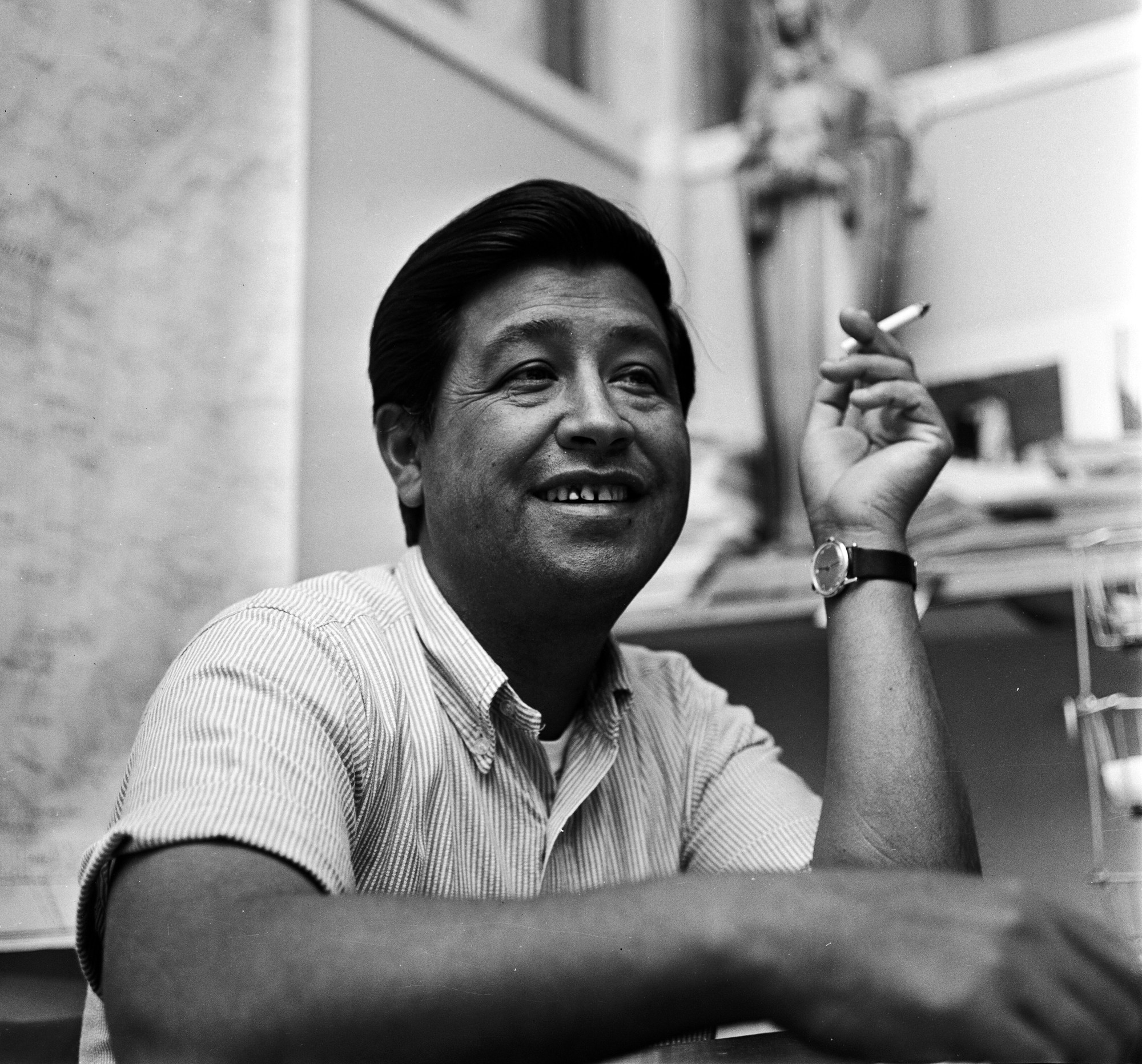
Photo: Los Angeles Times, via UCLA Library Digital Collections, CC BY 4.0, via Wikimedia Commons · Source: CultureTechLens
Rights basis: CC BY 4.0 (per Commons machine-readable license metadata)
Cesar Chavez enters the CultureTechLens record contextually, as the leader of an adjacent movement: the farmworker struggle he built with Dolores Huerta ran alongside the Black freedom movement, and the two movements recognized each other in documented ways — most concretely in two telegrams from Martin Luther King Jr. Chavez, a Mexican American labor leader, is not claimed here as a figure of Black culture; his record stands on the coalition history the sources carry.
Cesar Estrada Chavez was born on March 31, 1927, near Yuma, Arizona. In the late 1930s his family lost its farm and joined the migrant labor stream, and Chavez grew up working the fields of Arizona and California. In the early 1950s he began organizing for the Community Service Organization (CSO), the Latino civil-rights group, and rose to a top post in the organization before leaving it to build a union for farmworkers, who had been left out of the New Deal's labor protections.
In 1962 Chavez and Dolores Huerta co-founded the National Farm Workers Association (NFWA) — the seed of the United Farm Workers. Their nonviolent discipline was deliberate: Chavez modeled the movement's tactics on those of Martin Luther King Jr. and Mahatma Gandhi. In September 1965, Filipino grape pickers struck at Delano, California, and a week later the NFWA voted to join them, opening the Delano grape strike. In the spring of 1966 Chavez led the movement's pilgrimage march from Delano to Sacramento; on that march, the UFW records, he coined the slogan “Sí, se puede.”
King answered from Atlanta. In a telegram of September 19, 1966, he wrote: “Our separate struggles are really one — a struggle for freedom, for dignity and for humanity. … We are together with you in spirit and in determination that our dreams for a better tomorrow will be realized.” The historian Gordon Mantler's Power to the Poor: Black-Brown Coalition and the Fight for Economic Justice, 1960–1974 documents this exchange as part of a wider, real alliance between the Black and Chicano movements — shared organizers, shared boycotts, and a shared analysis of poverty.
The exchange deepened in crisis. In February 1968 Chavez began a fast in Delano — 25 days, at the cost of some 35 pounds — to recommit his movement to nonviolence. King telegraphed again: “I am deeply moved by your courage in fasting as your personal sacrifice for the farm workers in California,” the telegram reads, praising Chavez's “indefatigable work against poverty and injustice” and calling him “one of the outstanding men of America today.” Robert F. Kennedy traveled to Delano and broke the fast with Chavez on March 10, 1968, calling him “one of the heroic figures of our time.” Chavez's biographer Miriam Pawel records the limit honestly: King and Chavez never met. Their alliance ran through telegrams, lieutenants, and public solidarity — which was the substance of it, not personal acquaintance.
In July 1970 the Delano growers signed contracts with the union, winning the strike's core demands; in 1973 Coretta Scott King marched with Chavez in New York in support of the lettuce boycott. Chavez led the UFW through California's Agricultural Labor Relations Act of 1975; a jurisdictional war with the Teamsters ended in a 1977 pact; the grape boycott was renewed in 1984; and a 1988 fast against pesticide use in the fields drew supporters including Jesse Jackson to Delano. On Martin Luther King Jr. Day in 1990 he stated the coalition's thesis in his own words: “The same inhumanity displayed at Selma, in Birmingham … is displayed every day in the vineyards of California.” Chavez died in Yuma, Arizona, in April 1993.
Sources for this record
- Martin Luther King Jr. Praised Cesar Chavez for His 'Indefatigable Work' — United Farm Workers
Claims supported: Verbatim texts of King's September 19, 1966 telegram ('Our separate struggles are really one — a struggle for freedom, for dignity and for humanity… We are together with you in spirit') and his 1968 fast telegram ('deeply moved by your courage in fasting'; 'indefatigable work against poverty and injustice'; 'one of the outstanding men of America today'); Chavez's 1990 MLK Day statement - Cesar Chavez (biography) — United Farm Workers (republishing Biography.com)
Claims supported: Biographical spine: born March 31, 1927, near Yuma; family lost its farm in the late 1930s and became migrant workers; CSO organizing and rise to a top post; NFWA co-founded with Dolores Huerta, 1962; nonviolence modeled on King and Gandhi; September 1965 Delano strike joined a week later; 1966 Delano-to-Sacramento pilgrimage and 'Sí, se puede'; July 1970 grower contracts; 1973 lettuce-boycott march with Coretta Scott King; 1975 Agricultural Labor Relations Act; 1977 Teamsters pact; 1984 grape boycott renewed; 1988 fast drawing Jesse Jackson; death in Yuma, April 1993 - Chavez and King — Miriam Pawel
Claims supported: King and Chavez never met; their alliance ran through telegrams and intermediaries; Robert F. Kennedy broke the fast with Chavez on March 10, 1968 - Power to the Poor: Black-Brown Coalition and the Fight for Economic Justice, 1960–1974 (chapter abstract) — Gordon Mantler / Oxford Academic (UNC Press)
Claims supported: Scholarly frame for the documented Black–Brown coalition, including the King–Chavez exchange, as a real inter-movement alliance - Cesar Chavez — HowStuffWorks
Claims supported: The 1968 Delano fast: begun February 1968, 25 days, roughly 35 pounds lost; Robert F. Kennedy's presence at its end and his description of Chavez as 'one of the heroic figures of our time'
Citations
United Farm Workers. “Cesar Chavez” (biography, republishing Biography.com). https://ufw.org/?p=40392
Pawel, Miriam. “Chavez and King” (March 7, 2015). https://miriampawel.com/2015/03/07/chavez-and-king/
Mantler, Gordon. Power to the Poor: Black-Brown Coalition and the Fight for Economic Justice, 1960–1974 (UNC Press), chapter abstract. https://academic.oup.com/north-carolina-scholarship-online/book/20837/chapter-abstract/180306257?redirectedFrom=fulltext
HowStuffWorks. “Cesar Chavez” (the 1968 fast and Robert F. Kennedy). https://history.howstuffworks.com/historical-figures/cesar-chavez.htm
Published October 26, 2026, at the founder’s direction, from the head-verified staged proposed-mint record in the Entity Depth Program (Essentials Fragment 3 — Flagged Seven, Batch Essential-010). Canonical classification pending. Source: CultureTechLens
More person records
Browse the full directory: all entity records
Record CTL-E-5643 · CultureTechLens Knowledge Graph · proposed-mint record CTL-ESS-0159 · evidence grade: UNVERIFIED · census status: PROPOSED · 5 sources · first published October 26, 2026, from the head-verified Entity Depth staged record CTL-ESS-0159 — published ahead of canonical classification at the founder’s direction; canonical ID assignment and merge pending the founder’s classification sitting.
Directory: all entity records · the knowledge graph
Cite this record
Chicago: CultureTechLens. “Cesar Chavez (CTL-E-5643).” CultureTechLens Knowledge Graph. Chicago, IL: CultureTechLens, 2026. https://culturetechlens.com/graph/entities/ctl-e-5643/
APA: CultureTechLens. (2026). Cesar Chavez (CTL-E-5643) [Entity record]. CultureTechLens Knowledge Graph. https://culturetechlens.com/graph/entities/ctl-e-5643/
MLA: CultureTechLens. “Cesar Chavez (CTL-E-5643).” CultureTechLens Knowledge Graph, 2026, https://culturetechlens.com/graph/entities/ctl-e-5643/
Citation guidance for teachers, journalists, and funders: How to Cite Us.
From the Archive
The archive in pictures
The people, places, and institutions this work documents. Photographs from the CultureTechLens research record — rights-cleared, credited, and cited like everything else here.



Trust & evidence
Evidence before authority. CultureTechLens publishes its methods, its limits, and its corrections alongside its findings. Claims carry grades — VERIFIED, SUPPORTED, PROVISIONAL, DISPUTED, UNRESOLVED — and unknowns are never reported as zero.
Every claim graded. Every source named. Every correction public — see the corrections log.