 CULTURETECHLENS
Photo: TonyTheTiger, CC BY-SA 3.0, via Wikimedia Commons
The Charter Fight: What $50 Million Really Bought
The Charter Fight: What $50 Million Really Bought — part of CultureTechLens’s Black Culture in Data series.
In 2023, the WNBA spent $4 million on charter flights. Not per team — total. Charters were reserved for the playoffs and back-to-back games. The rest of the time, the best women's basketball players on earth flew commercial: middle seats, layovers, security lines, in a compressed Olympic-year schedule.
For athletes up to 6-foot-9. Think about that the next time your knees hurt in 34B.
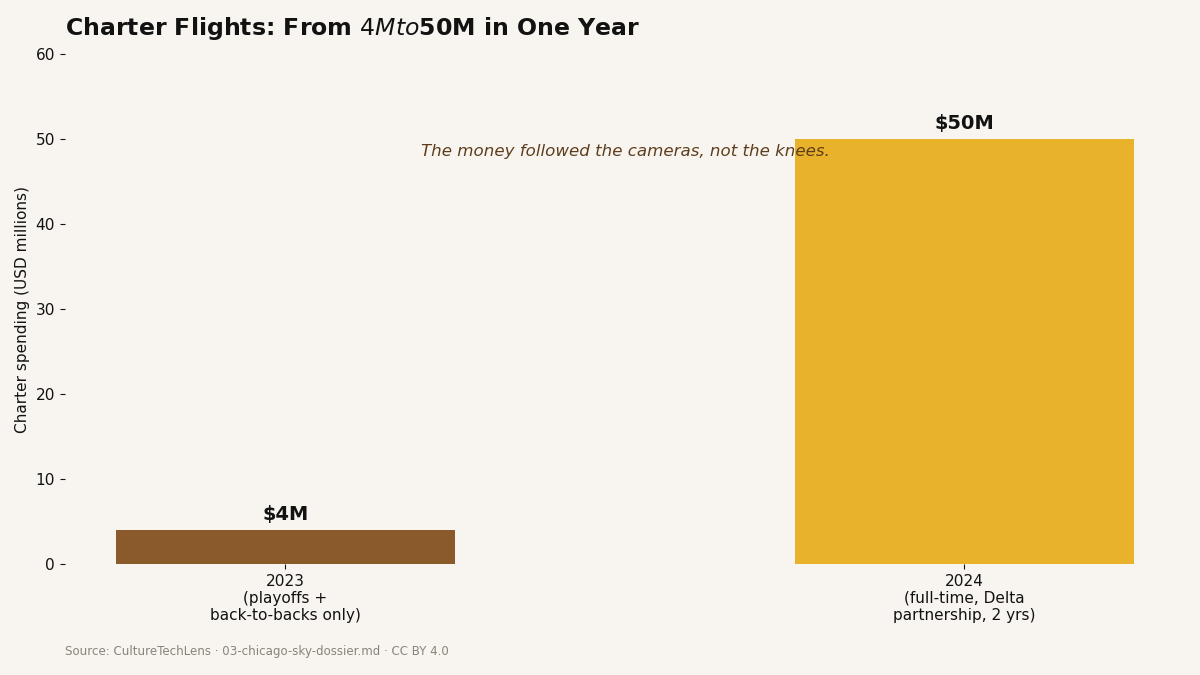
On May 7, 2024, Commissioner Cathy Engelbert announced full-time charter flights for every team — a Delta Air Lines partnership costing roughly $25 million a year for two years. Twelve and a half times the previous spending. Overnight.
What forced it
Five days before the announcement, rookie Caitlin Clark was mobbed by fans and a television crew at Dallas-Fort Worth airport. The footage traveled. The league moved.
But the pressure had been building for a year. In June 2023, Brittney Griner — 6-foot-9, one of the most recognizable women's basketball players alive — was harassed by a self-described "provocateur" at the same airport. ESPN's Christine Brennan said at the time that the incident should have been the catalyst. It wasn't. The league waited another eleven months, until the cameras found a different player.
The CTL read, and we stand on it: the league could afford $50 million for planes the moment the attention arrived — not when the players asked. The money followed the cameras, not the knees.
What the fight was really about
It is easy to file this under travel logistics. It wasn't. The charter fight was a labor fight wearing a logistics costume.
Liz Cambage, 6-foot-8, had said publicly that she paid out of pocket to upgrade her own seat because she physically did not fit in coach. Players were not asking for luxury. They were asking for the basic physical conditions of doing their jobs — the same conditions every NBA team had treated as non-negotiable for decades.
And the timing tells you everything about power. The players asked for years. A viral airport video asked for five days. Guess which one got $50 million.
This is the pattern the whole dossier keeps finding: the league's infrastructure has never led the players' needs. It follows the audience, the attention, the money — and the players get what falls out of that equation. The 2024 season was the most-watched in 24 years. The 2026 season has 216 national TV games. The charters arrived when the league needed to protect its product for television, not when it needed to protect its workers' bodies.
The epilogue
Cathy Engelbert — the commissioner who announced the charter deal, the league's first commissioner, in the chair since July 2019 — announced in September 2026 that she will retire at the end of the season. Napheesa Collier publicly criticized her leadership in the 2025 end-of-season press conference. No successor has been named.
The planes are still flying. The question the charter fight leaves behind is the one the whole economics series keeps asking: what does it take for the league to spend money before the cameras force it to? The players know the answer. They've been living it for thirty years.
This article is part of CultureTechLens's "Black Culture in Data" series, drawing on the research dossier "The Chicago Sky and the Economics of the WNBA" (Sports Lane 03). Every figure is evidence-graded in the dossier; all dollar figures are dated to their reporting.
The complete chart set is published with this article as part of CultureTechLens’s Black Athletic Record research program.
Companion: a shorter version of this explainer appears on the CultureTechLens blog, our companion editorial channel. Per CTL-PUB-001 (our companion-publishing rule), this page is the authoritative, citable record.
Source: CultureTechLens
From the Archive
The archive in pictures
Where the learning happened — and who kept it. Photographs from the CultureTechLens research record — rights-cleared, credited, and cited like everything else here.
Trust & evidence
Evidence before authority. CultureTechLens publishes its methods, its limits, and its corrections alongside its findings. Claims carry grades — VERIFIED, SUPPORTED, PROVISIONAL, DISPUTED, UNRESOLVED — and unknowns are never reported as zero.
Every claim graded. Every source named. Every correction public — see the corrections log.