 CULTURETECHLENS
Photo: TonyTheTiger, CC BY-SA 3.0, via Wikimedia Commons
The Money Flood: How the WNBA Quintupled in Three Years
The Money Flood: How the WNBA Quintupled in Three Years — part of CultureTechLens’s Black Culture in Data series.
In 2023, it cost $50 million to buy into the WNBA. The Golden State Valkyries paid it — the expansion fee for the league's first new franchise in years.
Three years later, Cleveland, Detroit, and Philadelphia each paid $250 million. Five times the price. Same league. Same twelve teams on the floor. The only thing that changed was the market's opinion of what women's basketball is worth.
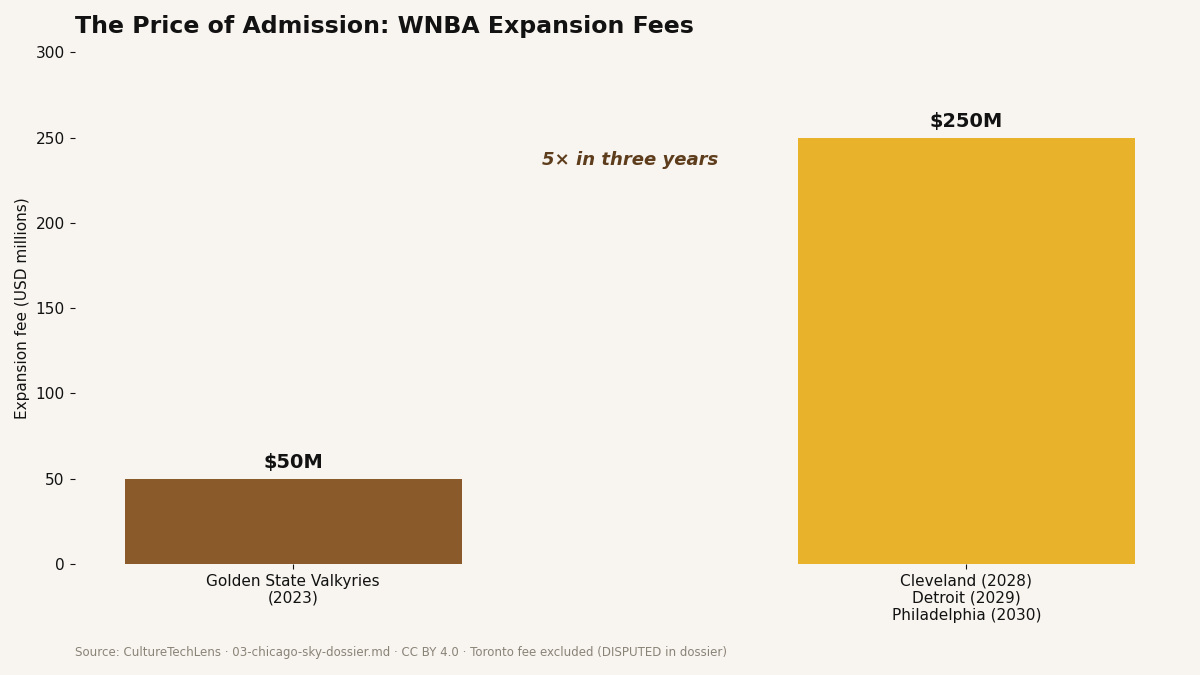
And the expansion fees are only half the flood. The media rights tell the same story, louder.
The $3.1 billion deal
In July 2024, the WNBA signed an 11-year media deal with Disney, Amazon, and NBCUniversal worth roughly $2.2 billion — about $200 million a year. It was announced as part of the NBA's broader $77 billion package, and at the time it felt like the ceiling had finally lifted.
It hadn't. In May 2026, the deal expanded to $3.1 billion, with Paramount, Scripps, USA Sports, and NBA TV added. The average annual value hit $281 million — roughly 6.5 times the previous deal's $43 million a year. The 2026 season carried a record 216 national television games.
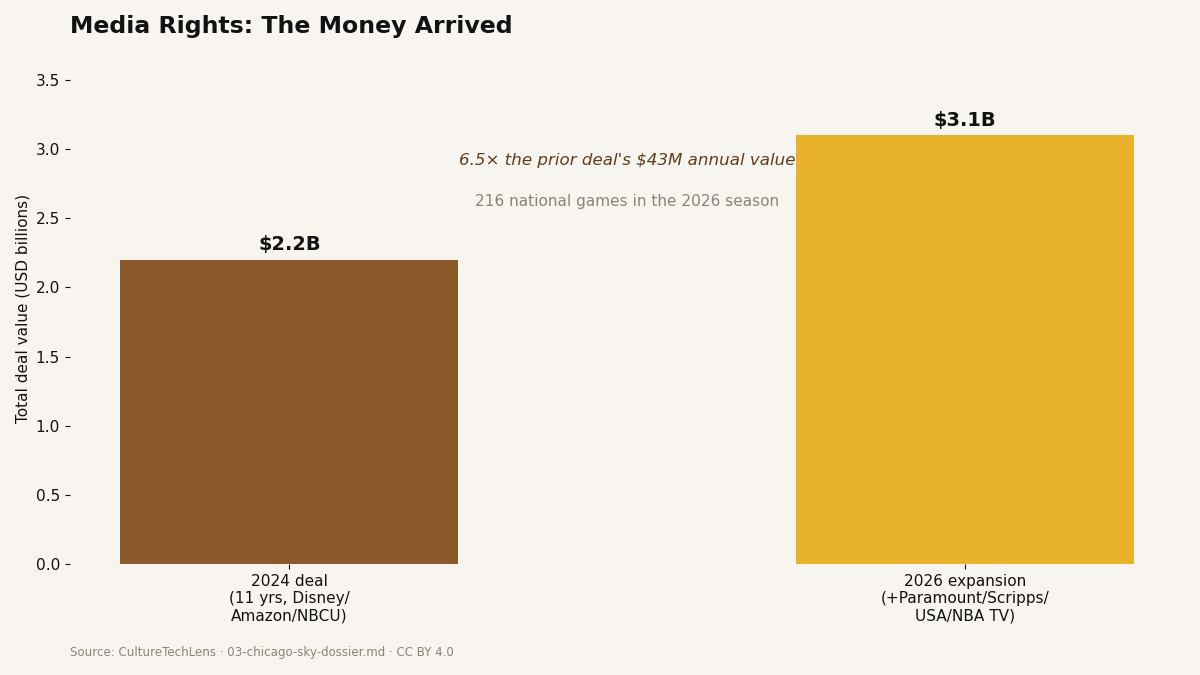
Put the two charts together and the pattern is unmistakable. The market didn't inch upward. It repriced the entire league in one motion — expansion fees up 5×, media money up 6.5×, all inside three years.
What the flood means — and what it doesn't
The CTL read, stated plainly in the dossier: the market decided women's basketball was undervalued; the players are still waiting for the market to pay them.
Consider the Chicago Sky's own mark. In June 2023, the franchise sold 10 percent to eight investors — mostly women, including Laura Ricketts and Tina Tchen — at an $85 million valuation. Headline news then, the second-highest valuation in the league. That $85 million would barely buy a third of a 2028 expansion team now.
And the Golden State Valkyries — the $50 million buy-in from 2023 — are now reported as the first women's sports franchise worth $1 billion. The team hasn't played a decade. It barely played a season.
The money is real. The $75 million capital raise in 2022, the $3.1 billion media deal, the $250 million expansion fees — these are the market pricing the future, not the past. The historical operating losses were real too. Both things are true at once, and the people who only ever mention the losses are telling you which half of the story serves them.
The lag
Here is the part that should sit with you. The 2024 regular season was the most-watched in 24 years. The 2025 Clark-vs.-Reese matchup was the most-watched regular-season game in 25 years. The audience arrived. The infrastructure is catching up. The 2026 CBA — the $7 million cap, the $1.4 million supermax — is the players buying what the market already priced, after years of fighting for a seat at the table where the pricing happens.
Valuations quintuple in three years. Paychecks take a collective bargaining agreement, an opt-out fight, and a decade of patience. That lag — between what the market says the league is worth and what the league pays the women who are the league — is the whole story of women's professional basketball. The flood arrived. Now watch where it goes.
This article is part of CultureTechLens's "Black Culture in Data" series, drawing on the research dossier "The Chicago Sky and the Economics of the WNBA" (Sports Lane 03). Every figure is evidence-graded in the dossier; all dollar figures are dated to their reporting. The Toronto Tempo expansion fee is disputed ($50M vs. $115M) and excluded from the chart.
The complete chart set is published with this article as part of CultureTechLens’s Black Athletic Record research program.
Companion: a shorter version of this explainer appears on the CultureTechLens blog, our companion editorial channel. Per CTL-PUB-001 (our companion-publishing rule), this page is the authoritative, citable record.
Source: CultureTechLens
From the Archive
The archive in pictures
Where the learning happened — and who kept it. Photographs from the CultureTechLens research record — rights-cleared, credited, and cited like everything else here.



Trust & evidence
Evidence before authority. CultureTechLens publishes its methods, its limits, and its corrections alongside its findings. Claims carry grades — VERIFIED, SUPPORTED, PROVISIONAL, DISPUTED, UNRESOLVED — and unknowns are never reported as zero.
Every claim graded. Every source named. Every correction public — see the corrections log.