 CULTURETECHLENS
Photo: TonyTheTiger, CC BY-SA 3.0, via Wikimedia Commons
Six Rings: The Dynasty as Data
Six Rings: The Dynasty as Data — part of CultureTechLens’s Black Culture in Data series.
Six championships in eight years. Two three-peats. A 6–0 Finals record — never taken to a Game 7, never facing elimination with a title on the line. The 1995–96 team went 72–10, the first 70-win team in NBA history.
You know the story. Here's the shape of it.
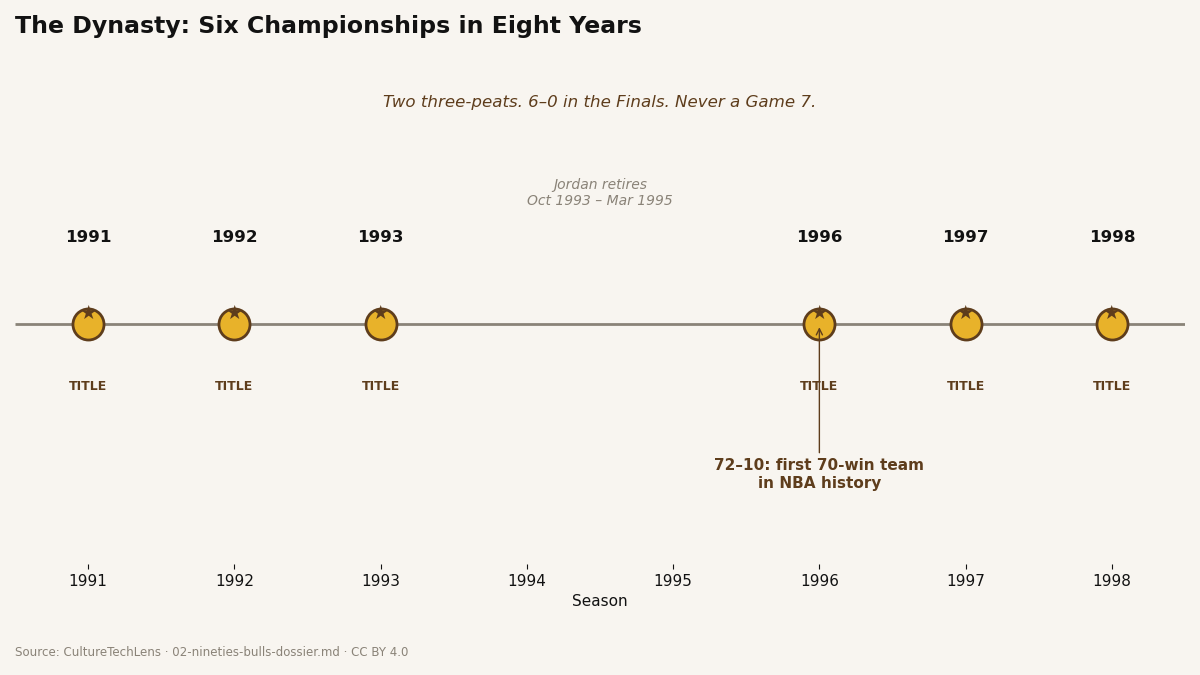
Look at the gap in the middle. That's the strangest part of the timeline — eighteen months where the greatest basketball player alive wasn't playing basketball. Michael Jordan retired in October 1993 at age 30, three straight titles in hand, seven straight scoring titles, and went to play Double-A baseball for the Birmingham Barons. He hit .202.
His father had been murdered that summer. The timeline doesn't show grief, but the gap is shaped like it.
What the data says
The first three-peat (1991–93) beat the Lakers, the Trail Blazers, and the Suns — Magic Johnson, Clyde Drexler, Charles Barkley. Three straight Finals MVPs for Jordan. Then the gap. Then the second three-peat (1996–98), which beat the SuperSonics and the Jazz twice, and included the 72–10 season — a record that stood until Golden State's 73–9 twenty years later.
The dynasty's Finals record, 6–0, is the perfection stat that no other modern dynasty touches. The last one ended on June 14, 1998, with Jordan's "Last Shot" over Bryon Russell. No Game 7. No farewell tour. Just the shot, the sixth title, and then the breakup.
What the data costs
The timeline is clean. The price wasn't. Scottie Pippen — the second-best player on all six title teams, by Jordan's own later admission the man without whom the titles don't happen — played the dynasty's peak years on a seven-year, $18 million contract he signed in 1991. In 1996–97, arguably his best season, he earned $2.25 million while Jordan earned $30.14 million. In 1997–98 he was the 122nd-highest-paid player in the NBA.
Jordan knew it. He said on the record that he wished he could legally give Pippen some of his own money. The organization never renegotiated. The resentment poisoned everything — and it's a straight line from that contract to the dynasty's end.
Because the end was a choice, not an expiration. Before the 1997–98 season, GM Jerry Krause told coach Phil Jackson it would be his last year "even if you go 82–0." Jordan said he wouldn't play for another coach. After the sixth title: Jackson left, Jordan retired, Pippen was sign-and-traded to Houston, Rodman was released. The 1998–99 Bulls went 13–37.
Jordan, Pippen, and Jackson all maintained they could have won a seventh. Krause's unpublished memoir argued the core was aging out. The question is unresolvable — which is why it still burns, and why Chicago still argues about it.
The export
The dossier's CTL angle is that the dynasty was Chicago's most effective global ambassador — and the export was Black culture. The Bulls were the NBA's flagship as the league opened offices in Hong Kong, Japan, and Taiwan. The Dream Team at Barcelona 1992 — Jordan and Pippen on the roster — is widely credited as the catalyst for basketball's globalization. Air Jordan did $126 million in its first year against a $3 million projection; Fortune once estimated Jordan's total U.S. economic impact at $10 billion.
The timeline shows six titles. What it doesn't show is the generation of kids on every continent who learned basketball by copying a Black man from Chicago's team — the fadeaway, the tongue, the shrug, the number 23. The data is the skeleton. The export was the flesh.
Six rings in eight years. Zero Game 7s. One gap shaped like grief. That's the dynasty as data — and the data, for once, doesn't need embellishment.
This article is part of CultureTechLens's "Black Culture in Data" series, drawing on the research dossier "The 1990s Bulls as Cultural Export" (Sports Lane 02). Every figure is evidence-graded in the dossier. The seventh-title debate is carried as disputed in the dossier — both positions stated, no arbiter.
The complete chart set is published with this article as part of CultureTechLens’s Black Athletic Record research program.
Companion: a shorter version of this explainer appears on the CultureTechLens blog, our companion editorial channel. Per CTL-PUB-001 (our companion-publishing rule), this page is the authoritative, citable record.
Source: CultureTechLens
From the Archive
The archive in pictures
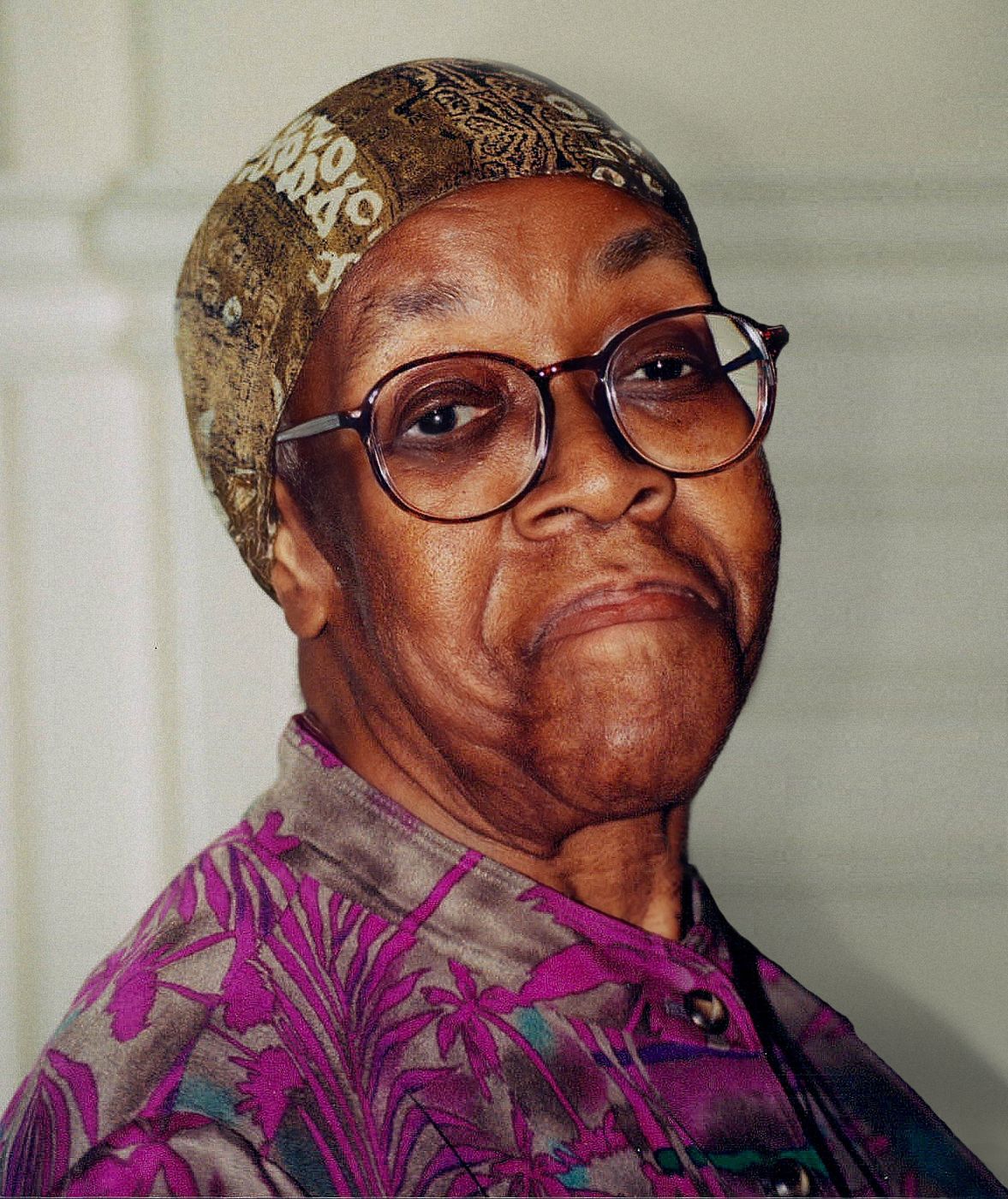
Where the learning happened — and who kept it. Photographs from the CultureTechLens research record — rights-cleared, credited, and cited like everything else here.


Trust & evidence
Evidence before authority. CultureTechLens publishes its methods, its limits, and its corrections alongside its findings. Claims carry grades — VERIFIED, SUPPORTED, PROVISIONAL, DISPUTED, UNRESOLVED — and unknowns are never reported as zero.
Every claim graded. Every source named. Every correction public — see the corrections log.